1941–1942: The Japanese offensive in the Pacific
Burma campaign (1942)
- Dates:
- 20 January – 20 May 1942
- Front:
- Pacific
- Location:
- British Burma, from Tenasserim and Moulmein through Rangoon, the Sittang and Irrawaddy valleys and the Shan States to Lashio, Myitkyina, the Chindwin and the Indian frontier (Manipur)On the battle map →
- Sides:
- JapanShōjirō IidaUnited Kingdom, British India and BurmaHarold Alexander, William SlimChinaJoseph Stilwell
- Result:
- Japanese victory. All of Burma was taken in four months, the Burma Road to China was cut on 29 April and the Allied forces were driven back to India and Yunnan. British, Indian and Burmese losses were about 13,500 men, Chinese losses several tens of thousands, and Japanese about 2,400 killed and dead of other causes.
- Author:
- Łukasz
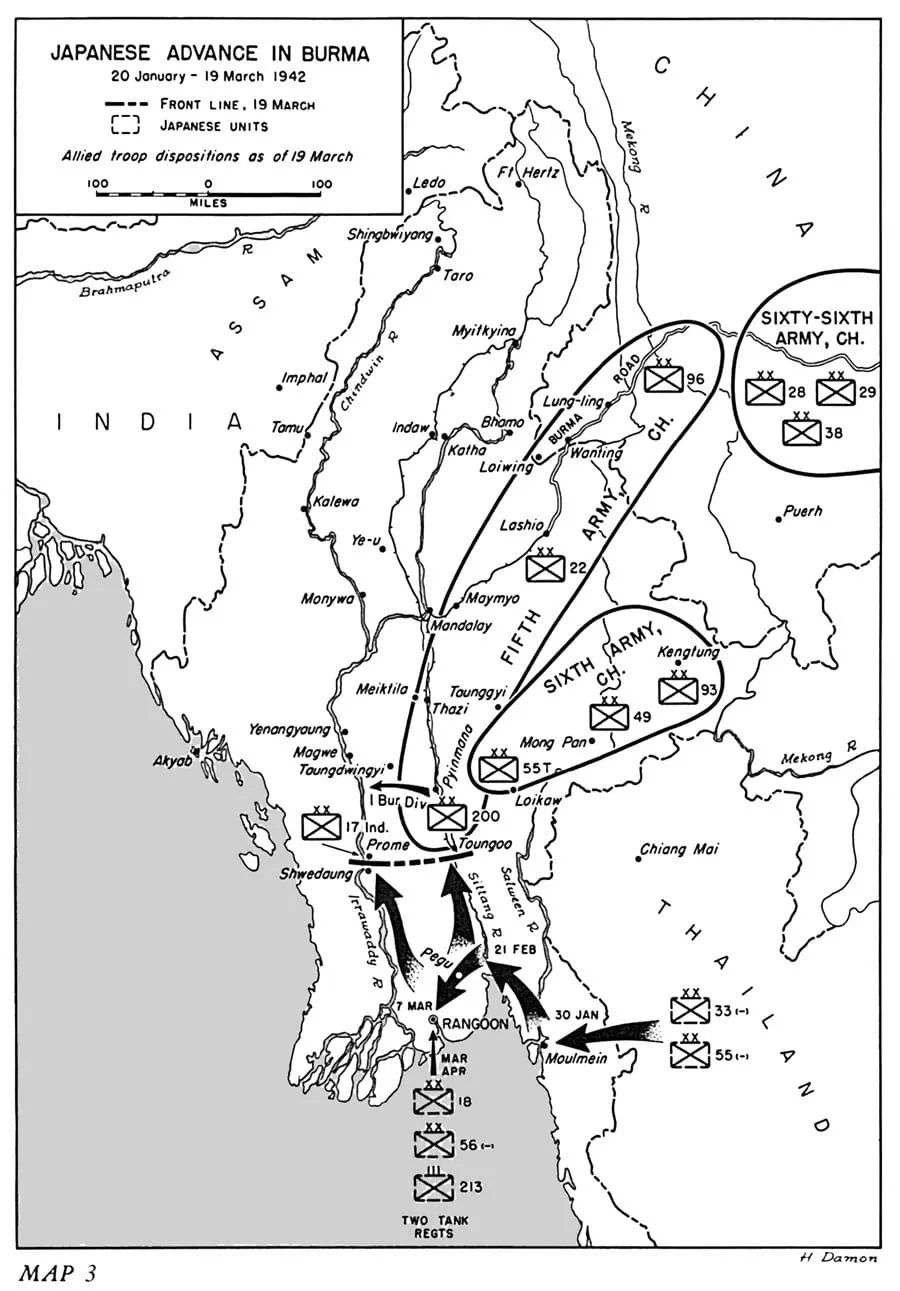
Around 20 January 1942 the main body of the Japanese 55th Division crossed the mountains on the Thai–Burmese border and set off towards Moulmein. Four months later, on 20 May, the last units of the British Burma Corps – exhausted, sick and almost without equipment – passed under the command of the headquarters in India on the plain of Imphal, and on the same day the American general Joseph Stilwell arrived there on foot, having led his staff out of Burma through jungle and mountains. In between, Lieutenant General Shōjirō Iida’s Japanese 15th Army, reinforced in March and April by two divisions brought in from Malaya and the Dutch East Indies, had conquered the whole of British Burma: the port of Rangoon, the oilfields on the Irrawaddy, Mandalay and Lashio, where the Burma Road to China began. British, Indian, Burmese and Chinese troops made a retreat of some 1,500 kilometres, described as the longest in the history of the British Army, and hundreds of thousands of civilians fled to India with them or ahead of them. Chiang Kai-shek’s China lost its last overland link with its allies.
Name and dates
In Polish writing the Burma campaign usually means the whole war for Burma from 1941 to 1945. The Burma campaign of 1942 is its first phase, which British historians call the first Burma campaign or the Japanese conquest of Burma, and the Japanese the Burma operation. It began with the 15th Army’s advance from Thailand across the Tenasserim hills; its main body moved off around 20 January 1942 and fought its first engagement with the British 16th Indian Brigade at Kawkareik on 22 January. The earlier events – the occupation of Victoria Point in mid-December, the December air raids on Rangoon and the capture of Tavoy on 19 January – were a prelude.
The end of the campaign is usually dated to 20 May 1942, when Lieutenant General William Slim’s Burma Corps, then being disbanded, came under the orders of the British IV Corps in India and Stilwell reached Imphal. The fighting did not, however, stop on a single day: the Japanese halted on the Chindwin at the end of May, and Chinese units were still struggling through the jungles of northern Burma in June and July. The Thai Phayap Army, Japan’s ally, occupied Kengtung in the Shan States on 27 May. With the arrival of the monsoon, which turned the roads to mud from mid-May, both sides suspended major operations until the end of the year.
Background
Burma, a colony separated from British India since 1937, was regarded in London as a safe rear area. Its defence rested on the assumptions that Singapore would stop the Japanese and that the mountains and jungles on the Thai border were impassable to large armies. Both assumptions collapsed within a few weeks. After the Japanese invasion of Thailand on 8 December 1941 and the Japanese–Thai alliance concluded on 21 December, the Burmese border became a front line, and the Malayan campaign soon showed that the Japanese army could move through jungle where the British did not expect it.
For Japan, Burma was a secondary but important objective. It shielded the conquests in South-East Asia from the west, it had rice, oil from the fields at Yenangyaung and metals, and above all it was the route by which aid reached China. Lorries carrying American weapons and fuel for Chiang Kai-shek’s army travelled from Rangoon by rail to Lashio and from there along the Burma Road to Kunming. Cutting this road, which the British had already once closed under Japanese pressure in 1940, was meant to deprive China of the means to carry on the war. The campaign was entrusted to Lieutenant General Shōjirō Iida’s 15th Army, subordinate to General Hisaichi Terauchi’s Southern Army. At first Iida had only two divisions, Lieutenant General Shōzō Sakurai’s 33rd and Lieutenant General Takeshi Koga’s 55th, both weakened by the loss of units to other fronts. With the Japanese marched the Burma Independence Army, formed in Bangkok on 28 December around Aung San and his comrades from the Thakin movement, who had been trained by Japanese intelligence. It began with about 2,000 men, but gained volunteers as it marched through the country.
From 27 December 1941 the British forces in Burma were commanded by Lieutenant General Thomas Hutton. He had the 1st Burma Division, made up largely of battalions of the Burma Rifles – recruited mainly from the national minorities, especially the Karen, hastily expanded and full of recruits – and Major General John Smyth’s 17th Indian Division, whose two original brigades had been sent to Malaya. In the air Rangoon was defended by a few dozen RAF aircraft and the American volunteer pilots of Claire Chennault’s Flying Tigers. From mid-January Burma came under the new Allied ABDA command of General Archibald Wavell, created at the Arcadia Conference and preoccupied above all with the defence of Malaya and the Dutch East Indies. Wavell rated the Japanese army low and, like London, wanted to hold as much of the country as possible in order to keep Rangoon, the port for reinforcements and for supplies to China.
From December Chiang Kai-shek had been offering his Fifth and Sixth Armies for the defence of Burma. Wavell, reluctant to hand the defence of a British colony to the Chinese and faced with the difficulty of supplying them, at first accepted only part of these forces, which Chiang regarded as an affront. The dispute over the role of the Chinese troops and over the supplies piling up in the port of Rangoon poisoned relations between the allies throughout the campaign.
Course: from Moulmein to the Sittang
The 55th Division crossed the Tenasserim hills lightly equipped, with pack horses and elephants instead of lorries, on the road from Rahaeng (today Tak) over the pass near Kawkareik. On 22 January it struck the 16th Indian Brigade, which was strung out along the road and easy to outflank. Japanese infantry worked round its positions through the jungle, and the brigade withdrew in haste, losing much of its transport. Meanwhile the 33rd Division advanced further north, towards Pa-an on the middle Salween. On 30 January the Japanese reached Moulmein (today Mawlamyine), the colony’s third city, on the eastern shore of the broad Salween estuary. Its garrison, the 2nd Burma Brigade, after night attacks on 30–31 January, crossed by river steamer to Martaban, abandoning much equipment and losing more than 600 men, most of them missing.
Smyth believed that, given the enemy’s superiority, he should pull the division back behind the wide rivers, preferably behind the Sittang, and give battle there. Hutton and Wavell demanded that he hold the line of the Salween and then every successive river. As a result the 17th Division, stretched along a long front, was outflanked time after time. On the night of 11–12 February the 33rd Division crossed at Pa-an and near the village of Kuzeik destroyed the 7th Battalion of the 10th Baluch Regiment; fewer than a third of its men survived. Martaban had already been abandoned, around 10 February. Smyth fell back to the Bilin river, where from 14 to 19 February his brigades held out in heavy fighting, but the Japanese again outflanked them from the north and from the sea. On 19 February Smyth at last received permission to withdraw behind the Sittang.
The retreat ran along a single road and then a narrow track through jungle and rubber plantations to the only bridge over the Sittang, an iron railway bridge planked over for vehicles. The columns moved in heat, without water, under attack from Japanese aircraft and, according to many accounts, by mistake from RAF and AVG aircraft as well. A lorry stuck on the bridge halted the traffic for several hours. Meanwhile two regiments of the 33rd Division, the 214th and 215th, were taking a short cut through the jungle to reach the bridge before the British. On 22 February the Japanese attacked the bridgehead on the eastern bank; Gurkhas and other units held them off all day, but behind them, cut off, the 16th and 46th Indian Brigades were still fighting. Before dawn on 23 February the commanders at the bridge concluded that they could not hold it until morning. Smyth, fearing that the Japanese would take the bridge intact and open the road to Rangoon, ordered it blown. At about 5.30 a.m. one span went up, and most of the division was left on the eastern bank.
All day the men of the cut-off brigades crossed the wide, fast-flowing river by swimming or on rafts and pieces of timber; many drowned and many were captured. The Japanese, intent on a rapid march on Rangoon, did not finish off the encircled troops but moved north to look for another crossing. After the disaster the 17th Division numbered 3,484 infantrymen, a little over 40 per cent of its establishment, and the survivors had, depending on the source, between about 550 and about 1,400 rifles and between a dozen or so and a few dozen machine guns; almost all the artillery and vehicles had been left across the river. Slim later called the Sittang the decisive battle of the first campaign, and the historian Louis Allen wrote that once the bridge was blown the road to Rangoon lay open and the fate of Burma was sealed. Smyth’s decision remains controversial to this day: some hold that it saved Rangoon for two weeks, others that the Japanese crossed upstream anyway and that blowing the bridge sacrificed the division. Smyth, seriously ill, lost his command on 1 March; it passed to Brigadier David Cowan.
Course: the fall of Rangoon
Rangoon had been in a state of disintegration since the December raids. The Indians, who made up the majority of the inhabitants and almost the whole of the port’s labour force, fled in their thousands, and in February, after the fall of Moulmein, the flight became an exodus. On 20 February the colonial authorities ordered the evacuation of civilians not needed for work in the city. Reinforcements arrived sparingly: on 21 February the British 7th Armoured Brigade, transferred from Egypt with American M3 Stuart light tanks, disembarked at Rangoon, followed later by the 63rd Indian Brigade. Churchill and Wavell wanted to send to Burma the Australian 7th Division, then returning from the Middle East, but the Australian Prime Minister John Curtin, fearing for his own country after the fall of Singapore, refused.
In the last days of February the command changed. The ABDA command was dissolved on 25 February, and Burma returned to Wavell’s authority as Commander-in-Chief, India. London, considering Hutton too pessimistic, sent in his place General Harold Alexander, who had commanded the last rearguard at Dunkirk. Alexander flew into Rangoon on 5 March; Hutton stayed on as his chief of staff. In line with Wavell’s order to defend Rangoon, the new commander threw the 7th Armoured Brigade and the remnants of the 17th Division into a counter-attack at Pegu, but in the fighting of 6 and 7 March he found that the Japanese were already working round the city from the north. On 6 March he ordered the evacuation.
On 7 March the British destroyed the port, the power station and the refineries at Syriam across the river; columns of smoke from burning oil rose over the city. Columns of troops, officials and refugees set off north on the road to Prome, but at Taukkyan, a few dozen kilometres outside the city, they ran into a Japanese roadblock which several attacks failed to break. They were saved by an enemy mistake. Colonel Takanobu Sakuma, commanding the 214th Regiment, had orders to cover the road only until the main body of the 33rd Division had swung round Rangoon from the west to attack the city. Not knowing that the British were at that moment abandoning it, he lifted the block as ordered, and on the morning of 8 March Alexander’s columns passed along an open road. Many historians believe that the Japanese could have captured the commander and most of the army in Burma that day. On the same day, 8 March, the 33rd Division entered a deserted, burning Rangoon.
The fall of the capital decided the fate of the colony. Without the port the army in Burma had no means of receiving reinforcements, ammunition or fuel, since no passable road led from India, and whatever stocks could be evacuated had to last to the end of the campaign. The Japanese, by contrast, gained a port through which they could bring in new divisions and hundreds of captured lorries. At the end of March they also occupied the Andaman Islands without a fight, and at the beginning of April the carriers of Admiral Chūichi Nagumo attacked Ceylon, covering the sea route to Rangoon.
Course: the battles in central Burma
After the loss of Rangoon the Allies tried to hold central Burma, with Mandalay, the oilfields and the road to China. On 19 March the 1st Burma Division, the 17th Indian Division and the 7th Armoured Brigade were formed into the Burma Corps (Burcorps), commanded by Lieutenant General William Slim, who had arrived from Iraq. The corps defended the Irrawaddy valley in the west. The eastern part of the front, the Sittang valley and the hills of the Shan States, was taken over by the Chinese Expeditionary Force: General Du Yuming’s Fifth Army, the Sixth Army and later the Sixty-sixth Army, each roughly the size of a British division and far more poorly armed. Formally they were commanded by Stilwell, appointed Chiang Kai-shek’s chief of staff and commander of American forces in the China–Burma–India theatre, who arrived in Burma in mid-March. In practice the Chinese generals – from April under General Luo Zhuoying – carried out only those of the American’s orders that Chiang had confirmed, and Chiang issued instructions from Chongqing that often contradicted what had been agreed on the spot. Stilwell’s plans for counter-attacks came to nothing.
The first blow fell on the Chinese. General Dai Anlan’s Chinese 200th Division, the best motorised unit of the Nationalist army, had its first units at Toungoo (today Taungoo) on the Sittang by 8 March. From 24 March the Japanese 55th Division attacked the town; the Chinese, surrounded on three sides, held out for several days in its old walls, fighting hand to hand and beating off assault after assault. Only when a motorised detachment of the newly arrived Japanese 56th Division outflanked them from the east did the division withdraw in good order on the night of 29–30 March, and on 30 March the Japanese took Toungoo. The road east now lay open to them, into the Karenni and Shan States and into the rear of the whole front.
The Japanese, meanwhile, were receiving reinforcements. At the end of March Lieutenant General Masao Watanabe’s 56th Division arrived through the port of Rangoon, followed at the beginning of April by Lieutenant General Renya Mutaguchi’s 18th Division, both released after the conquest of Malaya and Java. Iida now had four divisions and hundreds of captured lorries. He also gained command of the air: on 21 and 22 March Japanese bombers destroyed at Magwe airfield the remnants of the RAF and AVG units withdrawn from Rangoon, which then left for India and for the island of Akyab (today Sittwe). From then on Japanese aircraft bombed the towns with impunity; on 3 April a raid destroyed a large part of Mandalay.
In the west, at the request of Chiang, who wanted to relieve the pressure on Toungoo, Slim attacked at the end of March south of Prome (today Pyay). The counter-attack ended in failure: at Shwedaung on 29 and 30 March a Japanese roadblock, in which soldiers of the Burma Independence Army also fought, inflicted heavy losses on the 7th Armoured Brigade and the 17th Division, and on the night of 1–2 April the Japanese took Prome. The corps fell back to a line running from Minhla on the Irrawaddy through Taungdwingyi. Desertions multiplied in the ranks of the Burma Rifles, especially among Burman soldiers who did not want to fight for British rule, and behind the lines the Burma Independence Army and the local population increasingly turned against the British and the Indians.
Course: Yenangyaung and Lashio
In mid-April the Japanese 33rd Division struck at the oilfields at Yenangyaung, the largest source of oil in Burma and the only fuel available to the Allies in the country. From 10 April its units attacked the corps’ positions and then, as so many times before, outflanked them, driving in between the 17th Division at Taungdwingyi and the 1st Burma Division on the Irrawaddy. On 15 April Slim gave the order to destroy the fields and the refinery: wells, tanks and plant were blown up, and black smoke hung over the area. The next day Major General Bruce Scott’s 1st Burma Division, some 7,000 men including ancillary units, found itself encircled among the burning wells, in heat of up to 45 degrees, without water. Slim asked the Chinese for help. The commander of the Chinese 38th Division, General Sun Liren, a graduate of an American military college, came to the rescue with its 113th Regiment, supported by British tanks of the 7th Armoured Brigade. From 17 to 19 April the Chinese attacked from the north while the British fought their way across the Pin Chaung stream, abandoning almost all their guns and vehicles. On 19 April the two forces joined hands and the division escaped from the pocket, but as a decimated rabble. In China the battle is remembered as a great victory.
The fate of the campaign was, however, decided by what happened in the east. The Japanese 56th Division, moving in lorries, passed through the Karenni and Shan States, routed the Chinese Sixth Army scattered in the hills, and raced north towards the Burma Road, far behind the Allies’ backs. Around 20 April it took Taunggyi, the capital of the Shan States. Stilwell threw the 200th Division into a counter-attack, and it retook Taunggyi on 24 April, but the Japanese did not turn back; they simply pressed on. On 29 April, the birthday of Emperor Hirohito, they took Lashio, the terminus of the railway from Rangoon and the start of the Burma Road. China’s overland link with the outside world had been cut. The 56th Division then drove along the road into Yunnan and at the beginning of May reached the Salween on Chinese territory, where the Chinese blew the bridge and stopped it in a deep gorge.
Faced with the threat from the east and the north, Alexander and Stilwell, meeting on 25 April, concluded that central Burma could not be held. The decision was taken to retreat: the British and Indian troops were to withdraw to India, the Chinese to Yunnan or, if the road to China was closed, also to India. Slim’s corps crossed the Irrawaddy, and on 30 April the great Ava bridge near Mandalay was blown behind it. On 1 May the Japanese entered a ruined, burnt-out Mandalay.
Course: the retreat to India
Only one road – in truth a track – led to India: from Shwebo and Ye-u to the crossing of the Chindwin at Kalewa, and on through the Kabaw valley and the mountains to Tamu and Imphal. The Japanese tried to cut it in advance. At the turn of April and May (according to the British official history at dawn on 1 May, according to other accounts on the night of 1–2 May) a detachment of the 33rd Division, carried by boat up the Chindwin, took Monywa, surprising the headquarters of the 1st Burma Division. The hastily reassembled division could not retake the town, but it held the Japanese long enough for the rest of the corps to pass northwards. Kalewa could be reached only from the landing stage at Shwegyin on the eastern bank of the Chindwin, where, sheltered by cliffs, thousands of soldiers, wounded and refugees waited for the few river ferries. On 10 May the Japanese attacked the landing stage. The rearguards, above all Gurkhas and the tank crews of the 7th Armoured Brigade, held them off long enough for the men to cross, but the corps’ last tanks, guns and lorries had to be destroyed or abandoned on the bank. On 12 May the Japanese took Kalewa.
The corps marched on westwards through the jungle, at the last moment before the monsoon. When the torrential rains came in mid-May, the tracks turned to mud and malaria and dysentery spread through the camps. Slim’s corps brought most of its soldiers back to India, but almost none of its equipment: the tanks of the 7th Armoured Brigade, with a few exceptions, had been left on the eastern bank of the Chindwin. On 20 May IV Corps at Imphal took command of the units, and the headquarters of the Burma Corps was disbanded.
The Chinese fared worse. The Japanese 56th Division, pushing north from Lashio, took Bhamo (today Banmaw) at the beginning of May and Myitkyina on 8 May, cutting the road to Yunnan. The isolated units of Du Yuming’s Fifth Army set off through the jungle-covered mountains of northern Burma, some of them through the Hukawng valley and the Patkai hills to Assam; thousands of soldiers died of hunger, disease and exhaustion, and along the way they lived by plundering the local people and the refugees. The 200th Division, fighting its way through to China, ran into an ambush, and its commander Dai Anlan died of his wounds on 26 May. Only Sun Liren’s Chinese 38th Division crossed the Chindwin and reached India as a cohesive unit. Stilwell, with a party of more than a hundred – Americans, Britons, Chinese, Burmese nurses and cooks – turned down evacuation by air and on 6 May set out on foot from near Indaw. Setting the pace himself, he led them through jungle, rivers and mountains without, according to those who took part, losing a single person, and reached Imphal on 20 May.
Losses
According to British figures cited in the official history and by Louis Allen, the British, Indian and Burmese forces lost 13,463 men in the campaign: 1,499 killed, 2,595 wounded and 9,369 missing and captured. The last figure includes thousands of Burmese soldiers who simply went home. The RAF and the AVG lost more than a hundred aircraft. Chinese losses are less well known: Western historians estimate them at about 40,000 men out of roughly 95,000 sent to Burma, while Chinese studies give from over 56,000 to 61,000; most were killed or died not in battle but during the retreat through the jungle. The Japanese official history gives 2,431 dead from all causes, including 1,896 killed in action; total Japanese losses including wounded are estimated at about 4,600.
The flight of civilians claimed the most lives. At least 400,000–500,000 refugees reached India, the great majority of them Indians, along with Anglo-Indians and Anglo-Burmese, who feared both the Japanese and the Burmese hostile to them. The poor went on foot through Arakan, Manipur and the Hukawng valley. Cautious estimates speak of 10,000–50,000 dying on the way of hunger, exhaustion, malaria, dysentery and cholera; some researchers give higher figures. At the frontier the colonial authorities often let Europeans and people of mixed descent through first and held back the Indians, which was remembered in India as an expression of the empire’s racial hierarchy.
Significance
The conquest of Burma was the last great success of the Japanese offensive of the winter of 1941–1942. Japan closed off its conquered territory from the west, gained rice and oil – although the wells took a long time to rebuild – and reached the frontier of India. For the British Empire the defeat in Burma, coming straight after Malaya, Hong Kong and the sinking of Prince of Wales and Repulse, was a further blow to its prestige in Asia. In August 1942 the Quit India movement, launched by Mahatma Gandhi, broke out in India, and in prisoner-of-war camps and among Indian émigrés soldiers were recruited for the Indian National Army, which fought alongside Japan. In Burma the Japanese soon disappointed their Burmese allies: instead of independence they gave them, in August 1943, a puppet state headed by Ba Maw, and in 1945 Aung San went over to the Allies.
For China the cutting of the Burma Road meant almost complete isolation. For nearly three years aid reached it only by air, from Assam to Kunming over the Himalayas, on the route the airmen called “the Hump”, at the cost of hundreds of crashed aircraft. Stilwell, who told journalists in Delhi on 25 May that the Allies had taken “a hell of a beating” in Burma and had been run out of it in humiliating fashion, resolved to retake it. From the Chinese soldiers who had reached India he formed at Ramgarh in Bihar an army trained and armed by the Americans, and from December 1942 a new road to China was built across the mountains from Ledo in Assam, later named the Stilwell Road (Ledo Road). His conflict with Chiang Kai-shek over the conduct of the war lasted until his recall in 1944.
The British drew lessons from the defeat. Slim, who had led the corps through the whole campaign, concluded that the army had to learn to fight in the jungle, not to fear encirclement and to be supplied from the air. The first attempts to return to Burma – the Arakan offensive in the winter of 1942–1943 and Orde Wingate’s Chindit raid in 1943 – ended in failure or were of mainly moral significance. The retreat from Burma also contributed indirectly to the Bengal famine of 1943–1944: India lost Burmese rice, and fear of invasion led the authorities to destroy boats and stocks in the border districts. In 1944 the Japanese offensive against India was smashed at Imphal and Kohima, and Slim’s Fourteenth Army – the same army in which veterans of the 1942 retreat fought – reconquered Burma and in May 1945 entered Rangoon, three years after its loss.