1944–1945: The fighting for Burma and India
Battles of Imphal and Kohima
- Dates:
- 7 March – 3 July 1944
- Front:
- Pacific
- Location:
- The India–Burma frontier: the Imphal plain in Manipur, the Tiddim–Imphal road with Bishenpur, the Shenam Pass on the road from Tamu, Sangshak and Ukhrul, the Kohima ridge in the Naga Hills (Assam), and the Chindwin valley in BurmaOn the battle map →
- Sides:
- United Kingdom and IndiaLouis Mountbatten, William Slim, Geoffry Scoones, Montagu StopfordJapanRenya Mutaguchi, Kōtoku Satō, Masafumi Yamauchi, Genzō Yanagida
- Result:
- Decisive British-Indian victory. IV Corps held encircled Imphal thanks to supply by air, and XXXIII Corps retook the Kohima ridge and reopened the road to Imphal on 22 June. The Japanese 15th Army, ravaged by fighting, starvation and disease, called off its offensive on 3 July and withdrew across the Chindwin. It was the greatest defeat the Japanese army had suffered on land up to that time.
- Author:
- Łukasz
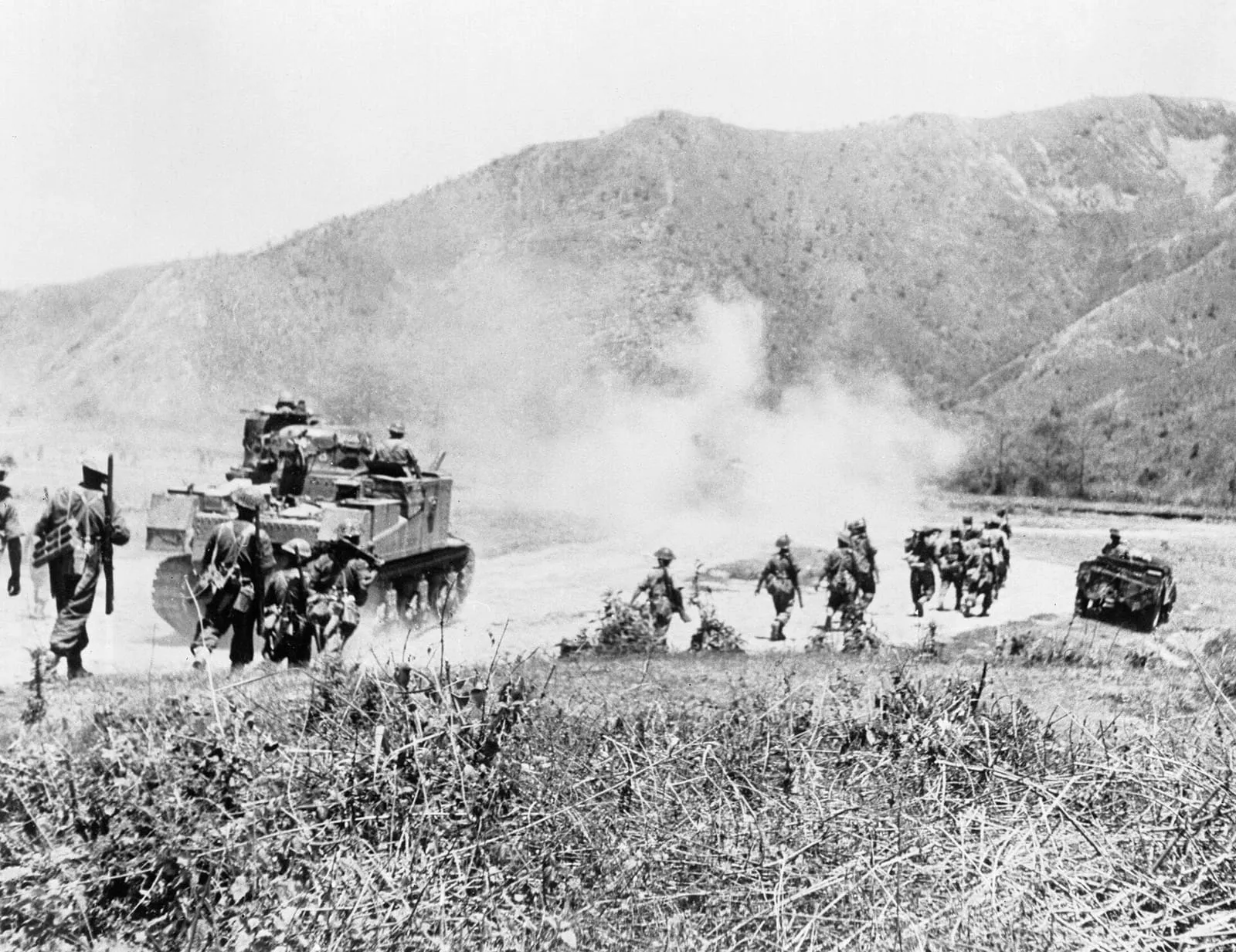
The Battles of Imphal and Kohima (Japanese インパール作戦 Inpāru sakusen – “the Imphal operation”) were a series of engagements fought from March to July 1944 in the mountainous borderland between British India and Burma. In an operation codenamed U-Go, Lieutenant General Renya Mutaguchi’s Japanese 15th Army crossed the Chindwin River and entered Manipur and the Naga Hills. Its aim was to destroy the British IV Corps on the Imphal plain, seize its depots and cut the road that supplied the front and the airfields serving China. The command of Lieutenant General William Slim’s Fourteenth Army accepted battle deliberately: it pulled its forward divisions back onto the plain, supplied the encircled troops by air and waited for the Japanese to exhaust their supplies. At Kohima a small garrison held the ridge above the road to Dimapur for two weeks, and then the British 2nd Division prised the Japanese out of their bunkers in the monsoon rains. In June the Japanese offensive fell apart from starvation and disease. On 3 July Mutaguchi called off the operation. The retreat across the Chindwin turned into a catastrophe.
The battle was the first great trial of strength in the final phase of the fighting for Burma and India. More than half of the Japanese soldiers who entered India were killed, wounded or fell sick, and the Fourteenth Army gained the opening it needed to reconquer Burma in 1944–1945.
Name and dates
English-language literature usually speaks of two battles – Imphal and Kohima – or of the “Battle of Imphal and Kohima” as a whole. They were two sectors of a single operation: the 31st Division advanced on Kohima in order to cut Imphal off from Dimapur, and both battles ended with the meeting of the forces advancing from Kohima and from Imphal on 22 June 1944. The Japanese called the whole Operation U-Go (ウ号作戦). The slogan of a “march on Delhi” (Chalo Dilli) belonged to the propaganda of Subhas Chandra Bose and his Indian National Army; it was not a real objective of the operation.
The battle is taken to have begun on 7 March 1944, when the Japanese 33rd Division moved against the Indian 17th Division on the Tiddim road; many accounts give 8 March, when Japanese units began crossing the Chindwin. The main forces – the 15th and 31st Divisions – crossed the river from 15 March. It is taken to have ended on 3 July 1944, when Mutaguchi called off the offensive. The pursuit of the Japanese went on until the end of July.
Background
The Burma front after 1942
In the spring of 1942, in the Burma campaign of 1942, the Japanese drove the Allied forces out of Burma, and the campaign came to an end. The front came to rest in the mountains along the Indian border, from the Arakan to northern Burma. In 1943 the first British offensive in the Arakan failed, and Orde Wingate’s first Chindit expedition was chiefly a propaganda success.
Imphal, the capital of the princely state of Manipur, became during this time a great base for IV Corps, with airfields and depots. It was linked to the railway in the Brahmaputra valley by a single road running for nearly 200 km through the mountains from Dimapur via Kohima – the seat of the administration of the Naga Hills district in the province of Assam. Whoever held Kohima could cut Imphal off.
In October 1943 the Allied South East Asia Command (SEAC) was set up under Admiral Louis Mountbatten. For 1944 the Allies planned a second offensive in the Arakan, an advance by General Joseph Stilwell’s Chinese divisions into the Hukawng Valley to cover the building of the Ledo Road, a second Chindit expedition and an advance by IV Corps to the Chindwin.
Mutaguchi’s plan
On the Japanese side, from March 1943 the front was commanded by Lieutenant General Masakazu Kawabe’s Burma Area Army, and the sector facing Imphal by Lieutenant General Renya Mutaguchi’s 15th Army. Mutaguchi’s regiment had taken part in the Marco Polo Bridge Incident, and his 18th Division had fought in the Malayan campaign and at Singapore. He considered the British-Indian forces weak, and Wingate’s expedition convinced him that larger forces could cross the mountains. He wanted to destroy IV Corps before it could attack, take Imphal and, in the boldest version of the plan, advance on Dimapur and cut the supply lines of Stilwell and of the airlift to China.
The higher staffs had reservations but gave way before his obstinacy. On 7 January 1944 Imperial General Headquarters approved a limited version of the operation: the capture of Imphal and the defence of the mountains west of the Chindwin. Prime Minister Hideki Tōjō supported it for political reasons too: an entry into India together with the Indian National Army was meant to strengthen the Provisional Government of Free India (Azad Hind).
The plan envisaged three thrusts. Lieutenant General Genzō Yanagida’s 33rd Division was to encircle the Indian 17th Division at Tiddim and advance on Imphal from the south. Major General Tsunoru Yamamoto’s group, with the 14th Tank Regiment and heavy artillery, was to smash the Indian 20th Division near Tamu and advance on Imphal from the east along the only metalled road. Lieutenant General Masafumi Yamauchi’s 15th Division was to close off Imphal from the north, and Lieutenant General Kōtoku Satō’s 31st Division was to take Kohima and cut the road to Dimapur. The Indian National Army fielded a brigade known as the Subhas Regiment, later also the Gandhi and Azad Brigades, as well as scouts and propaganda units. It was Bose who pressed the Japanese into giving it so large a role.
The weakness of the plan was supply. Mutaguchi assumed that Imphal would fall within three weeks and gave his divisions food for roughly that long – after that the troops were to live off British depots. Thousands of cattle were driven across the Chindwin as “living rations”; most of them died in the mountains. Most of the field artillery, and with it the anti-tank weapons, was also left behind, on the assumption that the British would not use tanks in the mountains. Nobody reckoned with the monsoon, which in May turned the tracks into mud.
All three divisional commanders had doubts. Satō considered the plan reckless and told his officers that they might all die of starvation. He and Mutaguchi were also divided by an old rivalry between army factions of the 1930s (the Kōdō-ha and the Tōsei-ha). Yanagida openly disdained his superior. Yamauchi was gravely ill with tuberculosis.
British preparations
Imphal was defended by the Fourteenth Army’s IV Corps under Lieutenant General Geoffry Scoones: Major General David Cowan’s Indian 17th Division at Tiddim, some 240 km to the south by road, Major General Douglas Gracey’s 20th Division near Tamu, the 23rd Division in reserve, and the 50th Parachute Brigade and the 254th Tank Brigade. The “Indian” divisions included British, Gurkha and Indian battalions.
These troops had been trained in jungle warfare and had fresh experience from the Arakan. There, in February 1944, the Japanese 55th Division had encircled the Indian 7th Division in the so-called Admin Box near Sinzweya during the Ha-Go counter-offensive. The encircled troops, supplied by air, held out, and the Japanese ran out of food. At the end of February Ha-Go collapsed.
Slim knew from reconnaissance and signals intelligence that the Japanese were preparing an offensive. Together with Scoones he decided to pull the 17th and 20th Divisions back onto the Imphal plain, where he could use his tanks, artillery and airfields, while the Japanese would have to fight at the end of long supply lines. He misjudged, however, the timing and strength of the attack, especially at Kohima, where he expected a regiment at most.
On the evening of 5 March Operation Thursday, the Chindit landings in central Burma, began. The commander of the Japanese air forces in Burma, Major General Noboru Tazoe, advised dealing with the airborne landing first, but Mutaguchi refused: once Imphal was taken, the Chindits would lose their bases anyway.
Course of the battle: March – the race for the Imphal plain
The Tiddim road
On 7 March the Japanese 33rd Division set off northwards, bypassing the positions of the 17th Division in the Chin Hills. Patrols informed Cowan of Japanese in his rear as early as 8 March, but Scoones gave the order to withdraw only on 13 March. That day the Japanese 215th Regiment attacked the large depot at Milestone 109 on the road, while the 214th Regiment took Tongzang and the Tuitum saddle, a dozen or so kilometres behind Cowan’s positions.
The 17th Division began its withdrawal on 14 March. On 15 March the Indian 48th Brigade drove the Japanese off the Tuitum saddle before they could dig in. The depot at Milestone 109, taken by the Japanese on 18 March, was recaptured on 25 March, and on 26 March the rearguard blew the bridge over the Manipur River behind it. Scoones had to send almost his entire reserve – the 23rd Division – to help, and the two divisions, supplied by air drops, reached the Imphal plain only on 4 April. Yanagida, alarmed by a garbled report that one of his regiments had been destroyed, pursued them cautiously, against Mutaguchi’s demands.
Tamu and the Shenam Pass
In the east the 20th Division held Tamu and the large depot at Moreh. On 20 March the M3 Lee tanks of the 3rd Carabiniers destroyed Japanese Type 95 Ha-Go light tanks near Tamu. Gracey, however, had to hand over part of his division to the corps reserve, and he withdrew to the Shenam Pass above the road to Imphal, burning the depot at Moreh. He was helped by the fact that two of the Yamamoto group’s battalions had been bogged down in northern Burma fighting the Chindits.
Sangshak
In the north-east the 15th and 31st Divisions crossed the Chindwin from 15 March. They advanced through the jungle on a front nearly 100 km wide. The left wing of the 31st Division, led by its infantry group commander, Major General Shigesaburō Miyazaki, got ahead of the neighbouring 15th Division and on 19–20 March ran into Brigadier Maxwell Hope-Thompson’s Indian 50th Parachute Brigade. The brigade, which had been training in the Ukhrul area and was only just occupying its positions, concentrated on a hill by the village of Sangshak.
Miyazaki had no orders to attack it, but he did not want to leave it astride his path. After clashes at the forward posts, the hill itself was fought over from 22 to 26 March. The defenders were short of water, the attackers of artillery. When units of the 15th Division arrived, Hope-Thompson broke out to Imphal on 26 March. The brigade lost about 600 men, the Japanese about 400 (estimates). But the action cost the 31st Division a week, and documents captured at Sangshak showed the British that a whole division, not a regiment, was advancing on Kohima.
The airlift and the 5th Division
Mountbatten took a step he was not formally entitled to take: he borrowed about 20 Curtiss C-46 Commando aircraft from the American airlift to China. With them and with Dakotas, Slim flew Major General Harold Briggs’s Indian 5th Division from the Arakan in eleven days, complete with artillery, jeeps and mules. Two of its brigades flew to Imphal, the third, the 161st Brigade, to Dimapur. On 28 March the Japanese 60th Regiment cut the Imphal–Kohima road. IV Corps was cut off by land.
On 24 March Orde Wingate, commander of the Chindits, was killed in an air crash over Manipur.
Course of the battle: Kohima
The siege (4–18 April)
Slim’s greatest fear was for Dimapur – a railway station and huge base with almost no combat troops. Its fall would have cut off not only Imphal but also Stilwell and the airlift airfields. The 161st Brigade was therefore pulled back from Kohima to Dimapur, and Lieutenant General Montagu Stopford’s XXXIII Corps, with Major General John Grover’s British 2nd Division, was sent from central India to Assam.
Satō, however, concentrated on Kohima. On 8 April Mutaguchi ordered him to send a detachment towards Dimapur. Satō reluctantly detached a battalion, but a few hours later the commander of the Burma Area Army, Lieutenant General Kawabe, countermanded the move. It is now regarded as one of the greatest opportunities the Japanese missed in the battle.
On 4 April the 161st Brigade returned to Kohima, but before the Japanese cut the road only Lieutenant Colonel John Laverty’s 4th Battalion of the Royal West Kent Regiment and a company of Rajputs managed to reach the town. With a battalion of the Assam Regiment, detachments of the Assam Rifles, a battalion from the Nepalese army and service troops, Colonel Hugh Richards’s garrison numbered about 2,500 men, about 1,000 of whom were not trained for combat. The rest of the brigade dug in some 3 km to the west, at Jotsoma, and supported the defenders with its fire.
The siege began in earnest on 6 April. The Japanese, who also shelled the ridge with guns captured at Sangshak, pushed the defenders back towards Garrison Hill. On the very first day they took GPT Ridge with the main water supply. The heaviest fighting raged around the bungalow of the district’s Deputy Commissioner, Charles Pawsey, and its tennis court, which became no man’s land: the two sides lobbed grenades at each other from trenches a dozen or so metres apart. On the nights of 7/8 and 8/9 April Lance Corporal John Harman of the Royal West Kents single-handedly destroyed two Japanese machine-gun posts. He was killed at the second and was awarded a posthumous Victoria Cross.
During the night of 17–18 April the Japanese took the bungalow and Kuki Picquet, splitting the defence in two. The defenders now held only part of Garrison Hill. But the Japanese were too exhausted to finish off the garrison.
Relief and the fight for the ridge (18 April – 13 May)
The British 2nd Division fought its way from Dimapur through the Japanese roadblocks and reached Jotsoma on 15 April. On 18 April, supported by artillery, tanks and aircraft, the 1st Battalion of the 1st Punjab Regiment broke through to the defenders. The following night some 300 wounded were carried out, and on 20 April Colonel Richards handed over the sector to the British 6th Brigade.
The relief did not end the fighting. Satō held the ridge and Naga Village with eight battalions, but he had only a dozen or so light mountain guns against some 90 British guns and dive-bombers. His bunkers, deeply dug in and mutually supporting, had to be taken one by one.
Attempts to outflank the position in the north (Naga Village) and the south (GPT Ridge) in early May bogged down in rain and mud. From 4 May the 2nd Division and Major General Frank Messervy’s Indian 7th Division, arriving from the Arakan, attacked along the ridge. On 11 May the Indian 33rd Brigade took Jail Hill and Kuki Picquet. On 13 May sappers bulldozed a track up to a higher terrace, an M3 Lee tank drove down onto the tennis court and destroyed the bunkers, and the 2nd Battalion of the Dorsetshire Regiment took the bungalow hill. The Kohima ridge had been cleared.
Satō’s withdrawal (late May – June)
The Japanese still held Naga Village and the Aradura spur south of the ridge, beating off attacks on 16, 24/25 and 28/29 May. But hunger decided the outcome. The 31st Division had set out with about three weeks’ food, the promised supplies never came, and a Chindit brigade operating in its rear cut it off from the villages. Mutaguchi, moreover, was demanding that Satō send part of his forces to Imphal.
On 25 May Satō informed 15th Army headquarters that unless he received supplies he would withdraw on 1 June. On 31 May he abandoned Naga Village and the positions north of the road, in defiance of Mutaguchi’s explicit order. Historians stress that this was the first time in the history of the Japanese army that a divisional commander had withdrawn on his own authority. Miyazaki covered the retreat with a few battalions, blowing bridges on the road to Imphal, while the rest of the division headed south to Ukhrul, where there was neither food nor medicine.
Course of the battle: Imphal encircled
Supply by air
From the end of March to 22 June IV Corps – according to British figures some 150,000 soldiers and labourers and thousands of pack animals – was supplied solely by air. British and American transport aircraft landed at the airfields at Imphal and (until the monsoon arrived) at Palel, or dropped loads by parachute to troops in the field. The effort to supply the encircled garrison, carried out from 18 April, was called Operation Stamina. By the end of the battle the air forces had delivered about 19,000 tons of supplies and 12,000 troops to Imphal and Kohima, and had flown out about 13,000 wounded and sick and 43,000 people not needed in the fortress. Rations had to be cut and the artillery had to husband its ammunition, but Imphal was not starved out.
Allied air power – mainly the RAF’s 3rd Tactical Air Force with No. 221 Group – dominated the battlefield. The Japanese army air force, bled white over the Arakan in February, made only a few large raids over Imphal and Kohima. Fighter-bombers attacked Japanese columns, depots and bridges all the way to the Chindwin, and during the monsoon the number of sorties did not fall but rose.
Attacks from four directions (April – May)
From the beginning of April the Japanese attacked the plain from several directions. In the north the 15th Division took the previously emptied depot at Kanglatongbi and the ridges above the road to Kohima, and one battalion took Nunshigum ridge, overlooking Imphal’s main airfield. On 13 April the Indian 5th Division retook it with the help of M3 Lee tanks of the 3rd Carabiniers, which climbed slopes considered impassable. Every officer of the squadron and of the attacking Dogra battalion was killed or wounded.
In the east the Yamamoto group attacked the Shenam Pass. Its attack on 4 April was chaotic, and anti-tank guns destroyed a dozen or so Japanese tanks on the road. From 8 to 22 April five peaks above the road changed hands repeatedly. Yamamoto then sent units across the mountains towards Palel airfield. On 28 April the Indian National Army’s Gandhi Brigade attacked it, without success.
In the south the 33rd Division struck at Bishenpur, held only by the Indian 32nd Brigade. The Japanese crossed the hills west of the village and came within about 16 km of Imphal, but were halted by artillery fire and lack of supplies. In May Mutaguchi removed the cautious Yanagida from command. On 22 May the 33rd Division was taken over by Lieutenant General Nobuo Tanaka, who threw its battalions into attack after attack until many were reduced to handfuls of men.
By 1 May the Japanese offensive had stalled everywhere. In mid-May near Bishenpur both sides simultaneously tried to outflank each other, and both suffered heavy losses. By June the 33rd Division, despite reinforcements, could no longer attack.
The counter-offensive and the meeting at Milestone 109
From May Slim and Scoones attacked the weakest Japanese division – the 15th Division north of Imphal. Progress was slow. The Japanese defended themselves on steep ridges such as Mapao, which the artillery could not hit, and the infantry took the summits only to be driven off them by fire from the reverse slopes. From the end of May the 5th Division advanced north along the road to Kohima, and the 20th Division towards Ukhrul, deep into the 15th Division’s rear.
The Japanese divisions were starving. Soldiers of the 15th Division abandoned their positions to search the villages for food. At the beginning of June Mutaguchi removed the mortally ill Yamauchi from command. The troops of XXXIII Corps, advancing from Kohima, broke Miyazaki’s rearguards and drove the 60th Regiment off the road. On 22 June the leading elements of the British 2nd Division and the Indian 5th Division met at Milestone 109 on the road from Dimapur, some 16 km north of Imphal. The siege was over, and lorry convoys once again drove into Imphal.
Course of the battle: collapse and retreat
As early as the end of April the Deputy Chief of the General Staff, Lieutenant General Hikosaburō Hata, reported to Tokyo that the operation would fail, but Tōjō ordered it to continue. On 6 June Mutaguchi met Kawabe. According to their later accounts, both understood that success was impossible, but neither wanted to be the first to give the order to retreat.
In June the monsoon turned the roads from the Chindwin into torrents of mud. Malaria, dysentery, typhus and beriberi spread among the Japanese soldiers, and rations fell to a handful of rice and whatever could be found in the forest. Mutaguchi kept issuing orders for new attacks: the 31st Division was to turn back and attack Imphal from the north together with the 15th Division. Neither was capable of carrying them out. At the beginning of July Satō, after weeks of ignoring orders, was relieved of his command. He was never court-martialled – according to some sources it was decided that he had suffered a nervous breakdown; according to others a psychiatric examination did not confirm this and the case was quietly dropped. As a result, all three divisions of the 15th Army changed commanders during the battle.
On 3 July 1944 Mutaguchi, with the consent of his superiors, called off the operation. The retreat to the Chindwin at the height of the monsoon was the most tragic part of the battle. Units, often broken up into scattered groups, abandoned their artillery, vehicles and the wounded who could not walk. Japanese soldiers called the line of retreat “the road of white bones” (hakkotsu kaidō). The British pursued them throughout July. When they recaptured Tamu at the end of the month, they found there some 550 unburied Japanese bodies and about 100 dying men.
The Indian National Army
The Indian National Army (INA) committed several thousand soldiers to the operation. Shah Nawaz Khan’s Subhas Brigade covered the left flank of the 33rd Division in the Chin Hills, and the Gandhi Brigade attacked Palel. Bose’s hopes that Indian soldiers in the British army would change sides en masse were not fulfilled – there were desertions on both sides, but on a small scale. The INA, supplied even worse than the Japanese, suffered heavy losses to hunger and disease during the retreat.
Losses
Figures for the losses vary from source to source. According to tallies cited in British historiography, the Japanese 15th Army lost about 54,900 men (killed, wounded, missing and sick), including 13,376 killed in action; other tallies give about 60,000. Many historians estimate that, including those who died of starvation, disease and exhaustion, some 30,000 Japanese lost their lives. Almost all of the roughly 12,000 horses and mules and about 30,000 head of cattle were also lost. Out of some 85,000–90,000 soldiers who entered India, this amounted to more than 60 per cent of the force.
British and Indian losses came to about 12,600 men at Imphal and about 4,100 at Kohima – nearly 17,000 killed, wounded and missing in all. Most of the wounded were evacuated by air, which saved many of their lives. The Kohima War Cemetery, laid out on the slope of Garrison Hill on the site of the tennis court, holds 1,420 Allied soldiers. The 2nd Division’s memorial bears an inscription that later became known as the Kohima Epitaph: “When you go home, tell them of us and say, for your tomorrow, we gave our today.”
Significance
Imphal and Kohima were the greatest defeat the Japanese army had suffered on land in the war up to that time. They did not decide the outcome of the war with Japan, which was being settled in the Pacific, but they changed the situation in South-East Asia. Japan lost the forces that were to have defended Burma and never again threatened India. Bose’s government lost what credibility it had left as a future government of India.
The battle showed that the British-Indian army, beaten in Malaya and Burma in 1942–1943, had learned to fight in the jungle. Three things proved decisive: Slim’s decision to accept battle on the Imphal plain rather than on the Chindwin; supply by air, which allowed the encircled troops to hold out while their besiegers starved; and the tenacity of the infantry at Kohima, on the Shenam and at Bishenpur. Most of the soldiers on the British side were Indians and Gurkhas, which also mattered in the later disputes over India’s place in the Empire.
On the Japanese side the battle became a byword for bad command. Mutaguchi pushed his plan through despite the doubts of the staffs and his divisional commanders, based his supply on captured stores, dismissed reports of starvation and removed all three of his divisional commanders. At the end of August 1944 he was himself relieved, and soon afterwards he was placed on the retired list. Kawabe was also removed. After the war Mutaguchi spent years defending his decisions and blaming his subordinates.
In the summer of 1944, after the capture of Myitkyina by Stilwell’s troops and the Chindits, the Allies went over to the offensive in Burma. In December 1944 the Viceroy of India, Archibald Wavell, knighted Slim and his corps commanders at Imphal. The Fourteenth Army crossed the Chindwin and the Irrawaddy, took Meiktila and Mandalay in March 1945, and at the beginning of May the Allies entered Rangoon. That rapid campaign would not have been possible without the destruction of the 15th Army at Imphal and Kohima. In 2013, in a poll held by the British National Army Museum, the battle was voted the greatest in the history of the British Army.