Germany
Hans von Seeckt
Chief of Staff of the 11th Army and of Mackensen's army group (1915), Chief of the Army Command of the Reichswehr (1920–1926), adviser to Chiang Kai-shek (1933–1935)
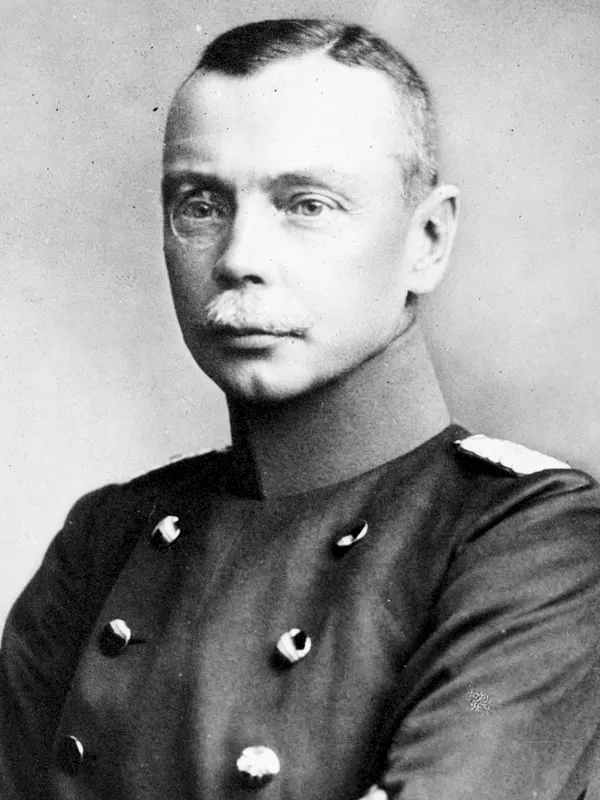
- Born:
- 22 April 1866, Schleswig (Prussia)
- Died:
- 27 December 1936, Berlin
- Author:
- Łukasz
- Photo:
- Bain News Service, publisher Ernst Sandau (d. 1918), domena publiczna, Wikimedia Commons
Throughout the First World War Hans von Seeckt was a staff officer, never a commander, yet he was among the most influential German soldiers of the period. As chief of staff to August von Mackensen he helped plan the breakthrough on the Russian front at Gorlice in 1915 and the conquest of Serbia. His real significance for the history of the twentieth century, however, lies in his work after the defeat. From 1920 to 1926, as Chief of the Army Command, he built the Reichswehr, limited by the Treaty of Versailles to 100,000 men, into a cadre army ready for rapid expansion; he kept it beyond the control of the republic and secretly circumvented the treaty’s prohibitions in cooperation with the Red Army. He regarded reborn Poland as a state that “must disappear”. His Reichswehr produced the generals who led the Wehrmacht to war in 1939.
Youth and staff career
He was born on 22 April 1866 in Schleswig, into a family of Pomeranian nobility with military traditions. His father rose to the rank of general. In 1885 Seeckt joined an elite regiment of Guard Grenadiers in Berlin. He attended the War Academy from 1893 to 1896, and at the same time, in 1893, he married Dorothee Fabian, who was partly of Jewish descent. Over the next twenty years he made his career in the General Staff and on corps staffs. He travelled a great deal, read widely and was regarded as an educated, cool and reserved officer. Because of that reserve and his ever-present monocle he was later nicknamed “the Sphinx”. In 1913 he became chief of staff of III Corps in Berlin.
Gorlice and Serbia
With III Corps he marched through Belgium in August 1914, fought on the Marne and in January 1915 planned a successful counter-attack at Soissons that brought him to the attention of the high command. In the spring of 1915 the Chief of the General Staff, Erich von Falkenhayn, formed a new 11th Army from picked divisions transferred from the west, which was to strike in western Galicia and rescue the hard-pressed Austria-Hungary. Mackensen became its commander and Seeckt its chief of staff. On 2 May 1915 Mackensen’s troops attacked at Gorlice and within a few days shattered the Russian 3rd Army. According to Basil Liddell Hart, Seeckt ordered the corps not to wait for the line to be straightened but to push on as far as they could, and he sent the reserves to wherever the front had already broken. The offensive recaptured Przemyśl and Lwów (Lviv) and by the summer had reached Brest-Litovsk. In the army it was said at the time that where Mackensen was, there was Seeckt, and where Seeckt was, there was victory.
In the autumn of 1915 Mackensen and Seeckt led the campaign against Serbia. Belgrade fell in October, and at the end of November the Serbian army had to retreat across the mountains of Albania to the Adriatic. In 1916–1917 Seeckt was chief of staff of the army groups of Archduke Charles and then of Archduke Joseph August, which defended eastern Galicia, the Carpathians and Transylvania. In practice it was he who directed operations, which the Austrians found hard to accept.
Turkey
In December 1917 Seeckt became chief of staff of the Ottoman army, formally deputy to Enver Pasha. He had hoped to direct the empire’s strategy, but soon discovered that Enver listened to German advice only when it matched his own intentions, and in 1918 Enver sent his best forces to the Caucasus instead of to the threatened fronts in Palestine and Mesopotamia. Seeckt’s attitude to the Armenian genocide is today one of the most frequently recalled aspects of his biography. According to researchers who cite his correspondence, in the summer of 1918 he replied to Berlin that one could not be the Turks’ ally and at the same time stand up for the Armenians. After the armistice with Turkey he returned in November 1918 to Germany, where the revolution was already under way.
Versailles and the birth of the Reichswehr
In the spring of 1919 he was the military expert of the German peace delegation. He tried in vain to persuade the victors to let Germany keep a larger army. The Treaty of Versailles limited the land forces to 100,000 professional soldiers, including 4,000 officers, and banned conscription, tanks, military aviation, heavy artillery and the General Staff. On 1 October 1919 Seeckt became head of the Troop Office (Truppenamt), which was the forbidden General Staff under a new name.
In March 1920, during the Kapp–Lüttwitz Putsch, he refused to use the army against the putschists. According to an often-quoted account, he said that the Reichswehr would not fire on the Reichswehr. The government fled Berlin, and the putsch collapsed only under the pressure of a general strike. Even so, after its collapse Seeckt became Chief of the Army Command (Chef der Heeresleitung), replacing General Walther Reinhardt, who had been one of the few willing to defend the republic by force of arms. This episode captures Seeckt’s attitude well. The army was to stand “above parties”, but that did not mean it served the republic. It served the state as its officers understood it.
A cadre army
For six years Seeckt built the Reichswehr according to his own plan. Since there could be only 100,000 soldiers, each was to be trained for command one level higher: the private for the role of an NCO, the NCO for the role of an officer. It was an army of leaders (Führerheer) that could be expanded rapidly when needed. In training Seeckt stressed independence, initiative, mission command and the cooperation of the arms; in doctrine he stressed a war of manoeuvre, fast and mobile, as opposed to the trench warfare of 1914–1918. The officer corps admitted carefully selected men, many of them from the nobility and the old General Staff. Many historians see this work as one of the foundations of the Wehrmacht’s successes in 1939–1941.
Seeckt kept the Reichswehr away from party politics, but also away from the control of parliament and government. Soldiers had no vote, and the Defence Minister, Otto Geßler, in practice gave the Chief of the Army Command a free hand. Critics spoke of a “state within the state”. The army also tolerated illegal reserve formations, the so-called Black Reichswehr, and cooperated with right-wing volunteer units.
With Moscow against Poland
The most important way of circumventing the treaty was cooperation with Soviet Russia. As early as 1921 Seeckt set up a secret group in the ministry, which included Major Kurt von Schleicher, to hold talks with the Bolsheviks on arms production. The Treaty of Rapallo of April 1922, which restored diplomatic relations between Germany and Russia, made these contacts easier. In the following years Germany financed arms factories in the Soviet Union, and secret German training centres were set up on its territory: a flying school at Lipetsk, and later a tank school near Kazan and a chemical weapons centre. There German officers learned what the treaty forbade them, while Soviet commanders drew on German experience. The cooperation lasted until 1933.
At the root of this policy lay hostility towards Poland. In September 1922 Seeckt wrote in a memorandum for Chancellor Joseph Wirth that Poland’s existence was intolerable for Germany and incompatible with its vital interests. Poland “must disappear and will disappear”, through its own weakness and through Russia, with Germany’s help. The basis of an understanding with Russia was to be the border of 1914. These words are today among the most frequently quoted testimonies to German eastern policy in the 1920s. Seventeen years later, in August 1939, the Molotov–Ribbentrop Pact heralded precisely such a partition of Poland, carried out by Germany and the Soviet Union.
1923
The republic’s most dangerous crisis came in 1923: the Franco-Belgian occupation of the Ruhr, hyperinflation, communist attempts at insurrection in Saxony and Hamburg, and right-wing conspiracies in Bavaria. On 11 March 1923 Seeckt met Adolf Hitler and noted that they shared the same goal and differed only in the means. Yet when units of the Black Reichswehr attempted a putsch at Küstrin (Kostrzyn) on 1 October that year, the Reichswehr crushed it. On the night of 8–9 November, when Hitler and Erich Ludendorff proclaimed a “national revolution” in Munich, President Friedrich Ebert entrusted Seeckt with supreme executive power in the Reich. The Munich Putsch collapsed the next day under the bullets of the Bavarian police, but Seeckt retained his emergency powers until 28 February 1924. During that time he banned the NSDAP, the communist KPD and the far-right Deutschvölkische Freiheitspartei. For several months he was the most powerful man in Germany. Some of those around him hoped he would take power as dictator; Seeckt did not, and he gave up his powers once the crisis had passed.
Dismissal and politics
In 1926 Seeckt was promoted to Colonel General. In the autumn of that year, without the minister’s knowledge, he allowed the former Kaiser’s grandson, Prince Wilhelm of Prussia, to take part in uniform in the manoeuvres of a regiment that carried on the traditions of the old Prussian Guard. The press turned it into a scandal, Geßler demanded his departure, and Chancellor Wilhelm Marx and President Paul von Hindenburg accepted his resignation. In October 1926 Seeckt left the army. His successors nonetheless continued his work, and the men he had trained took over key posts.
In retirement Seeckt wrote, among other things, Thoughts of a Soldier (1929), and went into politics. From 1930 to 1932 he sat in the Reichstag for the National Liberal German People’s Party. He criticised the Treaty of Versailles, demanded Germany’s right to rearm and belonged to the camp of the national right, although he was not a Nazi.
China
In 1933, after Hitler had come to power, Seeckt travelled to China at the invitation of Chiang Kai-shek, who had been using German military advisers for several years. In the spring of 1934 he returned there as chief adviser. He proposed creating a small, well-trained and modernly equipped army, developing a Chinese arms industry and exchanging Chinese raw materials, especially tungsten, for German weapons. German advisers are also credited with a part in the campaigns against the communists that in 1934 forced the Chinese Red Army onto the Long March. Seeckt, now ill, left China in March 1935, and the mission was taken over by General Alexander von Falkenhausen. German-trained divisions fought the Japanese at Shanghai in 1937, before Berlin, choosing an alliance with Tokyo, withdrew its advisers in 1938.
Seeckt died in Berlin on 27 December 1936 and was buried in the Invalids’ Cemetery. Hitler sent condolences to his widow, the authorities gave him a ceremonial state funeral, and an infantry regiment was named after him.
Significance
The British historian John Wheeler-Bennett placed Seeckt alongside Scharnhorst and Gneisenau as a man who rebuilt the army from the ashes of defeat. The judgement has some justification: without the cadre army of the 1920s Hitler could not have expanded the Wehrmacht so quickly after 1935, and the spirit of Seeckt’s training, with its emphasis on initiative and movement, lived on in the army that defeated Poland in 1939 and France in 1940.
Critics point to the other side of this achievement. Seeckt made the Reichswehr a “state within the state”, distrustful of democracy, and taught its officers that their loyalty belonged to Germany, not to the republic. When Hitler, who promised the army rearmament and greatness, took power in 1933, this attitude gave it no defence against him. For Polish historians Seeckt remains above all the advocate of an understanding with Soviet Russia at Poland’s expense, and his words that Poland “must disappear”, read in the light of September 1939, sound like a programme.
Sources
Mentioned in battles
(03)Often appears with
People who appear in the same events.