Battle of Suomussalmi
- Dates:
- 7 December 1939 – 8 January 1940
- Front:
- Scandinavia
- Location:
- The municipality of Suomussalmi in the Kainuu region of east-central Finland, some 40 km from the Soviet border – the burnt-out church village of Suomussalmi, the Hulkonniemi peninsula and the ice of Lake Kiantajärvi, the roads to Juntusranta and Peranka in the north, and the road from Suomussalmi through Haukila to the border village of Raate in the eastOn the battle map →
- Sides:
- FinlandHjalmar SiilasvuoSoviet UnionMikhail Dukhanov, Vasily Chuikov, Andrei Zelentsov, Alexei Vinogradov
- Result:
- Finnish victory. The Soviet 163rd Rifle Division was routed at Suomussalmi and the 44th Rifle Division destroyed on the Raate road. The plan to cut Finland in two at its narrowest point collapsed.
- Author:
- Natalia
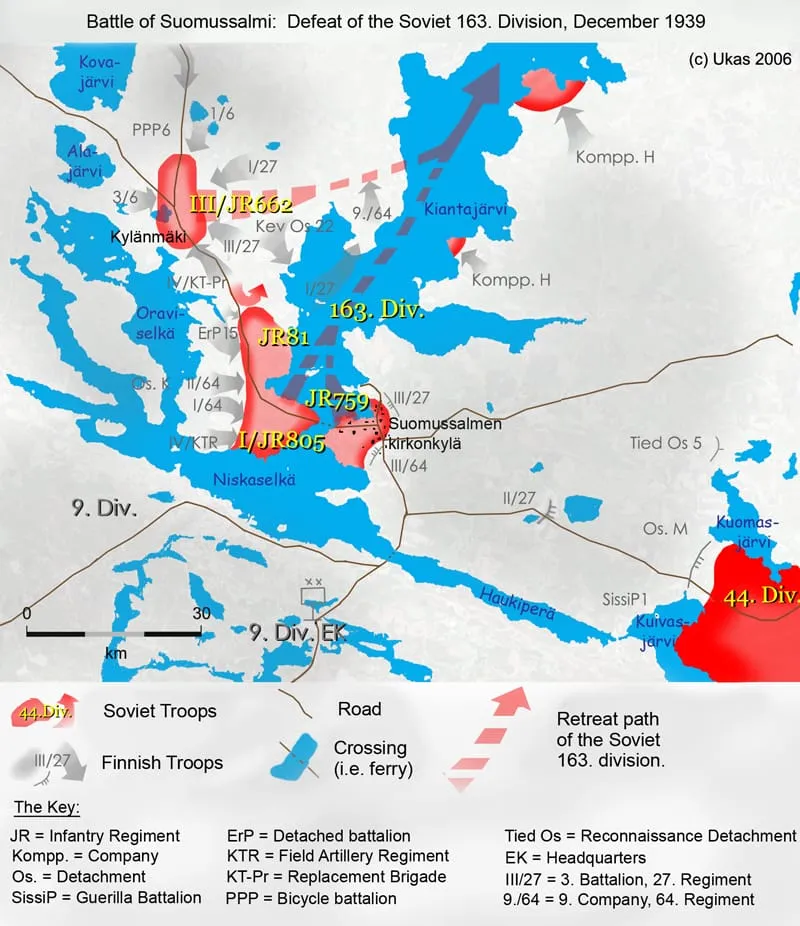
The Battle of Suomussalmi was the most spectacular Finnish victory of the Winter War and one of the most painful defeats suffered by the Red Army before 1941. In the roadless, snowbound forests of the Kainuu region, the Soviet 9th Army was to advance from the border to Oulu on the Gulf of Bothnia and cut Finland in two at its narrowest point. On 7 December 1939 its 163rd Rifle Division took the village of Suomussalmi, which the Finns had burnt, but it got no further. An improvised group under Colonel Hjalmar Siilasvuo, whose men moved on skis, cut it off from its rear and in the last days of December broke it, forcing the survivors to flee across the ice of Lake Kiantajärvi. The 44th Rifle Division, sent to its relief and strung out in a column several dozen kilometres long on a narrow forest road from Raate, was chopped into pockets and destroyed in the first week of January 1940. The Finns, outnumbered several times over and with almost no artillery, captured dozens of tanks and guns, hundreds of lorries and more than a thousand horses. The commander of the 44th Division, together with his chief of staff and the head of his political department, was shot in front of what was left of the division.
Name and dates
In Finland the fighting is known as the Battle of Suomussalmi (Finnish Suomussalmen taistelu), and its final phase in January as the Battle of the Raate Road (Raatteen tien taistelu). Russian historians write of the “fighting at Suomussalmi” and the “battle on the Raate road”. The two phases formed a single operation: the destruction of the 44th Division followed directly from the encirclement of the 163rd, and on the Finnish side both were directed by the same man.
The starting date varies. Finnish and English-language historiography dates the battle from 30 November 1939, when the 163rd Division crossed the border. Some accounts, along with a number of Russian studies, begin on 7 December, when the division entered Suomussalmi and the Finnish village centre became a battlefield. The case for the later date is that only then did the fight for the place itself begin; the earlier days were a march through the borderland, delayed by small Finnish covering detachments. Some Finnish sources state that Soviet troops did not secure the whole church village until 8 December. The battle is taken to have ended on 8 January 1940: organised resistance by the 44th Division ceased before noon on 7 January, and the following day the Finns finished combing the forests along the Raate road.
Background
The plan for the war against Finland, drawn up in Leningrad in the autumn of 1939 and approved by Joseph Stalin, assumed that the Red Army would cross the country within a few weeks. Alongside the main thrust by the 7th Army on the Karelian Isthmus and the 8th Army’s offensive north of Lake Ladoga, it provided for a march by the 9th Army across central Finland. Its commander, Komkor Mikhail Dukhanov, was to advance from Soviet Karelia through Suomussalmi, Hyrynsalmi and Puolanka to Oulu. Taking that town would have cut northern Finland off from the south and severed the only land rail link with Sweden, through Tornio and Haparanda, by which foreign aid was arriving. On the staff map the task looked simple: from the border to Oulu was less than 250 kilometres as the crow flies.
The Finnish command did not expect large forces in this area. It assumed that through the empty forests and bogs, crossed by a few narrow dirt roads, the Russians would send units no larger than a battalion. The border from Kuhmo to Kuusamo was watched by General Wiljo Tuompo’s North Finland Group, and around Suomussalmi there were only Separate Battalion 15 (ErP 15) and Separate Battalion 16 (ErP 16), made up largely of reservists and border guards – some 3,000 men in all.
The Soviet 163rd Rifle Division under Kombrig Andrei Zelentsov, formed only in the summer of 1939 in the Tula region, numbered well over ten thousand men and was supported by tanks and artillery. On 30 November it crossed the border from the Ukhta area (today Kalevala) in the Karelian ASSR by two roads. The 81st Mountain Rifle Regiment and the 662nd Rifle Regiment moved in the north through Juntusranta, while the 759th Rifle Regiment and a reconnaissance battalion took the road from Raate in the east. Small Finnish companies delayed the march, burning buildings as they fell back. The 662nd Regiment turned north towards Peranka and on 6 December was halted by ErP 16 at the Piispajärvi narrows. The other regiments closed in on Suomussalmi.
The fighting: the capture of Suomussalmi and the encirclement of the 163rd Division
On 7 December 1939 the Soviet columns from the north and east met at Suomussalmi. They found ashes. The inhabitants had been evacuated and Finnish soldiers had set fire to the village to deny the enemy shelter in frosts of 30–40 degrees below zero. The defenders withdrew west and south, behind the frozen narrows of Lakes Niskanselkä and Haukiperä. On 8 December units of the 163rd Division tried to push on across the ice towards Hyrynsalmi and Puolanka, but were thrown back.
Carl Gustaf Emil Mannerheim, who was following this axis closely from his headquarters at Mikkeli, sent Infantry Regiment 27 (JR 27) of the 9th Division from the reserve of General Headquarters to the Suomussalmi area. Its commander, the 47-year-old Colonel Hjalmar Siilasvuo, a former Jäger trained in Germany during the First World War, arrived with the first battalions on 9 December and took command of all units in the area. Thus was formed Group Siilasvuo, initially a few thousand men with almost no artillery or anti-tank weapons.
Siilasvuo first tried to retake Suomussalmi by frontal assault, but the Soviet units had dug in among the ruins and on the Hulkonniemi peninsula, and the first attacks cost the Finns dearly. So he changed his method. On 11 December his men, moving on skis away from the roads, cut the Raate road on the isthmus between Lakes Kuivasjärvi and Kuomasjärvi, a dozen or so kilometres east of the village, and set up a strong roadblock there. A few days later they also blocked the road north towards Juntusranta. The 163rd Division was encircled. Its supplies could now reach it only across the ice of Lake Kiantajärvi, under constant raids by Finnish ski patrols.
Over the following days the Finns did not storm the fortified positions but harried them from every side. Their patrols in white snowsuits appeared at night by the campfires, attacking sentry posts, transport and above all field kitchens, since in such cold a soldier without a hot meal lost his strength within a few days. The Red Army men, most of them unused to northern forests and often without skis or proper winter clothing, could not light fires without drawing fire, and froze at their posts. The Finns also tapped Soviet telephone lines, so they knew the movements of the supply columns. Soviet reports spoke of a “fear of the Finns”: whole sub-units sometimes abandoned their positions at the sound of skis in the forest.
On 20 December Kombrig Zelentsov, seeing his division bleeding to death, asked for permission to withdraw. It was refused. The command in Moscow, where the tone was set by the People’s Commissar for Defence, Kliment Voroshilov, and by Stalin, believed that a relief force would be enough. The 44th Rifle Division under Kombrig Alexei Vinogradov was sent to help the 163rd. On 22 December Dukhanov was removed from command of the 9th Army. He was replaced by Komkor Vasily Chuikov, until then commander of the 4th Army, which had marched into Poland in September. At the same time the head of the Red Army’s Political Directorate, Lev Mekhlis, arrived at the 9th Army, sent by Stalin to investigate the causes of the failures.
The fighting: the relief force stalls on the Raate road
The 44th Rifle Division was one of the Red Army’s better formations. Before the war it had been stationed at Zhytomyr in the Kiev Special Military District, and in September 1939 it had taken part in the invasion of Poland. Moved north by rail, it numbered, with its attached units, some 15,000–17,000 men, more than 40 T-26 tanks, about 120 guns, hundreds of lorries and some 4,500 horses. It also brought a band with its instruments, sheet music and banners for a victory parade. Its soldiers, many of them Ukrainians, had never seen such a winter, and reports by the political department were already recording desertions and reluctance to fight the Finns while the division was in transit.
In mid-December the division began to concentrate near the border, and on 20 December, according to Russian studies, its leading units set off along the road from Raate to Suomussalmi. The road was less than four metres wide and ran through dense forest between lakes and bogs. On the isthmus between Kuivasjärvi and Kuomasjärvi the head of the 44th Division ran into the Finnish roadblock on the Kuomasjoki stream, later called by the Finns “the Thermopylae of Suomussalmi”. A handful of defenders held up an entire division there. Vinogradov did not commit himself to a determined attack to break through to the 163rd Division a dozen or so kilometres away. His column came to a halt, and on 28 December it was ordered onto the defensive. It lay along the road for some 30 kilometres, from Haukila to the border, with heavy equipment that could not leave the roadway for the deep snow.
The Finnish command discovered the arrival of the new division in mid-December and brought further forces to the Suomussalmi area: Infantry Regiments JR 64 and JR 65, a guerrilla battalion (Sissi P 1), a bicycle battalion (PPP 6) and a little artillery. In the last ten days of December Group Siilasvuo was renamed the 9th Division. Even reinforced, it had by various estimates between about 11,000 and 17,000 men, against nearly 50,000 in the two Soviet divisions and their supporting units.
These days also produced an episode that passed into Finnish legend. The writer Ilmari Kianto, who lived by Lake Kiantajärvi, left a note in Russian in his house before being evacuated, asking the invaders to spare the home of a poor writer, as there were no troops on the nearby islands. A Finnish patrol that came on 19 December to burn the buildings found the letter. Kianto was sentenced to six months in prison for aiding the enemy and was later pardoned by the President.
The fighting: the destruction of the 163rd Division
On 24 December the encircled 163rd Division tried to break out to the south, and the next day to the west. Both attacks were repulsed by the battalions of JR 27. Siilasvuo meanwhile prepared the attack that was to decide the fight. On the morning of 27 December the Finns struck simultaneously from several directions: from the north-west the columns of Lieutenant Colonel Fagernäs and Major Harola, from the north the bicycle battalion, and on the ice of Kiantajärvi the units blocking the road to the north-east. Further north, a group under Lieutenant Colonel Paavo Susitaival drawn from ErP 16 and JR 65 took the Palovaara junction that day and pinned down the 662nd Regiment, which could no longer help the rest of the division.
On the first day the defence held firm. Then at around 9 a.m. on 28 December resistance in Fagernäs’s sector suddenly collapsed. The Red Army men began to abandon their positions: some fled to the ruins of Suomussalmi, others onto the ice of Kiantajärvi, leaving their weapons and equipment behind. Kombrig Zelentsov, no longer waiting for the 44th Division, which was nowhere to be seen anyway, ordered a breakout to the north-east. The columns that set off across the frozen lake towards Juntusranta and the border, several dozen kilometres away, were attacked by Finnish patrols. The retreat turned into a slaughter. Thousands of dead and frozen men were left on the ice and in the forests. By 30 December the Finns had cleared the area around Suomussalmi. The 163rd Division escaped the encirclement with heavy losses but, as Finnish studies stress, it was not wiped out entirely, for most of its men managed to reach the border. The commander of the 662nd Regiment and his commissar, accused of abandoning their unit, were shot in front of their troops.
The fighting: the destruction of the 44th Division on the Raate road
Siilasvuo now turned against the 44th Division. He divided his forces into four groups named after their commanders: Mandelin to the north of Haukila, Mäkiniemi to the south of it, Kari around the village of Eskola, and Fagernäs further east, towards the border. Rather than strike at the head of the column, the Finns meant to cut the road in several places at once and break the division into pieces that could be destroyed one after another. The Finns called such isolated pockets motti, the word for a stack of firewood ready to be chopped.
At dusk on 1 January 1940 the 1st Battalion of JR 27 approached the road unseen some two kilometres east of Haukila and destroyed a Soviet artillery battalion and a column of lorries standing there. On 2 January Soviet units counter-attacked from east and west, but the Finns held on thanks to barricades of felled trees and a single anti-tank gun, which knocked out eight tanks. On 3 and 4 January the Kari group took Eskola, a few kilometres south of the road, together with a strong Soviet strongpoint. More Finnish battalions reached the road, brought up at night on skis across frozen lakes and forests. Finnish soldiers cut their own paths and tracks through the woods, along which they dragged sledges carrying ammunition and wounded.
At dawn on 5 January, in a frost of nearly 30 degrees below zero and more than 40 centimetres of snow, the Finns launched their main attack: six battalions around Haukila, three near Eskola and one further east. The Soviet division had by now been cut into several pockets. Its soldiers, hungry – in the last days the daily ration was sometimes two rusks – and frozen, fought back fiercely, and tanks tried to ram the Finnish roadblocks, but they were destroyed by mines, petrol bombs and anti-tank gunfire. On 6 January Vinogradov concluded that further resistance was pointless, and that afternoon, with the consent of 9th Army headquarters, he ordered a retreat towards the border. The equipment was to be taken away or destroyed, but the order could not be carried out. The division disintegrated. Thousands of soldiers fled through the forest and across the ice to the north and east, abandoning lorries, guns and wounded. Some froze to death on the way.
Before noon on 7 January the Fagernäs group took the bridge over the Purasjoki stream, and organised resistance on the road ceased. JR 27 occupied the stretch from Haukila to Lake Lauttalampi. For another twenty-four hours the Finns combed the forests, gathering hundreds of exhausted, frostbitten prisoners. The remnants of the 44th Division made their way to the border in small groups through the northern forests.
Losses
The casualty figures have been disputed ever since the battle. According to the most frequently cited figures (including those of the American historian Allen Chew), the Finns lost some 2,700 killed and wounded in the whole battle, including about 900 dead. In the fighting on the Raate road alone, Finnish data put their losses at about 310 killed, 92 missing and 618 wounded.
Soviet losses were estimated very high during the war and for decades afterwards. The Finnish staff reckoned that the 44th Division alone had lost some 17,000 men, and Western literature settled on figures of 22,500–27,000 killed and wounded for the battle as a whole. Soviet propaganda claimed in January 1940 that the 44th Division had lost at most 900 men, mostly to frostbite. More recent research on both sides has brought the figures much closer together. Finnish historians put the losses of the 44th Division at no fewer than 7,000–9,000 dead. A commission set up by the Soviet command in January 1940 counted, in a division that numbered 13,962 men at the turn of the year, 1,001 killed, 1,430 wounded and 2,243 missing – but only from 1 January and excluding the other units that fought on the road. According to Soviet documents, the 163rd Division lost more than 3,200 men between 30 November and 15 January, including over a thousand killed and several hundred missing, not counting frostbite cases and the sick; Finnish estimates are several times higher. Overall, Soviet losses in the two battles are now put at many thousands killed and missing, with discrepancies of more than ten thousand. The Finns took some 1,300 prisoners on the Raate road and several hundred at Suomussalmi.
The booty was enormous, especially for an army that had almost no heavy equipment. On the Raate road alone, according to Finnish tallies, the Finns collected 43 tanks, 10 armoured cars, 71 field and anti-aircraft guns, 29 anti-tank guns, 106 heavy machine guns, more than 4,800 rifles, 260 lorries, 47 field kitchens and 1,170 horses. At Suomussalmi they captured a further dozen or so tanks, several dozen guns and more than 150 lorries. The captured rifles made it possible to replace obsolete weapons in the units of the North Finland Group, and the guns and tanks were taken into the Finnish army.
The victory also had a grim epilogue. Kombrig Vinogradov, the division’s chief of staff, Colonel O. I. Volkov, and the head of its political department, Regimental Commissar I. T. Pakhomenko, who had escaped the encirclement, were brought before a 9th Army military tribunal, charged with abandoning the division and losing its equipment. On 11 January 1940 they were shot in front of the remnants of the division. It was Mekhlis who had demanded the executions. In 1990 the military court of the Leningrad Military District rehabilitated Vinogradov. The prisoners returned by the Finns after the war, like all Red Army men coming home from captivity, faced interrogation by the NKVD and the camps. A veteran of the 44th Division claimed in 1991, in conversation with a Finnish author, that prisoners from his division had been shot, a claim that cannot be fully verified.
Significance
The Battle of Suomussalmi put an end to the Soviet plan to cut Finland in two. Had the 9th Army reached Oulu, the Finns would have had to fight on two fronts and the rail link with Sweden would have been cut. After the destruction of the two divisions the front in central Finland fell quiet. Siilasvuo’s 9th Division was moved south to Kuhmo, where it fought the encircled Soviet 54th Rifle Division until the end of the war.
News of the victory, announced at the turn of the year, went round the world. Photographs of frozen bodies and abandoned tanks on the forest road, published in newspapers across Europe and America, became a symbol of the Winter War and of the struggle of a Finnish David against a Soviet Goliath. For the Finns, who were holding out on the Karelian Isthmus with ever greater difficulty, it was an enormous encouragement. The captured weapons helped make up some of their shortages.
The battle became a textbook example of how small, well-led forces, mobile on skis and sledges, familiar with the terrain and prepared to fight in the cold, can defeat an enemy many times stronger in equipment but tied to the roads. The motti tactic – cutting a column, breaking it into pieces and destroying each in turn, while striking at field kitchens and campfires – was later studied in many armies. The defeat exposed the weaknesses of the Red Army: rigid command, commanders’ fear of responsibility, a lack of training for winter and forest warfare, poor reconnaissance and unsuitable equipment. The lessons Moscow drew from it shaped the Red Army reforms of 1940. At the same time it confirmed Adolf Hitler and his generals in their belief that the Red Army was weak after the Great Purge.
Hjalmar Siilasvuo became a national hero. In the Continuation War he commanded a corps, and in the Lapland War of 1944–1945 all the Finnish forces driving the Germans out of Lapland. Vasily Chuikov, who took over the 9th Army after the defeat, later won fame as commander of the 62nd Army in the Battle of Stalingrad. At the site of the fighting by the Raate road there now stands a Winter War memorial commemorating the fallen of both sides. A field of thousands of stones recalls the Soviet soldiers who died in these forests; the Russians unveiled their own memorial there in 1994, and the Ukrainians in 1998.