Finland
Hjalmar Siilasvuo
Commander of a brigade and of the 9th Division at Suomussalmi and Kuhmo (1939–1940), commander of III Corps (1941–1942, 1944), commander of Finnish forces in the Lapland War (1944–1945), Lieutenant General
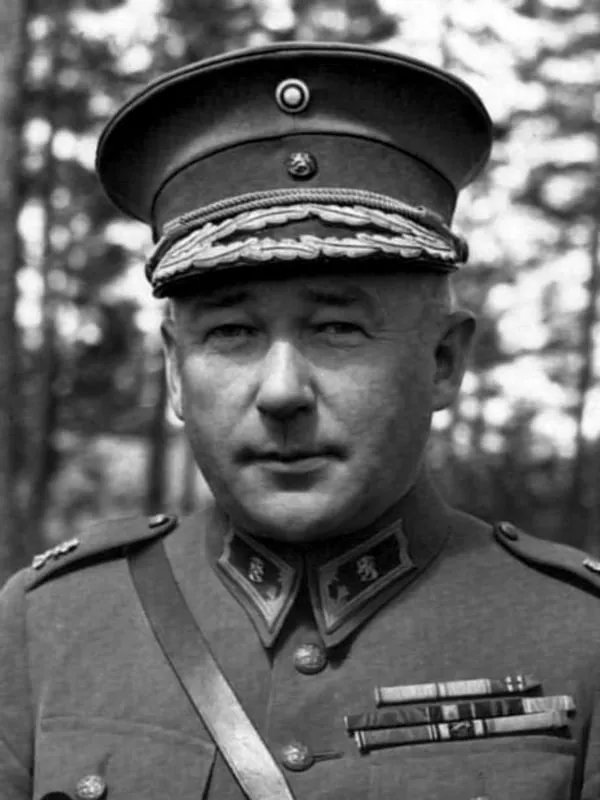
- Born:
- 18 March 1892, Helsinki (Grand Duchy of Finland, Russian Empire)
- Died:
- 11 January 1947, Oulu (Finland)
- Author:
- Łukasz
- Photo:
- autor nieznany, domena publiczna, Wikimedia Commons

Hjalmar Siilasvuo, until 1936 Hjalmar Strömberg, fought in five wars: in the First World War in the German army, in the Finnish Civil War, in the Winter War, in the Continuation War and in the Lapland War. He went down in history as the commander who in December 1939 and January 1940, in the forests of central Finland, destroyed two Soviet divisions in the Battle of Suomussalmi. That victory, made famous by foreign correspondents, turned him into one of the heroes of the Winter War and convinced the world that the Red Army was not invincible. In 1941–1942 Siilasvuo commanded a Finnish corps subordinated to the Germans in East Karelia, and in the autumn of 1944 he led the troops that drove the Germans out of Lapland. He was an able, brave and hot-tempered commander who could not abide desk work and often quarrelled with his superiors.
Youth and the Jägers
He was born on 18 March 1892 in Helsinki into the Swedish-speaking family of Frans Strömberg, a teacher and journalist, and Hulda, née Röman. His father died soon after his son’s birth and his mother in 1904. The twelve-year-old orphan was taken in by relatives, who sent him to the Swedish-language normal lyceum in Helsinki. After finishing school in 1911 he began to study law at the University of Helsinki.
Finland was then a grand duchy within the Russian Empire, and the policy of Russification provoked ever stronger resistance. After the outbreak of the First World War some young Finns decided to exploit Russia’s war with Germany to train the cadres of a future army of an independent state. In March 1915 Strömberg secretly travelled to Germany and on 23 March reported to the camp at Lockstedt in Holstein, where a secret military course for Finnish volunteers was under way. These volunteers were formed into the Royal Prussian 27th Jäger Battalion. Strömberg rose to section leader and fought against the Russians on the Eastern Front in Courland, on the Gulf of Riga and on the river Aa (Lielupe) in Latvia. The Jägers, nearly two thousand volunteers, later became the core of the Finnish army’s officer corps. All the regimental commanders under Siilasvuo at Suomussalmi were also former Jägers.
The Civil War and the interwar years
On 25 February 1918 Strömberg returned by ship to Vaasa with the main body of the Jägers. The Civil War was raging, and the White government welcomed the Jägers with open arms, as it needed trained officers. As a captain Strömberg commanded a company, and from the end of April a Jäger battalion, fighting among other places at Tampere and Viipuri (Vyborg). After the war he commanded a battalion in Hamina. There he met the pharmacist Salli Kolsi, whom he married in 1920. They had three children. Their eldest son, Ensio Siilasvuo, became a general and commander of the UN peacekeeping forces in the Middle East.
In 1924–1926 Strömberg completed the War College, was promoted to lieutenant colonel and in 1927 was posted to the Ministry of Defence. He loathed desk work. In July 1928 he took command of the 1st Bicycle Battalion at Terijoki on the Karelian Isthmus, right on the Soviet border. Within five years he turned a notorious battalion, rife with drunkenness and the bullying of recruits, into an elite unit. On his initiative an officers’ club was built at Terijoki, which in December 1939, after the Red Army took the town, became the seat of Otto Kuusinen’s puppet government of the Finnish Democratic Republic.
In 1933 he was promoted to colonel and given command of the Savo Jäger Regiment, and in 1934 he became commander of the North Ostrobothnia Military District in Oulu. He grew attached to the town and in 1937–1940 sat on its council. In February 1936, during a wave of Fennicisation of Swedish surnames, he changed his name to the Finnish Siilasvuo, reportedly after place names by Lake Kilpisjärvi in Lapland, where he went on skiing expeditions.
Suomussalmi
In the autumn of 1939, during the “extraordinary reserve exercises” – in effect a concealed mobilisation – the 9th Division, commanded by Siilasvuo, was formed in Oulu from reservists of northern Finland. It was the reserve of the Commander-in-Chief, Marshal Carl Gustaf Emil Mannerheim. When the Soviet Union attacked Finland on 30 November, it turned out that the Finnish command had misjudged the enemy’s intentions: the Red Army struck not only on the Karelian Isthmus but also in central Finland, aiming to reach Oulu and cut the country in two at its narrowest point. The Soviet 163rd Rifle Division was approaching Suomussalmi, while the 54th Division was advancing on Kuhmo. Siilasvuo’s division was split up: one regiment went to Kuhmo, while a brigade built around the 27th Infantry Regiment, with Siilasvuo at its head, set off by rail towards Suomussalmi on 7 December. General Wiljo Tuompo, commander of the North Finland Group, ordered him to defeat the enemy that had broken into Suomussalmi. On the evening of 8 December Siilasvuo took command in the area. At the start of the Battle of Suomussalmi he had fewer than five thousand men, with no artillery or anti-tank guns, facing a division several times larger.
Siilasvuo did not attack the village head-on. On 11 December his men, moving on skis through the forest, cut the road from Raate east of Suomussalmi, along which the 163rd Division received its supplies, and then, on an isthmus between lakes, blocked the Soviet 44th Division coming up the same road. After two weeks of fighting for the ruins of the village the brigade received reinforcements and was reorganised as the 9th Division. On 27 December Siilasvuo launched a general attack and within a few days destroyed the 163rd Division, whose remnants fled across the ice of Lake Kiantajärvi. From 1 to 8 January 1940 his troops cut the 44th Division into pockets (motti) and annihilated it in the Battle of the Raate Road. According to Finnish estimates the Red Army lost more than 20,000 men killed, frozen to death or taken prisoner at Suomussalmi and on the Raate road. More recent research based on Soviet documents gives lower losses for the 163rd Division, most of whose soldiers managed to withdraw. The 9th Division lost about 900 killed and 1,200 wounded. The Finns captured dozens of tanks and guns, hundreds of lorries and more than a thousand horses. On 8 January Siilasvuo showed the spoils to a group of foreign journalists, who made Suomussalmi a symbol of Finnish resistance.
In the second half of January the 9th Division was moved to Kuhmo. In the last days of the month Siilasvuo attacked the Soviet 54th Division there, cut it off from its rear and split it into several pockets. This time the encircled troops, supplied from the air, defended themselves fiercely, and attempts to relieve them, including one by a ski brigade, ended in disaster. The fighting went on until the last day of the war, 13 March 1940. Siilasvuo later claimed that had peace been concluded a few days later, he would have destroyed the entire division.
After the war he described his battles in the book Suomussalmen taistelut (The Battles of Suomussalmi), which sold tens of thousands of copies in 1940. The Finnish historian Mikko Uola accused him of claiming all the credit in it for himself, passing over the role of his superiors, General Tuompo and Lieutenant Colonel Paavo Susitaival, and of his subordinates, among whom the staff officer Captain Alpo Marttinen stood out. In 1940 Siilasvuo was promoted to major general and given command of V Corps.
The Continuation War
During the preparations for war with the Soviet Union in 1941, Finland agreed that in the north its troops would be placed under General Nikolaus von Falkenhorst’s German Army of Norway. Siilasvuo’s corps, renamed III Corps, passed under German command on 15 June 1941. As part of Operation Silberfuchs it was to push through East Karelia to the Murmansk Railway, cut it and reach the White Sea. In the Continuation War III Corps was the only formation of the Army of Norway to make significant progress, but in the trackless taiga, with its strength dwindling, it failed to reach its objective. At Kiestinki a Finnish regiment commanded by Jussi Turtola was encircled and suffered heavy losses, and Turtola himself was killed. It was then that the soldiers nicknamed their commander “Bloody Jalmari”.
In the autumn of 1941, under German pressure, Siilasvuo launched an attack on Louhi station on the Murmansk Railway. At this point politics intervened. The United States warned Finland that cutting the line along which Allied aid flowed to the Soviet Union would force it to change its policy towards Helsinki. Mannerheim, who could not issue orders to a corps under German command, gave Siilasvuo to understand that the attack should be halted. Siilasvuo slowed it down for several days, and on 17 November issued a written order to break off the attack, without giving the Germans the real reasons. Relations with the ally deteriorated badly as a result.
In July 1942 Siilasvuo was promoted to lieutenant general, but at the end of the year Mannerheim recalled him from the front and appointed him Inspector of Military Schools in Helsinki. Siilasvuo regarded this as a punishment. In February 1944, when the Finnish command was expecting a great Soviet offensive, he got III Corps back, this time on the eastern part of the Karelian Isthmus, by Lake Ladoga. When the Red Army struck the Isthmus in June 1944, his corps withdrew to the line of the river Vuoksi and held it until the end of the fighting. On 4 September 1944 Finland ceased fire, and on 19 September it signed the armistice in Moscow.
The Lapland War
The armistice obliged Finland to disarm or expel the more than 200,000 German soldiers stationed in Lapland. President Mannerheim entrusted this task to Siilasvuo, who knew the north and the German way of thinking, and who at the same time was neither one of the pro-German generals nor one of those reluctant to fight their former comrades-in-arms. At first the Finns and the Germans, by tacit agreement, waged a kind of sham war: the Germans withdrew northwards and the Finns followed without attacking. The Soviet Control Commission, however, threatened to intervene. On 1 October 1944 Siilasvuo carried out a daring landing at Tornio, in the German rear, against the prohibition of General Headquarters, which believed that the plan for a landing at Kemi had been betrayed. The soldiers sailed from Oulu in unarmed merchant ships without an escort, but the landing succeeded.
The Lapland War proved brutal. The retreating troops of General Lothar Rendulic burned towns and villages, including almost the whole of Rovaniemi, and mined the roads. Mannerheim, under pressure from the Control Commission, was dissatisfied with the pace of operations and on 19 October placed General Harald Öhquist over Siilasvuo. The offended Siilasvuo asked to be relieved, but the decision was soon reversed and he remained in post. The last battles were fought by his young 1st Division, made up of conscripts, since the experienced soldiers were being demobilised under the armistice. The last Germans left Finland on 27 April 1945. On 21 December 1944 Siilasvuo received the Mannerheim Cross, Second Class, Finland’s highest military decoration, for his services in three wars.
Final years
After the war he commanded the 1st Division in Oulu. He gave evidence at the trial of the Finnish politicians accused of responsibility for the war of 1941. Asked about his cooperation with the Germans, he said that in June 1941 his troops had stood at least ten kilometres from the border, ready for defence, and that it was the Germans who had sent them into the attack. He wrote a second book on the Winter War, Kuhmo talvisodassa (Kuhmo in the Winter War). He died at his home in Oulu during the night of 11 January 1947, aged 54, and was buried in the Oulu cemetery.
Significance
Siilasvuo was a typical member of the Jäger generation that built the army of independent Finland and led it through the wars of 1939–1945. The Battle of Suomussalmi became a textbook example of how a small, mobile army, well trained for fighting in the winter forest, can defeat an opponent with enormous superiority in numbers and equipment, and it is still studied at military academies today. Its renown also had political consequences. The Red Army’s defeats in the Finnish forests strengthened Adolf Hitler’s conviction that the Soviet Union could be quickly defeated.
Siilasvuo’s career also reflects the tangled fortunes of Finland in the Second World War. Within five years the same commander defended his country against the Soviet Union, fought alongside Germany and drove the Germans from Finnish soil. In Finland he is remembered above all as the hero of Suomussalmi and the Raate road. Historians also point to his hot temper and his tendency to take credit for his subordinates’ achievements. They stress, too, that it was he who in November 1941 halted the attack on the Murmansk Railway, which helped Finland avoid a break in relations with the United States.
Sources
Commanded in battles
(01)Mentioned in battles
(02)Often appears with
People who appear in the same events.