Soviet Union
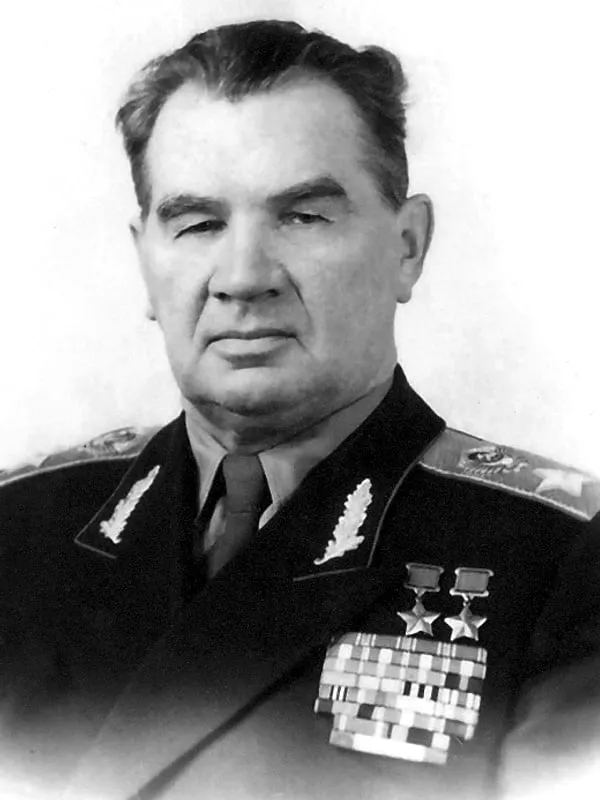
Vasily Chuikov
Commander of the 62nd (8th Guards) Army (1942–1946), Commander-in-Chief of Soviet forces in Germany (1949–1953), Marshal of the Soviet Union (from 1955)
- Born:
- 12 February 1900, Serebryanye Prudy, Tula Governorate (Russian Empire)
- Died:
- 18 March 1982, Moscow (USSR)
- Author:
- Natalia
- Photo:
- Министерство обороны СССР, CC BY 4.0, Wikimedia Commons

Vasily Chuikov was a commander whose name became bound up for ever with Stalingrad. A peasant’s son from near Tula, a regimental commander at the age of nineteen in the Civil War and an expert on China between the wars, in 1939 he led one of the armies that occupied eastern Poland, and in the Winter War he took over an army shattered by the Finns. For more than a year he was the chief Soviet military adviser to Chiang Kai-shek. In September 1942 he took command of the 62nd Army, which defended Stalingrad itself, and held on with it in the ruins on the Volga until Friedrich Paulus’s 6th Army was encircled. With the same army, renamed the 8th Guards Army, he went on through Ukraine and Poland to Berlin, where the garrison of the Reich capital surrendered at his headquarters. After the war he commanded the Soviet forces in Germany, became a Marshal of the Soviet Union and built up Soviet civil defence. To some he was the symbol of unbending defence, to others a commander who had no regard for the lives of his own soldiers. Both images rest on fact.
From Serebryanye Prudy to Kronstadt
He was born on 12 February 1900 (31 January in the Julian calendar) in the village of Serebryanye Prudy in Tula Governorate, into a large peasant family. He was the eighth of twelve children. He completed four years at a parish school and at the age of twelve went to Petersburg to find work, where he was apprenticed in a workshop making spurs for cavalry officers. In 1917 he served as a ship’s boy in a mine detachment at Kronstadt. He lived through the revolution among the Baltic sailors, a milieu that produced many later Bolshevik commanders. All his brothers became soldiers and fought in the Civil War.
The Civil War
He joined the Red Army in the spring of 1918 as a cadet on the Moscow instructors’ courses. In July that year he took part in suppressing the revolt of the Left Socialist Revolutionaries in Moscow, and in the autumn he fought on the Southern Front as a deputy company commander and then deputy regimental commander. In May 1919 he joined the Bolshevik Party. In the same month, at the age of nineteen, he replaced a wounded commander on the battlefield and until the end of 1921 commanded the regiment, later renamed the 43rd Rifle Regiment of the 5th Division. He fought against the forces of Admiral Alexander Kolchak in the Urals and western Siberia, as part of the 5th Army commanded by Mikhail Tukhachevsky.
In 1920 his regiment was transferred to the Western Front, for the war with Poland. He fought around Lepel, Lida and Vileyka. He was wounded four times in the Civil War. One of these wounds, received in 1920, left a fragment in his left arm that could not be removed. It troubled him all his life and, according to his biographers, contributed to the infection that led to his death sixty years later. For the Civil War he received two Orders of the Red Banner and a weapon of honour.
An orientalist in uniform
In 1925 Chuikov graduated from the Frunze Military Academy, and in 1927 from its eastern faculty, where he studied Chinese and the history of the Far East. In 1926, under cover as a diplomatic courier, he made his first journey to China: through Harbin, Mukden and Dairen to Tientsin and Beijing. From 1928 he was a military adviser in China; he came to know the country, its politics and its army, and learned to speak Chinese fluently. When the Sino-Soviet conflict over the Chinese Eastern Railway broke out in 1929, he was posted to the staff of Vasily Blyukher’s Special Far Eastern Army, where he worked in intelligence and took part in the talks on the surrender of the Chinese forces in Manchuria.
In the 1930s he ran refresher courses for intelligence officers, completed courses at the academy of mechanised forces and moved on to commanding troops. From December 1936 he commanded a mechanised brigade near Bobruisk, from 1938 a rifle corps and then the Bobruisk Army Group in the Belorussian Military District. The Great Purge, which decimated the Red Army’s officer corps, opened the way to rapid promotion for men like him: in less than a year he became a kombrig, a komdiv and a komkor.
Poland and Finland
In September 1939 his army group was turned into the 4th Army, which during the Soviet invasion of Poland advanced through Baranowicze and Prużana on Brest. It was his subordinates of Kombrig Semyon Krivoshein’s 29th Light Tank Brigade who met the German forces and took over Brest from Heinz Guderian’s corps.
In December 1939 Chuikov was sent to Karelia, where the Soviet 9th Army was suffering disaster in the Winter War. He replaced Komkor Mikhail Dukhanov, recalled after the destruction of the 163rd Rifle Division at Suomussalmi. He could no longer save the situation. At the beginning of January 1940 the Finns destroyed the 44th Division on the Raate road as it was coming to the rescue; its commander was shot after the defeat. Chuikov, who had ordered the division to hold its ground and wait for reinforcements, kept his post. In the spring of 1940 he returned to command the 4th Army, and in June he became a lieutenant general.
Adviser to Chiang Kai-shek
In December 1940 Chuikov became military attaché in China and chief military adviser to Chiang Kai-shek in Chongqing. According to his memoirs, before he left Joseph Stalin and Semyon Timoshenko instructed him to do everything possible to keep China fighting Japan and tying down the Japanese army, so that it could not strike at the USSR. Chuikov brought with him large deliveries of Soviet arms for the Kuomintang forces. Soon after his arrival, in January 1941, government troops destroyed the Communist New Fourth Army in the Southern Anhui Incident. Mao Zedong later reproached the Soviet adviser for failing to restrain Chiang. Chuikov, however, following Stalin’s instructions, went on supporting the Chongqing government, even after the Soviet–Japanese Neutrality Pact of April 1941, which was received with bitterness in China. After Germany attacked the USSR he repeatedly asked to be recalled to the front. In March 1942 he returned home. Late in life he described his Chinese experiences in his memoir Mission to China.
Stalingrad
After his return from China Chuikov took command in May 1942 of the 1st Reserve Army, then forming near Tula, which in July was renamed the 64th Army and sent to the newly created Stalingrad Front. From 22 July the army fought in the great bend of the Don. Chuikov commanded it – according to some sources as acting commander – until on 4 August the front commander, Lieutenant General Vasily Gordov, relieved him of the post and gave him an operational group on the army’s flank. His career seemed to have stalled.
At the beginning of September the German 6th Army and 4th Panzer Army reached the city itself, while the 62nd Army defending it was shattered and demoralised, and its commander believed that Stalingrad could not be held. On 11 September the front commander, Colonel General Andrei Yeremenko, and the member of the military council Nikita Khrushchev entrusted the 62nd Army to Chuikov. He formally took command on 12 September, on the eve of the first great assault on the city. According to his memoirs, he declared at the time that he would defend the city or die there.
For the next five months he commanded the army in the Battle of Stalingrad, amid the ruins, on a narrow strip of land along the Volga, supplied by night across the river. He kept his command post close to the front line, in dugouts and tunnels, often under fire. At the beginning of October his command post nearly burned down when German bombs hit nearby oil tanks. He kept the army in line by methods that were brutal even by the standards of the Red Army: he himself related that in the first days he had several commanders and commissars who had abandoned their positions shot. At the same time he learned fast how to fight in a city. He ordered his troops to stay as close as possible to the enemy, within grenade-throwing distance, so that the German air force and artillery could not strike without endangering their own men. He defended individual buildings and factory halls, counter-attacked at night and attacked with small assault groups. The most famous episodes of the battle are linked with these methods: the fighting for Mamayev Kurgan, Pavlov’s House, the Tractor Factory, the Barrikady works and the Red October steelworks.
By mid-November the Germans held most of the city but had failed to push the 62nd Army into the Volga. It tied down the forces of the 6th Army while the Stavka was preparing Operation Uranus, of which, as Chuikov himself admitted, he had not been forewarned. After Paulus was encircled, his army went over to the attack in the ruins and fought on until the last Germans surrendered on 2 February 1943. For Stalingrad Chuikov was recommended for the title of Hero of the Soviet Union, but in the end received the Order of Suvorov, 1st Class.
From the Dnieper to Berlin
In April 1943 the 62nd Army was granted Guards status for the defence of Stalingrad and became the 8th Guards Army (PL). Chuikov commanded it until the end of the war. In the summer and autumn of 1943 he fought in the Donbas and on the Dnieper; in October his army took Zaporizhzhia, and at the end of that month he became a colonel general. In 1944 he fought in right-bank Ukraine, in the battles for Nikopol, Kryvyi Rih and Odessa. In March 1944 he received his first title of Hero of the Soviet Union.
In the summer of 1944 the 8th Guards Army became part of the 1st Belorussian Front under Marshal Konstantin Rokossovsky. In the Lublin–Brest offensive his troops crossed the Bug, took part in the capture of Lublin and were among the first to enter the camp at Majdanek. At the beginning of August his divisions forced the Vistula at Magnuszew and established the Warka–Magnuszew bridgehead (PL), which they held despite strong German counter-attacks. It was from this bridgehead that the Vistula–Oder offensive was launched in January 1945. On 19 January Chuikov’s army took Łódź and then surrounded Poznań. The assault on the Poznań fortress, entrusted to Chuikov personally, lasted a month and ended on 23 February 1945 with the capture of the citadel. In April he received his second title of Hero of the Soviet Union.
In the Berlin offensive the 8th Guards Army attacked along the main axis of the 1st Belorussian Front, now commanded by Georgy Zhukov. On 16 April it struck from the bridgehead at Kostrzyn (Küstrin) at the Seelow Heights, where for several days it bled itself white attacking the strong German defences. Its divisions then fought in Berlin, drawing on their experience of Stalingrad. On the night of 30 April–1 May the Chief of the Army General Staff, General Hans Krebs, sent by Joseph Goebbels, arrived at Chuikov’s command post under a white flag. From him Chuikov became the first Allied commander to learn of Adolf Hitler’s suicide. Krebs tried to negotiate a ceasefire. Chuikov, after consulting Zhukov and Moscow, demanded unconditional surrender. On 2 May 1945, at his headquarters, the commander of the defence of Berlin, General Helmuth Weidling, signed the order for the garrison to surrender.
In Germany and in Moscow
After the war Chuikov stayed in Germany. Until 1946 he commanded the 8th Guards Army and headed the Soviet Military Administration in Thuringia; he was then deputy commander-in-chief of Soviet forces in Germany and, during the Berlin Blockade of 1948–1949, one of the most important Soviet soldiers in the country. In March 1949 he became Commander-in-Chief of the Group of Soviet Forces in Germany, and from October that year, after the creation of the GDR, also chairman of the Soviet Control Commission, which supervised the new state. After Stalin’s death, in May 1953, he was moved to command the Kiev Military District (PL). On 11 March 1955 he became a Marshal of the Soviet Union.
In 1960–1964 he was Commander-in-Chief of the Ground Forces and a deputy minister of defence of the USSR, and from 1961 to 1972 the first head of the USSR’s civil defence, which he built up with nuclear war in mind. From 1961 until his death he was a member of the Central Committee of the CPSU. In 1969 he led the Soviet delegation to the funeral of Dwight Eisenhower. He spent his last years as an inspector general in the Ministry of Defence.
He wrote a great deal. His memoirs of Stalingrad, Berlin and China are among the most important accounts by Soviet commanders, although – like all memoirs of the period – they must be read with caution. In the 1960s he provoked a loud dispute with Zhukov by claiming that the Red Army could have taken Berlin as early as February 1945 had the offensive not been halted on the Oder. Zhukov and most historians considered this unrealistic, because the front’s flanks were exposed at the time and the troops were exhausted.
Death and memory
Vasily Chuikov died in Moscow on 18 March 1982. In accordance with his wishes he was buried not in Moscow but in Volgograd, on Mamayev Kurgan, at the foot of the monument “The Motherland Calls”, on whose design he had advised, beside the soldiers of his army who fell in the battle. He was an honorary citizen of Volgograd and of Berlin; he was stripped of the latter title in 1992, as were many Soviet commanders.
In Russia he has remained the symbol of the defence of Stalingrad and one of the best-known commanders of the war. Historians value his tactical sense, especially in urban fighting – methods worked out on the Volga that he later used in Poznań and Berlin – and his presence in the front line. They also point to the price of his victories: orders that sent whole subunits to their deaths, the executions of his own soldiers and the enormous losses of the 62nd Army, which for five months lived on replacements ferried across the Volga. Stalingrad, which he defended, became the turning point of the war in the east and the start of the road that led the Red Army, and Chuikov with it, to Berlin.
Sources
Commanded in battles
(04)Mentioned in battles
(07)Often appears with
People who appear in the same events.
On the timeline
(34)1939
1940
1942
1943
1944
1945
January
February
March
April
May
- 02
- The flag over the ReichstagOn 2 May 1945 the German garrison of the Reichstag surrendered. The red banner had flown on the roof since 30 April; Khaldei's famous photograph was staged.
- Key eventThe surrender of BerlinOn 2 May 1945 General Helmuth Weidling surrendered Berlin to General Chuikov and ordered the garrison to lay down arms. Krebs's talks the day before had failed.
- The breakout from the bunkerOn the night of 1–2 May 1945 the occupants of Hitler's bunker tried to break out of Berlin. Krebs and Burgdorf shot themselves; Bormann died while fleeing.