Soviet Union
Kliment Voroshilov
People's Commissar for Military and Naval Affairs (1925–1934) and for Defence of the USSR (1934–1940), Marshal of the Soviet Union (from 1935), member of the Politburo (1926–1960), Chairman of the Presidium of the Supreme Soviet of the USSR (1953–1960)
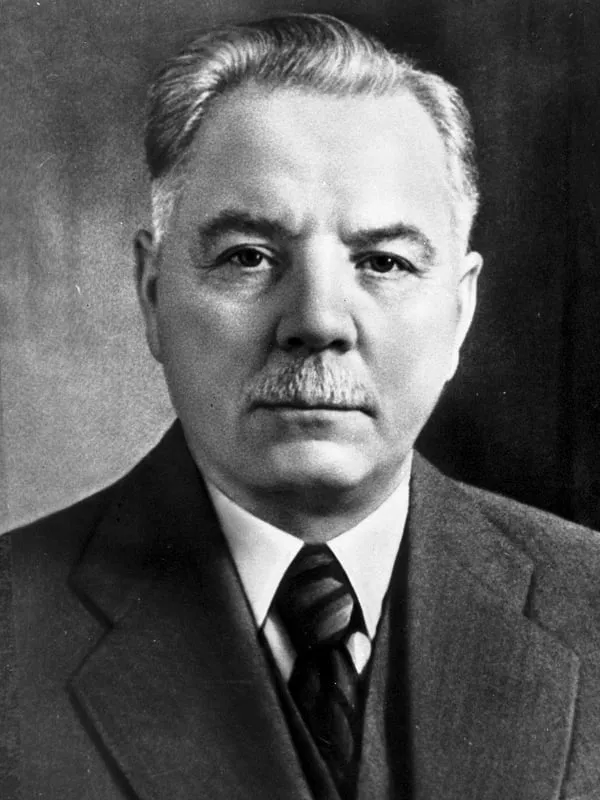
- Born:
- 4 February 1881, Verkhnye, Yekaterinoslav Governorate (Russian Empire)
- Died:
- 2 December 1969, Moscow (USSR)
- Author:
- Natalia
- Photo:
- Anefo, CC0, Wikimedia Commons

Kliment Voroshilov was Joseph Stalin’s closest military associate and the longest-serving head of the Soviet war ministry. The son of a Donbas labourer, a fitter and Bolshevik agitator, he met Stalin in 1906, and in 1918 he defended Tsaritsyn on the Volga at his side. From then on his career was bound up with Stalin’s. From 1925 to 1940 he headed the Red Army, first as People’s Commissar for Military and Naval Affairs and then as People’s Commissar for Defence. He was a faithful executor of the dictator’s will: he helped him push Trotsky out of the army, extolled him as the great commander of the Civil War, and in 1937–1938 was one of the leaders of the Great Purge, which cost the army most of its commanders. In August 1939 he conducted the military talks with the British and French that preceded the Molotov–Ribbentrop Pact; in September he prepared the invasion of Poland; and in March 1940 he signed the decision to murder the Polish prisoners of war at Katyn. He lost his post as Commissar for Defence over the Red Army’s defeats in Finland, and in 1941 he failed to prevent the encirclement of Leningrad. Even so, he outlasted everyone: after Stalin’s death he was the formal head of the Soviet state, and he died in 1969 as a twice-decorated Hero of the Soviet Union.
A worker from the Donbas
He was born on 4 February 1881 (23 January by the Julian calendar) in the village of Verkhnye in the Bakhmut district of Yekaterinoslav Governorate, today within the town of Lysychansk in Ukraine. His father, Yefrem, was a railwayman and miner, often out of work, and his mother, Maria, took whatever casual jobs she could find. In his memoirs Voroshilov wrote of his family’s Russian origins; according to some historians, his ancestors bore the Ukrainian surname Voroshylo. From the age of six or seven he herded cattle and gathered coal at the mines. He learned to read and write only at twelve, at a two-year village school.
From 1896 he worked at a steelworks, and in 1899 he led his first strike, for which he was dismissed. In 1903 he took a job at a German locomotive works in Luhansk and joined the Russian Social Democratic Labour Party, on the Bolshevik side. During the Revolution of 1905 he organised strikes and workers’ combat squads. In 1906 he travelled as a delegate to the party congress in Stockholm, where he shared a room with a Georgian delegate, Iosif Dzhugashvili – the future Stalin. A year later he attended the congress in London. Arrested and exiled several times, including to Arkhangelsk Governorate, he worked underground in Baku, St Petersburg and Tsaritsyn. In exile he met Golda Gorbman, a Jewish woman from Ukraine, who converted to Orthodoxy and took the name Yekaterina in order to marry him. They had no children of their own. They brought up an adopted son, Pyotr, and after the death of Mikhail Frunze in 1925 they also raised Frunze’s children.
Tsaritsyn and the Konarmia
The February Revolution found him in Petrograd. He soon returned to Luhansk, where he became head of the local soviet and was elected to the Constituent Assembly. After the October coup, in the spring of 1918, he commanded the 5th Ukrainian Army, a ramshackle collection of Red units that retreated from the Donbas before the advancing Germans in a long and perilous march all the way to the Volga. In Tsaritsyn, today’s Volgograd, he took command of the 10th Army. The commissar representing the central authorities there was Stalin. Together, in the summer and autumn of 1918, they directed the defence of the city against Ataman Krasnov’s Don Cossacks and supported the formation of large Red cavalry formations, headed by Semyon Budyonny.
At Tsaritsyn Voroshilov and Stalin openly disregarded the orders of the People’s Commissar for War, Leon Trotsky, and opposed the enlistment of former Tsarist officers – the so-called “military specialists” – into the Red Army. Trotsky regarded Voroshilov as an undisciplined amateur, threatened him with a court martial and in December 1918 had him recalled; his successor at the head of the 10th Army was Alexander Yegorov. The conflict bound Voroshilov and Stalin together for life and set both of them permanently against Trotsky. In 1919 Voroshilov was a member of the government of Soviet Ukraine, commanded the troops of the Kharkiv district and the 14th Army, and suppressed the revolt of Ataman Hryhoriv and peasant uprisings.
In November 1919 he helped create Budyonny’s First Cavalry Army and, as a member of its revolutionary military council – in effect its chief political commissar – went through its campaigns against Denikin’s forces and, in 1920, against the Poles. In the Polish–Soviet War the Konarmia broke through the front in Ukraine in June and took Zhytomyr, but in August, instead of supporting Mikhail Tukhachevsky’s advance on Warsaw, it became bogged down in fighting around Lwów (Lviv), and on 31 August it was defeated at the Battle of Komarów. The dispute over who was to blame weighed on Tukhachevsky’s relations with Voroshilov, Budyonny and Stalin for the next seventeen years. In March 1921 Voroshilov was one of the delegates to the Tenth Party Congress who went to Kronstadt to raise the morale of the troops storming the fortress of the mutinous sailors (the Kronstadt rebellion).
At the head of the Red Army
In 1921–1924 he commanded the North Caucasus and then the Moscow Military District. When the People’s Commissar for Military and Naval Affairs, Mikhail Frunze, died on the operating table in October 1925, Stalin pushed through Voroshilov’s appointment in his place. On 6 November 1925 Voroshilov took over the commissariat and the chairmanship of the Revolutionary Military Council of the USSR. He headed the war ministry for almost fifteen years, longer than anyone else in the history of the USSR. In 1926 he joined the party’s Politburo and remained in it, through its successive changes of name, until 1960.
He was above all a politician and Stalin’s man rather than a military theorist. He backed Stalin in the struggle against Trotsky, Grigory Zinoviev and Lev Kamenev, and later against Bukharin’s “Right Deviation”. For the dictator’s fiftieth birthday in 1929 he wrote an article, “Stalin and the Red Army”, which credited Stalin with the decisive role in victory in the Civil War and became the foundation of the official legend. He became the object of a cult himself: towns, academies and ships were named after him, and in 1935 his home town of Luhansk was renamed Voroshilovgrad.
As commissar he oversaw the expansion of the army during industrialisation. Under his leadership the Red Army received thousands of tanks and aircraft, moved from a system of territorial militias to a regular cadre army, and relocated some of its arms factories to the east. Voroshilov, however, remained wedded to the experience of the Civil War and to the cavalry. He viewed with distaste the ideas of Tukhachevsky, who wanted to build a mechanised army on a vast scale, while Tukhachevsky and his supporters regarded the commissar as a dilettante. In June 1934 the commissariat was renamed the People’s Commissariat for Defence. On 20 November 1935 Voroshilov became one of the first five Marshals of the Soviet Union, alongside Tukhachevsky, Budyonny, Yegorov and Vasily Blyukher.
The Great Purge
Voroshilov was one of the chief executors of the terror of 1936–1938. In August 1936, during the first Moscow trial, the defendants were accused among other things of plotting to assassinate him, and he himself was one of the Politburo members who ordered that the condemned men’s pleas for clemency be rejected and the sentences carried out at once. At the Central Committee plenum of March 1937 he denounced Bukharin and Rykov as “renegades”. According to researchers’ findings, his signature appears on 185 lists of people marked out for sentencing, on the basis of which more than 18,000 people were shot. Only Stalin, Vyacheslav Molotov and Lazar Kaganovich signed more such lists.
The army was hit hardest. On a list of 26 commanders sent over by the NKVD in May 1937, Voroshilov wrote to Nikolai Yezhov: “Take all the scoundrels.” According to some accounts, it was he who at the end of May summoned one of the most outstanding commanders, Iona Yakir, to Moscow, knowing that he would be arrested on the way. On 1 June 1937, at a meeting of the Military Council attached to the Commissar for Defence, he delivered a report on a “military-fascist conspiracy” in the army, and in June Tukhachevsky and seven other commanders were sentenced to death. In 1937–1938 three of the five marshals, most of the commanders of armies, corps and divisions, and tens of thousands of officers were killed or sent to prisons and the Gulag. Voroshilov sometimes saved individual subordinates, but he issued orders that opened the way to arrests and signed his consent to them. After the fighting at Lake Khasan in 1938, the Military Council under his chairmanship accused Blyukher of incompetence and treason. The marshal died in an NKVD prison in November 1938, beaten to death under interrogation.
1939: the Moscow talks and the attack on Poland
When Britain and France sent military missions to Moscow in the summer of 1939, Voroshilov headed the Soviet delegation and had full powers to sign a military convention. The talks opened on 12 August. On 14 August Voroshilov put the question on which everything hinged: would the Red Army, in the event of war, be allowed to pass through Polish and Romanian territory? Józef Beck’s government refused, and the Western delegates had no authority on the matter. On 17 August Voroshilov adjourned the talks, and on 21 August, with Stalin already awaiting Ribbentrop’s arrival, he broke them off indefinitely.
On 31 August 1939 Voroshilov presented the Supreme Soviet with a bill on universal military service, which allowed the army to be greatly enlarged. From the beginning of September a covert mobilisation was under way in the western military districts, and Voroshilov and the Chief of the General Staff, Boris Shaposhnikov, prepared the directives for the Belorussian and Ukrainian Fronts. On 17 September the Red Army entered Poland. Voroshilov was present when, on the night of 16–17 September, Stalin informed the German ambassador of the hour of the attack, and on 20 September he held talks with German officers on the demarcation line (the meeting of German and Soviet troops).
The Winter War
When Finland rejected the Soviet demands, Voroshilov approved the war plan drawn up by the staff of Kirill Meretskov’s Leningrad Military District and on 17 November placed the district on alert. Against the advice of Shaposhnikov, who wanted a carefully prepared operation using the best forces available, the leadership opted for a quick campaign by the district’s own forces, expected to last a few weeks. On 30 November the Red Army attacked Finland. The offensive stalled before the Mannerheim Line on the Karelian Isthmus, while in the north Finnish units encircled and destroyed entire divisions. On 9 December direction of the war passed to the Headquarters of the Main Military Council in Moscow, chaired by Voroshilov, whose members were Stalin, Shaposhnikov and the People’s Commissar of the Navy, Nikolai Kuznetsov. Voroshilov sent out orders and demanded harsh punishment of those responsible for failures.
The defeats of December discredited the Commissar for Defence. According to Nikita Khrushchev’s memoirs, at one dinner at Stalin’s dacha in Kuntsevo the dictator blamed Voroshilov for the losses, whereupon Voroshilov shouted back that Stalin himself was to blame for having the best commanders killed, and smashed a platter of roast meat on the table. In January 1940 command of the forces on the Isthmus was entrusted to Semyon Timoshenko, who broke through the Finnish defences in February. After peace was concluded in March 1940, a conference in April devoted to the lessons of the war exposed embarrassing weaknesses in the army, and on 7 May 1940 Timoshenko replaced Voroshilov as Commissar for Defence. Voroshilov became deputy prime minister and chairman of the Defence Committee attached to the Council of People’s Commissars. He kept his seat in the Politburo and his rank of marshal, but real influence over the army passed into other hands.
Katyn
On 5 March 1940 the Politburo considered a memorandum from the People’s Commissar for Internal Affairs, Lavrentiy Beria, proposing that Polish prisoners of war from the camps at Kozelsk, Starobilsk and Ostashkov, together with prisoners from the western oblasts of Ukraine and Belarus – almost 26,000 people in all – be shot without trial. The proposal was signed by Stalin, Voroshilov, Molotov and Anastas Mikoyan, and Mikhail Kalinin and Kaganovich also voted in favour. According to some accounts, in the autumn of 1939 Voroshilov had been inclined to release some of the prisoners, but in the end he put his name to the decision. On its basis some 22,000 Polish citizens – mostly officers, police officers, officials and members of the intelligentsia – were murdered in the spring of 1940. This Katyn massacre is Voroshilov’s direct responsibility.
The war with Germany
After the German attack on 22 June 1941 Voroshilov joined the State Defence Committee, which assumed all power in the state, and remained a member until November 1944. On 10 July 1941 he took command of the North-Western Direction, and in September of the Leningrad Front. He showed personal courage: during one counter-attack he is said to have led retreating soldiers forward himself. But he had no idea how to command a war of machines. On 8 September the Germans closed the ring of the siege of Leningrad, and a few days later Stalin replaced Voroshilov with Georgy Zhukov.
From then on Voroshilov’s roles were mainly ceremonial and organisational. He served as a representative of the Stavka in the formation of new units and on several fronts, and from September 1942 to May 1943 he was commander-in-chief of the partisan movement. In January 1943 he coordinated the fronts in Operation Iskra, which broke the siege of Leningrad. In November 1943 he accompanied Stalin to the Tehran Conference. He also headed the commission that drew up the terms of Germany’s surrender and of the armistices with its allies.
After the war
In 1945–1947 he chaired the Allied Control Commission in Hungary and from that position helped Mátyás Rákosi’s communists seize power. He attributed the communists’ poor showing in the elections of autumn 1945 partly to the fact that many of their leaders were not ethnically Hungarian – a remark understood as an allusion to the Jewish origins of some of them. From 1946 he was deputy chairman of the Council of Ministers of the USSR. In Stalin’s last years he fell into disfavour: as Khrushchev later revealed, the dictator suspected him of spying for the British and excluded him from the most important meetings.
After Stalin’s death in March 1953 Voroshilov became Chairman of the Presidium of the Supreme Soviet of the USSR – the formal head of state. In June 1953 he backed Beria’s arrest. In June 1957 he sided with the so-called Anti-Party Group of Molotov, Malenkov and Kaganovich, which tried to oust Khrushchev. Unlike the group’s leaders, he was not removed straight away for this, but in May 1960 he had to hand over his office to Leonid Brezhnev; in July he was removed from the Presidium of the Central Committee, and in 1961, after being criticised at the 22nd Congress of the CPSU, he was not re-elected to the Central Committee. After Khrushchev’s fall Brezhnev restored him to favour: in 1966 he again became a member of the Central Committee, and in 1968 he received a second Gold Star of a Hero of the Soviet Union. He died in Moscow on 2 December 1969 at the age of 88 and was buried in an individual grave by the Kremlin Wall.
Significance
Voroshilov was a typical representative of the men to whom Stalin owed his control of the army: loyal comrades from the Civil War, personally brave, adept at party intrigue, but with no training for leading a modern army. His name was borne by the KV heavy tanks, the General Staff Academy and several towns, yet the balance of his fifteen years at the head of the Red Army was tragic for it. As one of the leaders of the Great Purge, he deprived the army of its ablest commanders at the very moment Europe was heading for war. In 1939 he personally linked the three stages of the Soviet Union’s path into the Second World War: the failed talks with the West, the invasion of Poland alongside Germany, and the attack on Finland. The defeats in Finland, for which he bears much of the blame, convinced Hitler that the Red Army was weak, and at the same time forced Stalin into reforms that in 1941 were still under way. For Poles, Voroshilov remains above all one of the four men who signed with their own hands the death sentence on the victims of the Katyn massacre.
Sources
Commanded in battles
(01)Mentioned in battles
(08)Often appears with
People who appear in the same events.
On the timeline
(35)1934
1936
1938
1939
April
August
September
- 28
- The German–Soviet Boundary and Friendship TreatyOn 28 September 1939 Ribbentrop and Molotov signed the Boundary and Friendship Treaty, moving the partition line to the Bug and giving Lithuania to the USSR.
- The Soviet–Estonian Mutual Assistance PactOn 28 September 1939, under threat of war, Estonia signed a mutual assistance pact in Moscow, giving the USSR bases and the right to station 25,000 troops.
November
December
1940
January
- 07
- The destruction of Soviet divisions on the Raate roadIn the first week of January 1940 Colonel Siilasvuo’s Finns cut the Soviet 44th Division into pockets on the Raate road and destroyed it, taking tanks and guns.
- Timoshenko takes command in FinlandOn 7 January 1940 Moscow formed the North-Western Front under Komandarm Timoshenko. After the defeats of December, he was to break the Mannerheim Line.
February
March
April
1941
July
- 03
- Stalin’s speech of 3 JulyOn 3 July 1941, in his first radio address since the German attack, Stalin called for a patriotic war, partisan warfare and scorched earth.
- The Summer War in EstoniaFrom 3 July 1941 the Estonian Forest Brothers attacked Soviet units in the south. The Germans entered Estonia on 7 July and the front halted on the Emajõgi.