United Kingdom
Dudley Pound
First Sea Lord and Chief of the Naval Staff (1939–1943), Admiral of the Fleet
- Born:
- 29 August 1877, Isle of Wight (England)
- Died:
- 21 October 1943, London (United Kingdom)
- Author:
- Łukasz
- Photo:
- Bassano, domena publiczna, Wikimedia Commons

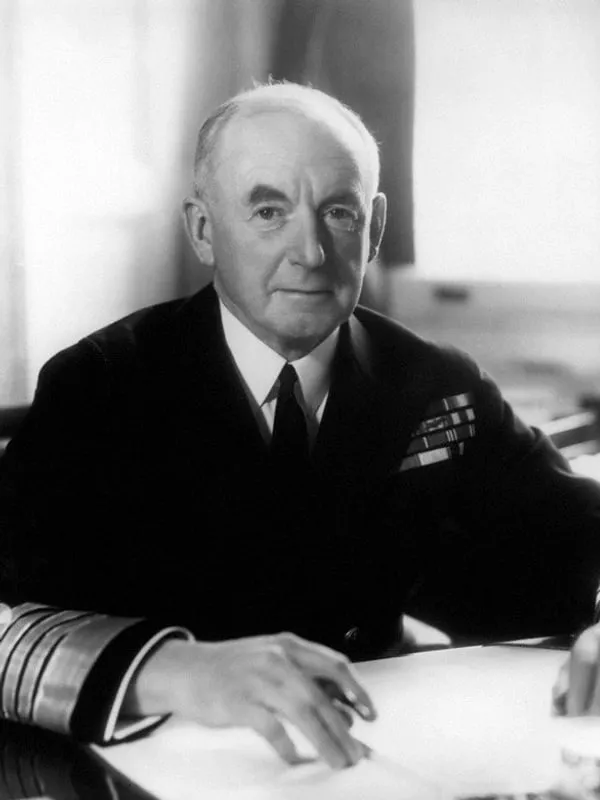
Sir Alfred Dudley Pickman Rogers Pound was the professional head of the British navy in the first and most difficult years of the Second World War. As First Sea Lord and Chief of the Naval Staff from June 1939 to September 1943, he was responsible for all Royal Navy operations, from the struggle against the U-boats in the Atlantic, through the evacuation from Dunkirk, the Mediterranean and the Arctic convoys, to the war against Japan. For most of that time he worked with Winston Churchill, first as First Lord of the Admiralty and then as Prime Minister, and he was one of the few men Churchill trusted enough to give way to them in arguments. His biographer called him “Churchill’s anchor”. Under his tenure the Royal Navy weathered the crises of 1940–1942 and in May 1943 won a decisive victory over the U-boats. Throughout the war, however, Pound was seriously ill, and several of his decisions, above all the order to scatter convoy PQ 17, remain controversial to this day. He died on the anniversary of the Battle of Trafalgar, a few weeks after leaving office.
Torpedo officer
He was born on 29 August 1877 on the Isle of Wight, according to some sources at Ventnor. His father, Alfred John Pound, was an Eton-educated barrister, and his mother, Elizabeth Pickman Rogers, was an American from a Boston family, from whose ancestors his unusually numerous Christian names derived. In January 1891, at the age of thirteen, he joined the navy as a cadet in the training ship HMS Britannia. As a midshipman he served in the battleship HMS Royal Sovereign in the Channel Squadron and in a cruiser on the China Station, and as a sub-lieutenant in, among other ships, a destroyer. In 1898 he was promoted to lieutenant, and in 1901 he completed the course at the torpedo school and became a torpedo specialist, which in those days also meant expertise in shipboard electrics and communications. He was torpedo officer of a cruiser in the Pacific and of battleships of the Atlantic and Mediterranean Fleets, worked in the Admiralty’s Naval Ordnance Department, and in 1909 was promoted to commander. Before the outbreak of the First World War he served on the staff of the Royal Naval War College. In 1908 he married Betty (Bessie) Whitehead, with whom he had two sons and a daughter.
Jutland and the Admiralty
On 31 December 1914 Pound was promoted to captain, and in May 1915 he was given command of the battleship HMS Colossus in the Grand Fleet. At the Battle of Jutland on 31 May 1916 his ship sailed in the battle line of Admiral John Jellicoe. She was hit by two shells but fought well and, according to British accounts, helped to destroy the German cruiser SMS Wiesbaden. In July 1917 Pound returned to the Admiralty, to the Plans Division, and then headed the Operations Division (Home Waters). He took part in preparing the Zeebrugge Raid of April 1918.
After the war Pound followed the typical career of a staff officer. In 1920 he commanded the battlecruiser HMS Repulse, in the 1920s he headed the Admiralty’s Plans Division, and in 1925 he became chief of staff to Admiral Roger Keyes, Commander-in-Chief of the Mediterranean Fleet. In 1926 he was promoted to rear admiral and served as Assistant Chief of the Naval Staff, and in 1929 he took command of the Battlecruiser Squadron, flying his flag in HMS Hood. In 1930 he became a vice admiral, and in 1932 Second Sea Lord, responsible for naval personnel. At the same time the great powers were limiting their fleets by treaty – the London Naval Treaty of 1930 and the Second London Naval Treaty of 1936 – while Britain allowed Germany to rebuild its navy under the naval agreement of 1935.
The Mediterranean
The Abyssinian crisis found him in the Mediterranean. After the Italian invasion of Ethiopia in 1935, Pound, by then a full admiral, became chief of staff to the Commander-in-Chief of the Mediterranean Fleet, Admiral William Fisher – an unusual post for an officer of that rank. The fleet was then preparing for a possible war with Italy. In March 1936 Pound succeeded Fisher in command. For three years he led Britain’s largest fleet during the Spanish Civil War, when British warships evacuated foreigners from Spanish ports and, from 1937, patrolled the Mediterranean against “unknown” submarines – in reality Italian – which were attacking ships bound for Republican Spain. The fleet also supported the British authorities during the Arab revolt in Palestine. Pound had a reputation as a demanding and efficient commander who kept a close eye on the fleet’s training.
First Sea Lord
In the spring of 1939 the First Sea Lord, Admiral Roger Backhouse, fell seriously ill. In June Pound took his place, handing over the Mediterranean Fleet to Admiral Andrew Cunningham. On 31 July 1939 he was promoted to the highest rank, Admiral of the Fleet. Even then he was not in good health: he suffered from a degenerative hip condition that robbed him of sleep, and during the war he was known to fall asleep in meetings. The other candidates, however, were thought to be in even worse shape.
On 3 September 1939, the day of the declaration of war on Germany, Winston Churchill became First Lord of the Admiralty – the navy’s political head – in Chamberlain’s War Cabinet. Churchill bombarded the admirals with ideas and minutes, meddled in the details of operations and wanted to take the offensive. Pound let him talk and rarely opposed him outright, but he knew how to play for time. That was how he scuppered the plan for Operation Catherine – sending a squadron of reconstructed battleships into the Baltic – which Churchill pressed in the autumn of 1939. In the first weeks of the war Pound’s Admiralty introduced convoys and took the sinking of the Athenia as proof that Germany was waging unrestricted submarine warfare. It also suffered its first heavy losses: the sinking of the aircraft carrier HMS Courageous in September and of the battleship HMS Royal Oak at Scapa Flow in October. On 5 October 1939 the Admiralty, in agreement with the French, formed hunting groups to track down the German “pocket battleships”, and in December one of them forced the Admiral Graf Spee to take refuge in Montevideo.
The crises of 1940–1942
During the Norwegian campaign in the spring of 1940 the Admiralty directed operations from London in such detail that commanders at sea, especially the Commander-in-Chief of the Home Fleet, Admiral Charles Forbes, accused Pound of “back-seat driving”. Changes of orders and an unclear division of responsibilities contributed to the defeat in Norway. A few weeks later the navy carried out the successful evacuation from Dunkirk. After the fall of France, Pound supported the Cabinet’s decision to prevent the French fleet from falling into German hands, which on 3 July 1940 led to the bombardment of French warships at Mers-el-Kébir. In the autumn of 1940 he blamed Admiral Dudley North, the commander at Gibraltar, for letting a French squadron bound for Dakar pass through the Strait of Gibraltar, and removed him from his post. The affair dragged on after the war, and North was eventually partly rehabilitated.
In 1941 the Admiralty directed the pursuit of the Bismarck, which ended with her sinking in May, and the evacuation of troops from Greece and Crete, paid for with heavy losses to the fleet. Towards the end of the year Churchill, against the advice of Pound, who preferred to send older battleships to the Far East, forced through the dispatch to Singapore of the new battleship HMS Prince of Wales with the battlecruiser HMS Repulse. Both ships were sunk by Japanese aircraft on 10 December 1941. In February 1942 the German battleships Scharnhorst and Gneisenau broke through from Brest up the English Channel to Germany (Operation Cerberus), which was received in Britain as a humiliation. In March 1942 Pound handed over the chairmanship of the Chiefs of Staff Committee to General Alan Brooke, and in the summer he was given a deputy who took over part of his duties.
The heaviest burden of his tenure was the affair of convoy PQ 17, sailing from Iceland to Archangel with supplies for the Soviet Union. On 4 July 1942 Pound, convinced that the battleship Tirpitz and other heavy ships were closing on the convoy, and despite the doubts of some of his intelligence officers, ordered the covering cruisers to withdraw westwards and the merchant ships to scatter and make for Soviet ports independently. The Tirpitz did not put to sea until the next day and soon turned back, but the unescorted ships became easy prey for U-boats and aircraft. Of the 35 ships that had left Iceland, 24 were sunk (some tallies give 23), and with them thousands of tons of equipment. Many naval officers regarded it as one of the most shameful episodes in the navy’s history.
Victory in the Atlantic and death
Pound’s most important task throughout the war, however, was the Battle of the Atlantic. He understood early on that Britain’s survival depended on protecting its shipping, and he defended the convoy system. He pressed the Cabinet to give Coastal Command long-range aircraft, over which he clashed with RAF Bomber Command, and he backed the development of escorts, radar and codebreaking. In January 1943, at the Casablanca Conference, it was agreed that defeating the U-boats would be the first condition for the further conduct of the war in Europe, and in May 1943 the German submarine fleet suffered a defeat after which Karl Dönitz withdrew it from the North Atlantic.
Pound did not enjoy this victory for long. In July 1943 his wife died. He had already suffered one stroke, and a second, paralysing one struck him in August during the Quebec Conference. It turned out that he had a fast-growing brain tumour, which had probably been affecting his condition for some time. In September he resigned, and Andrew Cunningham succeeded him. He declined a peerage but accepted the Order of Merit, which he received that same month. He died in London on 21 October 1943, the anniversary of the Battle of Trafalgar. After a funeral service in Westminster Abbey he was cremated, and his ashes, together with his wife’s, were scattered at sea in the Solent, close to the island where he was born.
Assessment
Opinions of Pound are divided. His critics, among them the British naval historian Stephen Roskill, reproached him for excessive direction of operations from London, for giving in to Churchill and for decisions that cost the fleet dearly, from Norway to PQ 17. General Brooke recorded critical remarks in his diary about a First Sea Lord who dozed through meetings of the Chiefs of Staff. His defenders, such as his biographer Robin Brodhurst, stress that for four years, while gravely ill, Pound bore responsibility for a navy fighting simultaneously in the Atlantic, the Mediterranean, the Arctic and the Indian Ocean; that he kept Churchill’s trust while talking him out of many dangerous ideas; and that it was under his tenure that the system which won the Battle of the Atlantic took shape. Pound himself shunned publicity, wrote no memoirs and died before the war ended, so his image was shaped mainly by others, Churchill among them in his history of the war.
Sources
Commanded in battles
(01)Mentioned in battles
(03)Often appears with
People who appear in the same events.