Battle of Viipuri (1940)
- Dates:
- 28 February – 13 March 1940
- Front:
- Scandinavia
- Location:
- The north-western part of the Karelian Isthmus – the Finnish rear line from Viipuri (Vyborg) through Tali to the Vuoksi river, the outskirts of Viipuri, the islands and the frozen Bay of Viipuri with its western shore (today Leningrad Oblast, Russia)On the battle map →
- Sides:
- Soviet Union (North-Western Front, 7th and 13th Armies)Semyon Timoshenko, Kirill MeretskovFinland (Army of the Isthmus, II and III Corps, Coastal Group)Carl Gustaf Mannerheim, Erik Heinrichs, Karl Lennart Oesch
- Result:
- Soviet advantage without a decision. The Red Army broke into the outskirts of Viipuri and seized a bridgehead across the Bay of Viipuri, but did not take the city. Viipuri passed to the USSR under the Peace of Moscow.
- Author:
- Łukasz
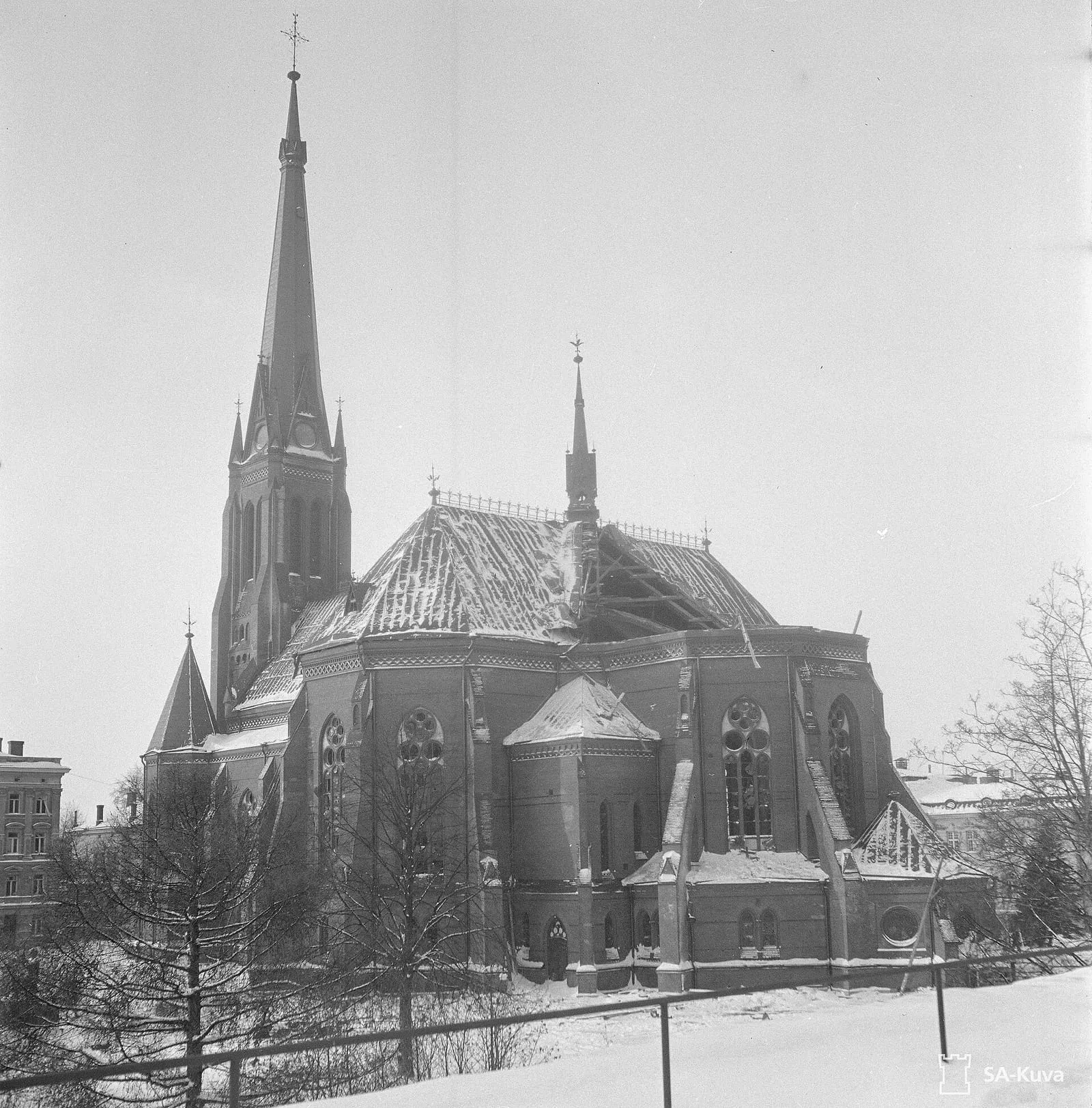
The fighting for Viipuri was the last battle of the Winter War. After the breaking of the Mannerheim Line in February 1940, the Finnish Army of the Isthmus fell back from one position to the next, and on 26 February Komandarm 1st Rank Semyon Timoshenko ordered the capture of Viipuri (Vyborg), one of Finland’s largest cities and the key to the road to Helsinki. On 28 February the Red Army resumed its general offensive along the whole western sector of the Karelian Isthmus. For two weeks Soviet divisions assaulted the outskirts of the city, the Tali isthmus to the east of it and the crossings of the Vuoksi river, while in the west they crossed the thick ice of the Bay of Viipuri and seized a bridgehead on its western shore, cutting the road from Viipuri to Helsinki. Yet the exhausted Finns stopped each of these thrusts before it could turn into a breakthrough. When the peace signed in Moscow came into force at 11 a.m. Finnish time on 13 March, Viipuri was still in Finnish hands. A few days later the Finns had to leave it all the same, because the treaty handed the city to the Soviet Union.
Name and dates
Neither Polish nor Western literature has settled on a single name for this fighting. Russian historiography speaks of the Vyborg operation (Russian Vyborgskaya operatsiya), usually dated 4–13 March 1940, that is, from the Soviet thrust across the Bay of Viipuri to the ceasefire. Finnish historians divide this stage into several battles: for the rear line (Finnish taka-asema) and the city itself (Viipurin taistelu), for Tali, for the Vuoksi crossings at Äyräpää and Vuosalmi, and the Battle of Viipuri Bay (Viipurinlahden taistelu), counted from 2 to 13 March. English-language literature uses the name Battle of Viipuri Bay only for the fighting on the ice of the bay.
The battle is taken to have begun on 28 February 1940. That day, after a two-hour artillery preparation, the Soviet 7th Army resumed its general offensive, and the Finnish II Corps, in accordance with the order issued by Marshal Carl Gustaf Emil Mannerheim on 27 February, began withdrawing from the broken intermediate line to the rear line in front of Viipuri. The same day the Finnish command set up a separate group to defend the shore of the Bay of Viipuri. It ended on 13 March, when the firing stopped at 11 a.m. Finnish time (noon Leningrad time). The fighting for the intermediate line, from 18 to 27 February, forms only the background, since it closed the previous stage of the war.
Background
The Mannerheim Line gave way on 11 February at Lähde near Summa, and on 15 February Mannerheim agreed to the withdrawal of II Corps from the western part of the Isthmus to the intermediate line (Finnish väliasema), which ran from Samolanlahti bay through Lakes Näykkijärvi and Muolaanjärvi to the Vuoksi. On 19 February General Erik Heinrichs took command of the Army of the Isthmus, and Major General Paavo Talvela took over III Corps on the Vuoksi and at Taipale. The intermediate line was shallow and poorly fortified. On 21 February the Red Army broke into it at Näykkijärvi, and over the following days pushed the Finns back step by step. On 27 February Mannerheim permitted a further withdrawal to the rear line, the last prepared line of defence on the Isthmus. It ran from Viipuri through Tali, Noskuanselkä and Kuparsaari to the Vuoksi, and the islands of the Bay of Viipuri became its western extension.
The Soviet plan, set out in Timoshenko’s order of 26 February, provided for taking Viipuri simultaneously from the front and by outflanking it on both sides. The 7th Army of Komandarm 2nd Rank Kirill Meretskov was to strike straight at the city with the 34th and 50th Rifle Corps, outflank it from the east with the 19th Corps, and with the 10th and 28th Corps cross the ice of the bay and come out on the western shore, in the defenders’ rear. The 13th Army, taken over at the beginning of March by Filipp Parusinov after Komandarm 2nd Rank Vladimir Grendal was recalled, was to force the Vuoksi at Äyräpää and Vuosalmi and outflank the Finnish III Corps, which was still holding the eastern part of the Mannerheim Line. From the outlying islands of the Gulf of Finland, Gogland and Lavansaari, Soviet units were to set off across the ice on 4 March towards the Finnish coast near Virolahti and Kotka.
The forces were more unequal than at any earlier point in the war. Against the bled-white Finnish divisions, which had been fighting without a break since December, the North-Western Front threw well over ten rifle divisions and several tank brigades, supported by artillery that could fire without restriction and by an air force that ruled the skies. Viipuri itself already bore the scars of weeks of bombing. According to Finnish figures, thousands of bombs fell on the city during the war, and most of the civilian population had been evacuated before the final assault.
The bay proved the greatest surprise. Finnish coastal defence doctrine assumed that the ice protected the shore from landings, and the defence of the Bay of Viipuri had been prepared with summer in mind. But the winter of 1939–1940 was exceptionally cold, and the ice, almost a metre thick, could bear infantry, guns and light tanks. Until the end of February the islands and the western shore of the bay were held by coastal batteries and a scratch collection of naval reserve battalions, with no field fortifications, no communications and no experience of infantry fighting. General Headquarters saw the danger at the last moment and began rushing troops there, but the command of the sector changed every few days.
The fighting: the withdrawal to the rear line (28 February – 3 March)
The withdrawal from the intermediate line went better than the Finnish command had feared. The Finnish 5th Division broke contact with the enemy on 28 February without much difficulty, leaving behind delaying detachments that fell back through successive lines via Säiniö towards Viipuri. The Soviet divisions at first advanced cautiously, but on 29 February they struck harder at the neighbouring and weak 23rd Division, built up from replacement units, and threatened the flanks of the formations on either side. On 1 and 2 March the Finnish regiments passed through the rear line, and the last delaying detachments were already fighting in the outskirts of Viipuri. According to Russian studies, on 2 March the Soviet 50th Rifle Corps reached the rear line north-east of the city and cut the railway to Antrea (today Kamennogorsk), while the leading units of the 34th Corps came up to the southern outskirts of Viipuri.
The city itself was defended by the Finnish 3rd Division, deployed from Papulanlahti bay to Pappilanniemi, and by the 5th Division to the east of it, from Lake Kärstilänjärvi to the Karjala suburb. On 2 March a Soviet attack pushed a battalion of the 3rd Division back a kilometre south of Huhtiala, and the next day a Finnish counter-attack collapsed after an hour and a half. At the same time, on the night of 2–3 March, the thrust across the bay began.
The fighting: the Bay of Viipuri (2–13 March)
The first objectives were the islands at the entrance to the Bay of Viipuri, above all Tuppura and Teikarsaari. On 2 March Soviet divisions set off across the ice from the long peninsulas on the eastern shore of the bay. The defenders of Tuppura had only part of their heavy equipment and too little ammunition, although the coastal batteries fired their last shells here, and the great 12-inch gun of the Ristiniemi fort at Säkkijärvi fired several dozen rounds in the course of the day. On the night of 2–3 March tanks encircled the island in a ring on the ice, and part of the garrison fled in panic. The battalions defending Teikarsaari withdrew to the mainland on the night of 3–4 March, and an attempt to retake the island failed.
Over the next twenty-four hours the Soviet 28th Rifle Corps, with Komdiv Mikhail Kirponos’s 70th Rifle Division and the 86th Division, struck at the Häränpäänniemi and Vilaniemi peninsulas on the western shore of the bay. On 4 March the tanks, which had outrun the infantry, were mostly destroyed or driven back, but the bridgehead on Häränpäänniemi held, and on 5 March the Red Army also broke into Vilaniemi. Mannerheim is said to have remarked at this point that the “last minutes” were approaching. Once the shore had been taken, the two bridgeheads quickly linked up, and unbroken columns of infantry, tanks and supply trains streamed west across the ice. The Finnish air force attacked them as best it could, but the Finns lacked the aircraft and heavy artillery to stop this movement.
On the Finnish side, the defence of the coast was entrusted on 1 March to the newly formed Coastal Group. Its first commander, Major General Kurt Martti Wallenius, brought in from Lapland, proved unequal to the task and after three days was replaced by the Chief of the General Staff, Lieutenant General Karl Lennart Oesch. Oesch threw into battle every battalion he could gather, including Colonel Johan Arajuuri’s 4th Division, regiments brought from around Viipuri and a cavalry brigade transported from Ladoga Karelia. Many units could not be welded together: communications were lacking, orders travelled slowly, and some battalions did not know to whom they were subordinate. Hasty counter-attacks, mounted without preparation, cost many lives. In one of them, on 7 March, a Finnish battalion lost all its company commanders in less than an hour.
The road from Viipuri to Helsinki, the main supply route of the Finnish forces on the Isthmus, was cut west of the bay. Sources give different dates, from 6 to 9 March, because Soviet units reached it at several points in turn. On 7 March Finnish General Headquarters formed Group Hamina under Major General Edvard Hanell on this axis, fearing that the Red Army would strike out from the bridgehead deep into southern Finland. The hardest days were 10–11 March, when a Soviet wedge advanced more than a kilometre in the centre of the Finnish front. By the end of the war the bridgehead had grown to about 10 kilometres deep and 7 wide.
On the northern flank of the bay the Finnish 4th Division defended the islands for a week under incessant artillery fire. The Soviet 10th Rifle Corps took the small town and fortress of Trångsund (today Vysotsk) with the island of Uuraansaari on 4 March, and after heavy fighting the island of Ravansaari on 8 March. By 10 March the Finns had withdrawn from the islands to the mainland, in places fighting their way out of encirclement. Their regiments had dwindled to a few hundred men, but they beat off the 10th Corps’ attacks on the western shore on that side of the bay to the end. On 11 March the 7th Army command moved the 3rd Cavalry Corps to the Koivisto area to exploit from the bridgehead, but the peace cut these preparations short.
The fighting: Viipuri and Tali (4–13 March)
At Viipuri itself the Soviet 34th Rifle Corps began its assault on 5 March. The already bled-white 7th Rifle Division pinned the defenders down, while the 95th Division delivered the main blow. Four days of fighting brought them no success, and on 9 and 10 March the Soviet divisions regrouped. On 7 March the Finnish regiment on the right flank of the 3rd Division, attacked by tanks, had to fall back towards the railway, but the next day, with effective artillery support, the Finns repulsed every attack. In the 5th Division’s sector the fighting centred on forward strongpoints, among them the one at the municipal poorhouse in Maaskola, lost on 7 March.
On 11 March Meretskov received yet another order to take the city. The 7th Rifle Division, reinforced by a tank battalion, broke into the southern outskirts of Viipuri and reached the racecourse, while the 95th Division only took part of the Karjala suburb in the evening. Finnish counter-attacks sealed off the penetrations in the 3rd Division’s sector. At the junction of the Finnish regiments near Tammisuo, tanks and several hundred infantry captured a number of strongpoints on the rear line, but there was no breakthrough. On the night of 12–13 March both Soviet divisions launched a night assault. The Finnish 3rd Division fell back to a supporting line level with Patterinmäki hill, and the Red Army occupied most of the southern outskirts. When the firing stopped, the Finns still held the centre and the northern and north-western parts of Viipuri, as well as the ruins of the railway station.
East of the city the 50th Corps, supported by two tank brigades, attacked Tali station and the village of Repola. The Finns raised the water level at the Juustila dam on the Saimaa Canal and flooded the ice and bogs north of Tammisuo, around Tali and Juustila. In places the Soviet soldiers waded waist-deep in icy water. Even so, between 7 and 9 March the Red Army broke the Finnish defence on the Tali isthmus, and according to Russian studies the 123rd Rifle Division – the same division that had broken the Mannerheim Line in February – took Tali station on 8 March. Some of the Finnish soldiers, exhausted by days of artillery fire, gave way to panic, but the attack was halted at Portinhoikka, where the road from Viipuri forked towards Lappeenranta and Antrea. The fiercely defended village of Repola fell to the Soviet divisions only on the night of 12–13 March. The water kept rising, and on 12 March the commander of the 123rd Division, Colonel Filipp Alabushev, gave up attacking across the flooded fields.
The fighting: the Vuoksi (March)
Further east, from the beginning of March, the Soviet 13th Army attacked with at least six divisions the Finnish positions at Äyräpää and Vuosalmi, held by the weakened 2nd and 21st Divisions. On 4 March the Finns lost the centre of the Äyräpää ridge and the church hill on the western bank of the Vuoksi, and on 5 March the island of Vasikkasaari in the river. Between 8 and 11 March the Red Army succeeded in forcing the Vuoksi and establishing a bridgehead about 500 metres deep on the eastern bank. This threatened the encirclement of the Finnish III Corps, which was still standing on the Mannerheim Line at Taipale. At Taipale itself the Finns held out until the end of the war.
The end of the fighting
Negotiations went on throughout. On 29 February the Finnish government agreed to open talks on Soviet terms, and on 6 March it proposed an armistice, but Moscow rejected it in order to keep up the military pressure. A delegation that included Prime Minister Risto Ryti and Juho Kusti Paasikivi arrived in Moscow on 7 March. Mannerheim warned the government that the army, which was beginning to run short of artillery ammunition, men and serviceable weapons, would soon collapse. Nor was the help that Helsinki had counted on arriving: the Allied plans for intervention depended on Norway and Sweden agreeing to let troops pass through, and both countries refused. The peace treaty was signed in Moscow on the evening of 12 March. The fighting went on until the last moment: Soviet divisions were still attacking during the night and on the morning of 13 March, and Russian studies admit that the guns fell silent only at noon Leningrad time, that is, at 11 a.m. Finnish time. According to the same studies, Finnish soldiers then climbed out of their trenches and, pointing to their watches, signalled to the Red Army men that the war was over.
Losses
The losses of the last two weeks of the war cannot be precisely separated from those of the Winter War as a whole. All sources agree that these were the bloodiest days of the war on the Karelian Isthmus for both sides. The Red Army, which according to Russian findings from the 1990s lost 126,875 killed, dead and missing in the whole war, suffered heavy losses at Viipuri and on the ice of the bay from Finnish artillery, machine guns and aircraft as it attacked across open ground. Finland, according to findings published in 2005, lost 25,904 killed and missing in the whole war. In the Bay of Viipuri sector most Finnish casualties were caused by artillery fire, which was particularly deadly on the rocky islands, where splinters of rock wounded as surely as shell fragments. Many Finnish battalions dwindled during these days to a few dozen or a few hundred men, and some, shattered in failed counter-attacks, ceased to exist. According to Finnish estimates, the Red Army on the Bay of Viipuri enjoyed roughly a fourfold superiority in infantry and a fivefold superiority in artillery.
Significance
The Red Army did not take Viipuri, and the operation developed far more slowly than its command had intended: in two weeks, by Russian reckoning, the 7th and 13th Armies advanced 15–35 kilometres. Finnish historians agree, however, that the peace came at the last moment. The defence of the bridgehead on the Bay of Viipuri had been broken and scattered, and the breakthrough at Tali and the crossing of the Vuoksi threatened the encirclement of the whole Army of the Isthmus. A Soviet breakout from the bridgehead onto the roads leading to Hamina and Lappeenranta would have opened the way into the heart of the country. It was the news from Viipuri that persuaded the Finnish government to accept the harsh peace terms.
The fighting also showed a change in the Red Army. The same army that in December had been unable to get through the Mannerheim Line carried out in March a risky operation on the ice involving several corps, though it still paid a very high price for every kilometre. On 21 March 1940 Kirponos was made a Hero of the Soviet Union for the crossing of the Bay of Viipuri, and Timoshenko, People’s Commissar for Defence from May 1940, reformed the Red Army in the light of the Finnish experience.
Under the Peace of Moscow Finland ceded Viipuri together with the whole of the Karelian Isthmus. Finnish troops withdrew from the city in the days after the ceasefire, and almost all its inhabitants, like more than 400,000 people from the whole of lost Karelia, moved to the interior of Finland. The loss of Viipuri, the economic and cultural centre of eastern Finland, became for the Finns a symbol of an unjust peace. In August 1941, during the Continuation War, Finnish troops retook the city. In June 1944 the Red Army captured it again, and the area around Tali and the Bay of Viipuri once more saw some of the heaviest fighting of the Finnish–Soviet war. Viipuri has belonged to Russia ever since.