Finland
Juho Kusti Paasikivi
Prime Minister of Finland (1918, 1944–1946), envoy in Stockholm (1936–1939) and Moscow (1940–1941), President of Finland (1946–1956)
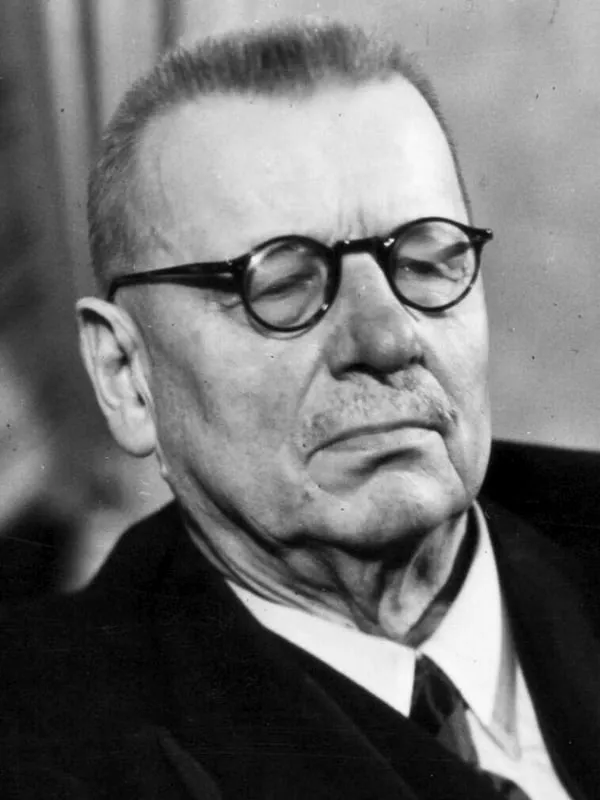
- Born:
- 27 November 1870, Koski Hl (Grand Duchy of Finland, Russian Empire)
- Died:
- 14 December 1956, Helsinki
- Author:
- Natalia
- Photo:
- F.E Fremling, CC BY 4.0, Wikimedia Commons

For more than half a century Juho Kusti Paasikivi was one of the most important men in Finland: an official and senator in the autonomous Grand Duchy, a banker, prime minister in the year independence was won, negotiator of peace with Soviet Russia and, finally, president. For the history of the road to the Second World War, however, the most important moments were the autumn weeks of 1939, when, as head of the Finnish delegation, he sat facing Joseph Stalin and Vyacheslav Molotov and listened to the Soviet demands that led to the Winter War. The man who in 1939 advised his government to give way became after 1944 the architect of the policy thanks to which Finland, defeated and dependent on the USSR, preserved its independence and its democratic system.
Youth
He was born on 27 November 1870 as Johan Gustaf Hellstén, in the sauna of a farm in the village of Huljala in the parish of Koski Hl (later Hämeenkoski), where his parents, small traders from Tampere, had stopped on their way to the fair in Lahti. His mother died when he was four, and his father, the owner of a drapery shop in Lahti, in 1884, leaving debts. The boy was brought up by an aunt. His father had nevertheless managed to send him to the best Finnish-language secondary school in the country, the lycée in Hämeenlinna, where Juho was top of his class. In the spirit of the Fennoman movement, which demanded equal status for Finnish alongside Swedish, in 1887 (according to some sources as early as 1885) he changed his Swedish-sounding surname to the Finnish Paasikivi, meaning “flagstone”.
In 1890 he began studying at the University of Helsinki. He first chose Russian language and literature, spent more than six months in Novgorod, and remained interested in Russia, its history and its literature for the rest of his life. He then switched to law and in 1901 defended his doctorate. He lectured at the university, taught in schools and practised as a lawyer in Lahti. In 1897 he married Anna Forsman, with whom he had four children.
Official and senator of the Grand Duchy
Paasikivi belonged to the Finnish Party, the so-called Old Finns, who in the face of Russification counselled caution and concessions in order to save the country’s autonomy. In 1903 he became director-general of the State Treasury of the Grand Duchy. When in 1904 Eugen Schauman shot the Governor-General, Nikolai Bobrikov, Paasikivi publicly called the assassination an abhorrent crime, against the mood of most of his compatriots, who saw the assassin as a hero. In 1907–1909 and 1910–1914 he was a member of the newly created single-chamber parliament, the Eduskunta, and in 1908–1909 a senator heading the finance department – in practice the Grand Duchy’s minister of finance. In 1914 he left politics to become director-general of the Kansallis-Osake-Pankki bank, which he ran for twenty years.
Independence and Tartu
After the Russian Revolution Paasikivi supported full independence for Finland. In the civil war of 1918 he sided with the Whites, and from 27 May to 27 November 1918 he headed the Senate, which was then the government. As a monarchist he wanted to tie the country to Germany, and he brought about the election of the German prince Frederick Charles of Hesse as King of Finland. Germany’s defeat in the First World War put paid to the plan; Paasikivi’s government resigned and Finland became a republic. His time in office is also burdened by the camps for captured Reds, in which some 12,000 people died of hunger and disease in 1918.
In 1920 Paasikivi led the Finnish delegation at the peace talks with Soviet Russia in Tartu, Estonia. The treaty signed on 14 October 1920 confirmed the old border of the Grand Duchy and gave Finland the Petsamo region with its ice-free port on the Arctic Ocean. Many Finns considered it a “shameful peace”, because they had dreamed of East Karelia. Paasikivi took the opposite view: that at Tartu Finland had obtained, if anything, too much, and that a border so close to Petrograd would hold only as long as Russia remained weak.
In 1934–1936 he led the conservative National Coalition Party, drawing it away from the far right of the Lapua Movement. In 1936, widowed and remarried, he became Finland’s envoy in Stockholm. His task was to win Sweden over to a defensive alliance with Finland. The mission failed: the Swedish Social Democrats distrusted the former monarchist, and Sweden wanted to keep a free hand.
Talks in the Kremlin
On 5 October 1939 Molotov invited Finland to Moscow for talks on “concrete political questions”. The government sent not the foreign minister, Eljas Erkko, but Paasikivi, who had Tartu behind him and knew Russian. On 12 and 14 October Stalin and Molotov presented their demands to him: a lease of Hanko as a naval base, and the cession of islands in the Gulf of Finland and part of the Karelian Isthmus in exchange for land in Soviet Karelia. According to the Finnish participants, Stalin said that since Leningrad could not be moved, the border would have to be moved away from it. In the following rounds, on 23 October and in early November, Paasikivi was accompanied by the finance minister, Väinö Tanner.
Within the government Paasikivi was among the advocates of far-reaching concessions, as was Marshal Carl Gustaf Emil Mannerheim. He believed that the Soviet Union was genuinely worried about Leningrad and that Finland could not win a war against it. Erkko’s instructions, however, allowed him to agree to no more than minor border adjustments. On 13 November the delegation left Moscow, and on 30 November the Red Army attacked Finland. Paasikivi later called the Winter War “Erkko’s war”.
In the government of Risto Ryti, formed after the outbreak of war, he was minister without portfolio and, together with the prime minister and Tanner, now foreign minister, one of the three men who directed the state’s policy. In March 1940 he travelled with Ryti to Moscow and signed the peace that cost Finland the whole of the Karelian Isthmus, including Viipuri (Vyborg). Immediately afterwards he became envoy in Moscow. He tried to improve relations with Stalin, but when he realised that Helsinki was drawing closer to Germany with revenge in mind, he resigned in February 1941. When, on taking his leave, he promised Stalin that as a private person he would go on working for good relations between the two countries, he was reportedly told: “You can never be a private person.”
The Continuation War and peace
During the Continuation War, which Finland entered in June 1941 alongside Germany, Paasikivi remained on the sidelines and wrote his memoirs. After Stalingrad he was convinced that Germany would lose and that Finland had to get out of the war as quickly as possible. In February 1944 the government sent him secretly to Stockholm for talks with the Soviet ambassador, Alexandra Kollontai, and at the end of March he went to Moscow with the former foreign minister Carl Enckell. Molotov set out the terms: a break with Germany and the internment or expulsion of its troops, the 1940 border, the cession of Petsamo and $600 million in reparations. Paasikivi advised accepting them, but parliament rejected them. Finland concluded an armistice only in September 1944, on worse terms, including the additional lease of the Porkkala peninsula near Helsinki.
On 17 November 1944 Paasikivi became prime minister. In a country supervised by the Allied Control Commission chaired by Andrei Zhdanov, he brought the communists into government and steered through parliament the law under which eight politicians, among them Ryti and Tanner, were convicted of responsibility for the war. It was the most distasteful task of his life, but he maintained that he had no choice: “Moscow is not a district court.” In a speech of 6 December 1944 he set out the principle that guided him for the rest of his life: relations with the Soviet Union are the main problem of Finnish foreign policy, and that policy must never be directed against the USSR.
President
In March 1946, after Mannerheim stepped down, parliament elected Paasikivi president. In 1947 Finland signed the Paris Peace Treaty, and in April 1948, at Stalin’s demand, the Agreement of Friendship, Cooperation and Mutual Assistance with the USSR. Paasikivi personally directed the negotiations and secured a treaty far milder than those concluded with Moscow by Hungary and Romania: Finland undertook to defend its own territory against an attack by Germany or its allies, but did not join the Soviet bloc. In the spring of 1948, when rumours of a communist coup were circulating, he put the army on alert, and after the communists lost the election he kept them out of the government.
In 1950 he was re-elected. His second term saw the completion of war reparations in 1952, the opening of the Helsinki Olympic Games and Finland’s admission to the UN in 1955. In 1954 he became the first Western head of state to receive the Order of Lenin. In September 1955 in Moscow he secured the return of Porkkala, from which Soviet troops withdrew in January 1956. “The pen has repaired what the sword destroyed,” he said on his return. His term ended on 1 March 1956, and he was succeeded by Urho Kekkonen, for many years prime minister and the continuer of his line. Paasikivi died on 14 December 1956 in Helsinki and was buried in Hietaniemi Cemetery.
Significance
Paasikivi was a conservative, a monarchist in 1918 and an opponent of socialism, but also a realist who never forgot what he had learned in Novgorod and at Tartu: that Russia, weak or strong, would always remain Finland’s neighbour. In 1939 his advice went unheeded. It is still debated whether the concessions he favoured would have prevented the Winter War, or would merely have opened the way to the fate of Estonia, Latvia and Lithuania. After 1944 his conviction that a small state must take account of the security interests of a powerful neighbour became the foundation of the so-called Paasikivi line, continued by Kekkonen. Critics later called it Finlandisation. Yet Paasikivi’s diaries, published in the 1980s, showed that for all his caution he guarded the limits of Finnish sovereignty and had no illusions about the Soviet Union: “We have nothing to thank the Soviet Union for, except that it did not treat us worse than it did,” he wrote in 1952. Finland, which fought the USSR twice in 1939–1944, was the only European country that had fought against it to come out of the war without being occupied and with its democratic system intact. That was in large part his achievement.
Sources
Mentioned in battles
(03)Often appears with
People who appear in the same events.