Soviet Union
Mikhail Kirponos
Commander of the Leningrad Military District (1940–1941), of the Kiev Special Military District and the South-Western Front (1941), Colonel General (from 1941)
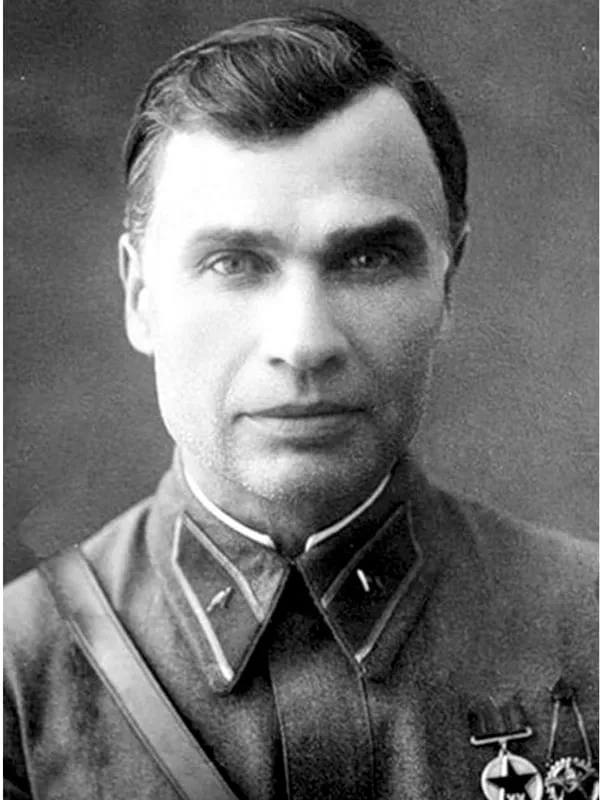
- Born:
- 12 January 1892, Vertiivka, Chernigov Governorate (Russian Empire)
- Died:
- 20 September 1941, Shumeikove grove near Lokhvytsia, Poltava Oblast (USSR)
- Author:
- Natalia
- Photo:
- autor nieznany, domena publiczna, Wikimedia Commons

Mikhail Kirponos commanded the strongest front of the Red Army at the moment of the German invasion of the Soviet Union, and he was one of four commanders of Soviet fronts to be killed in the war. The son of Ukrainian peasants, a Tsarist army medical orderly and a Bolshevik from the days of the Civil War, he spent most of his interwar career running military schools. In less than two years he was raised to the highest posts by the Great Purge of the army and by a victorious battle in the Winter War. In 1941 his South-Western Front defended Ukraine and Kiev for three months, but in September, when Stalin forbade a retreat, it was encircled and destroyed. Kirponos was killed on 20 September 1941 while trying to break out of the encirclement.
Forester and medical orderly
He was born on 12 January 1892 (30 December 1891 in the Julian calendar) in the small town of Vertiivka in the Nizhyn district of Chernigov Governorate, into a poor Ukrainian peasant family. His parents owned no land of their own and worked as hired labourers. He attended a parish school and a zemstvo school, but there was no money for further education. From 1909 he worked as a watchman and forest guard on forestry estates in the Chernihiv region. In 1911 he married for the first time.
In September 1915 he was called up into the Russian army. He completed an instructors’ course at the officers’ rifle school at Oranienbaum, served in a reserve regiment and in 1917 graduated from a military school for medical orderlies (feldshers). From August 1917 he was a company feldsher in an infantry regiment on the Romanian front. After the revolution the soldiers elected him chairman of the regimental committee and, in November, chairman of the soldiers’ council of XXVI Corps. In January 1918 the command arrested him for organising fraternisation with Austro-Hungarian soldiers; in February he was demobilised.
The Civil War
In 1918 Kirponos joined the Bolshevik party. In the spring, when Ukraine was occupied by German and Austro-Hungarian troops supporting Hetman Pavlo Skoropadskyi, he organised a partisan detachment in his home district which fought the occupiers and the Ukrainian government forces, and after the rising failed it crossed into Soviet Russia. In his curriculum vitae he later stressed that he had been an opponent of Ukrainian “separatism”. From August 1918 he served in the Red Army, in the units of the 1st Ukrainian Soviet Division of Mykola Shchors: he commanded a company, then a battalion, was chief of staff and then commander of a regiment that fought the forces of the Ukrainian People’s Republic and the Whites around Zhytomyr, Berdychiv and Kiev.
In 1919 he moved to the schools for Red commanders – in Zhytomyr, Kiev and Kharkiv – where for several years he was deputy commandant and then deputy for political affairs. From 1923 to 1927 he studied at the Frunze Military Academy in Moscow. After graduating he commanded a battalion, worked at the military school in Kharkiv, and from 1931 was chief of staff of the 51st Perekop Rifle Division in Odessa. In 1919 he had married for the second time, to Zofia Piotrowska, a Polish woman whose relatives were persecuted in the 1930s; her brother fled to Poland and her father was exiled to Kazakhstan. Kirponos did not divorce her.
Kazan and the purge
In the mid-1930s (in 1934 or 1935, depending on the source) Kirponos became commandant and commissar of the infantry school in Kazan, later named after the Supreme Soviet of the Tatar ASSR. In October 1935 he was given the rank of Kombrig. It was a quiet, second-rank post from which, in normal times, few rose to the top. But the times were not normal. In 1937–1938 the Great Purge took thousands of Red Army commanders, from Marshal Mikhail Tukhachevsky down to regimental commanders. Kirponos – with a wife whose family had been persecuted – could easily have been among the victims. In an autobiography written in 1938 he himself stressed that he had actively taken part in “unmasking enemies of the people” and in the struggle against the opposition, and had always kept to the “general line of the party”. The Russian writer Mark Solonin argued that he washed the “stain” from his personal file by zealous cooperation with the security organs. In November 1939 Kirponos became a Komdiv.
The Winter War
In December 1939, after the Soviet attack on Finland, Kirponos took command of the 70th Rifle Division of the 7th Army on the Karelian Isthmus. His division distinguished itself in the final phase of the war. At the beginning of March 1940 it crossed the ice of Viipuri Bay (Vyborg Bay), outflanked the Finnish fortified area around Viipuri (Vyborg) from the west, seized a bridgehead on the northern shore of the bay and cut the road from Viipuri to Helsinki, then beat off Finnish counter-attacks. On 21 March 1940 Kirponos was made a Hero of the Soviet Union and awarded the Order of Lenin.
From then on he rose at a pace exceptional even for the post-purge Red Army. In April 1940 he commanded the 49th Rifle Corps, and in June he became commander of the Leningrad Military District (PL). On 4 June 1940, when general officers’ ranks were restored in the Red Army, he became a lieutenant general. At the beginning of 1941 he succeeded General of the Army Georgy Zhukov, who had taken over the General Staff, as commander of the Kiev Special Military District, the strongest district in the country, since Stalin expected the main German blow to fall on Ukraine. On 22 February 1941 he was promoted to colonel general, and in February the 18th Party Conference elected him a candidate member of the Central Committee. In little more than a year he had gone from commandant of a school in Kazan to commander of nearly a million soldiers.
His colleagues, such as the district’s chief of staff, General Maxim Purkayev, praised his energy and diligence. Others doubted whether he was ready for such a role. Brigade Commissar Nikolai Popel, political commissar of the 8th Mechanised Corps, remembered him as a man who was “impeccably brave and resolute” but “had not yet grown into such a post” – in peacetime no one saw this as a great problem, forgetting that the moment war broke out a frontier district would become a front.
The South-Western Front
In June 1941 the district command, like the others on the western frontier, was receiving more and more reports of German preparations. According to the accounts of Soviet officers, in mid-June Kirponos tried to move some of his troops forward into frontier positions, but Moscow ordered this cancelled so as not to “provoke” the Germans. On 22 June, the day of the German attack on the USSR, the district was converted into the South-Western Front with Kirponos at its head. His troops, better prepared and deployed in greater depth than General Dmitry Pavlov’s Western Front, were not taken by surprise to the same extent as the armies in Belorussia.
Moscow demanded an immediate counter-offensive: Directive No. 3 of 22 June ordered the front to take Lublin by 24 June. Zhukov arrived on the spot, at Tarnopol (Ternopil), together with Nikita Khrushchev. Around Dubno, Łuck (Lutsk) and Brody six Soviet mechanised corps with thousands of tanks struck Colonel General Ewald von Kleist’s Panzer Group 1. It was one of the greatest tank battles of the war. The corps went into action piecemeal, without supplies or reconnaissance, and Kirponos and Zhukov disagreed over whether the attack made sense: on 27 June Kirponos ordered it broken off and a switch to the defensive, and Zhukov immediately countermanded the order. The Soviet corps lost most of their tanks but held up the Germans for more than a week. The Chief of the General Staff of the German Army, Colonel General Franz Halder, noted on 26 June that the enemy facing Army Group South had “firm and energetic leadership”.
In July the South-Western Front fell back to the Stalin Line and then to the approaches to Kiev. On 10 July Marshal Semyon Budyonny became his superior as commander of the South-Western Direction. The front refused to be broken: its headquarters kept in contact with its armies, and the Kiev Fortified Region stopped the German Sixth Army. In the south, however, in the first days of August the Germans encircled the 6th and 12th Armies, which had earlier been transferred to the Southern Front, at Uman. Meanwhile, behind Kirponos’s back, people were looking for grounds to blame him. According to documents published years later, on 16 July 1941 the head of military counter-intelligence sent Moscow a memorandum accusing him of a Trotskyist past, suspicious acquaintances and a wife who was a “Polish nationalist”.
The Kiev pocket
In August 1941 the fate of the South-Western Front was decided at Hitler’s headquarters. The order of 21 August sent Colonel General Heinz Guderian’s panzer group into the front’s rear, while Kleist prepared to strike from the bridgehead at Kremenchuk on the Dnieper. Kirponos and Budyonny repeatedly asked the Stavka for permission to shorten the front and withdraw. During the night of 11–12 September Joseph Stalin, speaking by teleprinter, forbade Kirponos to look for “lines to retreat to” and to give up Kiev. Kirponos then assured him that the front had no thought of withdrawing and asked only for reserves. His chief of staff, Major General Vasily Tupikov, who on 14 September warned Moscow of impending disaster, was called a panic-monger.
On 15–16 September the armoured pincers of Guderian and Kleist closed at Lokhvytsia, far to the east of Kiev. On 17 September Major General Ivan Bagramyan flew in to the front headquarters at Pyriatyn with a verbal order from Marshal Semyon Timoshenko, the new commander of the Direction, to abandon Kiev and break out to the east. Kirponos, mindful of Stalin’s prohibition, demanded written confirmation from the Stavka. In the evening, having received none, he ordered his armies to break out of the encirclement on his own authority. Moscow’s consent, and that only to the abandonment of Kiev, arrived during the night. The next day the front ceased to exist as a whole: its armies broke up into groups cut off from one another, and on 19 September the Germans entered Kiev. According to accounts, he refused to be evacuated by air while his troops remained in the pocket.
Death in the Shumeikove grove
The column of the headquarters of the front and of the 5th Army, with which Kirponos was travelling, was forcing its way east from Pyriatyn. On 20 September, near the farmstead of Dryukivshchyna, some 15 kilometres south-west of Lokhvytsia, it ran into the German 3rd Panzer Division. The remnants of the column – according to Soviet accounts about a thousand men, among them several hundred officers – took refuge in the Shumeikove grove. The Germans attacked it from three sides. Everyone, from private soldiers to the front commander, took part in the hand-to-hand fighting. Kirponos was wounded in the leg, and a few hours later he was killed by a shell fragment that struck him in the head. Also killed were the member of the front’s military council Mikhail Burmistenko, Tupikov and other staff officers, while the commander of the 5th Army, Major General Mikhail Potapov, was badly wounded and taken prisoner. Kirponos’s body was buried where he fell. The circumstances of his death were investigated by a Soviet commission after the war; for years an unconfirmed hypothesis also circulated that the badly wounded general had taken his own life.
In the Battle of Kiev the South-Western Front was almost completely destroyed. The Germans announced the capture of 665,000 prisoners; according to Russian calculations the front lost more than 700,000 men between July and the end of September, of whom more than 616,000 were killed, missing or taken prisoner.
Memory and assessment
After the liberation of Kiev Kirponos’s remains were exhumed and in December 1943 buried with military honours in the Kiev botanical garden; in 1957 they were moved to the Park of Eternal Glory above the Dnieper. In the USSR he became one of the heroes of the defence of Kiev: streets in Kiev, Chernihiv and Lokhvytsia were named after him, and monuments to him were erected in Kiev and Chernihiv. After the Russian invasion of Ukraine, as part of decommunisation, Kirponos Street in Kiev was renamed in 2022, and in 2023 his monument was dismantled.
Historians judge him severely, though with understanding for the conditions in which he fought. Like Pavlov, he is one of the commanders held responsible for the defeats of the summer of 1941. He is reproached for his lack of experience in commanding large formations, his frequent changes of decision and his blind obedience to the Stavka. Marshal Konstantin Rokossovsky, who commanded a mechanised corps in his front, recalled Kirponos’s bewilderment in the first days of the war and wrote that such enormous tasks were beyond his “measure”. Marshal Kirill Moskalenko saw him above all as a brave and resolute commander. What is clear, however, is that for three months his front could not be broken, although it was fighting Germany’s strongest armoured forces, and that the disaster of September was sealed by Stalin’s decision, not by the front commander. Unlike Pavlov, Kirponos was not charged or shot after the defeat – he was killed together with his staff, among the soldiers he had not been allowed to lead out of the encirclement.
Sources
Commanded in battles
(01)Mentioned in battles
(03)Often appears with
People who appear in the same events.