Breaking of the Mannerheim Line
- Dates:
- 1–17 February 1940
- Front:
- Scandinavia
- Location:
- The western part of the Karelian Isthmus, the Summa–Lähde sector between Lake Summajärvi and the Munasuo bog, on the road and railway from Leningrad to Viipuri (Vyborg) (today near the village of Sokolinskoye in Leningrad Oblast); holding actions at Taipale in the east of the IsthmusOn the battle map →
- Sides:
- Soviet Union (North-Western Front, 7th and 13th Armies)Semyon Timoshenko, Kirill Meretskov, Vladimir GrendalFinland (Army of the Isthmus, II and III Corps)Carl Gustaf Mannerheim, Hugo Österman, Harald Öhquist, Erik Heinrichs
- Result:
- Soviet victory. The Red Army broke through the main position of the Mannerheim Line at Lähde, and the Finnish II Corps withdrew to the intermediate line. At Taipale the Finns held their line.
- Author:
- Łukasz
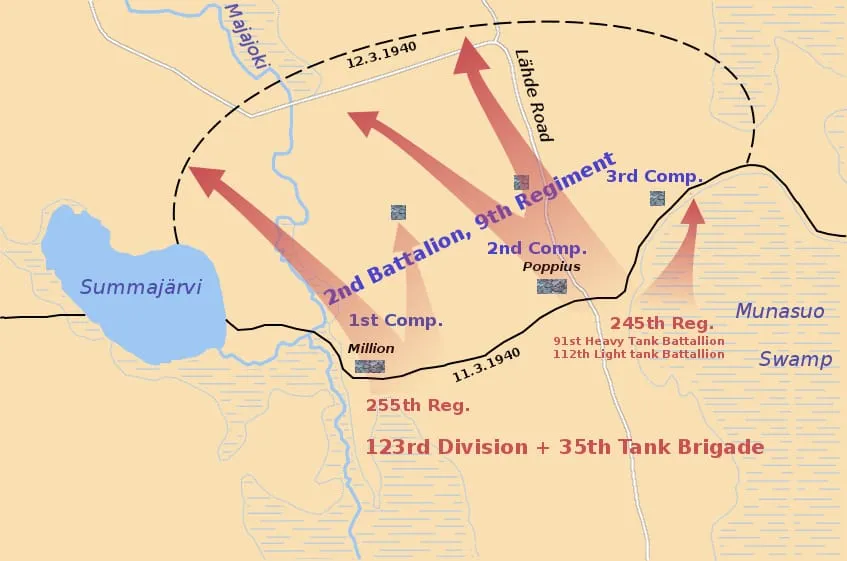
The breaking of the Mannerheim Line was the decisive operation of the Winter War. After the defeats of December, when the Red Army’s attacks on the Finnish fortifications of the Karelian Isthmus collapsed one after another, Moscow spent a month preparing a new offensive. On 1 February 1940 Soviet artillery and aircraft began methodically destroying the Finnish positions, while infantry and tanks attacked every day, wearing the defenders down. On 11 February the general offensive began, and that same day the Soviet 123rd Rifle Division broke into the main defensive position at Lähde, next to the village of Summa on the road to Viipuri (Vyborg). Finnish counter-attacks failed, and on 15 February Marshal Carl Gustaf Emil Mannerheim allowed the troops in the west of the Isthmus to withdraw to the intermediate line. By 17 February the Finns had broken contact with the enemy and occupied the new line. The Mannerheim Line, for more than two months a symbol of Finnish resistance, had been broken, and the war entered its final phase, which in March brought Finland to a peace on Soviet terms.
Name and dates
Russian historiography calls the operation the “breaking of the Mannerheim Line” (Russian proryv linii Mannergeyma). Finnish historians speak rather of the Second Battle of Summa or of the battles for Lähde and Summa (Finnish Summan taistelut), as distinct from the First Battle of Summa, fought from 17 to 22 December 1939. The village of Summa, where the strongest Finnish fortifications stood, gave its name to the whole sector. The actual breakthrough, however, came a few kilometres to the east, at Lähde, where the road to Viipuri crossed roads leading deeper into the Isthmus.
The operation is taken to have begun on 1 February 1940, when the North-Western Front opened a fire preparation lasting many days, combined with daily attacks on the Finnish positions. It ended on 17 February, when the Finnish II Corps completed its withdrawal from the broken main position to the intermediate line (Finnish väliasema) and the leading Soviet units came up to it. Chronologies of the war often give 15 February as the date of the breakthrough, when after the Finnish withdrawal the Red Army occupied the ruins of Summa, and 17 February as the day on which the Finns “continued their retreat”. The main position, however, had already been breached on 11 February, and 15 February was the day on which Mannerheim agreed to abandon it. The fighting for the intermediate line, from 18 to 27 February, and the march on Viipuri in March belonged to the next stage of the war.
Background
The Mannerheim Line ran across the Karelian Isthmus from the Gulf of Finland to Lake Ladoga. Contrary to Soviet propaganda, which compared it with the French Maginot Line, it was above all a network of trenches, wire entanglements, anti-tank ditches and boulders, and earth-and-timber shelters, with only a small number of concrete bunkers. The most modern of these, built in 1937–1939, were concentrated in the Summa–Lähde sector, regarded as the most threatened axis because it carried the shortest route from Leningrad to Viipuri. At Lähde stood two large bunkers: Sj4, known as “Poppius”, and Sj5, called “the Million” (Finnish Miljoonalinnake), because its construction was said to have cost more than a million marks. But the line had weaknesses: around Summa it bent inwards, and on the Munasuo bog, through a design error, there were almost no fortifications for a kilometre.
In December 1939 the 7th Army of Komandarm 2nd Rank Kirill Meretskov tried to cross this line on the march. The First Battle of Summa exposed all the weaknesses of the Red Army after the Great Purge: tanks broke through behind the Finnish trenches, but the infantry remained stuck at the wire, and the artillery fired according to plan rather than at targets. The attack collapsed with heavy losses, as did the attacks at Taipale at the eastern end of the Isthmus. On 26 December the 7th Army went over to the defensive. At the same time, north of Ladoga and in central Finland, Finnish units routed Soviet divisions at Tolvajärvi, at Suomussalmi and on the Raate road, and on the Kollaa they halted the 8th Army.
The December defeats forced Joseph Stalin to change his plans. At the end of the month frontal attacks without preparation were halted, and on 7 January 1940 the troops on the Isthmus were formed into the North-Western Front, commanded by Komandarm 1st Rank Semyon Timoshenko. The Leningrad party secretary Andrei Zhdanov became a member of the front’s military council, and Komandarm 2nd Rank Ivan Smorodinov (PL) its chief of staff. Stalin was pressed for time. After the expulsion of the USSR from the League of Nations, there was open talk in London and Paris of sending troops to help Finland, and the spring thaw in April would turn the Isthmus into a swamp. At the end of January Moscow let it be known through the Swedes that it was ready to talk to the lawful Finnish government, and the puppet “people’s government” of Otto Kuusinen was quietly dropped. The offensive was meant to force Helsinki to accept Soviet terms.
Forces and plans
The Isthmus was divided between two armies. Meretskov’s 7th Army in the west, from the Gulf of Finland to Lake Muolaanjärvi, was to deliver the main blow on the Viipuri axis. The 13th Army of Komandarm 2nd Rank Vladimir Grendal – an artilleryman of the old Tsarist army, born in the fortress of Sveaborg near Helsinki, who had received that rank on 16 January – operated in the east, from Muolaanjärvi to Ladoga. Its task was to pin the Finns down on the Vuoksi river and at Taipale, so that they could not shift reserves to the west.
The number of divisions on the Isthmus rose from about ten in December to more than twenty. Heavy 203 mm howitzers and 280 mm mortars capable of destroying concrete bunkers were brought up, along with artillery regiments of the High Command reserve, new tank brigades and aircraft. Estimates of the forces vary with the source. According to Western studies based on Finnish data, on 11 February the Red Army had some 460,000 men on the Isthmus, more than 3,000 guns and about 3,000 tanks, with some 1,300 aircraft in the air. Finnish publications also give a figure of about 1,550 tanks for that day, and some put the total number of Soviet troops on the Isthmus as high as 600,000. On the Finnish side, Lieutenant General Hugo Österman’s Army of the Isthmus had eight depleted divisions on the whole Isthmus, some 150,000 men. Lieutenant General Harald Öhquist’s II Corps defended the western part of the Isthmus, and Major General Erik Heinrichs’s III Corps the eastern part, from the Vuoksi to Ladoga. The Summa–Lähde sector was held by the 3rd Division. Above all the Finns lacked artillery ammunition and anti-tank guns, and the divisions that had been in the line since December had no one to relieve them.
Timoshenko’s plan was simple and methodical. For several days the heavy artillery, including guns brought forward to fire over open sights, was to destroy the Finnish bunkers and wire one by one, while aircraft bombed the rear. Daily infantry and tank attacks were to mislead the Finns about the direction of the main blow, draw out their fire and give them no rest. Only then would the general offensive begin, concentrated on a narrow sector. In January the troops practised assaults on mock-ups of the Finnish fortifications built in the rear. Particularly thorough preparations were made by Colonel Filipp Alabushev’s 123rd Rifle Division, which had failed to get through at Lähde in December. Assault groups were formed from infantry, sappers with demolition charges, tanks and guns, and the infantry learned to advance close behind the tanks and their own artillery fire, protecting the vehicles from Finnish “tank hunters” armed with bundled grenades and petrol bombs.
The fighting: ten days of fire (1–10 February)
On the morning of 1 February 1940 Soviet artillery opened fire along the whole front of II Corps, most heavily on the Summa sector and at Taipale. According to some Western studies, as many as 300,000 shells were fired at the Finnish positions in the first twenty-four hours. These figures are uncertain, but authors agree in comparing the intensity of the bombardment with the great battles of the First World War. Soviet aircraft bombed artillery positions, roads and railways in the rear. Over the following days the bombardment did not let up, and Soviet infantry with tanks, covered by smokescreens, attacked in several places at once, often at night.
The Finns beat off these attacks, but at an ever higher price. By day they sheltered in their bunkers, and by night they repaired the shattered trenches and wire, almost without sleep, in frosts of 30–40 degrees below zero. The Finnish artillery, which had shells for very little, was ordered to fire only at attacks that posed an immediate threat. Bunkers whose embrasures were being shelled by heavy guns at close range lost their combat value, and their garrisons suffered casualties. This time the Soviet tanks did not drive alone deep into the Finnish defences: the infantry followed close behind them and protected them with its fire from the Finnish soldiers who in December had stopped the vehicles with explosive charges. The attackers still suffered heavy losses, because the infantry often advanced in close order across open ground.
On 6 February three Soviet divisions with a tank brigade attacked the positions of the Finnish 3rd Division between Suokanta, Summa, Lähde and Merkki four times. The Finnish Infantry Regiment 7 held the village of Summa and the direct road to Viipuri, so the Soviet command shifted the weight of its attacks eastwards, towards Lähde. The American historian Allen F. Chew, author of one of the most frequently cited studies of the war, estimates that the Russians were losing as many as 500 men a day during this period, and in the first ten days of February 86 tanks and thousands of men. The Finnish front did not collapse, but the defenders were at the end of their strength and their reserves were melting away.
Meanwhile Mannerheim, who had foreseen from the outset that the main blow would fall on Summa, had nothing left with which to reinforce the Isthmus. His last reserve, the 5th Division, was handed over to the Army of the Isthmus, together with replacement battalions, often made up of barely trained recruits. In Helsinki the government of Risto Ryti was still counting on help from Sweden and the Western powers, and on 12 February the Foreign Minister, Väinö Tanner, went to Stockholm to sound out Soviet peace terms through the Swedes.
The fighting: the breakthrough at Lähde (11–13 February)
On the morning of 11 February the Soviet artillery began the heaviest fire preparation of the war, which lasted several hours. According to Finnish sources the fire rose to a hurricane bombardment at about 8.40 a.m., and the infantry went forward before noon. The general offensive covered the whole Isthmus, but its weight fell on the Lähde sector. A regiment of the 123rd Rifle Division, supported by two tank companies, attacked the “Poppius” bunker, defended by a company of the Finnish Infantry Regiment 9. “The Million”, which was supposed to cover it with its fire, had already been badly damaged by Soviet howitzers. Tanks drove right up to the bunker and blocked its embrasures with their armour, and sappers blew in the entrances. By about noon “Poppius” was in Soviet hands. Chew calls it the key to the whole sector west of Muolaanjärvi.
On the morning of 12 February Soviet sappers blew up “the Million”. The Soviet infantry took the belt of Finnish trenches between the two bunkers and began to spread out to the flanks. The Finnish defence tried to seal the breach with counter-attacks. Mannerheim released the 5th Division to II Corps, but its regiments arrived one by one, straight off the march, under constant fire. According to Chew, the Army of the Isthmus lost some 1,200 men on one of these days. On 13 February a counter-attack by Infantry Regiments 13 and 14 broke down under the fire of Soviet artillery and tanks. Not only men were now lacking, but artillery shells too, and without them counter-attacks against an enemy that was smothering the ground with fire had no chance.
According to Soviet reports, by 13 February the 123rd Division had passed through the whole depth of the main position, 6–7 kilometres, and widened the breach to about 6 kilometres. In that time it destroyed or captured a dozen or so Finnish bunkers and several dozen earth-and-timber shelters. The neighbouring 136th Rifle Division, supported by a tank brigade, broke into the Finnish defences towards the isthmus between Lakes Muolaanjärvi and Äyräpäänjärvi. The Soviet command, however, advanced cautiously: instead of plunging deep at once, it consolidated the ground it had won for fear of Finnish counter-attacks. This gave the Finns the time they needed to organise a withdrawal.
The fighting: the withdrawal to the intermediate line (14–17 February)
On 14 February the 7th Army widened the breach at Lähde, while Öhquist conferred with Mannerheim, Österman, the Army of the Isthmus’s chief of staff Colonel K. A. Tapola, and the Quartermaster General at General Headquarters, Aksel Airo. Holding on to the broken line threatened the encirclement of the whole of II Corps, since Soviet units could wheel along the inward-bent line into the rear of Summa’s defenders. On 15 February Mannerheim ordered II Corps to withdraw to the intermediate line, which ran from the coast of the Gulf of Finland through Lakes Näykkijärvi, Muolaanjärvi and Äyräpäänjärvi to the Vuoksi, from a few to a dozen or so kilometres behind the main line. This line had been under construction only since the beginning of the war; in many places it was unfinished, with trenches and few shelters.
The withdrawal began on the night of 15–16 February and was carried out in good order. Finnish units fell back under the cover of rearguards, taking their heavy weapons and wounded with them, and on the coast, in the Inkilä sector, they broke contact with the enemy without a fight on 16 February to avoid being surrounded. On 15 February the Red Army occupied the ruins of Summa. The Red Army’s chief of artillery, Nikolai Voronov, who watched the attack from a forward observation post, recalled years later that no one in Moscow would believe that Summa had been taken: the People’s Commissar for Defence rang him three times at 7th Army headquarters to ask whether the strongpoint had really fallen. According to Russian studies, that day Soviet infantry rode into the attack on the hulls of tanks for the first time.
On 16 February Soviet units took Kämärä station on the Leningrad–Viipuri railway. According to Soviet figures, the 7th Army’s breach was about 11–12 kilometres wide and 11 kilometres deep. On 17 February the leading units of the 123rd Division became the first Soviet troops to reach the intermediate line. That day the Finnish II Corps completed its withdrawal. The main position of the Mannerheim Line in the west of the Isthmus, from the Gulf of Finland to Muolaanjärvi, was lost, and the Finns abandoned the coastal batteries of Humaljoki and Saarenpää on its seaward flank over the following days.
Taipale and the east of the Isthmus
In the east of the Isthmus the fighting took a different course. Grendal’s 13th Army attacked the positions of the Finnish III Corps on the Vuoksi and on the Taipale river, where the Finns had been holding out since December. According to Russian biographies of Grendal, his army resumed its offensive on 13 February after regrouping. The Finnish 7th Division, formerly called the 10th Division, beat off heavy attacks at Taipale from 11 to 20 February and held most of its positions. III Corps remained on the main line until the end of the war, so that after the withdrawal of II Corps the Finnish front bent at an angle around the Vuoksi.
Grendal later claimed that his three-month offensive at Taipale, although it did not break through that sector, tied down considerable Finnish forces and diverted attention from the axis of the main blow. Moscow, however, was dissatisfied with the pace of his advance and on 2 March removed him from command of the 13th Army.
Losses
The losses in the battles for Lähde and Summa themselves cannot be separated precisely from the overall losses of the Winter War. All sources agree that the Red Army paid a very high price for the breakthrough. According to Chew, in the first ten days of February it lost thousands killed and wounded and 86 tanks. The Finnish historian Ohto Manninen estimates that in the battles to break the Mannerheim Line in the winter of 1939–1940 the 7th Army lost a total of 1,244 tanks destroyed and damaged, many of which were repaired. Russian figures for the whole war, established in the 1990s by a team under Grigory Krivosheyev, speak of more than 126,000 killed, dead and missing, and more recent archival research gives still higher figures. The greater part of these losses was suffered on the Karelian Isthmus in February and March 1940.
Finnish losses were many times smaller in number, but hard for a small army to bear. According to Chew, the Army of the Isthmus lost some 1,200 men on a single day of the breakthrough, and even in January, in positional fighting, it had lost more than 3,000. Exhaustion and the lack of relief for divisions that had been fighting without a break since December weighed as heavily as the casualties. The Finns also lost most of the concrete bunkers of the western part of the Mannerheim Line, which the Red Army blew up after the war.
Significance
The breakthrough at Lähde decided the Winter War. It showed that the small Finnish army, short of ammunition and reserves, could not long withstand an enemy able to throw ever new divisions into battle and fire as many shells as it liked. Mannerheim warned the government that the army might soon collapse and pressed ever harder for peace before Finland lost the rest of its strength. The remote and uncertain plans for Allied help could no longer change that.
After the withdrawal the Finnish command changed. On 19 February Österman, who had clashed with Mannerheim over a further withdrawal, stepped down from command of the Army of the Isthmus. He was replaced by Heinrichs, and III Corps was taken over by Major General Paavo Talvela, the victor of Tolvajärvi. The Finns held the intermediate line from 18 to 27 February. On 21 February the Red Army broke into it at Lake Näykkijärvi, and on 27 February Mannerheim agreed to a withdrawal to the rear line in front of Viipuri. Timoshenko had already ordered the capture of Viipuri on 26 February. At the beginning of March Soviet divisions crossed the ice of the Bay of Viipuri and stood in the outskirts of the city.
Meanwhile a diplomatic game was being played. On 23 February Moscow demanded the whole of the Karelian Isthmus with Viipuri and the lands around Ladoga; on 29 February the Finnish government agreed to open negotiations; and on 12 March 1940 it signed a peace in Moscow, ceding about a tenth of the country’s territory to the USSR. Stalin achieved his territorial aims but did not subjugate Finland, and the threat of intervention by the Western powers, which he had wanted to forestall by ending the war, turned the attention of London, Paris and Berlin to Scandinavia.
In the USSR the breaking of the Mannerheim Line became the model for breaching a fortified defence. For the February operation Timoshenko, Meretskov, Grendal and dozens of commanders received high decorations. The 123rd Rifle Division was awarded the Order of Lenin, and its commander Alabushev was promoted to Kombrig. The lessons drawn from it, stressing careful preparation, massed artillery and cooperation between infantry and tanks, were written into Soviet regulations, and from May 1940 Timoshenko, as the new People’s Commissar for Defence, reformed the Red Army according to them. Observers in Berlin, however, remembered the Winter War for its December defeats rather than for the February victory, bought at enormous cost. This confirmed Adolf Hitler and the German generals in their belief that the Red Army could be beaten in a single short campaign. In June 1941 Finland, embittered by the loss of Karelia, entered the war against the USSR at Germany’s side, and that same summer its troops recovered the Karelian Isthmus and the ruins of the Mannerheim Line.