Finland
Risto Ryti
Governor of the Bank of Finland (1924–1939, 1944–1945), prime minister (1939–1940), President of Finland (1940–1944)
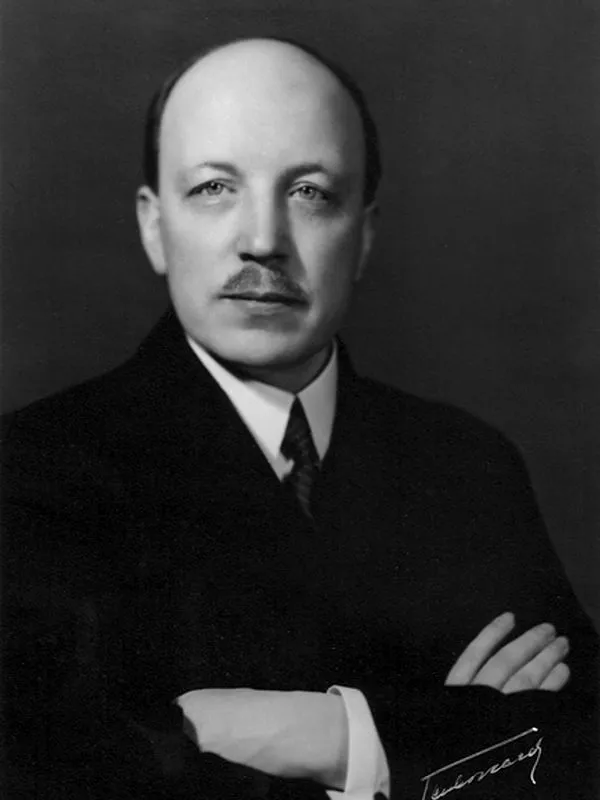
- Born:
- 3 February 1889, Huittinen (Grand Duchy of Finland, Russian Empire)
- Died:
- 25 October 1956, Helsinki
- Author:
- Natalia
- Photo:
- autor nieznany, domena publiczna, Wikimedia Commons

Risto Heikki Ryti was a Finnish lawyer, economist and politician who for fifteen years governed the central bank and, in the most difficult years of independent Finland’s history, served as its prime minister and president. He took office as head of government on the first day of the Winter War, and it was he who travelled to Moscow in March 1940 to sign the peace that took Karelia from Finland but saved its independence. As president he led the country into war with the Soviet Union alongside Germany in 1941, and in 1944 he signed a personal undertaking to Hitler that made it possible to withstand the Soviet offensive, and then stepped down so that his successor could withdraw from it. After the war he was sentenced to ten years’ imprisonment for his wartime policy. Even so, many Finns regard him as one of the greatest statesmen in their country’s history.
Youth and legal career
He was born on 3 February 1889 in Huittinen in Satakunta, in western Finland, then an autonomous Grand Duchy within the Russian Empire. He was one of ten children of a prosperous farmer who had taken his surname from the name of his estate, Ryti. The boy was drawn more to books than to work on the farm. After attending secondary school in Pori, in 1906 he began studying law at the University of Helsinki, completing his degree in three years.
This was the time of the second wave of Russification in Finland, and Ryti returned from Helsinki to his native Satakunta. He opened a law practice in Rauma and became the lawyer of Alfred Kordelin, one of the richest men in the country. In 1914 he went to England to study maritime law, but the outbreak of war forced him to return. In 1916 he married Gerda Serlachius, with whom he had three children.
The revolution in Russia affected him personally. On 7 November 1917, the day of the Bolshevik coup in Petrograd, Ryti and his wife were Kordelin’s guests at his Mommila estate when armed Russian sailors attacked the manor. In the shoot-out with members of the Civic Guard who came to help, Kordelin and many others were killed, and Ryti and his wife barely escaped with their lives. This experience, and the civil war of 1918, which he sat out in hiding in Red-held Helsinki, cemented his distrust of the left and of Soviet Russia.
Member of parliament, minister and banker
In 1919, at the age of thirty, Ryti was elected to the Eduskunta, the Finnish parliament, for the liberal National Progressive Party, the party of the republic’s first president, Kaarlo Juho Ståhlberg. He sat in parliament in 1919–1924 and 1927–1929. He was a republican and a democrat, but towards the Reds defeated in the civil war he took a hard line, opposing amnesties for prisoners. He quickly earned a reputation as the country’s leading expert on public finance. Between 1921 and 1924 he was twice minister of finance and put the young state’s budget in order.
In 1923 Ståhlberg appointed him governor of the Bank of Finland, and he took up the post at the beginning of 1924. He ran the bank for sixteen years. He was an adherent of classical economic liberalism and hard money: in 1926 he returned the markka to gold, and abandoned the gold standard only in 1931, following Britain. According to his critics, his policy deepened unemployment and farmers’ indebtedness at the start of the Great Depression, causing bitterness in the countryside, but it allowed Finland to repay its foreign debts. When, in December 1932, other debtors of the United States stopped paying, Finland alone paid the instalment due, which earned it a reputation in the West as an honest debtor. He maintained close contacts with bankers in London and New York, served on League of Nations committees, and in 1934 received the British Royal Victorian Order with a knighthood. An Anglophile, he opposed both communism and National Socialism, and at home he condemned the far-right Lapua Movement.
In 1925 the National Progressive Party nominated him for president. In the third round of voting in the electoral college he lost to the Agrarian candidate, Lauri Kristian Relander, by 109 votes to 172. In the 1930s he stood aloof from day-to-day politics, but as head of the bank he was one of the most influential figures in the state. In those years he grew close to the Social Democratic leader Väinö Tanner and to President Kyösti Kallio.
Prime minister in the Winter War
In the autumn of 1939, when Moscow demanded territorial concessions from Finland and a base at Hanko, Kallio offered Ryti the premiership, but he declined. He agreed only when, on 30 November 1939, the Red Army invaded Finland and the president and Marshal Carl Gustaf Emil Mannerheim appealed to his sense of duty. On 1 December he formed a coalition government in which Tanner became foreign minister and Juho Kusti Paasikivi minister without portfolio. These three men directed the state’s policy throughout the war, while the ailing Kallio increasingly left decisions to the prime minister.
From the outset Ryti assumed that small Finland could not win a long war against the USSR and that the war had to be ended as quickly as possible, before the army was exhausted. Moscow did not recognise his government, dealing only with the puppet “People’s Government” of Otto Kuusinen, but Finnish victories in December and January forced the Kremlin to change course. At the end of January 1940 Vyacheslav Molotov signalled through the Swedes that he was ready to talk to Ryti’s government. When in February the Red Army broke through the Mannerheim Line, while Britain and France were promising an expedition through Norway and Sweden, Ryti and Tanner argued in the cabinet that Western help would come too late and in too little strength, and would drag the country into the great war. At Paasikivi’s urging he himself led the delegation that left for Moscow on 6 March. There he had to accept terms harsher than those announced, and Molotov and Andrei Zhdanov rejected his proposal that the inhabitants of the ceded part of Karelia be allowed to remain in their homes. On 12 March 1940 Ryti was the first to sign the treaty under which Finland lost about a tenth of its territory and more than 400,000 people had to leave their homes.
During the “Interim Peace” Ryti remained prime minister. He tried to maintain relations with Moscow, which kept raising new demands, and sought support from Sweden, but the plan for a defensive alliance between the two countries collapsed in the face of Soviet and German opposition. Once Germany had seized Norway and Denmark and the Soviet Union had occupied the Baltic states in June 1940, Finland’s trade with the West virtually ceased, and the only great power willing to help was the Reich. From August 1940 Ryti agreed to secret military cooperation with Germany, including the transit of German troops through Finland to northern Norway.
President
In the summer of 1940 Kallio suffered a stroke, and in November he announced his resignation. Since an election of electors was deemed impossible in a country where a tenth of the population had been displaced, parliament passed an exceptional law under which the president was chosen by the electors of 1937. On 19 December 1940 Ryti received 288 of the 300 votes. That same evening Kallio died of a heart attack at Helsinki railway station, during a ceremonial farewell.
As president, Ryti, together with Mannerheim, Tanner and the defence minister Rudolf Walden, prepared Finland’s entry into the war on Germany’s side. After the German invasion of the USSR and Soviet air raids on Finnish towns, Finland declared on 25 June 1941 that it was at war. The next day, in a radio address, Ryti spoke of a “second defensive war” and said that this time the Finns were fighting together with the armed forces of mighty Germany, led by a “brilliant commander, Reich Chancellor Hitler”. These words were used against him after the war. He himself later claimed that he had not believed in a German victory, only that the Germans would smash the Red Army.
The Finnish army quickly recovered the lands lost under the Moscow peace and occupied East Karelia beyond the old border, and its troops took part in the siege of Leningrad. Throughout the war Ryti kept together a broad coalition stretching from the Social Democrats to the far right, and held to the thesis that Finland was waging a “separate war” against the USSR rather than being an ally of the Reich. He signed no alliance with Germany and did not travel to see Adolf Hitler, although Hitler flew to Finland in June 1942 for Mannerheim’s 75th birthday. In the summer of 1942 he also received Heinrich Himmler, whom he noted in his diary as an “extreme antisemite”. On 15 February 1943, again under an exceptional law, the same electors chose him for a second term, this time of two years. By then Ryti was convinced that Germany would lose, and he supported the cautious peace soundings of Edwin Linkomies’s new government.
The undertaking to Ribbentrop and resignation
On 9 June 1944 the great Soviet offensive on the Karelian Isthmus began, and on 20 June the Red Army took Viipuri (Vyborg). Moscow demanded unconditional surrender, and Finland urgently needed anti-tank weapons, aircraft and grain. On 22 June the German foreign minister, Joachim von Ribbentrop, flew into Helsinki and demanded an undertaking that Finland would not conclude a separate peace. Ryti wanted to put the matter to parliament, which would most probably have rejected it. In the end, on Mannerheim’s advice, on 26 June he signed a letter to Hitler in which he pledged, in his own name, not to make peace without Germany’s consent and not to appoint a government that would do so. Germany sent weapons and grain, and on 30 June the United States broke off diplomatic relations with Finland. Finnish historians disagree about how far German aid was decisive in halting the offensive at the Battle of Tali-Ihantala, but by mid-July the front had stabilised.
Being personal, Ryti’s undertaking did not bind his successor. On 1 August 1944 Ryti resigned, and on 4 August parliament, by an exceptional law, entrusted the office of president to Mannerheim. The marshal told the Germans that he did not consider himself bound by his predecessor’s letter, and Finland opened negotiations with Moscow. At the beginning of September it broke off relations with Germany, and on 19 September 1944 it signed the armistice in Moscow. Mannerheim later called Ryti’s conduct an act of civic courage.
Trial and last years
After his resignation Ryti returned to the governorship of the Bank of Finland, but in the new political situation he had to leave it in mid-1945. Under pressure from the Allied Control Commission, dominated by the Soviets, and from the Finnish communists, parliament passed a retroactive law on the punishment of those responsible for the war. In the trial, which lasted from November 1945 to February 1946, Ryti was the first of eight defendants, alongside Tanner and former prime ministers and ministers. He was charged with leading the country into war in 1941 and with the undertaking to Ribbentrop. He defended himself calmly, presenting himself as the executor of a policy supported by the majority of the nation. In his final statement he said that his conscience was clear and that one could serve one’s country in prison as well as in the presidential palace. On 21 February 1946 he was sentenced to ten years’ hard labour, the heaviest sentence of all the defendants.
In prison he fell seriously ill. He underwent a stomach operation and suffered from rheumatism, and from the autumn of 1948 he lay in hospital. In May 1949 his former colleague Paasikivi, by then president, pardoned him despite protests from the communists and the Soviet press. He never returned to public life, and did not finish the memoirs he had begun. He died on 25 October 1956 in Helsinki. His funeral, held in the days when the Red Army was crushing the uprising in Hungary, drew large crowds and became a quiet patriotic demonstration. He was buried in Hietaniemi Cemetery.
Significance
Ryti was a central and tragic figure in Finnish wartime politics. As prime minister he grasped earlier than many that Finland could not count on rescue from outside, and he made peace while the army was still fighting, even though it meant the loss of Karelia. As president he led the country into war alongside Hitler, counting on recovering the lost lands and on the defeat of the USSR, and in 1944 this policy brought Finland fresh losses and harsh armistice terms. Yet the same man took upon himself the undertaking to Germany that made it possible to halt the Soviet offensive, and then stepped aside so that the state could extricate itself from it. Thanks to this, Finland, alone among the countries that fought on Germany’s side in Europe, came out of the war without being occupied and with its political system intact.
In the Soviet era his name was a sensitive subject in Finland. After the collapse of the USSR he became a symbol of civic courage: in 1994 a statue of him was unveiled in front of the parliament building in Helsinki, and in 2004, in a television poll to find the greatest Finn, Ryti came second, behind Mannerheim. Historians still debate whether his policy of 1940–1944 was the shrewd game of a small state among great powers or a mistake that tied Finland to the Third Reich.
Sources
Mentioned in battles
(06)Often appears with
People who appear in the same events.