Soviet Union
Semyon Timoshenko
Commander of the Ukrainian Front (1939) and of the North-Western Front in the Winter War (1940), People's Commissar of Defence of the USSR (1940–1941), chairman of the Stavka (1941), Marshal of the Soviet Union (from 1940)
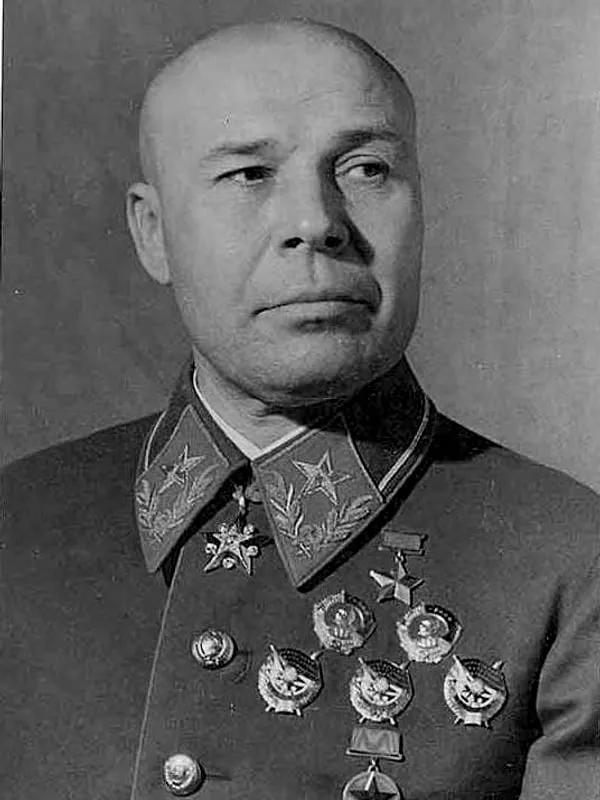
- Born:
- 18 February 1895, Orman, Bessarabia Governorate (Russian Empire)
- Died:
- 31 March 1970, Moscow (USSR)
- Author:
- Łukasz
- Photo:
- autor nieznany, CC BY 4.0, Wikimedia Commons

Semyon Timoshenko was a Soviet commander who in the space of two years rose from command of a military district to the summit of military power in Joseph Stalin’s state, and then fell from it just as quickly. A Ukrainian peasant from Bessarabia, a cavalryman of the First Cavalry Army and Stalin’s comrade from the Civil War, he survived the Great Purge and in September 1939 led the Ukrainian Front in the Soviet invasion of Poland. In January 1940 he took command of the troops on the Karelian Isthmus and in February broke through the Mannerheim Line, which earned him the post of People’s Commissar of Defence and a marshal’s baton. As commissar he prepared the Red Army for war with Germany, and when that war broke out he headed the Stavka, the Soviet supreme headquarters, for its first weeks. In 1941–1942 he commanded fronts in the battles of Smolensk, Rostov and Kharkiv. After the Kharkiv disaster of May 1942 Stalin never again entrusted him with independent command in the most important sectors, and until the end of the war he served as a coordinator of the operations of several fronts.
From Bessarabia to the cavalry
He was born on 18 February 1895 (6 February by the Julian calendar) in the village of Orman in the Akkerman district of the Bessarabia Governorate, today Furmanivka in Ukraine’s Odesa region, into a poor Ukrainian peasant family. According to family accounts he was the youngest of more than a dozen children. He completed only four years of parish school and worked as a farmhand. The village was mostly Moldovan, so in addition to Ukrainian and Russian he also spoke Moldovan.
In 1914 he was called up into the Russian army. According to Russian biographies he graduated from the machine-gun school at Oranienbaum and fought in the cavalry on the South-Western and Western Fronts, receiving the Cross of St George in three classes for bravery. His biographers also describe an episode from the end of the war: for striking an officer he was to face a court martial, and the February Revolution saved him from its verdict. He ended the war as a non-commissioned officer.
The Civil War and the war with Poland
In 1918 he joined the Red Army. He commanded a platoon, then a squadron, and in the summer of 1918 a cavalry regiment, with which he fought his way from the Crimea to Tsaritsyn. In the city, held by the Reds, he met Stalin and Kliment Voroshilov. That acquaintance determined his entire subsequent career. From November 1918 he commanded a cavalry brigade, from 1919 in the corps of Semyon Budyonny, out of which grew the First Cavalry Army. In 1919 he joined the Bolshevik party. In the Russian Civil War he fought against the forces of Denikin and later Wrangel, and against Makhno’s bands. He was wounded several times.
From November 1919 to August 1920 he commanded the 6th Cavalry Division, and then, until the autumn of 1921, the 4th Cavalry Division of the First Cavalry Army. With the Konarmiya he went through the whole 1920 campaign of the Polish–Soviet War: the June breakthrough of the Polish front in Ukraine, the march on Lwów (Lviv) and the retreat after the defeat at the Battle of Komarów on 31 August 1920, from which, according to Soviet biographies, his division broke out of encirclement. During this campaign the divisions of the Konarmiya committed looting and pogroms against the Jewish population, especially during the retreat in the autumn of 1920. The worst reputation attached to the 6th Division, which Timoshenko had commanded earlier: in October, by then under another commander, its regiments carried out a series of pogroms, for which some of them were disbanded and those responsible were shot. Timoshenko is thought to have been the model for Savitsky, commander of the Sixth Division in Isaac Babel’s cycle of stories Red Cavalry. For the fighting on the Polish front and against Wrangel he received two Orders of the Red Banner and an honorary revolutionary weapon.
A career in the 1920s and 1930s
In 1922 he completed the higher academic courses at the Military Academy of the Red Army, and later the advanced courses for senior commanders at the Frunze Military Academy (1927) and at the Military-Political Academy (1930). From 1925 to 1933 he was both commander and commissar of the 3rd Cavalry Corps in Minsk, one of the first commanders to combine the two functions. In his corps a cavalry division was then commanded by Konstantin Rokossovsky, and one of the brigades by the young Georgy Zhukov. In 1933 he became deputy commander of the Belorussian Military District, and in 1935 of the Kiev Military District.
The Great Purge, which in 1937–1938 claimed Mikhail Tukhachevsky, Iona Yakir, Ieronim Uborevich and thousands of other commanders, opened his way to the top. He belonged to the “cavalry” group of Voroshilov and Budyonny with which Stalin had been connected since Tsaritsyn, and he was a commander who could be trusted with districts whose previous commanders had been arrested. In 1937 he commanded in turn the North Caucasus and Kharkiv Military Districts, and in February 1938 he took over the most important of the western districts, the Kiev district, from Ivan Fedko, who was later shot. In February 1939 he was given the rank of Komandarm 1st Rank, and in March 1939 he joined the party’s Central Committee.
The invasion of Poland
In September 1939 the troops of the Kiev Special Military District were formed into the Ukrainian Front, with Timoshenko at its head. On 17 September his armies crossed the Polish border and advanced on Równe, Łuck, Tarnopol, Lwów and Stanisławów, towards the Romanian and Hungarian borders, to cut off the Polish forces’ line of evacuation. The Soviet invasion of Poland was accompanied by propaganda intended to break the Polish Army from within. Leaflets dropped over Polish units, bearing Timoshenko’s signature, portrayed officers as the enemies of the soldiers and called on the men to turn against them, while proclamations to the population urged them to settle accounts with the “Polish lords”. On 22 September near Lwów Major General Władysław Langner signed a protocol handing the city over to the Red Army that guaranteed the officers their freedom. The Soviets broke it at once; the officers they detained were taken to the camp at Starobilsk and in the spring of 1940 murdered in Kharkiv as part of the Katyn massacre, on the decision of the party leadership and at the hands of the NKVD. The Ukrainian Front ceased to exist at the beginning of October, and its commander returned to Kiev.
The Winter War
When in December 1939 the Red Army’s attacks on the Mannerheim Line broke down with heavy losses, and whole Soviet divisions were being destroyed in the forests of central Finland, Stalin looked for a commander who could turn the tide of the Winter War. According to the memoirs of Aleksandr Vasilevsky, at a meeting of the Main Military Council, after a long silence, Timoshenko volunteered, on condition that he would be given everything the operation required. On 7 January 1940 he took command of the newly formed North-Western Front, comprising the 7th Army of Kirill Meretskov and the 13th Army on the Karelian Isthmus.
He spent a month preparing the breakthrough. More than twenty divisions and heavy artillery were brought up to the Isthmus, the troops rehearsed assaults on mock-ups of the Finnish fortifications, and assault groups of riflemen, sappers and tank crews were formed to destroy the bunkers. On 1 February 1940 a bombardment lasting several days began, and on 11 February the general offensive opened, in which the Soviet 123rd Rifle Division broke through the Finnish defences at Lähde. In March Timoshenko’s troops reached Viipuri (Vyborg) and crossed the ice of the Bay of Viipuri, and on 12 March Finland signed the peace in Moscow. The victory was bought at an enormous cost in lives, but in Stalin’s eyes Timoshenko had achieved what Voroshilov could not. On 21 March 1940 he was made a Hero of the Soviet Union.
People’s Commissar of Defence
On 7 May 1940 he replaced Voroshilov as People’s Commissar of Defence and became one of three new Marshals of the Soviet Union. The same decree restored general officers’ ranks in the Red Army. Timoshenko launched a reform intended to draw the lessons of the humiliation in Finland. He ordered that the troops be taught “what war requires”, in the field, at night and in winter, tightened military discipline and introduced new disciplinary regulations, and in August 1940 he restored single command, subordinating the political commissars to the commanders. Some of the officers imprisoned during the purge returned to service. The mechanised corps disbanded in 1939 were re-formed: nine were created in the summer of 1940, and in early 1941 the formation of another twenty began, for which there were neither enough tanks nor trained cadres.
As commissar he took part in the occupation of the Baltic states in June 1940 and in the annexation of Bessarabia and northern Bukovina at the end of that month. On that occasion he visited his home village for the first time since 1914. At a conference of the senior command in December 1940 and in war games in January 1941 scenarios for a war with Germany were tested, and in February 1941 Zhukov became Chief of the General Staff. In the spring of 1941 Timoshenko and Zhukov grew increasingly alarmed at the concentration of the Wehrmacht along the border. In May 1941 the General Staff prepared a document proposing a pre-emptive strike against the German concentrations. It is still not known whether it was ever put before Stalin, who forbade anything the Germans might regard as a provocation. During the night of 21–22 June 1941 Timoshenko and Zhukov signed Directive No. 1, warning the border districts of a possible attack. In many units it arrived only after the first bombs had fallen.
The war with Germany, 1941–1942
On 23 June 1941, the second day of Operation Barbarossa, Timoshenko was placed at the head of the newly created Stavka of the High Command. His chairmanship was, however, largely nominal, since every decision lay with Stalin, who on 10 July himself took over the reorganised Stavka and on 19 July the Defence Commissariat as well. As early as 2 July, after the forces of the Western Front had been shattered in Belarus and its commander, General Dmitry Pavlov, arrested, Timoshenko took over that front, and on 10 July command of the entire Western Direction. In the Battle of Smolensk his troops suffered huge losses and again lost many divisions in encirclements, but with their counter-attacks they held up Army Group Centre’s march on Moscow for almost two months.
In September 1941 Stalin sent him to Ukraine to replace Budyonny, who had been demanding the withdrawal of the troops from Kiev. Timoshenko took command on 13 September, when the German pincers were already closing. Permission to retreat did not come in time, and in the Battle of Kiev most of the South-Western Front was killed or captured, including its commander, Mikhail Kirponos. Timoshenko rebuilt the front and, as commander-in-chief of the South-Western Direction, carried out one of the first successful counter-offensives that autumn: on 29 November 1941 Soviet troops retook Rostov-on-Don (PL) and threw back the German First Panzer Army, a defeat that cost Field Marshal Gerd von Rundstedt his post. In the West Timoshenko then became, for a few months, the most famous Soviet commander.
In the spring of 1942, despite the warnings of the General Staff, he persuaded Stalin to launch an offensive on Kharkiv from the salient at Barvenkovo. The attack began on 12 May, and within a few days the Germans struck at the base of the salient and trapped a large part of the Soviet forces in a pocket. In the Kharkiv operation the Red Army lost, according to Russian figures, more than 270,000 men, about 170,000 of them irrecoverably. The Germans announced the capture of some 240,000 prisoners. Responsibility lay with Timoshenko and with the member of the Direction’s military council, Nikita Khrushchev. The disaster opened the way for the German summer offensive towards Voronezh, Stalingrad and the Caucasus. In July Timoshenko briefly commanded the Stalingrad Front, but on 23 July 1942 Stalin removed him and replaced him with General Vasily Gordov.
Coordinator of fronts, 1942–1945
From October 1942 to March 1943 he commanded the North-Western Front, which was to destroy the German forces in the Demyansk salient. The offensive failed, and in February and March 1943 the Germans withdrew from the salient before they could be encircled. From then on he was a representative of the Stavka, coordinating the operations of several fronts: at Leningrad, in the North Caucasus and in the Kuban in 1943, and in the Baltic states in the spring of 1944. From August 1944 he coordinated the 2nd and 3rd Ukrainian Fronts in the Jassy–Kishinev Offensive, which tore Romania out of its alliance with Germany, and later in the fighting in Hungary and in the Vienna Offensive. After the capture of Kishinev he asked Stalin to award marshal’s rank to the commanders of the two fronts, Rodion Malinovsky and Fyodor Tolbukhin. On 4 June 1945 he received the Order of Victory, the highest Soviet military decoration. The coordinator’s role was prestigious, but others did the commanding. After Kharkiv Stalin never again gave him his full trust.
After the war
In the summer of 1945 Timoshenko visited the camp for repatriates at Staryye Dorogi in Belarus, where former prisoners of Auschwitz were waiting to go home. Primo Levi described in “The Truce” a tall marshal who announced to them that they would soon be setting off. After the war he commanded military districts: Baranovichi (renamed the Belorussian district), South Urals and, from 1949 to 1960, the Belorussian district once again. He then joined the Group of General Inspectors of the Ministry of Defence, an honorary berth for distinguished marshals, and from 1962 chaired the Soviet War Veterans’ Committee. In 1965, on his seventieth birthday, he was made a Hero of the Soviet Union for the second time. His daughter Yekaterina was married from 1946 to 1949 to Vasily Stalin, the dictator’s son. According to family accounts he refused to write his memoirs, saying that nobody would print the truth anyway. He died in Moscow on 31 March 1970. His ashes were interred in the Kremlin Wall.
Significance
Timoshenko was a commander of a transitional era in the Red Army: he came out of the Civil War cavalry and the circle of men Stalin had known since Tsaritsyn, but he understood that the army had to change. Zhukov, who thought highly of him, later said that he had been a far better People’s Commissar of Defence than Voroshilov and had managed to change a great deal for the better in a short time. His reforms of 1940–1941, however, came late and were left unfinished, and the strategic preparations for war were subordinated to Stalin’s conviction that Hitler would not attack in 1941. For Poles his role in September 1939 weighs heavily, when the troops of his front entered the eastern lands of the Polish Republic and his leaflets called for reprisals against the officers. In Finland his name is associated with the February breakthrough of the Mannerheim Line that ended the Winter War. In the history of the German–Soviet war he remains the commander of the first and hardest year: at Smolensk and Rostov he won time and the first victories; at Kiev and Kharkiv he lived through two of the greatest Soviet disasters.
Sources
Commanded in battles
(12)- 1 September – 6 October 1939Invasion of PolandPoland
- 17 September – 6 October 1939Soviet invasion of PolandPoland
- 30 November 1939 – 13 March 1940Winter WarScandinavia
- 1–17 February 1940Breaking of the Mannerheim LineScandinavia
- 28 February – 13 March 1940Battle of Viipuri (1940)Scandinavia
- 22 June – 5 December 1941Operation BarbarossaEastern Front
- 10 July – 10 September 1941Battle of Smolensk (1941)Eastern Front
- 30 September 1941 – 7 January 1942Battle of MoscowEastern Front
- 17 November – 2 December 1941Battle of Rostov (1941)Eastern Front
- 12–28 May 1942Second Battle of KharkovEastern Front
- 28 June – 18 November 1942Case BlueEastern Front
- 20–29 August 1944Jassy–Kishinev offensiveEastern Front
Mentioned in battles
(03)Often appears with
People who appear in the same events.