1941–1942: The Japanese offensive in the Pacific
Battle of Wake Island
- Dates:
- 8–23 December 1941
- Front:
- Pacific
- Location:
- Wake Atoll (Wake, Wilkes and Peale islands) in the central Pacific, some 3,700 km west of Honolulu and some 1,100 km north of Kwajalein AtollOn the battle map →
- Sides:
- JapanSadamichi KajiokaUnited StatesWinfield Scott Cunningham, James Devereux
- Result:
- Japanese victory. The first landing (11 December) was repulsed and the destroyers Hayate and Kisaragi were sunk; the second (23 December) ended in surrender. About 1,600 people were taken prisoner, including about 1,150 civilians.
- Author:
- Łukasz
On Monday 8 December 1941, a few hours after Japanese carriers had struck Pearl Harbor, bombers from the Marshall Islands appeared over the tiny American atoll of Wake in the central Pacific. They destroyed on the ground most of the Marine fighters that had arrived there only four days earlier. For the next two weeks fewer than five hundred Marines, a few dozen sailors and a handful of volunteers from among more than a thousand civilian construction workers defended three flat coral islets. On 11 December they repulsed a Japanese landing and sank two destroyers – Japan’s first defeat in its war with the United States. The relief force sent from Pearl Harbor with the carrier Saratoga, however, failed to arrive in time and was recalled. On 23 December a second, far stronger landing, supported by two carriers returning from Hawaii, took the atoll after more than ten hours of fighting. About 1,600 people were taken prisoner, most of them civilians. In America the defence of Wake became a symbol of resistance in the darkest weeks of the war, and its legend soon parted company with the facts.
Name and dates
The atoll takes its name from the British captain of the merchant ship Prince William Henry, who reached it at the end of the 18th century (sources give his first name as Samuel or William and the year as 1796 or 1792). In Polish one speaks of the battle for Wake or the defence of Wake Island; the US Marine Corps calls it simply “The Defense of Wake”.
Wake lies west of the International Date Line, as do Japan and the Marshall Islands. All dates and times are given in Wake local time. The first air raid came at noon on 8 December, when in Hawaii it was still 7 December. Where decisions taken at Pearl Harbor are concerned, it should be remembered that the calendar there showed the previous day: the order recalling the relief force was issued at 8.11 a.m. on 22 December Hawaiian time, when on Wake it was already the morning of 23 December and the last fight was under way. The battle is framed by the first air raid (8 December) and the surrender of the last defenders on Wilkes Island (23 December).
War chronologies sometimes credit 20 December with the sinking or damaging of “several Japanese ships” off Wake. On that day it rained over the atoll and there was not even an air raid; the only arrival was an American flying boat. The Japanese lost ships on 11 and 23 December.
Background
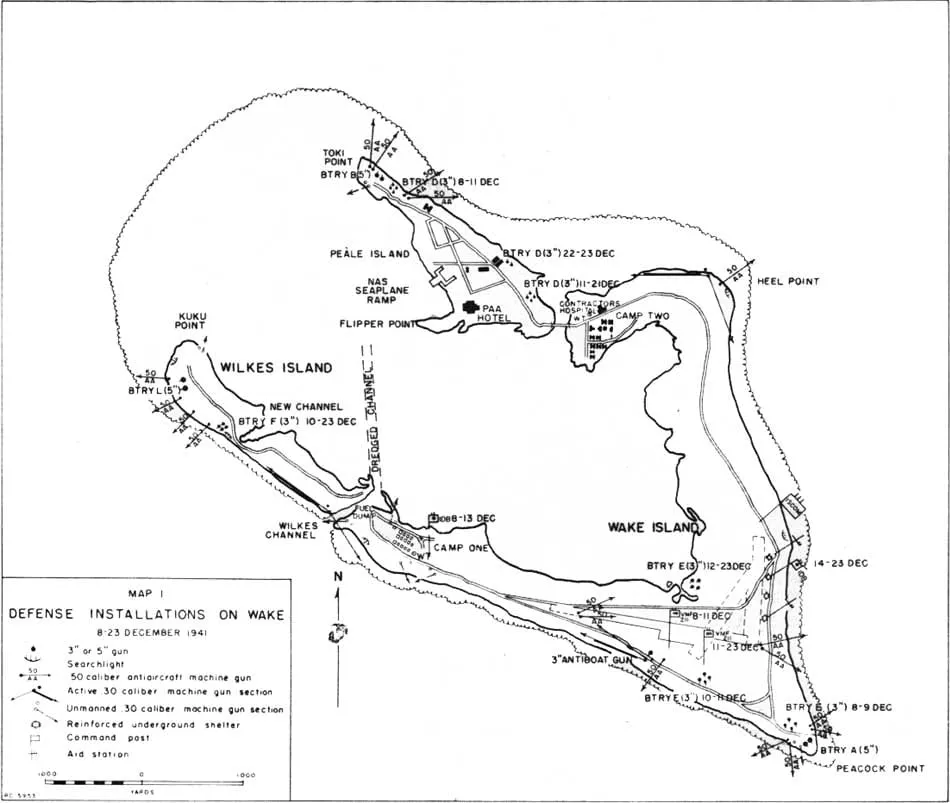
Wake is a V-shaped atoll made up of three low coral islands surrounding a shallow lagoon: Wake (the apex and arms of the V) and Wilkes and Peale (its tips). Its land area is about 6.5 km², rising barely a few metres above the sea. The United States took possession of the atoll on 17 January 1899, at the time of the annexation of Hawaii and Guam. In 1935 Pan American World Airways built a seaplane base and a small hotel on Peale: Wake became one of the stops for the transpacific “Clipper” flying boats on the route from San Francisco via Honolulu, Midway and Wake to Guam and Manila.
The atoll’s position also had military significance. Wake lies roughly two-thirds of the way from Hawaii to Guam and about 1,100 km north of the Marshall Islands, which Japan had administered since the First World War as a mandated territory and had been quietly fortifying since the 1930s. In 1938 an American board under Admiral Arthur Hepburn recommended building a base on Wake for patrol planes that would keep watch on the Japanese fleet in the Marshalls. Work began only in January 1941: a consortium of civilian construction firms led by Morrison-Knudsen brought some 1,150–1,200 workers to the atoll, who built an airfield, a seaplane base and a future submarine base.
Defence long remained a secondary matter. Admiral Husband Kimmel, Commander-in-Chief of the Pacific Fleet from February 1941, pressed for Wake to be garrisoned. Some historians see in his plans the idea of using the atoll as bait to draw the Japanese fleet to a place favourable to the American fleet. On 19 August 1941 the first detachment of the 1st Defense Battalion of the Marine Corps landed, and on 15 October Major James Devereux took command of it. The plan provided for three coast-defence batteries, four anti-aircraft batteries and two radar sets; in December there was less than half a battalion on the island, and the radars never arrived at all. On 28 November Commander Winfield Scott Cunningham, a naval aviator, arrived on Wake and, as the senior officer, took command of the whole atoll.
In those same days Kimmel, warned by Washington that war might break out at any moment, decided to reinforce the outlying atolls with aircraft. Vice Admiral William Halsey’s carrier Enterprise took on board twelve new Grumman F4F-3 Wildcat fighters of Major Paul Putnam’s Marine squadron VMF-211 and flew them off near Wake on 4 December. That is why Enterprise was not in harbour on 7 December when the attack on Pearl Harbor came. The pilots barely knew their new aircraft, and the airfield had no revetments, no spare parts and no experienced mechanics.
For Japan, Wake was a secondary objective, but not one that could be ignored. The war plan provided for Vice Admiral Shigeyoshi Inoue’s 4th Fleet, based at Truk, to take Guam, the Gilbert Islands and Wake in the first days. The order to begin operations was passed to the fleets by the “Niitakayama nobore” signal of 2 December. The capture of Wake was entrusted to Rear Admiral Sadamichi Kajioka, commander of the 6th Destroyer Squadron, and the preparation of the air attack to the 24th Air Flotilla on Roi island in Kwajalein Atoll.
Opposing forces
According to the American official history, on 8 December there were 449 Marines on the atoll, including 61 men of VMF-211, as well as 68 sailors from the naval air station under construction, five Army signalmen and one sailor from the submarine Triton who had been left on the island because of illness. Most of the sailors and signalmen had no weapons. The artillery consisted of six 5-inch (127 mm) guns, once removed from the battleship Texas, in three coast-defence batteries: A at Peacock Point on Wake Island, B at Toki Point on Peale and L at Kuku Point on Wilkes. Air defence relied on twelve 3-inch (76 mm) guns and a few dozen machine guns. There were enough men to crew only some of the positions; there was almost no infantry to defend the beaches. The air component consisted of VMF-211’s twelve Wildcats. Also on the island were about 1,150 civilian contractor’s workers and about seventy Pan Am employees, including several dozen Chamorros from Guam.
The Japanese relied above all on land-based aircraft. Mitsubishi G3M bombers from Roi, more than 1,100 km away, usually arrived at midday, while Kawanishi H6K flying boats from Majuro and Wotje bombed at night and at dawn. Kajioka’s invasion force initially consisted of the light cruiser Yūbari (flagship), two old light cruisers, Tenryū and Tatsuta, six destroyers of the Kamikaze and Mutsuki classes, two old destroyers converted into patrol boats for carrying landing troops (Nos. 32 and 33), two transports and submarines. The landing force numbered only about 450 men of the Maizuru 2nd Special Naval Landing Force. If necessary, the destroyers’ crews were also to go ashore.
Course of the battle
The first air raid (8 December)
News of the attack on Oʻahu reached Wake at about 6.50 a.m. on 8 December: an Army radio operator picked up a desperate, uncoded message from Hickam Field. Devereux sounded the alarm, and the Pan Am flying boat “Philippine Clipper”, which had taken off for Guam ten minutes earlier, was called back to the lagoon. Four Wildcats patrolled the sky north of the atoll. Putnam did not manage to disperse the other eight: the aircraft revetments were still being built, and taxiing the machines over the rough coral ground risked damaging them, which a squadron without spare parts could not afford.
At 11.58 a.m., according to the American official history, 36 Japanese bombers from Roi emerged from a rain squall at about 600 metres. The patrol had not spotted them, as they flew beneath it, and there was no radar on the island. Within minutes bombs and machine-gun fire had destroyed seven of the eight Wildcats on the ground and damaged the eighth, set the aviation fuel tanks ablaze and flattened the squadron’s camp. Of the 55 aviation personnel present at the aircraft, 23 were killed or died by morning and 11 were wounded. Bombs also fell on the Pan Am base on Peale, killing several of the airline’s employees, mostly Chamorros. The Japanese lost no aircraft, although anti-aircraft fire damaged several. In the afternoon the “Philippine Clipper”, riddled with bullets but still airworthy, left for Midway with its passengers and Pan Am’s white employees. The Chamorros remained on the island and later helped the defenders.
That day, landing after a patrol, Captain Henry Elrod damaged his propeller on debris on the runway. VMF-211 was left with three serviceable aircraft. Mechanics, helped by civilian volunteers, later assembled further machines from the wrecks.
Preparations for the landing (9–10 December)
The bombers returned before noon on 9 December. This time they hit the workers’ camp: the contractor’s hospital, where the previous day’s wounded lay, burned down, and barracks, workshops and storehouses were destroyed. The Wildcats shot down their first Japanese bomber, and the anti-aircraft guns hit several more. Devereux assumed that the Japanese had photographed his positions, so during the night the troops and about a hundred civilian volunteers moved an anti-aircraft battery to a new site and set up wooden dummies in the old one. The next day the bombs fell on the dummies. On 10 December a raid on Wilkes blew up explosives stored there by the contractor and destroyed the ammunition of the local anti-aircraft battery. During the night of 10–11 December the submarine Triton, patrolling south of Wake, fired four torpedoes at a Japanese ship from the invasion force’s screen. They were the first American torpedoes fired in the war; no hit was confirmed.
The landing repulsed (11 December)
Kajioka was convinced that three days of bombing had broken the defence. Just before 3 a.m. on 11 December observers on Wake made out the silhouettes of ships on the southern horizon. Devereux, followed by Cunningham, issued the order that was kept for the hours that followed: hold fire, keep the searchlights off, let the enemy come as close as possible and do not reveal that the coast batteries had survived. At about 5.30 a.m. Yūbari and the two old cruisers began shelling the south shore, setting the diesel oil tanks on fire.
At 6.15 a.m., when Yūbari had closed to about 4–5 kilometres, the order to open fire was given. Battery A at Peacock Point, despite its damaged rangefinder, hit the cruiser several times according to its commander’s account; Japanese records speak of light damage. Battery L on Wilkes shot even more effectively. The destroyers had closed to less than 4 kilometres from the shore, and at 6.52 a.m., after the third salvo, the leading destroyer, Hayate, blew up, broke in two and sank within two minutes. According to Japanese figures, one man was saved from her crew of about 170. She was the first Japanese surface warship lost in the Pacific War. Battery L also hit the destroyer Oite and a transport. At 7 a.m. Kajioka ordered a withdrawal to Kwajalein.
Then the four surviving Wildcats, armed with 100-pound bombs, attacked the retreating ships. At about 7.30 a.m. the destroyer Kisaragi, which was carrying depth charges, blew up and sank with all hands – 157 men, according to Japanese figures. She is most often credited to Elrod’s bomb, although the American official history notes that this is not certain. The airmen also damaged both old cruisers, patrol boat No. 33 and the transport Kongō Maru. Two Wildcats came back so badly shot up that one had to be written off. On the American side there were only a few wounded that morning.
The Japanese lost two destroyers and, by various calculations, from about 340 to more than 400 killed and wounded. It was their first defeat in the war with the United States, and the only landing in the first weeks of the Japanese offensive in the Pacific that the defenders managed to repulse before it reached the shore.
The siege from the air (12–22 December)
After the defeat of 11 December the Japanese decided first to destroy the defences from the air and then to return in greater strength. Almost every day, usually at noon, between a dozen and several dozen bombers from Roi came over the atoll, while flying boats bombed at dawn and by night. The defenders shot down individual aircraft, but lost guns, equipment, men and more Wildcats. The only Japanese loss under water was the submarine Ro-66, which sank with 63 men on 17 December after colliding with Ro-62.
In the United States the defence of Wake quickly became a legend. The press reported that when the atoll’s commander was asked what he needed, he replied: “Send us more Japs.” In reality Cunningham was sending Pearl Harbor long lists of missing equipment: gunsights, spare parts, radar. According to the most commonly cited explanation, the words “send us” and “more Japs” were added by a communications officer at the beginning and end of one of the reports as so-called padding, to make the cipher harder to break, and at Pearl Harbor they were read as part of the text. Both Cunningham and Devereux denied ever having said any such thing.
On 20 December, the only day without an air raid, an American PBY Catalina flying boat landed in the lagoon – Wake’s first contact with the outside world since the start of the war. It brought news of the approaching relief force and an order to prepare most of the civilians for evacuation. The next morning it flew off with dispatches and Major Walter Bayler, the last Marine to leave Wake before its fall.
The second Japanese invasion force sailed from Roi on the morning of 21 December; according to some accounts the Japanese, alarmed by intercepted radio traffic from the flying boat, brought the landing forward by a day. Already, after the defeat of 11 December, Admiral Isoroku Yamamoto’s Combined Fleet headquarters had assigned Kajioka reinforcements from the force returning from Hawaii: Vice Admiral Chūichi Nagumo detached Rear Admiral Tamon Yamaguchi’s 2nd Carrier Division, Sōryū and Hiryū, with two heavy cruisers, Tone and Chikuma, and destroyers. On 21 December carrier aircraft appeared over Wake for the first time – several dozen bombers with a fighter escort; after them came bombers from Roi. On 22 December the last two serviceable Wildcats, flown by Captain Herbert Freuler and Second Lieutenant Carl Davidson, threw themselves at an incoming raid escorted by Mitsubishi A6M Zero fighters. Davidson did not return, and the wounded Freuler barely managed to land his wrecked machine. VMF-211 had no aircraft left; its surviving airmen and mechanics became infantry.
The relief that never arrived
At Pearl Harbor a plan to help Wake was drawn up in the first days after the attack. Kimmel decided to send to the atoll the seaplane tender Tangier, converted into a transport, with units of the 4th Marine Defense Battalion, radars, guns, thousands of rounds and supplies, together with the Marine fighter squadron VMF-221 with its Brewster F2A Buffalo aircraft on board the carrier Saratoga. Saratoga, however, was coming from San Diego and did not reach Pearl Harbor until 15 December. That day Tangier sailed with the slow oiler Neches, which could make no more than 12 knots, and on 16 December the carrier followed with three heavy cruisers and nine destroyers. Task Force 14 was commanded by Rear Admiral Frank Jack Fletcher. Task forces built around the carriers Lexington and Enterprise were to support the operation from further off.
On 17 December Kimmel was relieved. Until the arrival of Admiral Chester Nimitz, who took command of the Pacific Fleet only on 31 December, the fleet was temporarily directed by Vice Admiral William Pye, a more cautious man than his predecessor. Fletcher’s force, held back by Neches, made slow progress. On 22 December, instead of heading straight for Wake, Fletcher spent the whole day refuelling his destroyers in heavy seas; he judged that in the event of a battle their fuel would be too low. Meanwhile, reports were reaching Pearl Harbor of Japanese carriers near the atoll.
During the night of 21–22 December, Hawaiian time, Pye conferred with his staff. Sending Tangier to Wake with two Japanese carriers present risked the loss of Saratoga, one of the three carriers the United States had left in the Pacific – and this two weeks after the disaster at Pearl Harbor. At 8.11 a.m. Hawaiian time, when on Wake it was already the morning of 23 December and fighting was raging on the beaches, Pye recalled the relief force. Saratoga was then some 425 nautical miles (nearly 800 km) from the atoll. The order was received aboard the ships with anger and shame. The force turned back, and on the return voyage, on 25 December, Saratoga delivered VMF-221’s aircraft to Midway. Historians still judge Pye’s decision differently: some see it as a lost opportunity and a failure of nerve, others as sensible caution, since the relief force would have arrived after Wake had fallen and straight into the path of two experienced carriers and heavy cruisers.
The second landing and surrender (23 December)
Kajioka’s second force was far stronger than the first. In addition to the ships that had survived 11 December, it had distant cover from the four heavy cruisers of the 6th Cruiser Division (Aoba, Kinugasa, Kako and Furutaka), and was supported from the north by Yamaguchi’s carriers. The landing force numbered about 1,500 men, including about 1,000 of the Maizuru 2nd Special Naval Landing Force, reinforced from Saipan. This time the Japanese had no intention of duelling with the batteries. The plan called for a night landing without preliminary bombardment: the two old destroyers, patrol boats Nos. 32 and 33, were to run at full speed onto the reef off the south shore of Wake Island, near the airfield, while landing barges put troops ashore on Wilkes and on Wake.
The landing began at about 2.35 a.m., according to official Japanese time, in a high surf and in darkness. The patrol boats ran aground on the reef. Second Lieutenant Robert Hanna, with one Marine and three civilian volunteers, ran to an unmanned 3-inch gun near the airfield and set both ships on fire from a range of a few hundred metres. Major Putnam, with some twenty men of VMF-211, mostly mechanics, took up position around the gun to shield it from Japanese attack. They fought there until morning; among those killed was Captain Elrod, who, now an infantryman, defended the position rifle in hand. He was awarded a posthumous Medal of Honor; he is regarded as the first airman to receive it for actions in the Second World War.
The Japanese, outnumbering the defenders several times over, spread through the scrub and cut the telephone cables; in his command post Devereux lost contact first with Wilkes, then with the airfield and then with the south shore, and did not know which positions were still holding. At 5 a.m. Cunningham sent a report to Pearl Harbor: “Enemy on island, issue in doubt.” At dawn carrier aircraft appeared over the atoll, and Japanese ships closed in on the shore.
In fact the defence was not collapsing everywhere. On Wilkes about a hundred men of the Takano company landed by the new channel and seized an anti-aircraft gun position, but at dawn Captain Wesley Platt gathered a few dozen men, including sailors and civilians, and with a counter-attack from two sides wiped out almost the whole detachment; he took two wounded Japanese prisoner. At Camp 1 Second Lieutenant Arthur Poindexter, with the reserve and the cooks, sailors and civilians attached to it, held his positions. But on Wake Island itself the main Japanese forces had taken the airfield area and were attacking the command post, and there were no rifles or men left for a counter-attack.
At about 7 a.m. Devereux reported the situation to Cunningham and asked whether any help was on its way. Cunningham already knew that the relief force had been turned back. Considering the more than a thousand defenceless civilians on the atoll and the inevitability of defeat, he decided to surrender. At about 8 a.m. Devereux set off with a white flag along the coast road towards the Japanese positions, and then for several hours went from position to position accompanied by a Japanese officer, ordering his men to lay down their arms. The last of them, Platt’s men on Wilkes, who after their victory had been advancing eastwards, saw Devereux with the white flag only just after 1.30 p.m. The fighting on land had lasted about eleven hours.
Losses
The casualty figures vary from source to source. According to American tallies, 49 Marines were killed during the whole defence (almost half of them in the first air raid on 8 December), two went missing and 49 were wounded; three sailors and about seventy civilians, including ten Chamorros, were also killed. All twelve Wildcats were lost. About 1,600 people were taken prisoner: between about 430 and 470 servicemen, according to different tallies, and about 1,150 civilians.
Japanese losses are less well known. Certain are the two destroyers sunk on 11 December, from which one man was saved, the two patrol boats wrecked on the reef on 23 December and the submarine Ro-66, lost in an accident. Several other ships were damaged, as were a few dozen aircraft. The destroyers alone cost the Japanese more than three hundred dead. Early American estimates spoke of about 820 killed and 333 wounded in the whole battle, and the Marine Corps official history of 1947 held that Japanese losses “easily exceeded a thousand” killed and wounded. Japanese records give much lower figures for the landing of 23 December alone – about 140 killed and wounded in the landing units. All sources agree that the attacker’s losses were many times greater than the garrison’s combat losses.
The fate of the prisoners and civilians
The Japanese held the prisoners on the island for several weeks; for the first days they were bound and crowded together on the airfield. On 12 January 1942 the ship Nitta Maru took most of them, about 1,200 people, to Yokohama and from there to a camp at Woosung near Shanghai. On the voyage, on the orders of the officer in charge of the transport, five prisoners chosen at random were beheaded “in revenge” for the losses suffered at Wake. Cunningham twice tried to escape from captivity and was caught each time. Most of the defenders survived the war in camps in China and Japan, where among other things they worked in mines.
Several hundred civilians were left on Wake to finish building the fortifications – this time for the Japanese. Some were later shipped to Japan; some died. When aircraft from American carriers bombed the island on 5–6 October 1943, the Japanese commander of the atoll, Rear Admiral Shigematsu Sakaibara, fearing a landing, had the 98 remaining civilian prisoners shot on 7 October. One of them escaped and carved the inscription “98 US PW 5-10-43” on a coral rock; he was soon caught and beheaded. The Japanese garrison, cut off and starving, surrendered only on 4 September 1945. Sakaibara admitted the crime and was executed on Guam in 1947.
Significance
Militarily, Wake was an episode. Japan held the atoll until the end of the war, and the Americans never tried to retake it: from February 1942 they bombed it several times from carriers and then left the isolated garrison to its own devices, so that Japanese soldiers there died more from hunger than from bombs.
Its moral significance was much greater. In December 1941 Americans read in their newspapers almost nothing but defeats: Pearl Harbor, the loss of Guam, the destruction of the air force in the Philippines and the sinking of the British capital ships off Malaya. Wake was the one place where the enemy had been held, if only for two weeks, and where his ships had been sunk. The press, and in 1942 the Hollywood film Wake Island, in which the defenders die to the last man, made the atoll an American Alamo. The legend, headed by the supposed “Send us more Japs”, obscured the reality: that the garrison surrendered, that most of it survived captivity, and that the people of Wake who suffered most were the civilian workers, who had had nothing to do with the war.
The battle also exposed the weakness of the American fleet in the first weeks of the war. The recall of the relief force, decided by a temporary commander in the days of the change of command after the disaster at Pearl Harbor, became one of the most contested decisions of the period and for years weighed on the reputations of Pye and Fletcher. For the Japanese, the first defeat at Wake was a warning against underestimating the enemy: Kajioka returned to the atoll only with carriers, heavy cruisers and a landing force three times larger.