1941–1945: The partisan war in Yugoslavia
Belgrade offensive
- Dates:
- 28 September – 20 October 1944
- Front:
- Balkans
- Location:
- Eastern and central Serbia: from the Danube at the Iron Gates and the Timok valley, through the mountains of eastern Serbia, the Morava valley and Šumadija, to Belgrade; on the flanks, Niš and Leskovac in the south and the Banat with Pančevo in the northOn the battle map →
- Sides:
- Soviet UnionFyodor Tolbukhin, Sergei Biryuzov, Nikolai Gagen, Vladimir ZhdanovYugoslaviaJosip Broz Tito, Peko Dapčević, Koča PopovićBulgariaKiril StanchevNazi GermanyMaximilian von Weichs, Hans Felber, Wilhelm Schneckenburger, Walter Stettner
- Result:
- Soviet-Yugoslav victory. The German Army Detachment Serbia was routed and its grouping from Smederevo destroyed. On 14 October partisans and Bulgarians took Niš, and on 20 October Soviet and Yugoslav troops captured Belgrade. Army Group E, retreating from Greece, lost its route through the Morava valley and had to fight its way through the mountains of the Sandžak and Bosnia. Belgrade became the seat of Tito's government.
- Author:
- Łukasz
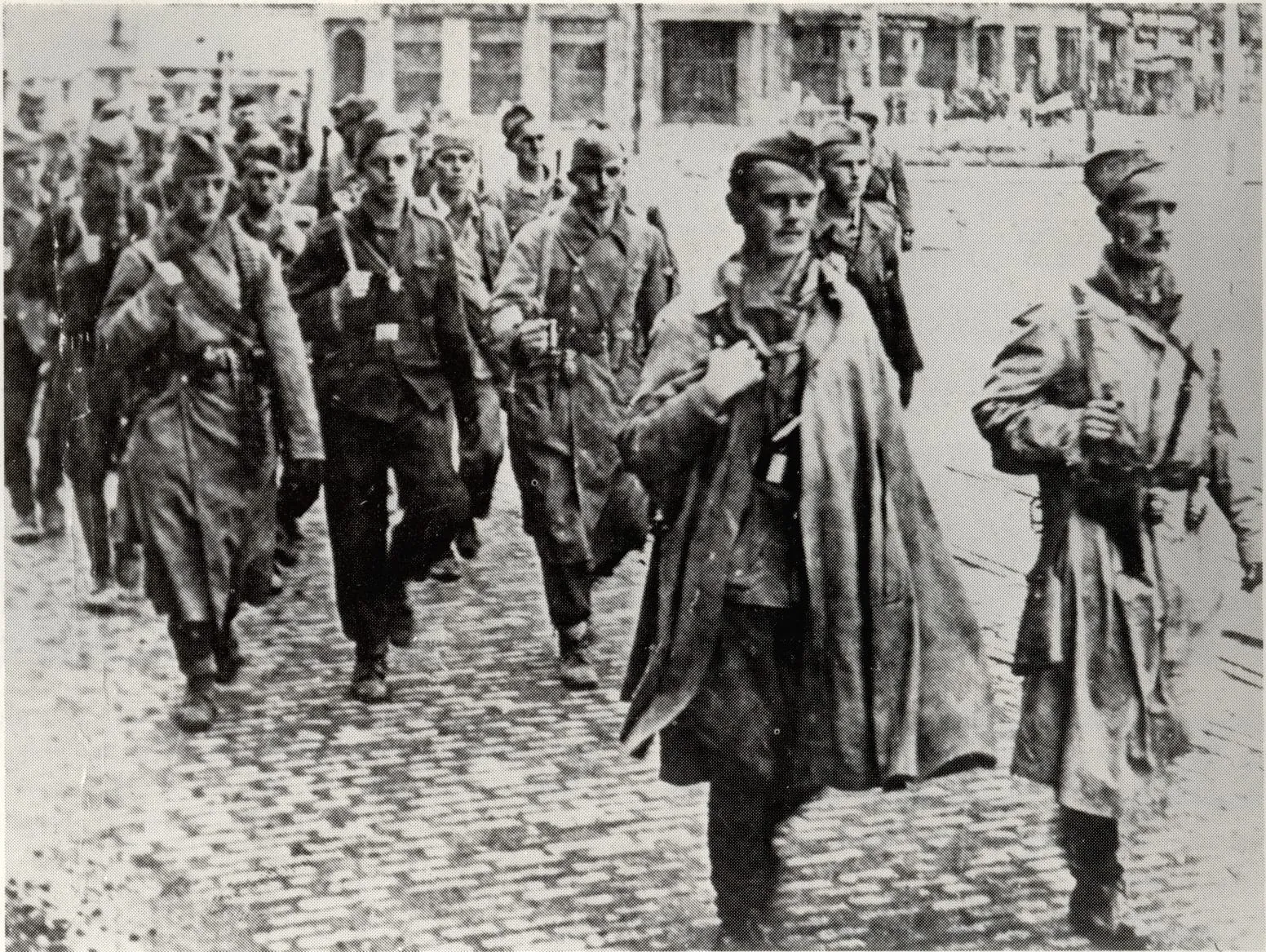
The Belgrade offensive (Serbian Beogradska operacija, Russian Белградская стратегическая наступательная операция) was a joint offensive by the Soviet 3rd Ukrainian Front, the Yugoslav National Liberation Army and Bulgarian forces, fought from 28 September to 20 October 1944 against the German forces in Serbia. In three weeks the Soviet 57th Army crossed the Danube and the mountains of eastern Serbia, the tanks of the 4th Guards Mechanised Corps, together with the partisan 1st Proletarian Corps, struck at Belgrade from the south, and the Bulgarian army and the partisans took Niš. After a week of street fighting the Yugoslav capital was liberated on 20 October. The operation cut the main line of retreat of the German Army Group E from Greece and ensured that Serbia – the only large region of the country where Josip Broz Tito’s partisans had so far been weak – passed into the hands of the communist authorities.
Name and dates
Soviet historiography treats the operation as a single “strategic offensive operation”, which began on 28 September and ended on 20 October 1944, the day the fortress on the Kalemegdan was taken. Yugoslav and Serbian military literature uses the same dates, notably the monograph Beogradska operacija (1964), written jointly by the Soviet general Sergei Biryuzov, in 1944 chief of staff of the 3rd Ukrainian Front, and the Yugoslav military historian Rade Hamović. Some Western studies stretch the operation from mid-September (the first Soviet air raids on Serbian railway lines) to the end of November 1944, including the fighting for the bridgeheads on the Danube and the Morava.
The offensive is usually divided into two stages. In the first (28 September – 10 October) the 57th Army, supported by the partisan 14th Corps, broke through the German defences on the Bulgarian-Yugoslav border and along the Danube, crossed the mountains of eastern Serbia and seized bridgeheads on the west bank of the Great Morava. In the second (11–20 October) the 4th Guards Mechanised Corps went into action through these bridgeheads and, together with the Yugoslav 1st Proletarian Corps and 12th Corps, struck at Belgrade. At the same time, on the southern flank, the Bulgarian Second Army and the partisan 13th Corps advanced on Niš and Leskovac, while on the northern flank the 46th Army of the 2nd Ukrainian Front cleared the Germans from the Banat on the left bank of the Danube.
Background
The Germans in Serbia and the partisans
After Yugoslavia’s defeat in April 1941, Serbia came under German military occupation, with General Milan Nedić’s collaborationist government in Belgrade. In the autumn of 1941 the uprising in Serbia was crushed, and Tito’s partisans and the Chetniks of Draža Mihailović parted ways in open civil war. The main partisan forces moved to Bosnia and Montenegro, where they survived successive German offensives, including the Battle of the Sutjeska in 1943. In Serbia itself the Chetniks had the upper hand, and the German garrison was small – according to the German historian Klaus Schmider, in the summer of 1944 it numbered only about 10,000 men.
In November 1943 the second session of AVNOJ at Jajce set up the National Committee for the Liberation of Yugoslavia, which Tito presented as a provisional government. In the spring and summer of 1944 Tito, now backed by the British rather than Mihailović, moved experienced divisions into Serbia from Bosnia, the Sandžak and Montenegro. After failed German anti-partisan operations on the borderlands of Montenegro, Serbia and Albania, several partisan divisions crossed the Ibar in July and August and established themselves in western and southern Serbia. On 1 September the partisans and Allied aircraft began coordinated attacks on railway lines and bridges throughout Yugoslavia (Operation Ratweek), which paralysed German transport. The 1st Proletarian Corps took Valjevo on 18 September and Aranđelovac on 20 September, gaining control of a large area south and south-west of Belgrade.
The collapse of the Axis in the Balkans
Serbia’s fate, however, was decided by events in the east. The defeat of the German Army Group South Ukraine in the Jassy–Kishinev offensive and the coup in Romania on 23 August opened the way for the Red Army to the lower Danube. On 8 September the Red Army entered Bulgaria, and a day later a coup brought to power the Fatherland Front government of Kimon Georgiev, which declared war on Germany. The Bulgarian troops that had until then been occupying Macedonia and part of Serbia withdrew home, and the reconstituted Bulgarian armies were placed under the operational command of the 3rd Ukrainian Front.
The German command in the Balkans – the Commander-in-Chief South-East, who was also commander of Army Group F, Field Marshal Maximilian von Weichs, with his headquarters in Belgrade – found itself in a hopeless position. Hitler agreed to the withdrawal from Greece, the Aegean islands and Macedonia of General Alexander Löhr’s Army Group E, several hundred thousand strong (including the island garrisons and rear-area units). Its main line of retreat ran from Skopje through Niš and the Morava valley to Belgrade and on to Hungary. Holding Serbia, and especially the Salonika–Belgrade railway, became the condition for saving the whole force. To defend it, an improvised Army Detachment Serbia (Armeeabteilung Serbien) was formed under General Hans Felber, Military Commander South-East. The 1st Mountain Division was moved from Montenegro to eastern Serbia, and the 7th SS Volunteer Mountain Division Prinz Eugen to the south-east of the country; they were supplemented by Brandenburg regiments, police units and soldiers withdrawn from Romania and Bulgaria. Reinforcements from Greece got through only with difficulty: of the 44 trains on which the 117th Jäger Division left Athens on 19 September, only seventeen had reached Belgrade by 8 October.
Tito’s agreement with Stalin
On the night of 18/19 September Tito secretly left the island of Vis without the knowledge of his British liaison officers; on 21 September he arrived in Red Army-occupied Romania and from there flew to Moscow, where he met Joseph Stalin for the first time. It was agreed that Soviet troops would enter eastern Serbia and take part in the fighting for Belgrade, and would leave Yugoslavia once the operation was over; in the areas where they were stationed, civil authority was to be exercised by the administration of the National Liberation Committee. Tito also agreed – reluctantly, given fresh memories of the Bulgarian occupation – to the participation of Bulgarian troops in the operation. On 28 September, the day the offensive began, the Soviet news agency TASS issued a communiqué stating that the Committee had requested permission for Soviet troops to enter temporarily and that the Soviet side had granted it. Historians point out that the communiqué amounted to de facto recognition of Tito’s committee as the government of Yugoslavia, while also serving Moscow as a convenient statement to the Western Allies.
Opposing forces
Marshal Fyodor Tolbukhin’s 3rd Ukrainian Front committed to Serbia Lieutenant General Nikolai Gagen’s 57th Army (64th, 68th and 75th Rifle Corps), Lieutenant General Vladimir Zhdanov’s 4th Guards Mechanised Corps, brought over from Bulgaria, the 17th Air Army and Rear Admiral Sergei Gorshkov’s Danube Flotilla. From the north, from the Romanian Banat, Lieutenant General Ivan Shlemin’s 46th Army of the 2nd Ukrainian Front advanced. According to Russian studies, the 57th and 46th Armies alone had some 190,000 men. The 4th Guards Mechanised Corps, the main striking force, had, according to the Yugoslav monograph, 160 tanks, 21 self-propelled guns and 31 armoured cars.
On the Yugoslav side two army groups took part in the operation. The first, made up of the 1st Proletarian Corps and the 12th Corps, was commanded by General Peko Dapčević and attacked Belgrade from the west and south. The second, with the 13th and 14th Corps, was commanded by General Koča Popović; the 14th Corps operated in eastern Serbia behind German lines ahead of the 57th Army, and the 13th Corps together with the Bulgarians on the Niš axis. The Yugoslav divisions were numerous but armed mainly with light weapons, which was why they were paired with the heavily armed Soviet corps in the main thrust. In the south, on the sector between Vranje and Zaječar, General Kiril Stanchev’s Bulgarian Second Army attacked, supported by an armoured brigade; in all, the three Bulgarian armies on the Yugoslav border numbered some 340,000 men at the beginning of October.
The German forces in Serbia are hard to count, as they consisted largely of improvised battle groups, police units, guard battalions and stragglers from Romania and Bulgaria. Russian literature gives a figure of about 400,000 men for the whole German force in the Balkans and about 200,000 for Yugoslavia, but these figures also include units far from the battlefield. Collaborationist formations also fought on the German side: Nedić’s Serbian State Guard and the Russian Protective Corps, while in many places the Chetniks were bound to the Germans by local non-aggression agreements.
Course of the operation
The Iron Gates and the mountains of eastern Serbia
The race for the Danube line began even before the formal start of the operation. On 7 September the partisan 23rd Division took Zaječar, and on 12 September it entered Negotin; the same day a Yugoslav delegation crossed the Danube to the Romanian bank and made contact with the Soviet 75th Rifle Corps. The German 1st Mountain Division, however, retook Zaječar and reached the Danube. On 22 September elements of the 75th Corps crossed the river in the area of the Iron Gates, but a counter-attack by the mountain troops drove them back to the Romanian bank.
The 57th Army’s offensive proper began on the night of 27/28 September. The 68th Rifle Corps forced the Timok on the border and struck from the Vidin area towards Negotin and Zaječar, the 75th Corps renewed its attack across the Danube, and the Danube Flotilla covered the right flank, ferried troops and equipment and put landing parties ashore near Radujevac and Prahovo. Behind German lines the partisan 14th Corps cut roads and communications, and the commander of the 57th Army sent his chief of staff, General Verkholovich, to its headquarters to coordinate operations. On 30 September Soviet troops took Negotin. The fighting broke up into a series of clashes for small towns, crossroads and passes, in which the Germans fell back step by step: the crossroads at Rgotina fell on 1 October, Štubik on 2 October, and on 3 October the Soviet 223rd Rifle Division and Serbian partisan brigades took Bor and its copper mine, where – according to Yugoslav literature – some 1,700 forced labourers, most of them Hungarian Jews, were freed.
By 4 October the German forces facing the 57th Army had broken up into three battle groups cut off from one another, the strongest of which was that of General Walter Stettner, commander of the 1st Mountain Division. The Soviet command did not stop to destroy them but sent motorised units deep into the country. The 5th Motorised Brigade covered about 120 kilometres from Negotin in twenty-four hours and on 8 October reached the valley of the Great Morava; on 9 October an assault group of the 93rd Rifle Division seized an intact bridge near the village of Donja Livadica, and by 10 October bridgeheads had been established on the west bank of the river around Velika Plana and Palanka. On 7 October the 64th Corps, with the partisan 45th Division, took Zaječar after heavy fighting.
German countermeasures
On 5 October Weichs moved the headquarters of Army Group F from Belgrade to Vukovar; Felber and the commander of the capital’s defences, General Wilhelm Schneckenburger, stayed in the city. On 2 October General Friedrich-Wilhelm Müller took over the front south of the Danube, with his headquarters at Kraljevo. On 10 October the German command had to admit that the Red Army had broken through to the Morava valley and that the 1st Mountain Division, still tied down in eastern Serbia, was in danger of being cut off. There was nothing with which to close the breach: reinforcements from Greece were stuck in Macedonia, and the Second Panzer Army, which was at the same time losing town after town to the partisans in Bosnia and Dalmatia, could send to Belgrade only two battalion groups of the 118th Jäger Division. Individual units were flown into the capital, among them the Rhodes Assault Battalion (Sturmbataillon Rhodos), without heavy weapons.
The flanks: Niš and the Banat
In the south the Bulgarian Second Army advanced on Niš and Leskovac, running almost at once into the Prinz Eugen Division. Together with the partisans, the Bulgarians routed Chetnik and Serbian State Guard units near Vlasotince; on 8 October the Bulgarian armoured brigade broke through the German positions at Bela Palanka, and on 12–13 October, together with the partisan 47th Division, it took Leskovac. On 14 October Bulgarian troops from the south and the partisan 13th Corps from the north and west captured Niš – the junction through which the main railway from Salonika to Belgrade ran. The Prinz Eugen Division suffered heavy losses, and Army Group E lost its most important rail and road links to the north.
On the northern flank the 46th Army’s 10th Guards Rifle Corps took Vršac and Bela Crkva in the Banat and on 6 October reached Pančevo. On the night of 9/10 October its 109th Rifle Division, together with a partisan brigade, crossed the Danube near Starčevo, threatening Belgrade from the north-east. Further north the corps of the 46th Army were crossing the Tisza and approaching Novi Sad, already preparing the coming offensive into Hungary.
The road to Belgrade
On 12 October the 4th Guards Mechanised Corps, which had come from Vidin via Zaječar, crossed the Morava and met units of the partisan 21st Division at Natalinci, east of Topola. Between Kragujevac and the Sava the Germans now held only isolated strongpoints at Šabac, Obrenovac, Topola and Mladenovac (PL); the areas between them were controlled by the partisans. On the main axis, from Topola towards Belgrade, the Soviet 36th Tank Brigade with the 13th and 14th Guards Mechanised Brigades and the partisan 1st, 5th and 21st Divisions advanced; Yugoslav soldiers often rode on the hulls of Soviet tanks. Topola and Mladenovac fell after brief joint attacks, and the 15th Guards Mechanised Brigade, with a partisan brigade, broke through on the right flank towards the Danube and late in the evening of 13 October reached the river at Boleč.
The German forces were thus split in two: the Belgrade garrison, and Stettner’s grouping (the remnants of the 1st Mountain Division, a Brandenburg regiment and other units) withdrawing from eastern Serbia in the Smederevo area. The heaviest fighting on the approaches to the capital took place on 12–13 October for Mount Avala, south of the city. There, on 12 October, General Schneckenburger was mortally wounded; according to German records he died the next day at Beli Potok (some accounts wrongly state that he was killed on 14 October, the day the assault on the city began).
The fighting in the city
On 14 October Zhdanov’s tanks and Dapčević’s partisans broke into the southern suburbs of Belgrade. The Yugoslavs advanced along the roads south of the Sava, the Soviet 13th Mechanised Brigade headed for the main railway station and the Sava bridges, and on 15 October the 36th Tank Brigade broke through the city centre to the Danube. The assault was halted, however, because substantial forces had to be turned back against Stettner’s grouping, which – about 20,000 strong according to Soviet figures – was trying to break through from Smederevo to Belgrade. On 16–17 October it was encircled in the Avala area and by 19 October destroyed; General Stettner was killed on 18 October. Only some of his men managed to reach the Sava and get across to the far bank.
From 18 October the fighting again concentrated on the capital. On the Soviet side the 263rd Rifle Division, brigades of the 4th Guards Mechanised Corps and several artillery brigades fought there, among others; on the Yugoslav side, units of seven divisions. The German defence was based on fortified buildings in the centre and on a bridgehead covering the Sava bridges, which was fought over for four days. According to Soviet accounts, the use of heavy artillery and aircraft was restricted out of consideration for the Yugoslav allies, and sappers defused several hundred explosive charges with which the Germans had mined buildings and bridges. On 19 October there was fighting for the Albania Palace, the Hotel Moskva and the fortress on the Kalemegdan above the confluence of the Sava and the Danube. On the morning of 20 October Soviet tanks and partisans of the 1st Proletarian Division attacked the last German strongpoint in the fortress; by that evening the fighting in Belgrade was over. The remnants of the garrison withdrew across the Sava to Zemun, which the partisans took on 22 October.
Losses
Figures for losses come from different sources and cover different periods. According to the tallies of Grigori Krivosheev, cited by David Glantz among others, the Red Army lost 4,350 killed and missing and 14,488 wounded and sick in the Belgrade offensive (28 September – 20 October), a total of 18,838 men. According to the monograph by Biryuzov and Hamović, 2,953 Yugoslav soldiers were killed in the assault on Belgrade alone; Serbian sources state that about 960–976 Soviet soldiers were also killed in the fighting for the city. The Bulgarian Ministry of Defence puts the Bulgarian army’s losses in the fighting in Serbia in the autumn of 1944 at more than 3,000 killed, although this figure covers a longer period than the Belgrade offensive itself.
German losses cannot be established precisely. Soviet figures speak of 10,000 killed and 8,000 taken prisoner in the fighting for Belgrade and against Stettner’s encircled grouping alone; Western literature (Max Hastings among others) gives an estimate of about 25,000 killed, wounded and captured, including about 15,000 killed, for the operation as a whole. Neither the full losses of the collaborationist formations nor those of the civilian population of Belgrade are known; the city had also been bombed several times by Allied aircraft since April 1944.
Political consequences
The liberation of Belgrade sealed the fate of Serbia. General Nedić left the capital at the beginning of October and went to Austria; his government ceased to exist. Some of the Chetnik units that had fallen back on Belgrade were transported by the Germans to Kraljevo on 3–5 October, and Mihailović withdrew to Bosnia with the Chetnik units that remained loyal to him. Within a few weeks the Chetniks, who had enjoyed broad support among the Serbian peasantry, had been driven out of the region that had been their main base. At the end of October Tito moved his headquarters and the National Liberation Committee to Belgrade; the capital became the seat of the new government, and 20 October was later celebrated as the city’s liberation day.
Liberation was followed by repression. The Yugoslav Department for the Protection of the People (OZNA) arrested and shot real and alleged collaborators, political opponents and members of the old elites, often without trial or after summary proceedings. Serbian research conducted since 2009 puts the number of victims of this repression in central Serbia alone in 1944–1945 at about 30,000; the figure is disputed. In areas occupied by the Red Army there were also rapes and looting, about which the Yugoslav leadership complained in Moscow.
In line with the Moscow agreement, the troops of the 3rd Ukrainian Front turned north into Hungary once the operation was over; the Red Army set up no administration of its own in Yugoslavia, and its units left the country over the following months. Tito could later present the liberation of Yugoslavia as primarily the achievement of his own army, which the Red Army had helped in a single operation – something that set his position apart from that of countries where communist rule was installed by Soviet troops.
Significance and the further course of the war
The Belgrade offensive did not achieve all the aims set for it by the Soviet command: Army Group E was neither cut off nor destroyed. The loss of Niš and the Morava valley did, however, force it to retreat along the only remaining route – from Skopje through Kosovska Mitrovica, Kraljevo and Užice to Sarajevo. Weichs later called the fighting for this route decisive for the fate of the whole force. From 22 October the Germans held a bridgehead at Kraljevo against the Soviet 64th and 68th Corps, and stopped the Bulgarians short of Pristina. The retreat through the mountains of the Sandžak and Bosnia, harried by the partisans, cost Army Group E heavy casualties and almost all its heavy equipment; its first units reached the Drava only in February 1945, too late to strengthen the defence of Hungary.
The Yugoslav 1st Proletarian Corps pursued the Germans into Syrmia (Srem) west of Belgrade, where in December 1944 the front settled on what became known as the Syrmian Front, held by the Germans until April 1945. In November the Soviet 57th Army, with the Yugoslav 51st Division, crossed the Danube into Baranja, and this bridgehead served the 3rd Ukrainian Front as an assembly area before its advance on Budapest. On 17 October a Yugoslav military administration was introduced in Vojvodina, the Banat and Baranja, a period marked by reprisals against the local Germans and Hungarians.
For Yugoslavia the liberation of Belgrade meant that the partisans took power over the whole country and that the Chetniks were finally defeated. Tito’s agreement with Stalin of September 1944, which provided for the withdrawal of Soviet troops after the operation, allowed the Yugoslav communists to retain greater independence than the governments of other countries occupied by the Red Army. The monument to Soviet soldiers erected in the city centre in 1944 was removed in 1954, a few years after the split between Belgrade and Moscow, and the remains of the Red Army men buried beneath it were moved to the war cemetery. The joint Monument to the Liberators of Belgrade in the war cemetery holds the remains of more than 3,500 Yugoslav and Soviet soldiers killed in the fighting for the city. On 19 October 1964, on their way to the celebrations of the twentieth anniversary of the liberation, Marshal Biryuzov and Colonel General Zhdanov – the two commanders whose names were most closely associated with the Belgrade offensive – were killed when their aircraft crashed on Mount Avala.