1940–1941: The war in the Balkans
Invasion of Yugoslavia
- Dates:
- 6–17 April 1941
- Front:
- Balkans
- Location:
- Kingdom of Yugoslavia: Belgrade and the Morava valley, Niš, Skopje and the Vardar valley, Slovenia (Maribor, Celje, Ljubljana), Croatia and Slavonia (Zagreb, Osijek), Bosnia (Sarajevo), the Dalmatian coast and Montenegro, the Bačka and the BanatOn the battle map →
- Sides:
- Nazi Germany (with Italy and Hungary)Maximilian von Weichs, Wilhelm List, Ewald von KleistYugoslaviaDušan Simović, Danilo Kalafatović
- Result:
- Axis victory. After eleven days of fighting, on 17 April 1941, the unconditional surrender of the Yugoslav army was signed in Belgrade; it came into force at noon on 18 April. More than 300,000 soldiers were taken prisoner. King Peter II and General Simović's government fled into exile via Greece. The Yugoslav state was dismembered: the Independent State of Croatia was set up in Zagreb under the rule of the Ustaše, Serbia was placed under German military occupation, and the remaining lands were shared out among Germany, Italy, Hungary and Bulgaria.
- Author:
- Łukasz
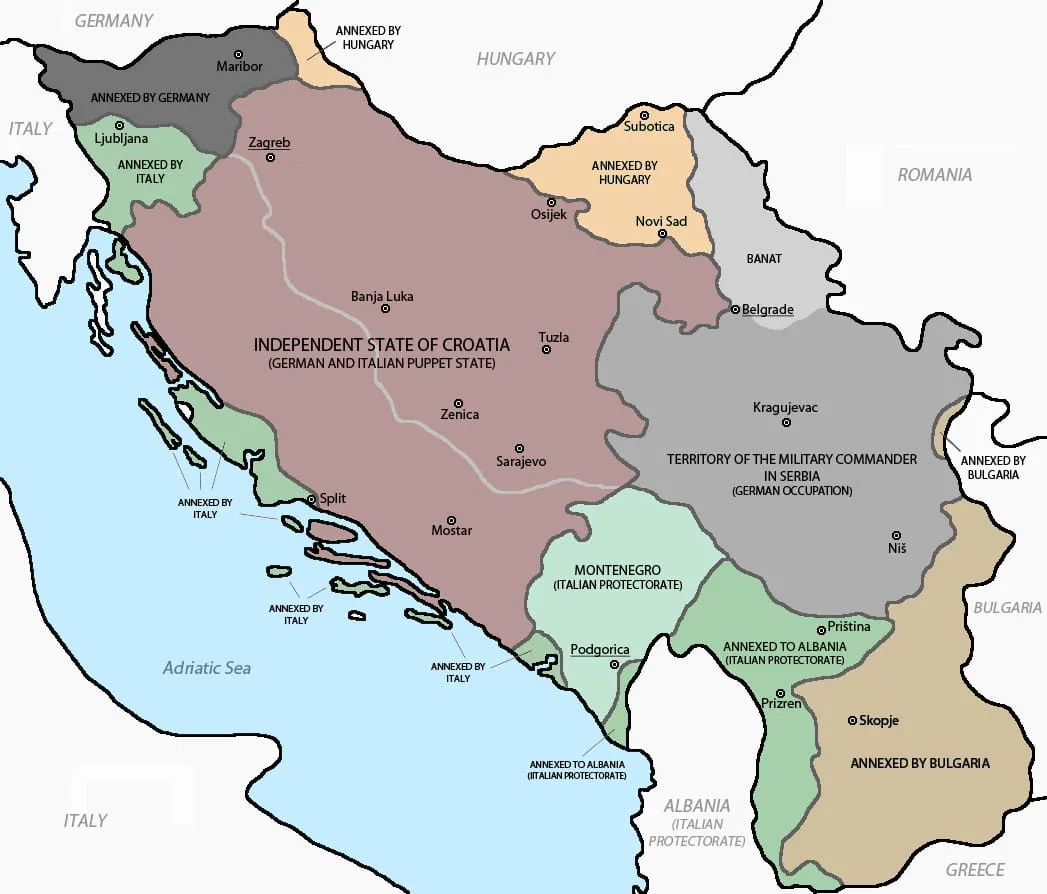
The invasion of Yugoslavia, known in Serbian and Croatian historiography as the April War, was one of the shortest campaigns of the Second World War. On Sunday 6 April 1941, without a declaration of war, the Luftwaffe bombed Belgrade and German troops crossed the border from Bulgaria. Further attacks followed from Austria, Hungary and Romania, and on 11 April the Italian and Hungarian armies joined in. The Yugoslav army, not fully mobilised and stretched along frontiers almost 3,000 kilometres long, fell apart within days. On 10 April the Germans entered Zagreb, where the Independent State of Croatia was proclaimed that same day; on 12–13 April they took Belgrade, and on 15 April Sarajevo. On 17 April representatives of the Yugoslav high command signed an unconditional surrender.
The invasion was Adolf Hitler’s answer to the coup of 27 March, which had overthrown the government that two days earlier had signed Yugoslavia’s accession to the Tripartite Pact. Hitler then resolved to destroy Yugoslavia “militarily and as a state”. The campaign was improvised in a few days, and the Wehrmacht lost little more than 150 men killed in it. For the Yugoslavs the defeat meant the end of their state, the partition of the country among the victors and the beginning of four years of occupation, genocide and civil war.
Name and dates
German documents called the campaign “Operation 25” (Unternehmen 25), after the number of Hitler’s directive of 27 March 1941, and the raid on the capital Operation Strafgericht (“judgement”, “punishment”). In Yugoslavia and the states that rose from its ruins it is called the April War (Serbian Aprilski rat, Croatian Travanjski rat). Together with the attack on Greece (Operation Marita) it makes up the Balkan campaign.
It is taken to have begun on 6 April 1941, the day of the raid on Belgrade and of the first advance from Bulgaria, and to have ended on 17 April, the day the surrender was signed in Belgrade. The instrument came into force at noon on 18 April, and some studies close the campaign on that date.
Background
A state encircled
The Kingdom of Yugoslavia was a multinational state ruled by Serbs, and the conflict between Serbs and Croats had gone on since its birth in 1918. After the assassination of King Alexander I in 1934 a regent, Prince Paul Karađorđević, governed on behalf of the under-age Peter II. The agreement of 1939, which gave Vladko Maček’s Croats an autonomous Banovina of Croatia, satisfied neither many Serbs nor many Croats. Waiting in exile in Italy were the Croatian nationalists – the Ustaše of Ante Pavelić.
Since the Anschluss of Austria Yugoslavia had bordered on the Reich, and since the annexation of Albania on Italy along two stretches of frontier; in the autumn of 1940 its neighbours Hungary and Romania joined the Tripartite Pact. Hitler, who before attacking the Soviet Union wanted to strike at Greece through Bulgaria in order to settle the Greco-Italian War and drive the British out of Greece, preferred to have Yugoslavia on his side. On 1 March Bulgaria joined the pact, and German troops entered the country from Romania. Under pressure, the regent agreed to accession, which the Prime Minister, Dragiša Cvetković, signed in Vienna on 25 March. In return Germany undertook not to demand the passage of troops or Yugoslavia’s participation in the war.
During the night of 26–27 March a group of officers, mostly airmen, led by General Dušan Simović, overthrew the government and the regency and declared Peter II of age; Simović became Prime Minister. Serbian towns cheered, while in Zagreb and Ljubljana the coup was received with unease. The new government, however, did not repudiate the Tripartite Pact, assured Berlin of its loyalty and, for fear of provoking the Germans, long delayed general mobilisation.
Directive No. 25
Hitler took the coup as a personal affront. On 27 March itself he gathered his commanders in the Reich Chancellery and announced that Yugoslavia would be destroyed “militarily and as a state”, “with merciless harshness”, without waiting for declarations of loyalty from the new government and without an ultimatum. That same day he signed Directive No. 25. The Wehrmacht was to strike concentrically at Belgrade from the area of Graz and from Bulgaria, the Luftwaffe was to bomb the capital, and the Croats were to be promised autonomy. The attack on the Soviet Union would have to be put off by as much as four weeks.
The Army High Command drew up the plan within a day. On 29 March in Vienna General Friedrich Paulus, deputy chief of the general staff, went through it with the army commanders: Field Marshal Wilhelm List of the 12th Army, Colonel General Maximilian von Weichs of the 2nd Army and Colonel General Ewald von Kleist of Panzer Group 1. It was settled that the raid on Belgrade and the attack on Greece would take place together on 6 April, Kleist’s advance from Bulgaria on 8 April, and the advance of the 2nd Army, whose divisions were still travelling by rail from France and Germany, around 12 April. The whole operation was directed from Wiener Neustadt by the Commander-in-Chief of the Army, Field Marshal Walther von Brauchitsch, while from 11–12 April Hitler followed the campaign from his special train near Mönichkirchen.
Allies and neighbours
Hitler at once drew Yugoslavia’s neighbours into the war. During the night of 27–28 March he wrote to Benito Mussolini, asking him to suspend operations in Albania, where the Italian spring offensive had in any case collapsed, and to cover the border with Yugoslavia. He promised Hungary the Banat and the Bačka, lost under the Treaty of Trianon, and Bulgaria Macedonia. The Regent of Hungary, Miklós Horthy, and the generals wanted to seize the opportunity, while the Prime Minister, Pál Teleki, who in December 1940 had signed a treaty of “eternal friendship” with Yugoslavia, shot himself during the night of 2–3 April. Horthy then limited mobilisation and declared that Hungary would move in only once Yugoslavia had ceased to exist as a state. The Germans were nonetheless able to concentrate troops in Hungary.
Romania did not enter the war, but it made its territory near Timișoara available for the concentration of the German XLI Panzer Corps and provided airfields for the Luftwaffe. On 5 April, the eve of the attack, Simović’s government signed a treaty of friendship and non-aggression with the Soviet Union in Moscow, which committed Stalin to no assistance whatever. When the attack came, Moscow did not protest.
Opposing forces
The Wehrmacht and its allies
Against Yugoslavia the Germans committed Weichs’s 2nd Army, part of List’s 12th Army with Kleist’s Panzer Group 1, and the independent XLI Panzer Corps: 19 divisions in all, five of them armoured, plus three strong motorised regiments. In the north, in Carinthia, Styria and western Hungary, the 2nd Army assembled XLIX Mountain Corps, LI Army Corps and General Heinrich von Vietinghoff’s XLVI Panzer Corps. From Bulgaria, Kleist’s XIV Panzer Corps was to drive through Niš on Belgrade, and General Georg Stumme’s XL Panzer Corps, with the Leibstandarte SS Adolf Hitler regiment, on Skopje, to cut Yugoslavia off from Greece. From Romania came General Georg-Hans Reinhardt’s XLI Panzer Corps with the SS Division Reich and the Großdeutschland Regiment; Hitler sent it towards Belgrade without consulting the Army High Command, wanting an SS formation to be the first into the capital.
In the air, General Alexander Löhr’s Luftflotte 4 operated together with General Wolfram von Richthofen’s VIII Air Corps. Within ten days Hermann Göring sent it some 600 more aircraft from France, Sicily and Africa. Depending on the count, between more than 750 and nearly 1,000 aircraft were deployed against Yugoslavia.
The Italians fielded General Vittorio Ambrosio’s 2nd Army in the Julian March and Istria, and part of General Alessandro Pirzio Biroli’s 9th Army in northern Albania: 22 divisions in all, some 300,000 men and more than 600 aircraft. The garrison of Zara (today Zadar), an Italian enclave in Dalmatia, numbered about 9,000 men. The Hungarian 3rd Army under General Elemér Gorondy-Novák comprised a dozen or more brigades.
The Yugoslav army
Fully mobilised, the army of the Kingdom of Yugoslavia was to number 28 infantry divisions, three cavalry divisions and several dozen independent regiments and detachments, some 1 to 1.2 million men. When the first bombs fell, mobilisation, ordered in full only on 3 April, was still under way. Barely a dozen or so divisions, most of them under strength, stood in their assigned positions. The army relied on horse-drawn transport, its artillery was largely obsolete, it had only two tank battalions, and its stocks of ammunition, medicines and food would last a few weeks. The air force had more than 400 combat aircraft, including several dozen Messerschmitt Bf 109s and Hurricanes as well as home-built Rogožarski IK-3 fighters, but it was short of spare parts. The navy had four destroyers and four submarines.
The defence plan R-41 provided for manning every frontier, so that neither Slovenia and Croatia nor northern Serbia would be given up without a fight. Three army groups were strung out from the Alps to Macedonia; the 1st Army Group (4th and 7th Armies), made up largely of Croats and Slovenes, defended Slovenia and Croatia. If things went badly, the army was to fall back into the mountains in the south of the country, while the 3rd Army, together with the Greeks, was to attack the Italians in Albania, so as to open the way to Greece and recreate the Salonika front of the First World War. The historian Jozo Tomasevich judged that the decision to defend every frontier in itself sealed the defeat. Of 165 generals on the active list, all but four were Serbs, and the loyalty of many Croatian soldiers to a state they identified with Serbian domination was uncertain.
Course of the campaign
Strafgericht: the raid on Belgrade (6–7 April)
Belgrade had no strong anti-aircraft defences, and at the beginning of April the Yugoslav government had declared it an open city in the event of war. The Germans knew the positions of the Yugoslav field airfields and of the shelters in the capital, because on 3 April an air force major, the Croat Vladimir Kren, had flown to Graz and defected, also betraying the air force’s codes. Hitler demanded the destruction of the city. According to some historians, Löhr at the last moment replaced this order with a list of specific targets: the ministries, the general staff, the post office, the power station, the barracks and the royal palace.
At around 5 a.m. on 6 April, Palm Sunday in the Catholic calendar, German troops crossed the border, and the Propaganda Minister, Joseph Goebbels, read out on the radio a proclamation by Hitler that justified the attack by an alleged conspiracy between the Belgrade authorities and Great Britain. There was no formal declaration of war. At around 6.30 a.m. the first wave appeared over the city: depending on the count, between 150 and more than 230 bombers and Ju 87 dive-bombers with a strong fighter escort. The first strike lasted about an hour and a half, and further waves came in during the day. Fighter pilots from Zemun and the surrounding airfields shot down a dozen or so German aircraft, but in two days they themselves lost several dozen machines shot down or damaged. The raids went on into 7 April, after which bad weather halted them.
The bombing of Belgrade destroyed the city centre, the power station, the waterworks and communications. The National Library of Serbia burned down with hundreds of thousands of books, manuscripts and medieval documents. The death toll is disputed to this day. Shortly after the raid the occupation authorities gave a figure of 2,271 victims; an American study published in 1953 and based on the accounts of German generals spoke of more than 17,000, and other sources of 5,000–10,000. Tomasevich, having analysed post-war research, considered 3,000–4,000 dead the most likely figure; the lowest estimates put it at 1,500. Like the bombing of Warsaw and of Rotterdam, the raid was meant to break the will to resist, and for Hitler it was also revenge for the coup. For his part in it Löhr was sentenced by a Yugoslav court after the war and executed in 1947.
The raid paralysed command. Immediately after the first wave the King, the government and the high command left the capital and moved into the interior, and communications between the general staff and the armies in the field all but broke down. The Luftwaffe also attacked airfields across the country. For several days Yugoslav bombers attacked German columns and airfields in Bulgaria, but after eleven days the Yugoslav air force had practically ceased to exist.
From Bulgaria to Skopje (6–9 April)
On land, Stumme’s XL Panzer Corps struck first. At dawn on 6 April its 9th Panzer Division set off from the Kyustendil area towards Kumanovo, and the 73rd Infantry Division towards Štip. The under-strength Yugoslav divisions held the mountain roads for only a few hours. On the afternoon of 7 April the spearhead of the 9th Panzer Division entered Skopje, nearly 100 kilometres from the border. On 8 April units of the Leibstandarte took Prilep, cutting the Belgrade–Salonika railway. Yugoslavia was cut off from Greece and the British. On 9 April Stumme stood before Bitola, ready to strike into Greece.
At the same time the 2nd Panzer Division of XVIII Mountain Corps passed through the Yugoslav sliver of Macedonia near Strumica and on the morning of 9 April entered Salonika, encircling the Greek troops holding the Metaxas Line. In Macedonia, where part of the population resented Serbian administration, resistance quickly died away.
The breakthrough at Niš (8–12 April)
On the morning of 8 April Kleist’s Panzer Group 1 moved off from the area north-west of Sofia. XIV Panzer Corps crossed the border near Pirot and, led by the 11th Panzer Division, advanced on Niš. The Yugoslav 5th Army, one of the few fully mobilised, put up stubborn resistance despite the rain, road blocks and demolished bridges, but the division, supported by artillery and aircraft, broke through its line on the very first day. On 9 April German tanks drove into Niš. Reserves sent to the area were broken up on the march by the Luftwaffe.
From Niš the Morava valley led straight to Belgrade. On 10 and 11 April the 11th Panzer Division pushed north, crushing attempts at resistance by the retreating 5th Army near Paraćin and Kragujevac; in one of these clashes the Germans took more than 5,000 prisoners. The 5th Panzer Division turned south and then went on to the Greek campaign. On 11 April Kleist’s spearheads ran into the southern wing of the withdrawing 6th Army and shattered it, and by the evening of 12 April they stood a few dozen kilometres from the capital.
The collapse of the northern front (6–11 April)
In the north, Weichs’s 2nd Army was not due to move off until 12 April, but from 6 April its units were seizing bridges and hills across the border. Improvised Feuerzauber assault groups attacked bunkers in Slovenia, and on 8 April one of them took Maribor on its own initiative. LI Corps crossed the border near Radkersburg and captured the bridges over the Mura intact, while XLVI Panzer Corps secured bridgeheads over the Mura and the Drava near Barcs. Resistance was so weak that the command brought the start of the offensive forward to 10 April.
Mutinies broke out in the units of the Yugoslav 4th Army holding the Drava line. During the night of 7–8 April Croatian soldiers of the 108th Infantry Regiment of the Slavonska Division near Grubišno Polje took command away from their Serbian officers and, together with other mutinous units, on 8 April entered Bjelovar, where the mayor proclaimed an independent Croatian state. Maček and the Ban of Croatia, Ivan Šubašić, called on the soldiers to stay at their posts, to no effect. Maček himself, Deputy Prime Minister in Simović’s government, refused to leave the country and on 7 April returned to Zagreb. German reports described Croatian soldiers throwing away their weapons and going home. The historian Aleksa Djilas points out, however, that many Croatian units did fight and that most Croatian officers remained loyal until 10 April.
Before dawn on 10 April, despite frost and snowstorms, XLVI Corps moved off from the Barcs bridgehead. The 8th Panzer Division headed east, between the Drava and the Sava, towards Osijek and Belgrade, and the 14th Panzer Division south-west towards Zagreb. In a single day it covered almost 160 kilometres, and at 7.30 p.m. its tanks reached the outskirts of the Croatian capital, greeted by cheering crowds. On the way it took more than 15,000 prisoners, among them 22 generals. Even before it arrived, that afternoon, a former Austro-Hungarian officer, Slavko Kvaternik, had proclaimed on the radio, in the name of the absent Pavelić, the creation of the Independent State of Croatia. Maček called on Croats to obey the new authorities, and on 11 April the new government called on Croatian soldiers to stop fighting. In Mostar Ustaše supporters clashed with the Yugoslav army.
In Slovenia, XLIX Mountain Corps crossed the border during the night of 9–10 April and on 11 April took Celje. Envoys of hastily formed Slovene authorities asked for a ceasefire. The Yugoslav 7th Army withdrew south along mountain roads, while the 4th Army had practically ceased to exist.
The Italians, the Hungarians and the Yugoslav offensive in Albania
The Italian 2nd Army opened its offensive at noon on 11 April, when the Yugoslav army in the north was already disintegrating. That same day the Italians entered Ljubljana and Sušak; on 12 April their raiding columns linked up with the German 14th Panzer Division near Vrbovsko and then pushed south along the Dalmatian coast, through Senj and Knin to Split (15 April), Šibenik (16 April) and Dubrovnik (17 April). Entire Yugoslav divisions surrendered without a fight. The Yugoslav navy played no significant part, and on 12 April the monitors on the Danube were bombed or scuttled by their own crews.
In northern Albania the Yugoslav 3rd Army, as planned, went over to the offensive against the Italians on 7 April. The Zetska Division advanced along the road from Podgorica towards Shkodër and in places gained several dozen kilometres, a cavalry detachment crossed the Prokletije mountains, and the Kosovska Division broke through the Italian defences in the Drin valley. This was the only Yugoslav offensive of the war and the only sector on which the army had any success. The fall of Skopje and the appearance of the Germans at Prizren, in its rear, forced it to halt. From 11 April the Italian Centauro Armoured Division drove the Yugoslavs back, and on 17 April the Italians took Kotor, Cetinje and Podgorica.
The Hungarian 3rd Army crossed the border on 11 April, when Croatian independence had already been proclaimed in Zagreb and Horthy could claim that Yugoslavia had ceased to exist. The Hungarians occupied the Bačka between the Danube and the Tisza and southern Baranja, including Subotica and Novi Sad. Only the garrisons of the border fortifications offered them any serious resistance. At the demand of Romania, which also laid claim to the Banat, the Hungarians did not go east of the Tisza; the Banat was occupied by the Germans. Bulgarian troops took no part in the fighting and entered Macedonia only after the surrender.
The fall of Belgrade (12–13 April)
Three German groups converged on Belgrade from three directions. Reinhardt’s XLI Panzer Corps crossed the border from Romania north of Vršac, and on 11 April its spearheads entered Pančevo on the far bank of the Danube. The 8th Panzer Division of XLVI Corps captured the bridges over the Sava near Sremska Mitrovica intact during the night of 11–12 April and was approaching the capital from the west, and Kleist’s 11th Panzer Division from the south. Simović then called on all units by radio to attack the enemy wherever they met him, without waiting for orders from above – which said everything about the state of command.
On the afternoon of 12 April SS-Obersturmführer Fritz Klingenberg of the motorcycle battalion of the SS Division Reich, against orders, crossed the Danube with a handful of men in a captured boat, since all the bridges had been blown. After a few skirmishes his patrol reached the city centre and at 5 p.m. hoisted the swastika flag over the German legation. Klingenberg threatened the mayor, Jevrem Tomić, with an air raid and artillery bombardment, pretending that large forces were following behind him, and at around 7 p.m. Tomić handed the city over to him. Klingenberg was awarded the Knight’s Cross for this. During the night units of the 8th Panzer Division drove into the city, patrols of the Großdeutschland Regiment came in from the north, and from 6.32 a.m. on 13 April the 11th Panzer Division, with Kleist at its head, entered Belgrade from the south.
The pursuit to Sarajevo and the King’s flight (13–15 April)
After the fall of Belgrade the Yugoslav command still hoped that the remnants of the army could withdraw into the mountains of Bosnia and Serbia and put up prolonged resistance there. Weichs, who now directed the whole operation, organised two pursuit groups converging on Sarajevo: a western one led by the 14th Panzer Division and an eastern one under Kleist, led by the 8th Panzer Division. The Germans were in a hurry, because the panzer divisions were needed for the attack on the Soviet Union. On 14 and 15 April they took prisoners by the tens of thousands, among other places near Užice and Zvornik. In Herzegovina and Dalmatia there were clashes between the Ustaše and Serbian soldiers, and the Luftwaffe bombed Serbian concentrations near Mostar. On 15 April the two panzer divisions drove into Sarajevo simultaneously from west and east, and the Yugoslav 2nd Army, which had its headquarters there, capitulated.
The government met for the last time on Yugoslav soil on 13 April at Pale near Sarajevo. That day the King appointed General Danilo Kalafatović chief of staff of the high command, while Simović, keeping the premiership, prepared to leave the country. King Peter II flew out to Greece from an airfield near Nikšić in Montenegro on 14 April, and the government followed on 15 April. Yugoslavia’s gold reserves were also flown out aboard bombers and transport aircraft. More than 70 Yugoslav aircraft escaped to Greece, but many of them were destroyed there by the Italian air force. The destroyer Zagreb was blown up in the Bay of Kotor by two junior officers, who died with her.
Surrender (14–18 April)
On 14 April the high command decided to ask for an armistice and authorised the army commanders to negotiate local ceasefires. The Germans replied that the only basis for talks could be the unconditional surrender of the entire army. That evening an envoy of the high command reported to Kleist’s headquarters asking for an immediate end to the fighting. The German Army High Command entrusted the negotiations to Weichs, who arrived in Belgrade on 15 April and drew up the terms. The Yugoslav envoy who arrived on 16 April had no full powers, so he flew back to fetch authorised representatives.
On 17 April an armistice based on the unconditional surrender of all the Yugoslav armed forces was signed in Belgrade. It was signed for Yugoslavia, on Kalafatović’s authority, by the former Foreign Minister Aleksandar Cincar-Marković – the same man who in March had signed the accession to the Tripartite Pact – and by General Radivoje Janković; some studies attribute the signature to Kalafatović himself. Weichs signed for Germany and the military attaché, Colonel Luigi Buonofati, for Italy, with the proviso that the same terms applied with respect to the Italian army. The Hungarians and Bulgarians sent liaison officers but did not sign, since formally they were not at war with Yugoslavia. The surrender came into force at noon on 18 April, twelve days after the first raid on Belgrade.
Losses
The attackers’ losses were surprisingly small. According to German figures, the army lost 558 men in Yugoslavia: 151 killed, 392 wounded and 15 missing. The Luftwaffe lost, by various estimates, several dozen aircraft. The Italians, who fought longest in Albania, had about 800 killed and 2,500 wounded according to figures cited in the literature, and the Hungarians about 120 killed and more than 200 wounded, including paratroopers killed in the crash of a transport aircraft on 12 April.
Yugoslav losses were never precisely established; the number of soldiers killed is estimated at several thousand. The heaviest loss was borne by the people of Belgrade: from 1,500 to 17,000 killed according to various sources, most probably 3,000–4,000. Depending on the count, between 254,000 and about 345,000 soldiers went into German captivity, and about 30,000 into Italian. The Germans quickly released prisoners of Croatian, Slovene, German, Hungarian and Macedonian nationality, but kept most of the Serbs. By various estimates, from about 180,000 to more than 200,000 of them spent the rest of the war in prisoner-of-war camps in Germany. About 1,000 soldiers and several hundred airmen made their way through Greece to Egypt.
Significance
The April campaign was one of the Wehrmacht’s swiftest victories. In eleven days, at negligible cost, Germany and its allies destroyed an army that on paper numbered more than a million men. The attacker’s technical superiority, the unfinished mobilisation, the dispersal of the troops along the frontiers, the paralysis of command after the raid on Belgrade and the crisis of the state itself all contributed. Serbian nationalists later blamed a Croatian “fifth column”; Croatian ones blamed the incompetence of the Serbian officer corps and the Belgrade politicians. Historians such as Tomasevich and Djilas point out that the army mirrored the weakness of the state, and that the defeat was decided above all by the mistakes of the command and the backwardness of the armed forces; desertions hastened a collapse they did not cause.
Yugoslavia was partitioned before the fighting had ended. At a meeting in Vienna on 21–22 April Joachim von Ribbentrop and Galeazzo Ciano fixed the boundaries of the zones. Germany annexed northern Slovenia and placed Serbia, within its borders from before the Balkan Wars, together with the Banat, under military administration. Italy took southern Slovenia with Ljubljana and most of Dalmatia, made Montenegro a protectorate and attached Kosovo to Albania. Hungary took the Bačka, Baranja, Međimurje and Prekmurje, and Bulgaria most of Macedonia and a sliver of eastern Serbia. The Independent State of Croatia, which also took in Bosnia and Herzegovina and Syrmia, became a satellite state under the rule of Pavelić’s Ustaše; Pavelić arrived in Zagreb on 15 April.
The swift victory did not bring the Axis peace in the Balkans. As early as April the Ustaše began a campaign of persecution and killing of Serbs, Jews and Roma that turned into genocide. In the mountains of Serbia Colonel Dragoljub (Draža) Mihailović began gathering soldiers who had not laid down their arms, and after Germany attacked the Soviet Union the communist partisans of Josip Broz Tito took up the fight. The occupation of Yugoslavia became one of the bloodiest in Europe, intertwined with civil war, and keeping the country in submission tied down hundreds of thousands of German, Italian, Hungarian and Bulgarian soldiers until the end of the war.
The question of how far the campaign, and the simultaneous attack on Greece, delayed Operation Barbarossa – which began on 22 June 1941 rather than in mid-May – is still debated. Some historians believe the delay cost the Germans the capture of Moscow before winter. Others, such as Martin van Creveld, reply that the date was determined rather by a wet spring and unfinished preparations, and that the divisions used in Yugoslavia were quickly redeployed to the east.