1944: The Red Army’s summer offensive
Jassy–Kishinev offensive
- Dates:
- 20–29 August 1944
- Front:
- Eastern Front
- Location:
- Bessarabia and Romanian Moldavia: a front running from the Eastern Carpathians past Iași and along the lower Dniester (Chișinău, Bender, Tiraspol) to the Black Sea; the pocket between the Dniester and the Prut (Chișinău – Huși – Leova); the pursuit through Bârlad and Focșani towards Galați, Brăila and ConstanțaOn the battle map →
- Sides:
- Soviet UnionRodion Malinovsky, Fyodor Tolbukhin, Semyon TimoshenkoNazi GermanyJohannes Frießner, Maximilian Fretter-PicoRomania (until 23 August)Petre Dumitrescu
- Result:
- Soviet victory. The 2nd and 3rd Ukrainian Fronts broke through in the first two days and by 24 August had trapped the main forces of the German Sixth Army and part of the Eighth Army in a pocket between the Dniester and the Prut; the pocket was eliminated by 29 August. According to the war diary of Army Group South Ukraine, 18 divisions were lost; according to Soviet figures, more than 200,000 German and Romanian soldiers were taken prisoner. On 23 August King Michael I's coup overthrew Antonescu, and Romania went over to the Allies. Soviet losses according to Russian figures: about 13,200 killed and missing and about 54,000 wounded and sick.
- Author:
- Łukasz
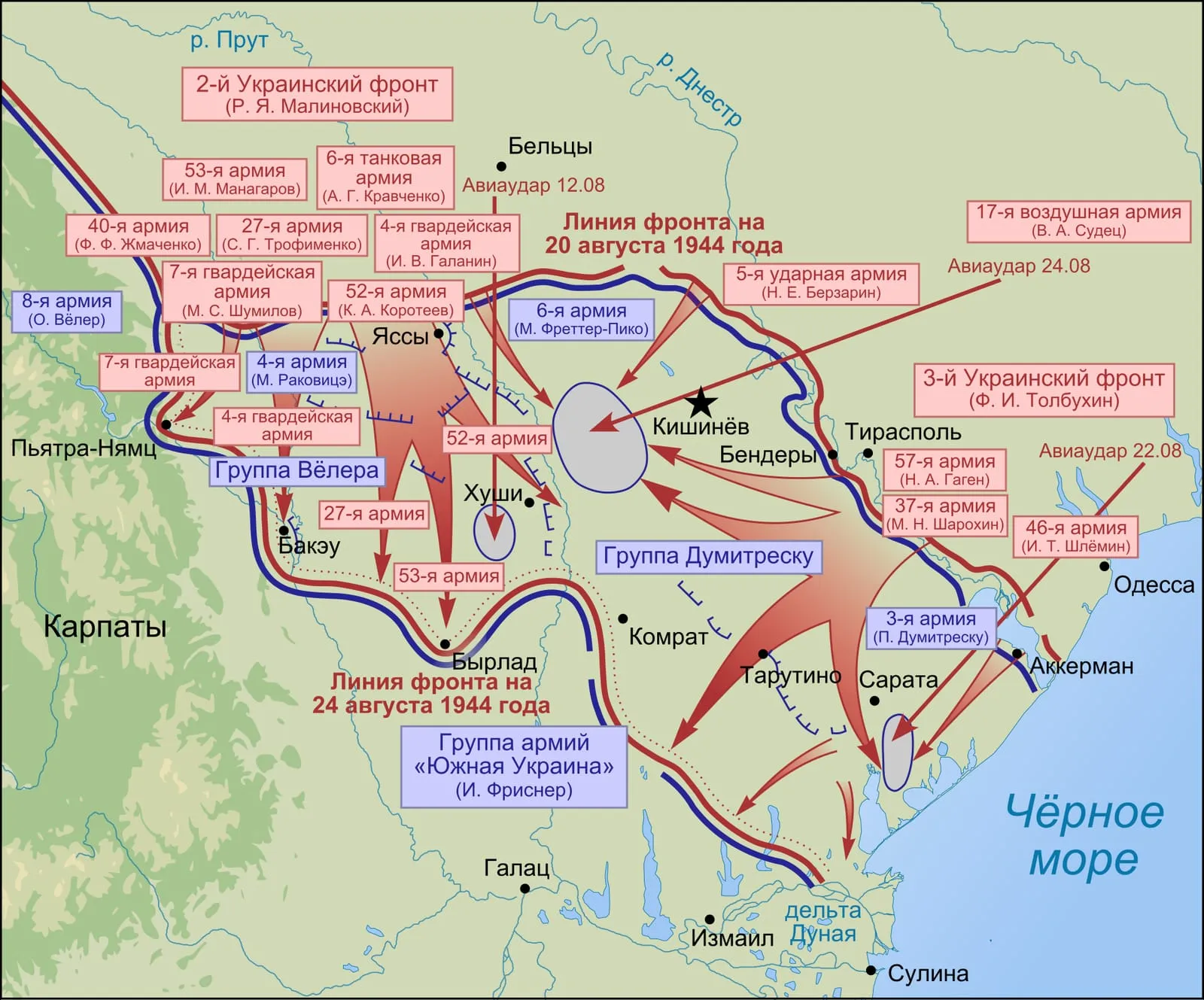
The Jassy–Kishinev offensive (Russian Ясско-Кишинёвская операция; in German literature also Schlacht um Rumänien, or the “battle on the Prut”) was a Red Army offensive at the end of August 1944 which in ten days smashed the German-Romanian front in Bessarabia and Romanian Moldavia (PL). On 20 August General of the Army Rodion Malinovsky’s 2nd Ukrainian Front attacked north-west of Iași (Jassy), and General of the Army Fyodor Tolbukhin’s 3rd Ukrainian Front struck from a bridgehead on the Dniester south of Bender (Bendery). The two pincers met on the Prut and closed a pocket around the main forces of the German Sixth Army – the same army that had been re-formed after the disaster at Stalingrad – and part of the Eighth Army.
Midway through the operation, on 23 August, King Michael I had Marshal Ion Antonescu arrested, and Romania left its alliance with the Third Reich. For the Germans this meant the loss not only of more than a dozen divisions but also of Romanian oil and the whole southern wing of the Eastern Front. The road to the Balkans – to Bulgaria, Yugoslavia and Hungary – lay open to the Red Army. Soviet historiography called the operation the “Jassy–Kishinev Cannae” and counted it among the “ten Stalinist blows” of 1944.
Name and dates
Soviet and Russian military historiography classes the Jassy–Kishinev offensive as a strategic offensive operation and dates it to 20–29 August 1944; some accounts and most of the literature use the same dates. 20 August was the day of the artillery preparation and of the attack by both fronts; 29 August is the date the Soviet side adopted as the end of the destruction of the encircled groupings between the Dniester and the Prut and west of the Prut. Isolated German groups that had broken out of the pocket and were heading for the Carpathians were still being destroyed until 4 September, and the pursuit on the outer front flowed seamlessly into the occupation of the rest of Romania: on 31 August Soviet troops entered Bucharest.
The American historian David Glantz calls the August offensive the “second” Jassy–Kishinev operation, as he regards the unsuccessful Soviet attacks on the same sector between 8 April and 6 June 1944 – among them at Târgu Frumos – as the first. Soviet historiography did not treat that spring attempt as a separate operation. German literature often describes the August fighting as the “battle on the Prut” or, more broadly, the “battle for Romania”, including in it the fighting against the Romanian army after 23 August.
Background: Romania on the brink of defeat
Romania entered the war against the USSR in June 1941 chiefly to recover Bessarabia and northern Bukovina, which it had been forced to cede to the Soviet Union in the summer of 1940 after a Soviet ultimatum. A few weeks later the Second Vienna Award took northern Transylvania from it and gave it to Hungary, which led to the abdication of Carol II and the Antonescu dictatorship. Romanian armies then fought alongside the Wehrmacht at Odessa, in the Crimea and on the Don, and in November 1942 it was their sectors on the flanks of Stalingrad that were broken by Operation Uranus, which led to the encirclement of the Sixth Army. The disaster on the Volga cost Romania two armies and convinced part of the elite in Bucharest that the war could not be won.
From 1943 the opposition leaders – the National Peasant Iuliu Maniu and the Liberal Constantin (Dinu) Brătianu – sought contact with the Western powers, while the deputy prime minister and foreign minister Mihai Antonescu sounded out the possibilities of peace through neutral countries. In the spring of 1944 the opposition’s envoy, Prince Barbu Știrbey, held talks with Allied representatives in Cairo, while parallel contacts with Soviet diplomats went on in Stockholm. The Allies, however, demanded unconditional surrender to all three great powers, and Marshal Antonescu could not bring himself to break with Hitler.
Meanwhile the war had reached the country’s borders. In March 1944 Konev’s troops crossed the Dniester and entered Bessarabia; in April the 3rd Ukrainian Front, still under Malinovsky, took Odessa; and in May the German-Romanian Seventeenth Army was defeated in the Crimean offensive. The front stabilised on a line running from the Eastern Carpathians past Târgu Frumos and the northern approaches to Iași to the lower Dniester and the Black Sea. This created a large salient on the Iași–Chișinău axis, enveloped on both sides by Soviet forces: from the north by the 2nd Ukrainian Front (under Malinovsky from May), and from the east by Tolbukhin’s 3rd Ukrainian Front, which held bridgeheads on the west bank of the Dniester. From 5 April American bombers from Italy attacked Ploiești – the Reich’s main source of oil – as well as Bucharest and Constanța.
In the summer the picture shifted still further in the Red Army’s favour. Operation Bagration destroyed Army Group Centre in Belarus, and the Lwów–Sandomierz offensive drove the Germans out of Eastern Galicia. To plug these gaps the German command had by mid-July taken more than a dozen divisions from Romania – 12 according to Russian studies – including most of the armoured units (among them XL Panzer Corps with the 14th and 23rd Panzer Divisions). Practically all that remained were the German 13th Panzer Division and 10th Panzergrenadier Division and the Romanian 1st Armoured Division “Greater Romania”.
Forces and plans
At the end of July 1944 Hitler swapped the commanders of two army groups: Colonel General Ferdinand Schörner, until then in Romania, took over Army Group North, while its commander, Colonel General Johannes Frießner, who had been demanding permission to retreat in the Baltic states, took over Army Group South Ukraine on 25 July. It consisted of two mixed German-Romanian groupings. On the western wing, from the Carpathians to the Prut and the Iași area, stood Army Group Wöhler – the German Eighth Army under General of Infantry Otto Wöhler and the Romanian Fourth Army. On the eastern wing, from the Prut along the Dniester to the sea, stood Army Group Dumitrescu – the German Sixth Army under General of Artillery Maximilian Fretter-Pico and the Romanian Third Army under General Petre Dumitrescu, who had already commanded it on the Don in 1942. Russian studies give the army group’s strength as 25 German and 22 Romanian divisions, one Slovak division and five Romanian brigades; it was supported from the air by Luftflotte 4 with some 810 German and Romanian aircraft.
According to Soviet figures, they faced some 1.3 million soldiers, 16,000 guns and mortars, about 1,870 tanks and self-propelled guns and about 2,200 aircraft, against some 900,000 German and Romanian soldiers, 7,600 guns, 400 tanks and 810 aircraft on the Axis side. These figures come from Soviet sources, and those for the Axis are estimates that are hard to verify; there is no doubt, however, that the Red Army’s superiority in armour and aircraft was overwhelming. The operations of both fronts were coordinated on behalf of the Stavka by Marshal Semyon Timoshenko, and the left wing of the 3rd Front was supported by Admiral Filipp Oktyabrsky’s Black Sea Fleet and the Danube Flotilla. The 2nd Front also included the 1st Tudor Vladimirescu Volunteer Infantry Division, formed in the USSR from Romanian prisoners of war.
The Soviet plan called for two blows on widely separated sectors, chosen where the front was held by the more poorly armed Romanian divisions. The 2nd Ukrainian Front was to break through north-west of Iași, between the Siret and the Prut, and swing south towards the Prut crossings at Huși, while at the same time driving deep into Romania towards Focșani. The 3rd Ukrainian Front was to strike from the bridgehead at Chițcani (Kitskany), south of Bender and Tiraspol, and then turn west towards the Prut. The pincers were to meet in the rear of the Sixth Army, which held the centre of the salient around Chișinău (Kishinev). Troops were concentrated by night and camouflaged, and dummy preparations were meant to convince the enemy that the main blow would fall directly on Chișinău.
The Romanian general staff expected precisely this manoeuvre and warned of a repeat of Stalingrad: a blow against the Romanian armies on the flanks and the encirclement of the German Sixth Army in the centre. Marshal Antonescu proposed withdrawing to a fortified line running Carpathians – Focșani – Nămoloasa – Brăila – Danube. Frießner, whom Hitler had just removed from the north for demanding a retreat, was unwilling to take such a step, and the German command – according to accounts cited in the literature – considered the warnings exaggerated. After the destruction of Army Group Centre, Berlin believed that the Soviet effort would be concentrated in Poland and on the Baltic, and that there would be no major offensive in the south. Political tension was rising in Bucharest too, however: on 5 August Antonescu met Hitler at the Wolf’s Lair near Rastenburg (Kętrzyn), but – according to the accounts of those present – made no unequivocal declaration that Romania would stand by Germany to the end.
Course of the battle: the breakthrough (20–21 August)
On the morning of 20 August the artillery of both fronts opened fire on narrow breakthrough sectors only a few kilometres wide. On the Iași axis the fire was directed by Colonel General Nikolai Fomin, near Bender by Colonel General Mitrofan Nedelin; according to German and Soviet descriptions the bombardment lasted from an hour and a half to nearly two hours, with an average of 260–280 barrels per kilometre of front. According to Russian studies, the infantry and their supporting tanks went into the attack at about 7.40 a.m., covered by the ground-attack aircraft of the 5th and 17th Air Armies.
North of Iași the 27th and 52nd Armies of the 2nd Ukrainian Front broke through the defences of the Romanian corps, and that same day Malinovsky committed General Andrei Kravchenko’s 6th Tank Army (PL) to the breach. The German 76th Infantry Division, outflanked on both sides by retreating Romanian units, suffered heavy losses near Lețcani. The Romanian 1st Armoured Division “Greater Romania” fought one of the few organised actions of the day at Scobâlțeni, in the Podu Iloaiei area; according to the account of the Romanian tank crewman Ion S. Dumitru, it destroyed some 60 Soviet tanks for the loss of about half that number before being forced to withdraw southwards. By evening the front of Army Group Wöhler between the Prut and the Siret had been torn open to a width of about 30 kilometres and a depth of more than ten.
On the Dniester the 37th, 46th and 57th Armies of the 3rd Ukrainian Front attacked from the Chițcani bridgehead. The German XXX Corps beat off the first attacks, but after a second artillery bombardment the Romanian 4th Mountain Division and 21st Infantry Division were almost completely destroyed, and the German 306th Infantry Division – according to a German study – lost half its strength during the shelling. A counter-attack by the 13th Panzer Division, which was poorly equipped, failed to stop the advance. Franz Josef Strauß, later a Bavarian politician, who served in its panzer regiment, recalled that after three days the division had ceased to exist as a tactical unit.
On 21 August the 52nd Army took Iași, and the 7th Guards Army Târgu Frumos. That day Tolbukhin committed the 4th Guards Mechanised Corps and the 7th Mechanised Corps to the breakthrough, and they set off westwards towards the Prut. The Stavka then ordered both fronts “by joint efforts to close the ring of encirclement more quickly in the Huși area”. Having assessed the situation after the first day, Frießner issued an order on 21 August – without Hitler’s consent – to withdraw behind the Prut; he received the approval of the Army High Command only the next day. By then it was too late: the units of the Sixth Army, on foot and horse-drawn, had several dozen kilometres to cover over hilly terrain cut by valleys running north to south, while the Soviet armoured units were moving along those very valleys.
Course of the battle: the Prut pocket and the coup in Bucharest (22–24 August)
By 22 August the operational reserves of Army Group South Ukraine were exhausted. The 4th Guards Army of the 2nd Ukrainian Front pushed the German VII Corps southwards and seized the Prut crossings at Ungheni and Costuleni, the 7th Guards Army crossed the Siret, and General Sergei I. Gorshkov’s cavalry-mechanised group took Roman and pushed on towards Bacău. On the coast, Lieutenant General Aleksandr Bakhtin’s landing group crossed the Dniester estuary and, with help from the 46th Army, took Akkerman (Bilhorod-Dnistrovskyi), cutting off the Romanian Third Army by the sea.
On the morning of 23 August the German 10th Panzergrenadier Division, the last reserve, sent towards Vaslui, ran into superior armoured forces and was pushed back towards Huși. That day the Soviet 18th Tank Corps reached the Huși area, the 7th Mechanised Corps reached the Prut crossings at Leușeni, and the 4th Guards Mechanised Corps those at Leova. The 6th Tank Army, having driven several dozen kilometres south, surrounded Vaslui and reached Bârlad, heading on towards Focșani. German troops were abandoning Chișinău, which according to the Soviet chronology was taken on 24 August by General Nikolai Berzarin’s 5th Shock Army.
On the afternoon of 23 August, in Bucharest, King Michael I summoned Marshal Antonescu to the palace and, when Antonescu refused to conclude an immediate armistice, had him arrested together with Mihai Antonescu. The coup, prepared for weeks by the court, part of the generals and the National Democratic Bloc (National Peasants, Liberals, Social Democrats and Communists), culminated in the king’s evening radio address announcing the break with Germany and the acceptance of the United Nations’ armistice terms. General Constantin Sănătescu became prime minister. The Romanian army was ordered to cease fighting the Red Army, although in many places – especially where units were already encircled – the order changed little. Hitler ordered the coup to be crushed by force: on 24 August the Luftwaffe bombed Bucharest, and the troops of General Alfred Gerstenberg, commander of the air defences of the oil region, attacked the city from the north. The next day Romania declared war on Germany.
On 24 August the forces of the two fronts linked up in the Huși and Leușeni area: the ring around the German VII, XLIV, LII and XXX Corps was closed. According to Russian studies, 18 divisions were trapped in the pocket. The same day the Romanian Third Army, pinned against the sea, ceased resistance. The Red Army completed the first stage of the operation – breaking through the defences and encircling the enemy – in five days, advancing 130–140 kilometres in that time.
Course of the battle: the destruction of the pocket and the pursuit (25–29 August)
According to Russian studies, the Soviet command assigned 34 divisions to destroying the encircled forces and sent 50 divisions and the main strength of both air armies deep into Romania. On 25 and 26 August the mass of the Sixth Army, squeezed into the area between Chișinău and the Prut, was under constant fire from artillery and aircraft, which flew up to two thousand sorties a day; the 17th Air Army alone logged 943 sorties over the pocket in those two days. Thousands of soldiers tried to get across the Prut by swimming or on makeshift craft, as the crossings were either in Soviet hands or destroyed. Several divisional commanders were killed in the fighting and the attempts to break out, and the commander of XXX Corps, Lieutenant General Georg-Wilhelm Postel, was taken prisoner; the commander of the 257th Infantry Division, Major General Friedrich Blümke, had already been badly wounded in an air raid on 24 August and captured. The Sixth Army headquarters, with Fretter-Pico, was outside the pocket.
According to Russian studies, the encircled grouping east of the Prut had ceased to exist by the end of 27 August. Some units, however, managed to cross to the west bank and form a second pocket in the Huși area, which the 3rd Ukrainian Front reduced by 29 August. According to German figures, only about 10,000 men from the whole grouping broke through to the south-west, towards Adjud; they were pursued by units of the 7th Guards Army and the 23rd Tank Corps, and the last groups were destroyed by 4 September.
Meanwhile, on the outer front, Soviet troops were advancing deep into Romania almost unopposed. The 7th Guards Army took Bacău and the 40th Army Târgu Neamț, driving the German XVII Corps out of the Eastern Carpathians. On 27 August the 6th Tank Army captured Focșani, opening the way through the Focșani Gate onto the Wallachian Plain. In the last days of August landings by Rear Admiral Sergei Gorshkov’s Danube Flotilla and the 46th Army seized the Danube ports – Kiliya, Izmail and Galați – and on 28 August Brăila and Sulina. On 29 August Tolbukhin’s troops, together with the Black Sea Fleet, took Constanța, Romania’s main port. The German fleet in the Black Sea, deprived of its bases, began scuttling itself off the Bulgarian coast and on the Danube.
Deep inside Romania German and Romanian troops were now fighting each other. Gerstenberg’s attempt to seize Bucharest stalled in the suburbs, and the Brandenburg special forces dropped onto Romanian airfields on 24 August were wiped out. The Romanian army seized the Predeal Pass and Brașov, cutting the Germans’ shortest line of retreat to Transylvania, as well as Giurgiu on the Danube. According to Romanian figures, in the fighting between 23 and 31 August it took some 56,000 Germans prisoner, who were then handed over to the Red Army. The German forces concentrated around Ploiești – mainly anti-aircraft artillery – were driven north of the city and surrendered on 31 August, while Gerstenberg and the rest of his men had already been taken prisoner by the Romanians near Bucharest on 28 August.
Losses
The scale of German losses remains uncertain, because most of the Sixth Army’s records were lost. The war diary of Army Group South Ukraine recorded the loss of 18 divisions on 5 September 1944; other German tallies speak of the destruction of 19 infantry divisions as well as a panzer division and a panzergrenadier division. German literature cites an estimate of about 150,000 killed and about 106,000 prisoners; other studies give a figure of about 115,000 German prisoners, of whom – according to German estimates – a large proportion died before they could be transported to camps in the USSR. The German Red Cross later handled some 80,000 tracing requests for soldiers whose last known whereabouts were in Romania. The Soviet side announced the capture of 208,600 German and Romanian soldiers and officers; historians point out that this figure included Romanian soldiers detained and disarmed after the coup, when Romania was no longer an enemy. Part of the literature puts total German and Romanian losses (killed, missing, wounded and prisoners) at around 650,000, although such high figures are difficult to verify.
Soviet losses, according to the Russian statistical study edited by Grigori Krivosheev, were 13,197 killed and missing and 53,933 wounded and sick, out of a combined strength of the two fronts and the fleet of some 1.3 million men. Even if these figures, based on surviving reports, are too low, the ratio of losses was one of the most favourable to the Red Army of the entire war. A separate matter was the fate of the Romanian soldiers detained after 23 August: according to the Moldovan historian Anatol Petrencu, more than 170,000 of them were deported, and many died of hunger, cold and disease in the prisoner-of-war camp at Bălți.
The dispute over the causes of the defeat
Frießner, in his memoirs Verratene Schlachten (“Betrayed Battles”), published in 1956, and before him Heinz Guderian, blamed the speed of the catastrophe above all on the “treachery” of the Romanians, who were said to have abandoned their positions or gone over to the enemy. Later research – including the analysis of the Soviet historian Viktor Mazulenko and the work of the British historian Mark Axworthy – has called this version into question. Many Romanian units did resist, but they lacked modern anti-tank weapons, artillery and air defence; nor are there any Soviet reports of Romanians going over en masse before 24 August. In this view the fundamental cause of the collapse was the inability of horse-drawn infantry divisions – German and Romanian alike – to hold together during a retreat under the blows of Soviet mechanised forces. Significantly, the one formation that did hold together was the Romanian 1st Armoured Division, the only one with adequate mobility and anti-tank weapons. Decisions by the German command also contributed to the defeat: the withdrawal of armoured forces from Romania in the summer, the rejection of Antonescu’s proposal to fall back to the Focșani – Nămoloasa – Brăila line, and the belated order to retreat behind the Prut.
Significance
The Jassy–Kishinev offensive was, alongside Bagration, the Wehrmacht’s greatest defeat of the summer of 1944. The German Sixth Army was destroyed for the second time in less than two years, which is why German literature sometimes calls August 1944 on the Prut a “second Stalingrad”; the war diary of Army Group South Ukraine compared the scale of the catastrophe with the disaster on the Volga. The army was re-formed once again and fought in Hungary in the autumn under Fretter-Pico. In September Malinovsky and Tolbukhin were promoted to Marshal of the Soviet Union.
The most important consequences, however, were political and strategic. The coup of 23 August, made easier by the collapse of the front, took Romania out of the war on the Axis side and within a few days turned it into an enemy of Germany. On 31 August Soviet troops entered Bucharest, and on 12 September an armistice was signed in Moscow under which Romania ceded Bessarabia and northern Bukovina to the USSR and put its armies into the field against Germany and Hungary; in return it recovered northern Transylvania. The loss of the Ploiești oilfields, which until recently had supplied most of the Reich’s crude oil from outside its borders, deepened the German fuel crisis in the last months of the war. In Bessarabia the Moldavian Soviet Socialist Republic was restored.
The collapse of the southern wing of the front opened the way for the Red Army into the Balkans and to the middle Danube. On 5 September the USSR declared war on Bulgaria, and a few days later Tolbukhin’s troops entered the country, where the pro-communist Fatherland Front took power. The Germans had to pull their forces out of Greece, Albania and southern Yugoslavia in haste, and on 20 October the Red Army and Tito’s partisans took Belgrade. The 2nd Ukrainian Front pushed on across the Carpathians into Transylvania and Hungary, where in the autumn the long battle for Budapest began.
The defeat also sealed Romania’s political fate. Antonescu, handed over to the Soviets by the new government, returned from Moscow to Bucharest as a defendant and was executed on 1 June 1946. King Michael I, whom Stalin decorated with the Order of Victory, was forced by the communists to abdicate in December 1947. In post-war Romania 23 August was celebrated as the national day – the “day of liberation from fascism” – until 1989, and in Moldova and Transnistria 24 August is still Liberation Day. For military historians the operation remains a textbook example of a Soviet encirclement of 1944: two blows against weak sectors of the front, the rapid commitment of mechanised forces to the breach, and the simultaneous closing of the pocket and pursuit on the outer front.