- Category:
- Military operations
- Front:
- Balkans
- Date:
- 20 October 1944
- Author:
- Natalia
- Battle:
- Belgrade offensive
- Tags:
- Yugoslavia, Red Army, Josip Broz Tito, Wehrmacht
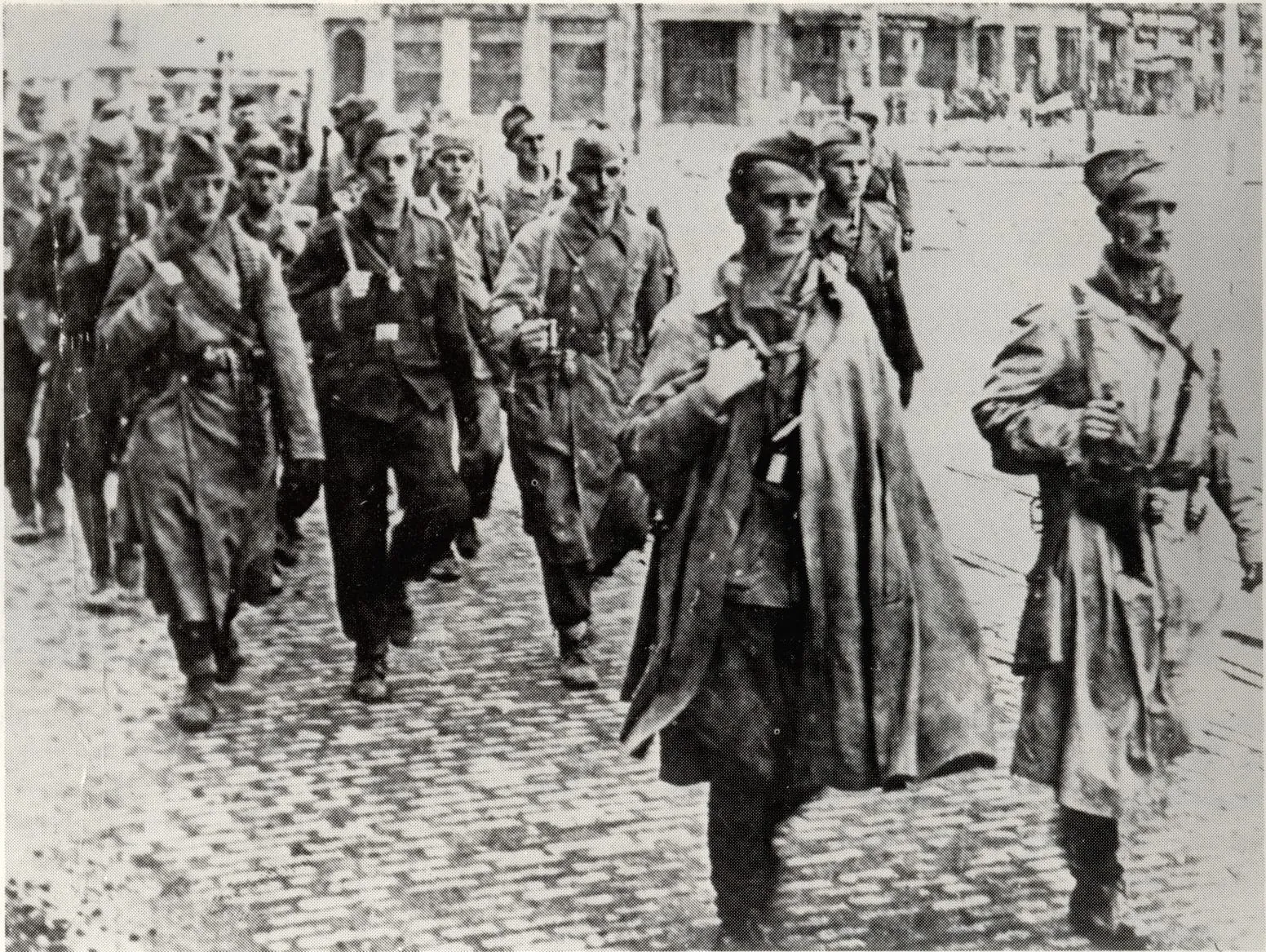
On 20 October 1944 Soviet troops and the Yugoslav Partisans of Josip Broz Tito brought the fighting for Belgrade to an end. In the morning they took the Kalemegdan fortress above the confluence of the Sava and the Danube, the last major centre of resistance in the city, and the remnants of the German garrison withdrew across the Sava bridge to the left bank of the river, to Zemun. By evening the city was in Allied hands. The battle for the Yugoslav capital, which had begun on its southern outskirts on 14 October, lasted seven days and was one of the few operations of the Second World War in which Soviet and Yugoslav units fought side by side, often in the same streets and the same buildings. It concluded the Belgrade offensive, which had begun on the Danube on 28 September.
Belgrade under occupation
Belgrade was the capital that suffered first. On 6 April 1941, the first day of the German attack on Yugoslavia, the Luftwaffe bombed the city without a declaration of war, killing thousands of its inhabitants. After the capitulation of Yugoslavia Belgrade became the seat of the German military commander in Serbia and, from August 1941, of the collaborationist government of Milan Nedić as well. The occupiers murdered almost all of Belgrade’s Jews: the men were shot in the autumn of 1941 in reprisal for insurgent actions, and the women and children held in the Sajmište camp on the left bank of the Sava were killed in the spring of 1942 with exhaust fumes in a gas van. At the Banjica camp on the outskirts, communists, Chetniks, hostages and Roma were imprisoned and shot. In 1944 the city was bombed several times by Allied aircraft attacking railway junctions, bridges and the airfield at Zemun; the heaviest raids, in April, at Orthodox Easter, claimed many civilian lives, which the propaganda of Nedić’s government exploited.
Belgrade also housed the headquarters of Field Marshal Maximilian von Weichs’s German Army Group F, which commanded all German forces in the Balkans. The city was the hub through which the railway lines from Greece and Macedonia ran to Hungary, and its loss would close the main line of retreat of Army Group E, which was then withdrawing from Greece.
The road to Belgrade
After the Red Army entered Yugoslavia, the Soviet 57th Army and the Partisan 14th Corps broke through the German defences in eastern Serbia in the first days of October. On 8–10 October Soviet motorised units reached the valley of the Great Morava and seized a bridgehead on its western bank. Through it passed the 4th Guards Mechanised Corps of Lieutenant General Vladimir Zhdanov, with some 160 tanks according to Soviet figures, which on 12 October linked up near Topola with General Peko Dapčević’s Partisan 1st Proletarian Corps. The Yugoslav corps had plenty of men but mostly light infantry weapons; the Soviet corps had tanks, artillery and mortars. This combination decided the course of the fighting that followed.
The Germans had weak and improvised forces in Serbia. The defence of Belgrade itself was entrusted to General Wilhelm Schneckenburger, until recently head of the German military mission in Bulgaria, whose scratch corps consisted of the remnants of various units, police detachments and troops withdrawn from Romania and Bulgaria. The headquarters of Army Group F moved to Vukovar on 5 October, while the commander of Army Detachment Serbia, General Hans Felber, remained in Belgrade. In the east, around Smederevo, General Walter Stettner’s battle group, with the 1st Mountain Division and a Brandenburg regiment, was falling back after fighting the 57th Army.
On 12 and 13 October Soviet tanks and Partisans destroyed the garrisons at Topola and Mladenovac (PL) and then fought their way across Mount Avala, which dominates the southern approaches to the city. In the fighting around Avala Schneckenburger was mortally wounded – on 12 October according to German records – and died the next day. On the evening of 13 October the Soviet 15th Guards Mechanised Brigade and the Partisan 5th Division broke through to the Danube near Boleč. Stettner’s group was thus cut off from the Belgrade garrison.
Seven days of fighting in the city
On the morning of 14 October Soviet units reached the southern suburb of Banjica. The first to enter the city were the Soviet 36th Guards Tank Brigade and the 13th and 14th Guards Mechanised Brigades, and with them the Partisan 1st and 6th Proletarian Divisions and the 5th and 21st Assault Divisions. The Partisans advanced from the south along the roads beside the Sava, supported by the fire of Soviet tanks and artillery; on the other side of the Danube the 46th Army of the 2nd Ukrainian Front cleared the Banat and took Pančevo. The main thrusts were directed at the bridgehead on the Sava and the Kalemegdan fortress. The Germans defended themselves in fortified public buildings, and key positions changed hands several times. On 15 October the Soviet 36th Brigade broke through the city centre to the bank of the Danube. The main railway station was taken only after a day of fighting, and the bridgehead on the Sava was fought over for four days.
Some of the forces, however, had to be diverted from the assault. On the evening of 15 October Stettner’s group attacked from the direction of Smederevo in an attempt to break through to the garrison in the centre. For two days it attacked through Zvezdara and along what is now King Alexander Boulevard, suffering heavy losses. On 17 October Stettner abandoned his vehicles and heavy equipment and tried to bypass the city to the south, through the Avala area, towards the Sava. Soviet and Partisan units, including divisions withdrawn specially from the fighting in the city, blocked his way. The group was destroyed and Stettner was killed on 18 October; some of his soldiers made their way in scattered groups to the German bridgehead at Šabac. Soviet literature on the battle usually speaks of the destruction of two German corps groups, “Stettner” and “Schneckenburger”; in practice the Belgrade garrison, after the death of its commander, had ceased to exist as a separate formation even before the fighting in the city was over.
On 17 and 18 October Partisans of the 1st Proletarian Division took the National Theatre, fighting room by room, and by the evening of 18 October the Germans had been pushed back towards the Sava. Particularly bloody fighting raged for the Ministry of Transport building, the railway station, the Hotel Moskva and the town hall. By the end of 19 October the Germans held only Kalemegdan, the Albanija Palace – then the tallest building in the city – Terazije square, the area around the Sava bridge and the Čukarica district. During the night of 19–20 October the Albanija was taken, and on the morning of 20 October Soviet tanks and Partisans of the 1st Proletarian Division stormed Kalemegdan.
At dawn on 20 October the last German units were withdrawing across the Sava bridge under fire from Soviet aircraft and artillery. Sappers had prepared the bridge for demolition, but – according to Yugoslav tradition – a retired schoolteacher, Miladin Zarić, who lived nearby and knew about explosives from the time of the Balkan Wars, cut the detonator wires. Soviet and Partisan units crossed the bridge and established a bridgehead on the left bank. In the evening the Germans made one more attempt to blow up the crossing with a lorry full of explosives, but the vehicle was hit before it reached it. The bridge survived, and Zemun, on the left bank of the Sava, was taken on 22 October.
Losses
The exact losses of both sides are difficult to establish. According to Yugoslav figures, 2,953 soldiers of the Partisan army and about 960–980 soldiers of the Red Army were killed in the fighting for Belgrade between 14 and 20 October; most of them were buried in the Cemetery of the Liberators of Belgrade. Soviet losses in the whole Belgrade offensive, from 28 September to 20 October, amounted according to figures published by Grigoriy Krivosheev to 4,350 killed and missing and 14,488 wounded and sick. Soviet and Yugoslav sources stated that the Germans lost some 15,000 killed and 9,000 prisoners in the operation, and that among the dead were both generals commanding in the Belgrade area, Schneckenburger and Stettner; these figures are not fully confirmed by German sources. Inhabitants of the city were also killed in the street fighting, and many buildings in the centre were destroyed.
After the liberation
The inhabitants who had survived the fighting turned out in crowds to greet the soldiers of both armies. A few days after the fighting ended Tito, who had previously been at Vršac in the Banat, arrived in Belgrade and took the salute at a parade of the units that had taken the city. The National Committee for the Liberation of Yugoslavia and the supreme command moved to the capital, and Belgrade became the centre of the new authority whose nucleus Tito had proclaimed less than a year earlier.
The liberation also had a dark side, which for decades went unspoken in public in Yugoslavia. Immediately after entering the city the Partisan security service, OZNA, began arresting and executing people deemed to be collaborators, supporters of Nedić’s government, Chetniks and opponents of the communists. According to the memoirs of Milovan Đilas, the Partisan leadership had decided even before entering Belgrade that the capital, regarded as the main centre of Serbian “reaction”, would have to be thoroughly “cleansed”. Officials, police officers, businessmen, journalists, artists and clergy, as well as chance victims, fell prey to summary courts and executions without trial. Their number remains a subject of research: in 2009 the Serbian government set up a state commission to investigate the secret graves of people killed after 12 September 1944, and historians estimate the number of victims of repression in central Serbia alone at tens of thousands (the most frequently cited figure is about 30,000). For Belgrade itself there is no single generally accepted figure; the estimates of Serbian historians, based among other things on the commission’s material, vary considerably.
Milan Nedić did not wait for the Soviets and Partisans to enter Belgrade: his government dissolved itself on 4 October, and two days later the prime minister left for Austria. Dragoljub Mihailović, whose movement had lost its base in Serbia, withdrew with the rest of his forces to Bosnia.
Its place in the war
The loss of Belgrade and the Morava valley cut the main line of retreat of Army Group E from Greece through Skopje and Niš to Hungary. The German forces had to withdraw through the mountains of the Sandžak and Bosnia under constant Partisan attack, abandoning much of their equipment; their leading units reached the Drava only in mid-February 1945. At the same time Marshal Fyodor Tolbukhin’s Soviet 3rd Ukrainian Front was able to turn north towards Hungary, where the Battle of Debrecen had been under way since the beginning of October. In accordance with the agreement Tito had reached with Stalin in September, the main Soviet forces did not remain in Yugoslavia. The burden of the continuing war against the Germans fell on Tito’s army, which west of Belgrade, on the Syrmian Front, fought heavy positional battles until April 1945.
The liberation of Belgrade also settled the balance of power within the country. The Partisans, who for three years had fought mainly in the mountains of Bosnia, Montenegro and Croatia, took power in Serbia – until then the weakest point of their movement – and in the capital. At the Moscow Conference at the beginning of October Churchill and Stalin had set down in their “percentages agreement” a fifty-fifty division of influence in Yugoslavia, but in practice power in the country was decided by the presence of Tito’s army in Belgrade. Tito’s agreement in November with the prime minister of the government-in-exile, Ivan Šubašić, and the formation of a joint government in March 1945 did not change the fact that real power lay with the communists.
In Yugoslavia 20 October was celebrated as the city’s day, and the question of who had liberated Belgrade was argued over long after the war. After Tito’s break with Stalin in 1948 official Yugoslav historiography emphasised the part played by the Partisans, and Soviet historiography the role of the Red Army. On 19 October 1964, on the eve of the 20th anniversary of the liberation, Marshal Sergey Biryuzov, in 1944 chief of staff of the 3rd Ukrainian Front, and Colonel General Vladimir Zhdanov, whose corps had been the first to enter the city, were killed in a plane crash near Belgrade while flying to the celebrations.
Sources
Meanwhile
(04)Elsewhere, within a week.
- 18 October 1944 · MilitaryThe VolkssturmOn 18 October 1944 at Bartenstein in East Prussia Himmler announced the creation of the Volkssturm – a levy en masse of men aged 16 to 60.
- 23 October 1944 · PacificThe Battle of Leyte Gulf beginsThe Battle of Leyte Gulf began on 23–24 October 1944. US submarines sank two of Kurita's heavy cruisers, and Halsey's aircraft sank the battleship Musashi.
- 23 October 1944 · DiplomacyThe recognition of de Gaulle's governmentOn 23 October 1944 the USA, Britain, the USSR and Canada formally recognised de Gaulle's administration as the Provisional Government of the French Republic.
- 23 October 1944 · PacificB-29s in the MarianasIn autumn 1944 B-29 bombers arrived on Saipan to raid Japan. The first landed on 12 October; the first raid on Tokyo came on 24 November. Tinian opened in 1945.
Related events
(04)The same battle, people or subject.
- 1 October 1944 · BalkansThe Red Army in YugoslaviaAt the turn of September and October 1944 the Red Army crossed the Danube and entered eastern Serbia, as Tito had agreed beforehand with Stalin.
- 23 October 1944 · BalkansThe liberation of Novi SadOn 23 October 1944 Yugoslav Partisans, followed by Red Army soldiers, entered Novi Sad, the capital of Bačka, which Hungary had seized in 1941.
- 4 December 1943 · BalkansTito proclaims a provisional governmentIn early December 1943 the world learned of Tito's government set up at Jajce. The royal government protested, while the British turned away from Mihailović.
- 29 November 1943 · BalkansThe second session of AVNOJ at JajceOn 29 November 1943 at Jajce in Bosnia the partisan council AVNOJ declared itself Yugoslavia's supreme authority, set up Tito's government and barred the king.