Yugoslavia
Milan Nedić
Chief of the General Staff of the Yugoslav Army (1934–1935), Minister of the Army and Navy (1939–1940), Prime Minister of the Government of National Salvation in occupied Serbia (1941–1944)
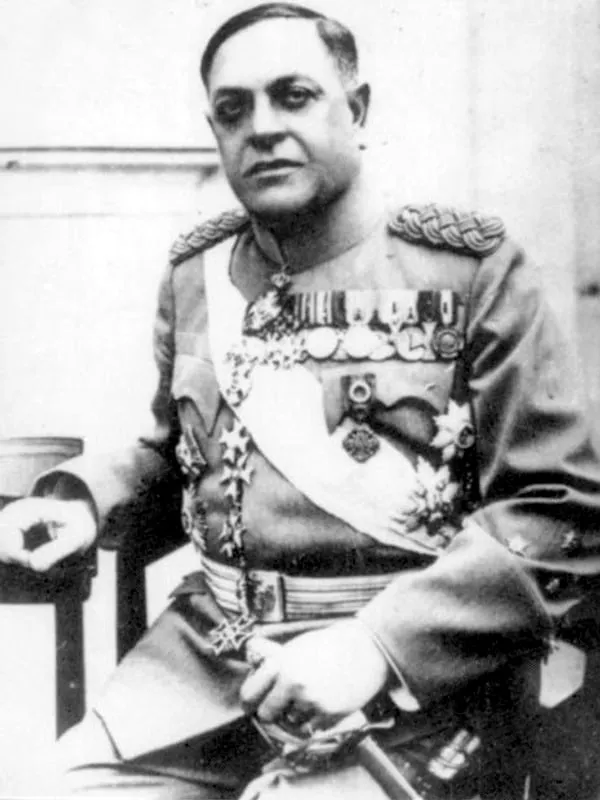
- Born:
- 2 September 1878, Grocka (Kingdom of Serbia)
- Died:
- 4 February 1946, Belgrade
- Author:
- Łukasz
- Photo:
- autor nieznany, domena publiczna, Wikimedia Commons

Milan Nedić was a professional officer who fought in every one of the Serbian army’s wars from 1912 to 1918 and rose to become Chief of the General Staff and Minister of War of the Kingdom of Yugoslavia. Convinced that Germany would win the war, in the autumn of 1940 he urged the regent to join the Axis and lost his post for it. After Yugoslavia’s defeat he accepted from the German military commander the premiership of the collaborationist Government of National Salvation in occupied Serbia, which he held from August 1941 to October 1944. He presented himself as a man who took upon himself the shame of collaboration in order to save his nation from annihilation. Yet his government helped the Germans fight the resistance, adopted Nazi language and ideology, and took part in the persecution as a result of which Serbia became one of the first countries in Europe that the occupier declared “free of Jews”. He died in 1946 in a Belgrade prison, and the dispute over how to judge him continues in Serbia to this day.
Origins and youth
He was born on 2 September 1878 in Grocka (PL) on the Danube, not far from Belgrade (some Serbian sources give 1877). His father Đorđe was a district prefect and his mother Pelagija a teacher. The family came from Šumadija and took pride in ancestors who had fought in the Serbian uprisings against the Turks in the early 19th century. Through his great-grandmother Nedić was related to Dimitrije Ljotić, later the leader of the Serbian fascists, and his younger brother Milutin also became a general in the Yugoslav Army.
He finished secondary school in Kragujevac and in 1895 entered the military academy in Belgrade. In 1904 he completed the academy’s higher school and the general staff course, and began his service in the army of the Kingdom of Serbia. He married Živka Pešić, the daughter of an artillery officer; they had a son, Dušan, and several daughters. By 1910 Nedić was already a major.
The Balkan Wars and the First World War
In the Balkan Wars of 1912–1913 he fought against Turkey and Bulgaria and received many decorations for bravery. In 1913 he was promoted to lieutenant colonel. The First World War brought rapid advancement: by 1915 he was a colonel and, as his biographers stress, the youngest general staff colonel in the Serbian army. In the winter of 1915/1916, during the Albanian Golgotha – the retreat of the army, the government and thousands of civilians across the mountains of Montenegro and Albania to the Adriatic – his units covered the withdrawal. In 1916 he served as orderly officer to King Peter I, and in September 1918 he commanded an infantry brigade of the Timok Division in the breakthrough on the Salonika front that opened the Serbian army’s way home. The retreat through Albania, which he later described in his book Srpska vojska na Albanskoj Golgoti, remained the defining experience of his war.
General of the Kingdom of Yugoslavia
After the war he served in the army of the new Kingdom of Serbs, Croats and Slovenes as chief of staff of several army districts and as a divisional commander. In 1923 he became a major general, and in 1930 an army general, taking command of the Third Army in Skopje. He wrote historical works on the Serbian army and its breakthrough on the Salonika front, and on King Alexander I as a military leader. In June 1934 he became Chief of the General Staff, but the following year, probably as a result of a conflict with the Minister of War, General Petar Živković, he was moved to the Military Council. British diplomats described him at the time as “rather slow-witted and obstinate”.
In August 1939, in the government of Dragiša Cvetković formed after the agreement with the Croats, Nedić became Minister of the Army and Navy. In this post he faced two problems that would decide his later fate. The first was the weakness of the army, of which he himself was more aware than anyone. Nedić did not believe that Yugoslavia could defend itself against Germany, especially after the fall of France in 1940, and held that Serbia’s only salvation lay in an accommodation with the stronger side. The second was the influence of Ljotić, whose Zbor movement was winning supporters among the officers. The bulletin of this banned organisation was secretly printed at the War Ministry’s printing works and distributed around the country by military couriers. Nedić also disliked Dragoljub Mihailović, who had warned in memoranda that the army could not defend the country’s long borders, and punished him for it with arrest.
After the Italian attack on Greece in October 1940, Yugoslavia found itself encircled. On 1 November Nedić submitted a memorandum to the regent, Prince Paul, and to Prime Minister Cvetković, proposing that the country abandon neutrality, join the Axis and seize Salonika before the Italians did. The regent, who sympathised with Britain and was married to a Greek princess, had no intention of attacking Greece. On 6 November 1940 Nedić was dismissed. The official reason was the army’s unpreparedness during the Italian air raid on Bitola; the real one was his contacts with Ljotić. Zbor was dissolved and its members arrested.
The April defeat
When the coup of 27 March 1941 overthrew the government that two days earlier had joined the Tripartite Pact, Nedić welcomed it. The new Prime Minister, General Dušan Simović, thought highly of him and gave him command of the Third Army Group, which was to defend Macedonia against the Germans advancing from Bulgaria, and Kosovo and Montenegro against the Italians in Albania. This front collapsed in the first days of the invasion of Yugoslavia: as early as 7 April the Germans took Skopje and cut Yugoslavia off from Greece. The government-in-exile later held Nedić responsible for the disintegration of the defence in Macedonia.
After the capitulation, unlike most Yugoslav generals, Nedić was not sent to a prisoner-of-war camp in Germany. He returned to Belgrade and was placed under house arrest. On 5 June 1941 his only son, Dušan, and his pregnant daughter-in-law were killed when an ammunition depot exploded in the fortress at Smederevo.
Prime Minister of occupied Serbia
In the summer of 1941 an uprising broke out in Serbia that the three German occupation divisions were unable to suppress. The Germans, who had until then been content with the compliant commissarial administration of Milan Aćimović, decided to set up a government headed by a man with enough authority to build Serbian armed forces to fight the partisans. Edmund Veesenmayer, an envoy of the German Foreign Ministry, chose Nedić as a determined anti-communist who believed in a German victory. The general hesitated, and the Germans threatened that if he refused, Bulgarian and Hungarian troops would occupy the whole of Serbia and he himself would be taken prisoner. On 29 August 1941 the military commander in Serbia, General Heinrich Danckelmann, appointed Nedić’s government, and on 1 September the new Prime Minister announced on the radio that he wished to “save the core of the Serbian nation” and called on the insurgents to lay down their arms.
The Government of National Salvation had no standing in international law and was recognised by no state. Nedić was allowed to expand the gendarmerie, from which the Serbian State Guard was formed in 1942, and Ljotić’s volunteer units, later renamed the Serbian Volunteer Corps, operated under his government’s supervision. He set up summary courts that sentenced communists to death, introduced censorship and a National Labour Service, and dismissed teachers and professors suspected of hostility to the occupation. His propaganda, financed by the Germans, spoke of the “communist-Jewish rabble”, extolled the “Aryan” character of the Serbian peasant and contrasted the healthy countryside with the corrupt city, while Nedić himself figured in it as the “father of Serbia”. The government enforced German decrees depriving Jews and Roma of the right to work, to education and to property. The police and gendarmerie helped with the arrests, the Serbian State Guard guarded the Banjica camp in Belgrade, where opponents of the occupation were imprisoned and shot, and state offices took over the property of the murdered. The killing of the Jews was carried out by the Germans: in the autumn of 1941 the Wehrmacht shot almost all adult Jewish men as hostages, and in the spring of 1942 the women and children held in the Sajmište camp were suffocated in a gas van. Of the roughly 16,000–17,000 Jews in occupied Serbia, the overwhelming majority perished.
Nedić also suffered humiliations that showed the limits of his power. In October 1941 the Wehrmacht, applying the rule of a hundred people shot for every German killed, massacred some 2,000 men in Kraljevo and nearly 2,800 in Kragujevac, the town of his youth. Nedić protested and threatened to resign, but could at most secure some limits on indiscriminate shootings. From the autumn of 1941 his government maintained secret contacts with Mihailović’s Chetniks, and some Chetnik units “legalised” themselves by joining his forces. In January 1942 command of the Serbian State Guard passed to the Higher SS and Police Leader August Meyszner, and the Germans handed a large part of the country over to occupation by the Bulgarians, whom Nedić detested. He took in hundreds of thousands of Serbian refugees from Croatia, Kosovo and Macedonia, for which some Serbs remembered him with gratitude, although historians point out that the Germans themselves demanded that the refugees be admitted. His memoranda of 1942, in which he asked for greater autonomy, the withdrawal of the Bulgarians and the annexation of eastern Bosnia and Srem to Serbia, were ignored, and he repeatedly threatened to resign.
On 18 September 1943 he was received by Hitler. Nedić presented a plan for a new, enlarged Serbia united with Montenegro and with territory taken from Croatia. Hitler rejected it, promising instead to give him authority over the Serbian formations, which Nedić received only in November, when he also took over the Ministry of the Interior. Hermann Neubacher, the German Foreign Ministry’s special envoy for the Balkans, tried to strengthen his government, but in 1943 the Germans themselves were concluding truces with Chetnik commanders over the Prime Minister’s head. In August 1944 Nedić met Mihailović in secret and tried to unite the anti-communist forces against the partisans and the approaching Red Army. By then it was too late.
Flight and death
On 4 October 1944, as Soviet troops and the partisans of Josip Broz Tito were entering Serbia, the Government of National Salvation was dissolved. On 6 October Nedić and most of his ministers left via Budapest and Vienna for Kitzbühel in the Tyrol. After Germany’s surrender he was detained by the Western Allies; Serbian and Polish studies name the Americans, some English-language accounts the British. On 1 January 1946 he was handed over to the authorities of communist Yugoslavia. In prison in Belgrade he was interrogated while awaiting trial. On 5 February 1946 the newspapers reported that the previous day he had committed suicide by jumping from a window while his guards were not looking. Many Serbs never believed this version, and a post-war register of victims recorded him as “liquidated”. Whether he jumped or was pushed has never been established.
Assessment and the dispute over his memory
In communist Yugoslavia Nedić was a symbol of treason, a collaborator on a par with Pavelić. From the mid-1980s some Serbian historians and commentators began to rehabilitate him as a patriot who, in an impossible situation, had saved the nation’s “biological substance”, and in 1993 the Serbian Academy of Sciences and Arts included him in its list of the hundred most eminent Serbs. His portrait hung in the government building among those of Serbian prime ministers until it was taken down in 2008. An application by his descendants for judicial rehabilitation was rejected in 2018 by the Higher Court in Belgrade, and in April 2019 the Court of Appeal upheld that ruling. In 2024 the family began new proceedings.
Historians, Serbian ones among them, point out that Nedić was neither a Serbian Pétain nor a protector of his nation. His government had no real power, but it lent the Germans Serbian hands to fight the resistance, moved ideologically towards National Socialism and took part in the Holocaust, which in Serbia was exceptionally swift and almost total. An estimated 141,000 to 167,000 people died in occupied Serbia – in German mass shootings, in camps and in the civil war in which his government was one of the sides. His life shows how an officer who had fought for Serbia in two Balkan Wars and on the Salonika front came, in the Second World War, to believe in a German victory and tied his country’s fate to it.
Sources
Mentioned in battles
(01)Often appears with
People who appear in the same events.