1944: The fighting for Hungary
Operation Frühlingserwachen
- Dates:
- 6–16 March 1945
- Front:
- Eastern Front
- Location:
- Western Hungary and the Croatian borderlands: the area between Lake Balaton, Lake Velence and the Danube (Székesfehérvár, Seregélyes, Gárdony, Enying, the Sió Canal at Simontornya, Dunaföldvár), the sector south of Lake Balaton between Nagybajom and Kaposvár, and the bridgeheads on the Drava at Donji Miholjac and ValpovoOn the battle map →
- Sides:
- Soviet Union, Bulgaria and YugoslaviaFyodor Tolbukhin, Rodion MalinovskyNazi Germany and HungaryOtto Wöhler, Sepp Dietrich, Hermann Balck
- Result:
- Soviet victory. After ten days of attacking, the Germans had driven between a few and about 30 km into the defences of the 3rd Ukrainian Front, but they failed to reach the Danube and called off the offensive on 15 March. According to Soviet figures the 3rd Ukrainian Front lost 32,899 men, including 8,492 killed and missing; estimates of German losses vary widely – from about 12,000–15,000 killed, wounded and missing according to German reports to more than 27,000 men and some 500 tanks and assault guns according to Soviet data. On 16 March the Red Army opened the Vienna offensive, and within a week it had thrown the German forces back to their starting positions and beyond, towards the Austrian border.
- Author:
- Łukasz
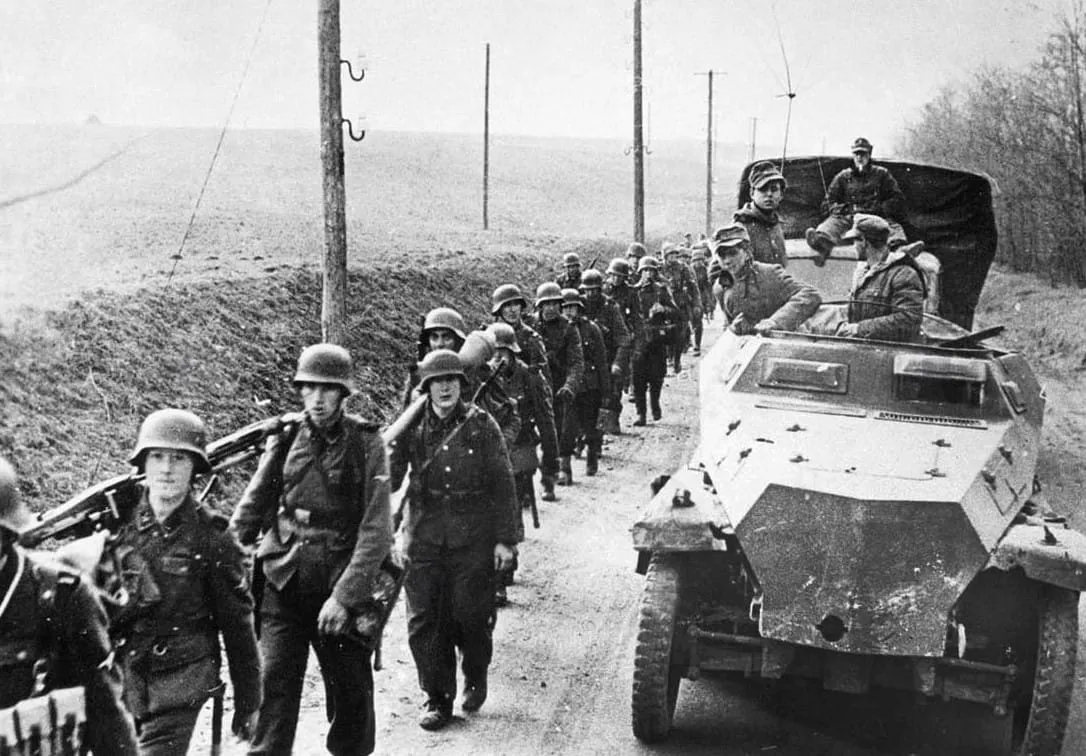
Operation Frühlingserwachen (German: Unternehmen Frühlingserwachen, “Spring Awakening”) was the last great German offensive of the Second World War. It began on 6 March 1945 in western Hungary, in the area of Lake Balaton, and was directed against the troops of Marshal Fyodor Tolbukhin’s 3rd Ukrainian Front and the Bulgarian and Yugoslav armies fighting alongside it. The main blow was struck by the Sixth SS Panzer Army of Josef “Sepp” Dietrich, transferred to Hungary after the defeat of the Ardennes offensive.
Adolf Hitler sent his last armoured reserves not to the Oder, where after the Vistula–Oder offensive the Red Army already stood some 70 km from Berlin, but to Lake Balaton. He wanted to protect the last oilfields still at the Reich’s disposal, push the Soviet forces back across the Danube and, if all went well, even retake Budapest, lost only a few weeks earlier. None of these aims was achieved. The attack, made through melting snow and deep mud against an anti-tank defence organised in great depth, advanced about 30 km at its furthest point and petered out on 15 March. The next day the Red Army launched its offensive on Vienna, which within a few days wiped out all the German gains.
In Soviet and Russian historiography the battle is known as the Balaton defensive operation (Russian: Балатонская оборонительная операция), and in German historiography as the Plattensee offensive (German: Plattenseeoffensive, after the German name for Lake Balaton).
Name and dates
The German plan was originally codenamed Süd (“South”); the name Frühlingserwachen was given to it at the end of February 1945. Strictly speaking, the codename denoted the main thrust between Lake Balaton and Lake Velence, while the subsidiary attacks had names of their own: Eisbrecher (“Icebreaker”) south of Lake Balaton and Waldteufel (“Forest Devil”) from the Drava. The Army High Command (OKH), however, used the name Frühlingserwachen for the whole offensive, and that is how it has become established in the literature.
The battle can be taken to have begun on 6 March 1945 – the day on which all three thrusts got under way, during the night and early morning – and to have ended on 16 March, the day the Soviet counter-offensive began. Some authors end the operation on 15 March, when the Germans called off their attack; this is also how Russian historiography counts it, dating the Balaton defensive operation to 6–15 March. Others include the retreat up to 19–23 March, by which time the Red Army had recovered all the ground lost during the German offensive.
Background
In the autumn of 1944 the Red Army entered Hungary, and at the end of December it encircled Budapest. The siege of the capital lasted seven weeks. In January 1945 the Germans tried three times to break through to the city (Operations Konrad I–III); in the third of these, launched on 18 January south of Lake Velence, their tanks came within some 20 km of the suburbs before they were halted and, by mid-February, thrown back into the area between Lake Velence and Lake Balaton. On 13 February the last defenders of Buda capitulated. From then on the front in western Hungary ran from the bend of the Danube at Esztergom, past Székesfehérvár and the eastern end of Lake Balaton, and then south of the lake towards the Drava, where Bulgarian and Yugoslav troops faced the German Army Group E.
For Hitler, Hungary and eastern Austria mattered in 1945 above all for economic reasons. After the loss in August 1944 of the Romanian oilfields at Ploiești, which had been bombed for months, the last significant sources of oil at the Reich’s disposal were the deposits around Nagykanizsa in south-western Hungary and the fields near Zistersdorf in Lower Austria, together with the refineries at Komárom and Pét. At a conference on 23 January 1945 it was reckoned that the Hungarian and Austrian oil region provided about 80 per cent of the remaining supply and that without it the war could not be continued. According to the post-war testimony of German generals, Hitler said he would rather lose Berlin than Hungarian oil and Austria. Even there, however, fuel was growing ever scarcer – according to Albert Speer, much of the extraction equipment had already been destroyed by Allied bombers, and the refineries at Komárom and Pét were bombed while the battle was still in progress, on 14 and 16 March.
The dispute over the use of the reserves had begun in January. When the Soviet offensive from the Vistula opened on 12 January, the Chief of the Army General Staff, Heinz Guderian, demanded that the Sixth Panzer Army, then being withdrawn from the Ardennes, be sent to the Oder front to defend Berlin. On 22 January Hitler decided otherwise and sent it to Hungary. The German plan was to strike the 3rd Ukrainian Front, which held the line from the Danube in the north to the Drava in the south, before the Red Army could attack towards Vienna.
Before the main offensive began, the Germans also carried out Operation Südwind (17–24 February). Units of the I SS Panzer Corps, the first to reach Hungary, wiped out a bridgehead of the 2nd Ukrainian Front on the Hron (Hungarian: Garam) north of the Danube. It was the last successful German attack of the war, but it came at a high price: the SS divisions suffered losses before the offensive proper, and Soviet intelligence, from the testimony of prisoners and the presence of the Leibstandarte and Hitlerjugend divisions, concluded that a large armoured force was being assembled in Hungary.
The German plan
Four versions of the operation were drawn up by the staffs of Army Group South, the Sixth SS Panzer Army and the Sixth Army. The commander of Army Group South, General of Infantry Otto Wöhler, favoured a more cautious plan, which would first secure the left flank between Lake Velence and the Danube. On 25 February at the Reich Chancellery, however, Hitler chose the bolder version, designed to bring about a rapid junction of forces in the south. The plan, finalised on 28 February, provided for three thrusts.
The main one, Frühlingserwachen, was to be made by the Sixth SS Panzer Army from between Lake Balaton and Lake Velence south-eastwards, towards the Danube. The I SS Panzer Corps was to force the Sió (PL) Canal, and the II SS Panzer Corps to seize the crossing at Dunaföldvár. On the left flank the attack was to be made by General Hermann Breith’s III Panzer Corps of Hermann Balck’s Sixth Army, which operated as Army Group Balck (the Hungarian Third Army was also subordinated to it). Once the Danube had been reached, part of the force was to swing north along the river towards Budapest and part south along the Sió, to meet the troops advancing from the Drava.
The second thrust, Eisbrecher, was entrusted to General Maximilian de Angelis’s Second Panzer Army, which was to attack from the Nagybajom area south-west of Lake Balaton towards Kaposvár. The third, Waldteufel, was to be carried out by the XCI Army Corps of General Alexander Löhr’s Army Group E, which came under Field Marshal Maximilian von Weichs’s Command South-East. The corps was to force the Drava and advance north through Mohács. Had all three thrusts succeeded, the Soviet 26th and 57th Armies would have been trapped in a pocket between Lake Balaton, the Drava and the Danube.
The plan suffered from serious weaknesses. The area of the attack lay on the boundary between two commands – the OKH, to which Army Group South answered, and the OKW, which controlled the South-East front – and this made coordination difficult. Weichs himself and the staff of Army Group E doubted whether infantry without tanks could get as far as Mohács. Above all, however, an armoured offensive was to be launched during the thaw, on lowland criss-crossed by canals and waterlogged meadows. At the beginning of March alarming reports on the state of the roads and the ground reached the headquarters of Army Group South, and the attack was postponed from 5 to 6 March.
The movement of troops was shrouded in strict secrecy. The trains carrying the Sixth SS Panzer Army were first routed to the Zossen area near Berlin, to suggest that it would be used on the Oder, and only then sent via Vienna to Győr. The soldiers were ordered to cover the unit markings on their vehicles and uniforms, including the cuff titles bearing the names of the SS divisions on their sleeves; the units were given cover names, and in correspondence Dietrich was referred to as the “Senior Engineer Commander in Hungary”.
Forces
The core of the German force was the Sixth SS Panzer Army with four SS panzer divisions that had fought in the Ardennes: the 1st Leibstandarte SS Adolf Hitler and the 12th Hitlerjugend in Hermann Priess’s I SS Panzer Corps, and the 2nd Das Reich and the 9th Hohenstaufen in Wilhelm Bittrich’s II SS Panzer Corps. Wehrmacht divisions were also placed under the army, among them the 23rd Panzer Division, the I Cavalry Corps and Hungarian units on the northern shore of Lake Balaton. Army Group Balck included, among others, the 1st and 3rd Panzer Divisions and the SS panzer divisions Totenkopf and Wiking, while the Second Panzer Army had at its disposal, among others, the 16th SS Panzergrenadier Division Reichsführer-SS, brought over from Italy. Air support was provided by Luftflotte 4.
On paper this was the strongest armoured force the Germans assembled in the last year of the war. In reality the SS divisions had not had time to recover after the Ardennes and Operation Südwind – they had been hastily brought up to strength with poorly trained recruits, often from the Luftwaffe and the navy, and according to Western researchers only about a third of the staff of the Sixth SS Panzer Army were Waffen-SS officers. Soviet studies put the German and Hungarian forces at some 430,000 men, about 6,000 guns and mortars, 877 tanks and assault guns and about 850 aircraft. German and Hungarian research, including that of Krisztián Ungváry, gives lower figures: just over 700 serviceable tanks took part in the attack – roughly 30 per cent of all those the Wehrmacht then possessed – among them heavy Tiger IIs and Panthers.
According to Soviet figures, the 3rd Ukrainian Front numbered some 400,000 men, 6,800 guns and mortars, about 400 tanks and self-propelled guns and about 700 aircraft of the 17th Air Army. In the first echelon, the 4th Guards Army (from the Danube to Seregélyes) and the 26th Army (from Seregélyes to the eastern end of Lake Balaton) were to take the main blow, with the 57th Army south of the lake. The left flank was held by General Vladimir Stoychev’s 1st Bulgarian Army (PL), and beyond the Drava stood the 3rd Yugoslav Army. The 27th Army formed the second echelon, and the front reserve comprised the 18th and 23rd Tank Corps, the 1st Guards Mechanised Corps and the 5th Guards Cavalry Corps. Marshal Rodion Malinovsky’s neighbouring 2nd Ukrainian Front held the line north of the Danube.
The Soviet defence and the reserve “for Vienna”
The German preparations did not remain secret. On 17 February the Supreme High Command headquarters (the Stavka) ordered the 2nd and 3rd Ukrainian Fronts to prepare an offensive on Bratislava and Vienna for the middle of March. Only a few days later, however, reports arrived of SS divisions on the Hron, and on 21 February the head of Soviet military intelligence reported to Stalin that the entire Sixth SS Panzer Army was on its way to Hungary. By the beginning of March there was no longer any doubt about where and when the blow would fall. The Stavka ordered Tolbukhin to go over to the defensive and bleed the German armoured force white, while continuing preparations for the Vienna offensive.
Tolbukhin based his defence on the experience of the Battle of Kursk in 1943. Within two weeks his troops built three defensive belts, 25–30 km deep, along the axis of the main attack. On the 83-km sector from Gánt to Lake Balaton, 66 anti-tank areas were created and 65 per cent of the front’s artillery concentrated. On average there were more than 700 anti-tank mines to every kilometre of front, and in the zone of the 26th Army as many as 2,700. The front was to conduct a positional defence, without the costly counter-attacks that had cost it heavy tank losses in January and February. Because the depots lay on the eastern bank of the Danube and the pontoon bridges were being destroyed by aircraft and drift ice, supplies were also carried across the river by cableways and a fuel pipeline.
The most distinctive decision of the Soviet command was to keep a reserve untouched. General Vasily Glagolev’s 9th Guards Army – formed from airborne units, large and well rested – was brought up from the Stavka reserve to the area east of Székesfehérvár, behind the positions of the 4th Guards Army. The Stavka forbade its use in the defensive fighting, because it was earmarked for the attack on Vienna. According to the memoirs of General Sergei Shtemenko, then of the General Staff, Tolbukhin asked during the hardest days of the battle for permission to commit this army, but was refused and told to manage with the forces he had. The Soviet command thus took a calculated risk: the defence was to hold out without support so that the counter-offensive could begin as soon as the German attack had exhausted itself. From 10 March, when fog grounded much of the 17th Air Army, the 5th Air Army of the 2nd Ukrainian Front was also drawn into the fighting at Lake Balaton.
The course of the battle: the first days (6–10 March)
The offensive began during the night of 5–6 March at its southern end. Troops of the XCI Army Corps forced the Drava at Donji Miholjac and Valpovo, taking the 1st Bulgarian Army and the 3rd Yugoslav Army by surprise, and established two bridgeheads about 8 km wide and about 5 km deep. They got no further, however. Without tanks, on sodden meadows and under constant attack by Soviet aircraft, they became bogged down in fighting with the Bulgarians and with Josip Broz Tito’s Yugoslav Partisans, soon reinforced by the Soviet 133rd Rifle Corps.
At dawn on 6 March the Second Panzer Army moved off. The attack from Nagybajom towards Kaposvár was led by the LXVIII Army Corps with the Reichsführer-SS division, which had no tanks, only assault guns and armoured personnel carriers. According to German accounts the attack stalled after only a few hours, a few kilometres from its starting positions. The commander of the Soviet 57th Army, General Mikhail Sharokhin, moved some 600 guns and mortars from other sectors to the threatened one, together with a Soviet and a Bulgarian infantry division. By 12 March the attack south of Lake Balaton had run out of steam, having advanced less than 10 km.
The main thrust between the lakes began on 6 March after a short artillery preparation. Not all the divisions had managed to reach their starting positions; some units of the II SS Panzer Corps went into action only in the evening. On the first day the Germans penetrated up to 4 km into the defences of the 4th Guards and 26th Armies and took Seregélyes. Tolbukhin moved the 18th Tank Corps forward to meet them. Over the following days the Germans threw 70, then 100 and more tanks at a time into attacks on sectors 1–2 km wide, and they also attacked at night, using night-vision devices, probing for weak spots in the defence. The Soviet command in turn rushed anti-tank reserves to those spots.
The weather hampered the attack. Snow, rain and thaw turned the fields into a quagmire; tanks sank up to their turrets, and the heavy Tiger IIs had to be hauled out by tractors. The armoured columns could not leave the few roads, which made them easy targets for anti-tank guns and ground-attack aircraft. Things went particularly badly for the II SS Panzer Corps, which ran into marshy ground east of the Sárvíz canal and made almost no progress. On 10 March, according to German returns, the entire German striking force around Lake Balaton had only 230 serviceable tanks and 167 assault guns.
The course of the battle: reaching the Sió Canal and the halt (9–15 March)
The Germans achieved their greatest success on their right flank, along the eastern shore of Lake Balaton. On 9 March the Leibstandarte and Hitlerjugend divisions broke through the defences of the Soviet 135th Rifle Corps of the 26th Army and by evening had reached the area of Enying. In five days the German troops had overcome the main and second defensive belts, but ahead of them still lay the army rear belt and the front line of defence. On 11 March (12 March according to some sources) the I SS Panzer Corps forced the Sió Canal, about 30 metres wide at that point, at Simontornya and established a small bridgehead on its southern bank. This was the furthest point the offensive reached: the Danube was still some 30 km away.
On the left flank Breith’s III Panzer Corps advanced south of Lake Velence as far as Gárdony, and there it stuck. According to German figures, the corps, which had begun the attack on 6 March with 153 tanks, had only 63 left after a few days, including assault guns. The II SS Panzer Corps, attacking between it and the I SS Panzer Corps, was still unable to force its way through the marshy ground towards Dunaföldvár. The Sixth SS Panzer Army had driven a wedge into the Soviet defences but had not torn them apart, and its flanks remained exposed.
Tolbukhin, meanwhile, was reinforcing the threatened sectors – he drew on the 27th Army from the second echelon and on the front reserves, and additional units were transferred to him from the 2nd Ukrainian Front. By 14 March it had become clear that the offensive would not achieve its aims: it would neither reach the Danube nor link up with Army Group E. In the first eight days Army Group South, by its own reports, had lost more than 15,000 killed, wounded and missing.
On 15 March the attack came to a halt. In ten days the Germans had advanced 8–30 km into the Soviet defences, depending on the sector, reaching the Sió Canal at their furthest point. Guderian later wrote in his memoirs that in those days every chance of a major success vanished and the SS divisions lost the morale they had had until then.
The Soviet counter-offensive (16 March onwards)
On 16 March, after an hour-long artillery preparation, the right wing of the 3rd Ukrainian Front went over to the attack – with practically no operational pause after the end of the defensive fighting. The fresh 9th Guards Army and the 4th Guards Army struck north of Székesfehérvár at the screen formed by Army Group Balck, whose task was to cover the rear of the Sixth SS Panzer Army. The attack was supported by the 17th and 5th Air Armies. This was the first day of the Vienna offensive, which Malinovsky’s 2nd Ukrainian Front joined a day later.
The direction of the attack was dangerous for the Germans: if the Soviet Guards armies broke through from the north to Lake Balaton, they would cut off the SS panzer divisions that had pushed far to the south, towards the Sió Canal. By 18 March the 9th Guards Army had broken through the defences between Székesfehérvár and Mór, and the 4th Guards Army had advanced through Felsőgalla to the outskirts of Tata, severing the link between the Sixth SS Panzer Army and the Hungarian Third Army. On 19 March the 6th Guards Tank Army, transferred to Tolbukhin from the 2nd Ukrainian Front, entered the battle and drove towards Várpalota. On the same day the Red Army recovered the last scraps of ground lost since 6 March.
The German panzer divisions had to abandon their gains in haste and fall back through a narrow corridor along the north-eastern shore of Lake Balaton, which by 22 March had narrowed to about 3 km. At the cost of heavy losses, and covered among others by the Hohenstaufen division, they had escaped from it by 23 March. On 21 March, in defiance of an order to hold to the last man, Székesfehérvár was abandoned. On the western shore of Lake Balaton and in the Bakony Forest the Red Army captured abandoned tanks, often undamaged, that had been immobilised by lack of fuel. A bitter joke from these days is attributed to Dietrich: that his army was rightly called the Sixth, because he had six tanks left. Between 16 and 25 March the Hungarian Third Army was destroyed west of Budapest. At the end of March the Red Army crossed the Austrian border, and at the beginning of April the last German troops were driven out of Hungary.
The cuff-title order
The defeat of the elite SS divisions provoked Hitler’s fury. He decided that the troops, and the Leibstandarte in particular, “had not fought as the situation demanded”. In the second half of March he ordered that, as a mark of disgrace, the soldiers of the SS panzer divisions that had fought at Lake Balaton (usually listed as the Leibstandarte SS Adolf Hitler, Das Reich, Hohenstaufen and Hitlerjugend, and in some accounts also Totenkopf) be stripped of the cuff titles bearing their units’ names. This order, known in the literature as the “cuff-title order” (German: Ärmelstreifenbefehl), was above all symbolic: the cuff titles had in any case already been removed, from 30 January, to keep the transfer secret. According to the accounts of veterans and biographers, Dietrich did not pass the order on to his subordinates, and his officers are said to have reacted with indignation. The episode is often cited as evidence of the collapse of Hitler’s trust even in his most loyal formations in the last weeks of the war; its details and the units it was addressed to vary, however, from one account to another, and these accounts are largely post-war and come from the SS men themselves.
Losses
The figures for losses are incomplete and contradictory. According to Soviet returns, cited among others in the study edited by Grigori Krivosheev, the 3rd Ukrainian Front lost 32,899 men in the Balaton defensive operation (6–15 March), including 8,492 killed and missing and 24,407 wounded and sick; according to other Soviet data it also lost 152 tanks and self-propelled guns and 415 anti-tank guns. Bulgarian and Yugoslav losses are counted separately.
Soviet sources estimated German and Hungarian losses at more than 27,000 men, more than 300 guns and mortars, some 500 tanks and assault guns and more than 200 aircraft. The German figures are much lower: Army Group South reported more than 15,000 killed, wounded and missing in the first eight days, and the Hungarian historian Krisztián Ungváry gives 12,358 killed, wounded and missing for 6–15 March, and only 31 tanks lost irrecoverably. Ungváry explains the small number of tanks destroyed by the fact that, because of the mud and the difficulty of getting forward, many never went into action at all, and damaged ones were recovered for repair. The real losses of equipment came only during the retreat after 16 March, when hundreds of tanks and vehicles were abandoned without fuel or blown up; of the more than 700 tanks committed to the offensive, few remained in German hands by the end of March.
The civilian population also bore the brunt of the fighting. The front had been rolling back and forth through the same villages and small towns of western Hungary since January, and Székesfehérvár changed hands several times. Once the front had passed, the population fell victim to violence by Red Army soldiers, especially the rape of women, which is attested by numerous documents and accounts.
Significance
Operation Frühlingserwachen was the last great offensive of the Wehrmacht and the Waffen-SS in the war. Its failure sealed the fate of western Hungary and opened the road to Austria for the Red Army. The strategic sense of the offensive was questionable from the start: the strongest armoured force the Reich still possessed was used up in a struggle for oilfields that could no longer be fully exploited in any case, while the Oder front, 70 km from Berlin, was left without reserves. The battle also showed how far the balance of forces had shifted – even surprise at the point of attack no longer gave the Germans an advantage against a prepared defence in depth, and the Soviet command could afford to hold back an entire fresh army in reserve in order to go straight over to the counter-offensive.
For the Red Army this was the last major defensive operation of the war, conducted – as at Kursk – in order to bleed the enemy white before launching its own attack. Soviet propaganda and historiography stressed that the “flower” of the SS had been destroyed at Lake Balaton; modern historians point out rather that the German divisions, for all their reputation, had been worn out and poorly reinforced before the battle, and that the defeat was decided largely by the terrain and the lack of fuel.
Aftermath
The Vienna offensive, launched on 16 March, brought the troops of the 3rd Ukrainian Front to the Austrian border on 29 March, and on 4 April the last German units were driven out of Hungary – a date that post-war Hungary adopted as its Liberation Day. On 13 April, after several days of fighting, the Red Army captured Vienna. The remnants of the Sixth SS Panzer Army withdrew deeper into Austria and in May 1945 most of them surrendered to the Americans; Joachim Peiper, who had fought at Lake Balaton at the head of the Leibstandarte’s panzer regiment, also gave himself up to them. Dietrich was convicted by an American military tribunal for the Malmedy massacre and, in West Germany, for his part in the killings of the “Night of the Long Knives”; he died in 1966. Balck and Wöhler were taken prisoner after the war and brought before the courts; in 1948 Wöhler was sentenced in the High Command Trial to eight years’ imprisonment for crimes committed on the Eastern Front. After the war Tolbukhin commanded the Soviet forces in the Balkans and died in 1949, while Malinovsky became Soviet Minister of Defence in 1957.