1944: The fighting for Hungary
Siege of Budapest
- Dates:
- 29 December 1944 – 13 February 1945
- Front:
- Eastern Front
- Location:
- Budapest and its surroundings: Pest on the left bank with Kőbánya, Kispest and Csepel Island, Buda on the right bank with Castle Hill and Gellért Hill, and to the west the battlefields of the relief attempts from Esztergom, Tata and Bicske to Székesfehérvár and Lake BalatonOn the battle map →
- Sides:
- Soviet Union and RomaniaRodion Malinovsky, Fyodor TolbukhinNazi Germany and HungaryKarl Pfeffer-Wildenbruch, Iván Hindy
- Result:
- Soviet victory. After 51 days of fighting in the city (counting from the first clashes on 24 December), the Red Army took Pest on 18 January 1945 and Buda on 13 February. Three German relief attempts (Operations Konrad I–III, 1–28 January) failed to reach the city. The German-Hungarian garrison of about 79,000 men was destroyed – according to Krisztián Ungváry, only about 600–700 soldiers reached their own lines after the breakout on the night of 11–12 February. About 38,000 civilians were killed, and more than 80 per cent of the buildings in Budapest were destroyed or damaged.
- Author:
- Łukasz
The Siege of Budapest (Hungarian: Budapest ostroma) was the struggle for the Hungarian capital, fought from the end of December 1944 to the middle of February 1945 between the Red Army, supported by the Romanian VII Army Corps, and the German-Hungarian garrison defending the city. The troops of the 2nd Ukrainian Front of Marshal Rodion Malinovsky and the 3rd Ukrainian Front of Marshal Fyodor Tolbukhin closed the ring around the city on 26 December 1944. On 29 December they sent envoys to the defenders with an ultimatum, and after it was rejected and both envoys were killed they launched the assault. The garrison was commanded by the Waffen-SS general Karl Pfeffer-Wildenbruch, commander of the IX SS Mountain Corps; the Hungarian units by General Iván Hindy, commander of the Hungarian I Corps.
The fighting lasted seven weeks. Flat Pest, on the left bank, fell on 18 January 1945, and the retreating Germans blew up the bridges over the Danube. Hilly Buda, on the right bank, held out for almost another month. In January three German relief operations, codenamed Konrad, came within some ten to several dozen kilometres of the city, but none broke the ring. On 11 February, against Hitler’s orders, the remnants of the garrison attempted to break out from Castle Hill; they were almost all killed or captured. On 13 February the last resistance ceased.
Alongside Stalingrad and Leningrad, Budapest was one of the longest and bloodiest battles for a great city in the whole war. Unlike Warsaw, Berlin or Vienna, its population was not evacuated: an estimated 800,000 civilians were trapped in the encirclement. According to the Hungarian historian Krisztián Ungváry, author of the standard monograph on the siege, about 38,000 of them died. At the same time Arrow Cross gangs were murdering the Jews of Budapest, and after the Red Army entered the city its inhabitants fell victim to looting and mass rape.
Name and dates
The siege can be taken to have begun on 29 December 1944 – the day of the ultimatum and the start of the assault – and to have ended on 13 February 1945, the day the last defenders of Buda capitulated. The literature, however, uses different time frames. Many studies, including English-language ones, date the siege from 26 December, the day the ring was closed near Esztergom. Ungváry dates the whole battle for Budapest from 3 November 1944, when the first Soviet tanks appeared in the suburbs – on this reckoning it lasted 102 days, including 51 days of fighting in the city itself, which began on 24 December in the Buda hills. Soviet and Russian historiography includes the siege in the Budapest offensive operation, which lasted from 29 October 1944 to 13 February 1945, or 108 days.
Some of the more detailed dates also vary from source to source. This applies above all to the end of the fighting in Pest (17 or 18 January), the course of the Konrad operations and the timing of the breakout on the night of 11–12 February.
Background
Hungary had fought on Germany’s side since 1941, but after the defeat of the Hungarian Second Army on the Don in January 1943 the regent Miklós Horthy and his government were looking ever more openly for a way out of the war. Hitler’s answer was the occupation of Hungary by the Wehrmacht on 19 March 1944. Under German occupation, and with the participation of the Hungarian gendarmerie, about 437,000 Jews from the provinces were deported to Auschwitz between May and July 1944, according to German reports; the Jews of Budapest survived because Horthy halted the deportations at the beginning of July. In the spring and summer the capital was also a target of Allied air raids.
After Romania went over to the Allies in August 1944, the front approached Hungary’s borders. On 1 October a Hungarian delegation arrived in Moscow to negotiate an armistice, and on 15 October Horthy announced on the radio that Hungary was leaving the war. The Germans were ready for this: Otto Skorzeny’s men kidnapped the regent’s son, and Horthy was forced to revoke his declaration and step down. Power passed to the leader of the Arrow Cross party, Ferenc Szálasi (the Arrow Cross coup), who pledged to fight on at the Reich’s side to the end. For the Jews of Budapest this meant the end of their relative safety.
At the same time the Battle of Debrecen (6–29 October) was being fought on the Hungarian Plain, at the end of which the 2nd Ukrainian Front reached the Tisza. On 28 October the Stavka – under pressure from Stalin, who wanted the Hungarian capital taken quickly – ordered Malinovsky to strike at Budapest at once. The operation began on 29 October, before Malinovsky had been able to gather his forces. On 3–4 November Soviet tanks reached the south-eastern suburbs of Pest, but the attack off the march failed: the defenders stopped it on the Attila Line, the belt of fortifications surrounding the left-bank part of the city. On 4 November, during the rush hour, the accidental detonation of charges laid by German sappers brought down the Margaret Bridge; several hundred people were killed.
The Stavka then changed its plan: instead of a frontal attack on Pest, the city was to be encircled. In November and December the 2nd Ukrainian Front worked its way round Budapest from the north, while Tolbukhin’s 3rd Ukrainian Front, which after the Belgrade offensive had crossed the Danube in southern Hungary, advanced through Transdanubia between the Danube and Lake Balaton. At the beginning of December units of the 46th Army crossed the Danube at Ercsi, south of the capital, at heavy cost. For their part, the Germans concentrated a large share of their armoured forces on the Eastern Front in Hungary – Hitler regarded the Hungarian oilfields near Nagykanizsa, the last significant source of oil available to the Reich after the loss of Ploiești, as strategically indispensable.
Szálasi and his government left Budapest on 9 December. Earlier still, at the turn of November and December, Hitler had declared the city a fortress (Festung Budapest), to be defended “house by house” regardless of losses and the fate of the civilian population. No evacuation of the inhabitants was carried out – partly for lack of time and means, partly because the German and Hungarian authorities did not want to cause panic. On 19–20 December both Soviet fronts launched their final encircling offensive. On 24 December the spearheads of the 3rd Ukrainian Front broke into the Buda hills, and on 26 December they reached the Danube near Esztergom, closing the ring. On 27 December the defenders lost Ferihegy airfield.
Opposing forces
According to Ungváry, about 79,000 soldiers were trapped in the ring: about 33,000 Germans and about 37,000 Hungarians, plus several thousand members of auxiliary and volunteer formations. The core of the German forces consisted of two Waffen-SS cavalry divisions – the 8th SS Cavalry Division Florian Geyer and the 22nd SS Volunteer Cavalry Division Maria Theresia, made up largely of Hungarian Germans – together with the 13th Panzer Division, the Feldherrnhalle Panzergrenadier Division and police units. The Hungarian forces were commanded by General Iván Hindy’s I Corps, which included among others the remnants of the 10th and 12th Infantry Divisions and the 1st Armoured Division, anti-aircraft artillery units, the gendarmerie and improvised volunteer battalions, among them a unit of young men under Major László Vannay. Armed members of the Arrow Cross party also fought on the defenders’ side.
The command was split in two and the two halves co-operated badly. Karl Pfeffer-Wildenbruch, a police officer and from 1944 a Waffen-SS general, reported directly to the German Army Group South, and through it to Hitler, and rarely consulted Hindy on his decisions. The Germans did not trust the Hungarian units, and the Hungarians resented the Germans for condemning their capital to destruction for the sake of the Reich’s war aims. From the outset the garrison suffered from shortages of ammunition, fuel and food. Supplies were brought in by air: after the loss of Ferihegy, aircraft and gliders landed until 9 January on a makeshift strip in the park below Castle Hill and on the avenues of Pest; after that only parachute containers were dropped, and many of them fell into the Soviet zone.
On the Soviet side the city was besieged by troops of both fronts. From the east, in Pest, the attack was made by units of the 2nd Ukrainian Front – the 30th Rifle Corps, the 18th Guards Rifle Corps and the Romanian VII Army Corps – combined into the so-called Budapest Group of Forces, commanded by General Ivan Afonin and, after he was wounded in January, by General Ivan Managarov. From the west, in Buda, two rifle corps of the 46th Army of the 3rd Ukrainian Front were fighting; in February they were placed under the Budapest Group. The forces directly assaulting the city numbered between 100,000 and 180,000 men according to various estimates; behind them stood the full armies of both fronts, which in January had to fend off the German relief attempts. The Romanian corps was withdrawn from Budapest in mid-January.
The attackers had superiority in artillery and aircraft, but the city – especially Buda, with its hills, thick-walled tenements, cellars, sewers and the labyrinth of caves beneath Castle Hill – favoured the defence. Both sides soon found that the fighting resembled that at Stalingrad: for individual houses, floors and cellars, with assault groups, sappers, flamethrowers and guns firing over open sights.
The course of the siege: the ultimatum and the fighting for Pest (29 December – 18 January)
On the night of 28–29 December the commands of both fronts announced over the radio and by loudspeaker that envoys would be coming. On the morning of 29 December Captain Miklós Steinmetz, a Hungarian-born Red Army officer, set out in the Kispest sector on the Pest side, and Captain Ilya Ostapenko at Budafok on the Buda side. Both carried an ultimatum: the garrison was to surrender in return for a promise that the men’s lives would be spared, that they would be fed and that the wounded would be cared for. Steinmetz was killed with his companions before he reached the Hungarian lines – according to one version by the defenders’ fire, according to another, given by a Hungarian officer, because his car ran over an anti-tank mine. Ostapenko reached Pfeffer-Wildenbruch’s headquarters, was given a refusal and was killed on his way back. Soviet propaganda presented both deaths as cold-blooded murder; Ungváry, relying among other things on the account of a surviving companion of Ostapenko, concludes that he was killed by Soviet artillery fire and that neither envoy was killed deliberately. The circumstances remain disputed. That same day the Red Army began its assault.
Pest, lying on the flat left bank of the Danube, was hard to defend. Soviet units advanced along the broad avenues and through the industrial suburbs – Kőbánya, Kispest, Rákospalota – while the defenders fell back, shortening their line. The fighting took place in a city full of people. The inhabitants, including tens of thousands of refugees, were stuck in cellars without water, light or heating, in temperatures well below freezing. Their food stocks quickly ran out; dead horses became one of the main sources of food for soldiers and civilians alike. In mid-January the Red Army took Csepel Island with its armaments works, which had gone on producing ammunition and Panzerfausts until the very last days.
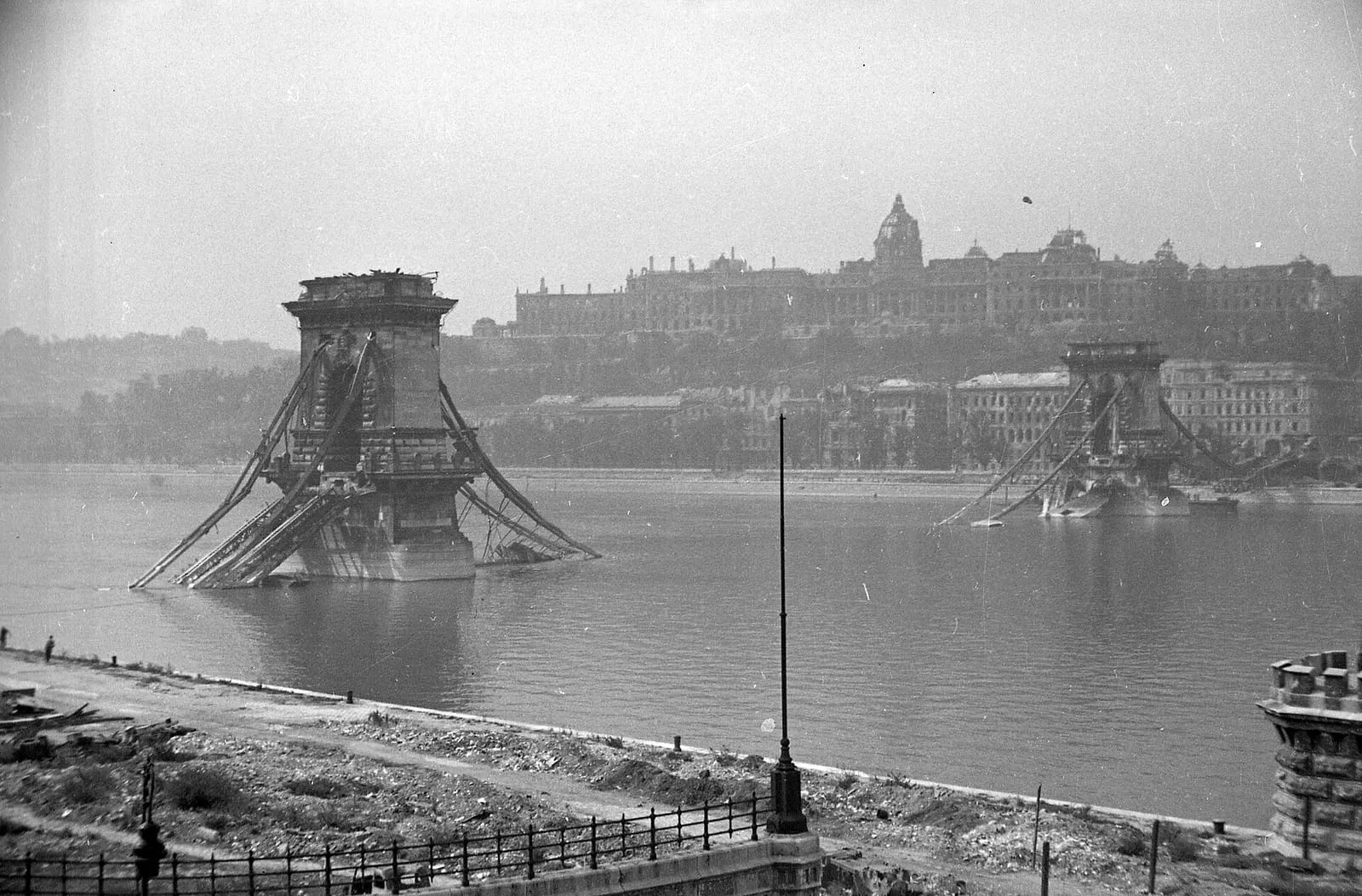
At the beginning of January the defence of Pest began to fall apart. Soviet troops cut it into pieces, reached the Danube near the Margaret Bridge and threatened to cut off the units fighting in the city centre. On 17 January Hitler agreed to the withdrawal of the Pest garrison to Buda. The crossing over the bridges, jammed with fleeing soldiers, civilians, carts and wounded, took place on the night of 17–18 January. On the morning of 18 January, despite the protests of Hungarian officers, German sappers blew up all the remaining bridges in Budapest, including the Chain Bridge of 1849, the symbol of the city. That day Pest fell into Soviet hands.
On 18 January the Red Army also reached the ghetto in Pest’s District VII, into which some 70,000 people had been crammed. Some of the buildings of the so-called international ghetto, protected by neutral states, had already been taken a few days earlier. The inhabitants of the ghetto survived – although in the ghetto itself several thousand people died of hunger, disease and cold within a few weeks, and bodies lay in the streets and courtyards.
Relief attempts: the Konrad operations (1–28 January)
Hitler would not allow the garrison to break out of the encirclement, but he wanted to restore contact with it. The IV SS Panzer Corps of General Herbert Gille, with the SS Totenkopf and Wiking panzer divisions, was transferred to Hungary from the Warsaw front, which the Chief of the Army General Staff, General Heinz Guderian, considered a mistake, since it weakened the defence of the Vistula in the face of the expected Soviet winter offensive. The aim of the Konrad operations was not to evacuate the defenders, but to break through a corridor and hold Budapest.
Operation Konrad I began on the night of 1–2 January 1945 from the Tata area, through the wooded hills north-west of the city. The Germans took their opponents by surprise and within a few days were approaching Bicske, but the Soviet command moved more corps to the threatened sector and the attack stalled about 20 km from the city. Konrad II, launched on 7 January from the direction of Esztergom, was meant to reach Buda through the Pilis hills. The German spearheads got as far as Pilisszentkereszt, about 20 km from Buda; according to Ungváry they could have tried to push further, but the higher command stopped them. By 12 January both operations had been called off.
Konrad III was the most dangerous. The IV SS Panzer Corps, secretly moved to the area north of Lake Balaton, struck on 18 January at the junction between two armies of the 3rd Ukrainian Front, reached the Danube at Dunapentele within two days, cutting the Soviet position in Transdanubia in two, and on 22 January retook Székesfehérvár. Stalin briefly considered withdrawing his troops to the east bank of the Danube, but in the end ordered them to hold their positions; Tolbukhin sent reserves to the threatened axis, including some of the forces earmarked for the assault on Buda. The German spearheads reached the Váli stream, about 20–25 km from the ring of encirclement. Pfeffer-Wildenbruch asked for permission to break out towards them – Hitler refused. The exhausted German units were halted, and on 28 January they began to pull back; Székesfehérvár remained in their hands.
In the west the Ardennes offensive was under way at this time, and on 12 January the Soviet offensive from the Vistula began, breaking through the front in Poland within a few days. For Hungary’s sake, then, the Germans had weakened the sector of the front that mattered most to them, without achieving their aim. After the failure of Konrad III the fate of Budapest was sealed.
The course of the siege: Buda and Castle Hill (18 January – 11 February)
Buda, built on the hills of the right bank of the Danube, was far harder to take than Pest. The defenders, crammed into an ever smaller area, could fire down on the attackers, and in the cellars and the caves beneath Castle Hill they set up hospitals, stores and command posts. There was fighting for the Farkasrét cemetery, for the Southern Railway Station, for Margaret Island – linked to Buda by the surviving half of the bridge and used as a landing ground and drop zone – and for Gellért Hill with its citadel, defended by Waffen-SS units. Both sides used the sewers to move troops and to lay ambushes. From the turn of January and February the volunteer Buda Regiment, formed from Hungarian prisoners of war and deserters, also fought on the Soviet side.
The situation in Buda was desperate. Airdrops provided the garrison with only a fraction of the supplies it needed, and once the last landing grounds were lost the gliders stopped flying. Thousands of wounded lay in overcrowded hospital cellars without medicines or dressings. The civilians, of whom there were several hundred thousand in Buda, suffered hunger and thirst; water was drawn from the Danube under fire. Artillery fire and aerial bombs destroyed one quarter after another, including the Royal Palace, which burned down.
At the beginning of February the Red Army tightened the ring from several directions. After two days of fighting it took the Southern Railway Station, and on 10 February it broke onto Castle Hill, almost cutting the remnants of the garrison in two. On 11 February, after a massive assault from three sides, Gellért Hill fell. The defenders now held an area of less than two square kilometres.
The breakout of 11 February
Hitler still forbade the abandonment of the city. Pfeffer-Wildenbruch nevertheless decided to break out with the remnants of his troops to the north-west, towards the Buda hills and the German lines, some 25–40 km away. This time he included General Hindy in his plans. The breakout began on the evening of 11 February, the last day of the Yalta Conference. Some 28,000 German and Hungarian soldiers set out from Castle Hill in three waves, and with them thousands of civilians. The Soviet troops, who most probably knew of the preparations, were waiting in prepared positions, especially around Széll Kálmán Square.
The first wave, helped by fog and surprise, got through the first Soviet lines. The following waves ran into the fire of artillery, rocket launchers and machine guns; the streets leading from Castle Hill were strewn with thousands of dead. According to Ungváry, 5,000–10,000 men reached the wooded hills north-west of the city, but most of them were rounded up or killed over the following days. Only about 600–700 soldiers reached the German lines. Pfeffer-Wildenbruch and Hindy, who had left Castle Hill through an underground sewer, were captured in a Buda suburb in the very first hours of the breakout. The last groups of defenders in Buda capitulated on 13 February 1945.
Moscow celebrated the capture of Budapest with an artillery salute, and a medal “For the Capture of Budapest” was instituted for those who had taken part in the fighting.
The Holocaust in the besieged city
At the time of the encirclement some 100,000–120,000 Jews were still living in Budapest – the only large Jewish community in Central Europe to have survived until the end of 1944. After Szálasi took power, thousands of them, women among them, were sent on foot in November on death marches towards the Austrian border to build fortifications; one of their organisers was Adolf Eichmann, even though the gas chambers at Birkenau had by then ceased operating. In November and December the Arrow Cross authorities crowded most of the rest into a closed ghetto in Pest’s District VII (about 70,000 people) and into the so-called international ghetto – several dozen apartment buildings under the protection of neutral states.
During the siege, when state authority in the city had in practice collapsed, armed Arrow Cross gangs raided protected houses, hospitals and shelters, marched Jews to the Danube, shot them on the embankment and threw the bodies into the river. People in hiding, forced labourers and those suspected of helping Jews also fell victim. The number murdered in this way is estimated at about 10,000–15,000; today they are commemorated by the “Shoes on the Danube Bank” memorial near the Parliament. According to post-war accounts, a planned massacre in the ghetto was prevented in mid-January – the credit is given, among others, to pressure from the Swedish diplomat Raoul Wallenberg and to the stance of the German General Gerhard Schmidhuber; the circumstances of the affair are partly unclear.
Wallenberg, from July 1944 secretary of the Swedish legation in Budapest, issued thousands of Swedish protective passports and maintained houses under the Swedish flag. Similar work was done by the Swiss vice-consul Carl Lutz, the apostolic nuncio Archbishop Angelo Rotta, the Italian Giorgio Perlasca, who passed himself off as a Spanish diplomat, and the Red Cross. Thanks to their efforts, and to the Red Army’s rapid advance, about 100,000 Jews survived in Budapest. On 17 January 1945 Wallenberg went to the Soviet headquarters in Debrecen – it is believed, to present a plan of aid for the survivors – and was arrested by Soviet counter-intelligence. Taken to Moscow, he disappeared in a Soviet prison; the Soviet authorities later claimed that he had died in 1947, but his fate has never been fully explained.
The civilian population
Some 800,000 inhabitants lived through the siege in cellars and shelters, without electricity, gas or running water. According to Ungváry, about 38,000 civilians died: about 13,000 as a result of military operations and about 25,000 from hunger, disease and cold and in executions, including the Arrow Cross killings. More than 80 per cent of the city’s buildings were destroyed or damaged, among them the Royal Palace and the Parliament building, and all the bridges over the Danube lay in the river.
The Red Army’s entry was accompanied by looting and the mass rape of women. Estimates of the number of women raped in Budapest vary enormously – from 5,000 to 200,000; a frequently cited figure is about 50,000. The Soviet command did issue orders forbidding violence against the population, but did not enforce them. Thousands of civilian men were seized in the streets and deported together with prisoners of war to labour camps in the USSR – according to Ungváry, partly in order to make up the numbers in earlier, inflated Soviet reports of prisoners taken. In January 1945 tens of thousands of Hungarian Germans were also deported for forced labour in the Donbas.
Losses
According to Ungváry’s estimates, of the garrison’s roughly 79,000 soldiers about 30,000 Germans and about 9,000 Hungarians were killed, and about 11,000 Germans and about 29,000 Hungarians were taken prisoner; most of the dead fell during the breakout. The 8th and 22nd SS Cavalry Divisions, the 13th Panzer Division, the Feldherrnhalle Division and the Hungarian I Corps were destroyed. The Soviet side announced the capture of about 110,000 prisoners – according to Ungváry, this figure included detained civilians. According to the tables compiled by Grigori Krivosheev, the Red Army lost about 80,000 killed and missing and about 240,000 wounded and sick in the Budapest operation as a whole (29 October 1944 – 13 February 1945), and thus including the fighting outside the city. The losses suffered in the siege itself are not precisely known.
Significance
Contemporaries and historians compared Budapest with Stalingrad because of the length of the fighting, its ferocity and Hitler’s ruthless order to defend the city to the end. The similarity is limited, however – in Budapest it was above all civilians who died, and what was at stake was not a turning point in the war but its prolongation. The stubborn defence and the Konrad operations tied down large German forces in Hungary at the very moment the fate of the Vistula front was being decided, and delayed the Soviet advance on Vienna. For the Red Army the siege was a rehearsal for the storming of Berlin; for Hungary it was a catastrophe that destroyed the capital and opened the way to Soviet domination of the country.
Aftermath
While the siege was still under way, on 21–22 December 1944, the Provisional National Government of General Béla Miklós was formed in Debrecen; it declared war on Germany and on 20 January 1945 signed an armistice in Moscow. In March 1945 the Germans launched the last great offensive of the war at Lake Balaton (Operation Spring Awakening), which collapsed after a few days; on 4 April – the date adopted in post-war Hungary – the last German troops were driven out of the country, and on 13 April, exactly two months after the fall of Budapest, the Red Army took Vienna. Pfeffer-Wildenbruch spent ten years in Soviet captivity and died in West Germany in 1971. Iván Hindy was sentenced to death by a Hungarian people’s tribunal in 1946 and executed. Ferenc Szálasi went to the gallows the same year. After the war Wallenberg was honoured with the title of Righteous Among the Nations and with honorary citizenship of several countries.