1945: From the Vistula to the Oder
Vistula–Oder offensive
- Dates:
- 12 January – 3 February 1945
- Front:
- Eastern Front
- Location:
- Polish lands between the Vistula and the Oder: the Baranów–Sandomierz, Warka–Magnuszew and Puławy bridgeheads, Warsaw, Radom, Kielce, Częstochowa, Kraków, Łódź, the Upper Silesian Industrial Region, Greater Poland with Poznań, and the Oder bridgeheads at Ścinawa (Steinau), Oława (Ohlau) and KienitzOn the battle map →
- Sides:
- Soviet Union and Poland (Polish 1st Army)Georgy Zhukov, Ivan Konev, Stanisław PopławskiNazi GermanyJosef Harpe, Ferdinand Schörner, Heinz Guderian
- Result:
- A Soviet victory. In three weeks the 1st Belorussian and 1st Ukrainian Fronts smashed the German Army Group A, advanced some 300–500 km from the Vistula to the Oder, took Warsaw, Kraków, Łódź and Upper Silesia, encircled Poznań and seized bridgeheads on the Oder about 70 km from Berlin. According to the figures compiled by Grigori Krivosheev, Soviet losses amounted to 43,476 killed and missing and 150,715 wounded and sick; German losses are known only from estimates – Soviet figures spoke of about 295,000 killed and 147,000 prisoners.
- Author:
- Łukasz
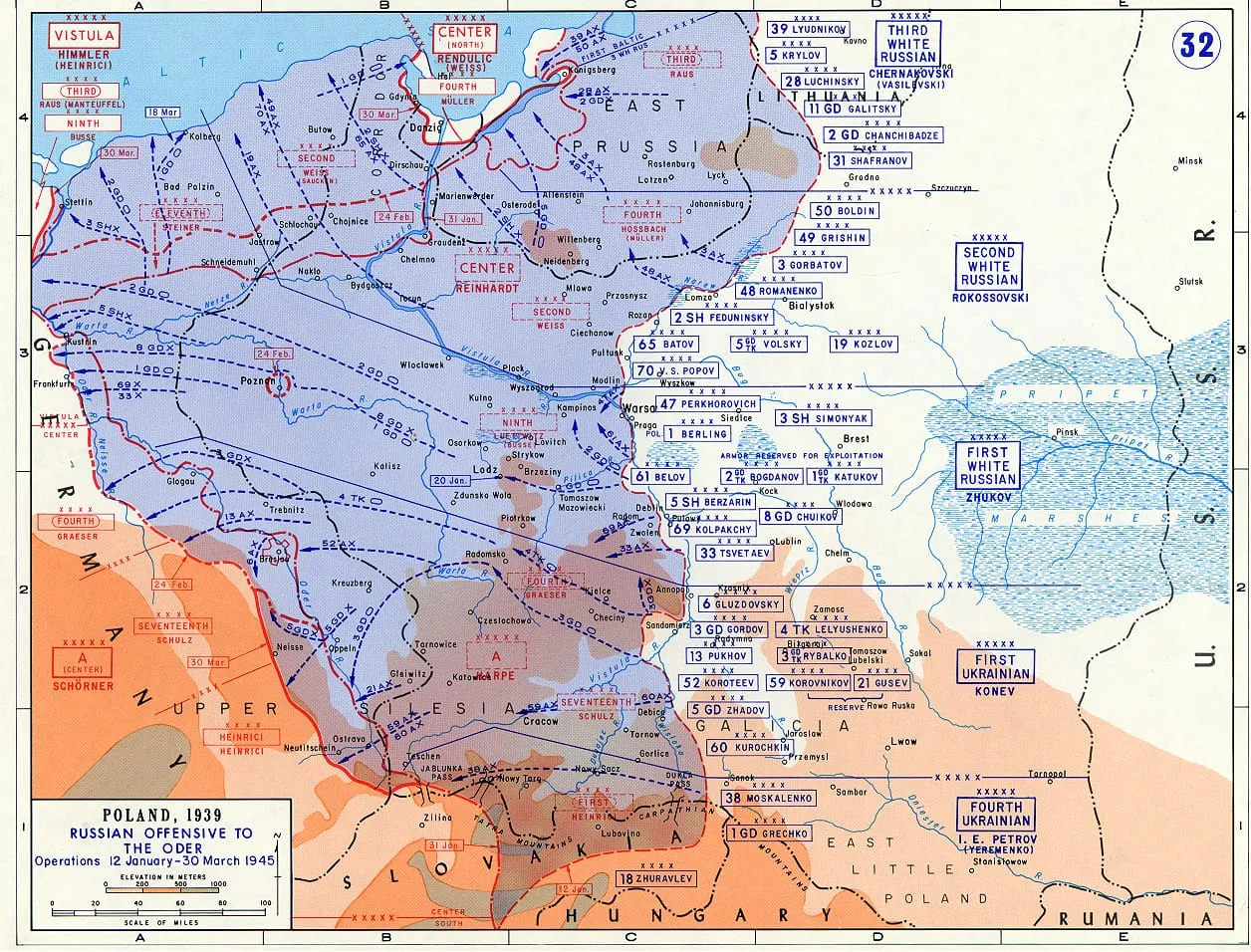
The Vistula–Oder offensive (Russian Висло-Одерская операция), known in Polish literature also as the January offensive, was the winter attack of the two strongest fronts of the Red Army: Marshal Georgy Zhukov’s 1st Belorussian Front and Marshal Ivan Konev’s 1st Ukrainian Front. It opened on 12 January 1945 with a blow from the Baranów–Sandomierz bridgehead; two days later Zhukov’s troops moved out of the bridgeheads at Magnuszew and Puławy. The 1st Belorussian Front included the Polish 1st Army under Major General Stanisław Popławski.
Facing them stood the German Army Group A under Colonel General Josef Harpe, who was replaced during the battle by Colonel General Ferdinand Schörner. In less than three weeks the German front on the Vistula ceased to exist. The Red Army took the ruins of Warsaw, Radom, Kielce, Częstochowa, Kraków, Łódź and Upper Silesia, encircled Poznań and, at the end of January, seized bridgeheads on the Oder – the nearest, at Kienitz, lay about 70 km from Berlin. The figure of some 500 km often cited in the literature (the distance covered, according to Soviet and Polish studies, by Zhukov’s leading armoured formations) has earned the operation a reputation as one of the fastest front-level advances of the entire war.
For Poles the operation had a double meaning. It ended the German occupation of most of the lands of pre-war Poland and made possible the liberation of Auschwitz. At the same time, NKVD units followed in the wake of the front, arresting soldiers of the Home Army and consolidating the power of the communist Provisional Government. For some Poles, therefore, it was the end of one occupation and the beginning of a new dependence – both views are present in the historiography, and both are grounded in fact.
Name and dates
The name “Vistula–Oder operation” comes from Soviet historiography, which divides the winter campaign of 1945 into separate front operations. Within the offensive as a whole it distinguishes, among others, the Warsaw–Poznań operation (1st Belorussian Front) and the Sandomierz–Silesian operation (1st Ukrainian Front). Polish tradition more often speaks of the January offensive, German tradition of the fighting of Army Group A between the Vistula and the Oder.
The operation can be dated by the limits used in Soviet and Russian studies: from 12 January (the attack of the 1st Ukrainian Front) to 3 February 1945, when both fronts – having reached the Oder and closed the ring around Poznań – went over to the defensive and began preparing for the next operations. Some authors, especially Western ones, end their account on 31 January, the day of the crossing at Kienitz, and treat the fighting for Poznań and Küstrin (Kostrzyn) separately.
Background
In the summer of 1944, after Operation Bagration and the Lwów–Sandomierz offensive, the Red Army reached the Vistula and seized three bridgeheads on its western bank: the Baranów–Sandomierz bridgehead (called the “Baranów” bridgehead in German studies), the Warka–Magnuszew (PL) bridgehead and the Puławy bridgehead. Soviet troops also stood on the right bank of the Vistula opposite Warsaw, where in August and September German forces had crushed the Warsaw Uprising. In the autumn of 1944 the front in central Poland froze; the main Soviet effort was concentrated in the Balkans, Hungary and the Baltic states.
The Stavka and the General Staff approved the plan for the 1945 campaign in November 1944. The Berlin axis was entrusted to three fronts: the 1st Belorussian, which Zhukov took over in November from Konstantin Rokossovsky (who moved to the 2nd Belorussian Front advancing on East Prussia), Konev’s 1st Ukrainian and – on the northern flank – the 2nd Belorussian. Joseph Stalin reserved personal coordination of the fronts for himself. Under the original plan the first stage, ending on the line Bydgoszcz–Poznań–Wrocław, was to take about 15 days, and the whole offensive as far as Berlin about 45 days.
The start of the attack was brought forward from around 20 January to 12 January. Stalin later presented this, at Yalta among other places, as help for the Western Allies fighting in the Ardennes – on 6 January Winston Churchill had asked him in a telegram when the offensive in the east would begin. Some historians (David Glantz among them), however, argue that the decision was driven mainly by weather forecasts: the thaw expected at the end of January threatened to soften the ground, which the tanks needed frozen.
Soviet superiority was overwhelming. According to Glantz, the two fronts had about 2.2 million soldiers in 163 divisions, more than 7,000 tanks and self-propelled guns, some 33,000 guns and mortars and about 5,000 aircraft. Army Group A had – depending on how they are counted – around 400,000–450,000 soldiers (some authors give up to 800,000 including rear units and the Volkssturm), some 4,000 guns and about 1,100–1,150 tanks. At each of the bridgeheads the attackers’ superiority in artillery and armour was many times greater than these overall ratios.
The Chief of the German Army General Staff, Heinz Guderian, relying on intelligence reports from Reinhard Gehlen, tried to convince Adolf Hitler that the Vistula front would collapse at the first blow, and demanded that reserves be transferred there from the west and from Hungary. Hitler dismissed the Soviet figures as a bluff; in the second half of January he sent the 6th SS Panzer Army, withdrawn from the Ardennes, not to the Oder but to Hungary, where the siege of Budapest was under way. He also rejected a proposal to pull the troops back to a shorter defensive line, and ordered the armoured reserves to be kept just behind the front line – within range of the Soviet artillery.
Course of the battle
The breakthrough on the Vistula (12–17 January)
At 4.35 a.m. on 12 January the artillery of the 1st Ukrainian Front opened fire on the positions of the 4th Panzer Army in front of the Baranów–Sandomierz bridgehead. The barrage fell above all on the divisions of the XLVIII Panzer Corps, deployed along the face of the bridgehead; after several hours the infantry went into the attack, and in the afternoon Pavel Rybalko’s 3rd Guards Tank Army and Dmitry Lelyushenko’s 4th Tank Army entered the breach. The German armoured reserves of the XXIV Panzer Corps, positioned too close to the front, were partly destroyed before they could counter-attack. On the very first day the front of the 4th Panzer Army was torn open over several dozen kilometres. On 15 January Konev’s troops took Kielce.
On 14 January the 1st Belorussian Front struck. From the Magnuszew bridgehead Nikolai Berzarin’s 5th Shock Army and Vasily Chuikov’s 8th Guards Army attacked, followed into battle by Mikhail Katukov’s 1st Guards Tank Army and Semyon Bogdanov’s 2nd Guards Tank Army. The 69th and 33rd Armies broke out of the Puławy bridgehead, heading for Radom and Łódź. The German Ninth Army under General Smilo von Lüttwitz was unable to hold a coherent defence. On 16 January Soviet troops took Radom, and Zhukov’s leading tank corps broke out into open country and drove west, bypassing centres of resistance.
North of Warsaw the 47th Army crossed the Vistula near Modlin, while the 61st Army outflanked the city from the south. Faced with the threat of encirclement, the command of Army Group A – with the consent of the head of the OKH Operations Branch, Colonel Bogislaw von Bonin, but against Hitler’s orders – withdrew the garrison of “Fortress Warsaw”. On 17 January units of the Polish 1st Army, together with the Soviet 47th and 61st Armies, entered the ruined left-bank city, which the Germans had abandoned. The Polish soldiers, many of them from the eastern borderlands, found a sea of rubble: after the surrender of the Uprising German units had systematically blown up and burned one district after another, and the civilian population had been expelled.
Hitler reacted to the loss of Warsaw with fury. Von Bonin and two of his officers were arrested by the Gestapo, and the commanders of the Ninth Army and of the XLVI Panzer Corps were dismissed. Harpe too was removed; Army Group A was taken over by Schörner, until then commander of Army Group North in Courland, formally with effect from 20 January. On 19 January Hitler issued an order obliging commanders from division level upwards to report to him in advance every decision to attack or retreat. At a time when the front was moving several dozen kilometres a day, this deprived commanders of what little freedom of action they had left – Guderian later described it as one of the causes of the defeat.
Częstochowa, Kraków and Łódź (16–19 January)
Konev’s right wing, with the 5th Guards Army and the 52nd Army, advanced through Radomsko towards Częstochowa. After a full day of fighting on 16 January the German garrison began to leave the city, and on 17 January – the date given by most studies, although some give 16 January – Częstochowa was taken by Soviet units (among the spearheads was the tank battalion of Major Semyon Khokhryakov). In the autumn of 1944 Częstochowa had been the seat of the last commander of the Home Army, Brigadier General Leopold Okulicki, who on 19 January issued an order dissolving the Home Army and releasing its soldiers from their oath – in order to deny the NKVD a pretext for repressing an organised underground.
On 17 January Konev received new tasks: his tank armies were to advance on Wrocław and the Oder, while the 59th and 60th Armies, supported by the 4th Guards Tank Corps, were to take Kraków and open the way into Upper Silesia. Kraków, the seat of Hans Frank and capital of the General Government, was threatened with encirclement by an outflanking move from the north and west; the Germans therefore abandoned the city during the night of 18–19 January. Kraków passed into Soviet hands almost undamaged, although the retreating Germans blew up some of the bridges over the Vistula.
A legend grew up around the saving of Kraków, cultivated in communist Poland by Konev’s memoirs, official ceremonies and popular culture (including the 1967 Soviet film Major Whirlwind). According to it, the marshal deliberately refrained from using heavy artillery and aircraft, and Soviet scouts and the Polish underground foiled at the last moment the blowing up of the mined city. Historians, among them Kraków scholars of the occupation, point out that the Germans did mine the bridges and certain buildings, but that there is no evidence of a plan to destroy the whole Old Town; the city was saved chiefly by the hasty German retreat in the face of encirclement, and the Soviet encircling manoeuvre, convenient for Konev himself as well, was not dictated solely by concern for historic monuments. A monument to Konev erected in Kraków in 1987 was dismantled in January 1991 and handed over to the Russian city of Kirov.
On Zhukov’s axis, Chuikov’s 8th Guards Army reached Łódź on 18 January and took the city the next day – the second largest in the country, where until August 1944 the Germans had run the Litzmannstadt Ghetto. On 18 January troops of the 1st Ukrainian Front took Piotrków Trybunalski. On 19 January alone the two fronts reported the capture of several hundred localities. Encircled German groupings – among them the remnants of the XLII Army Corps near Przysucha – were destroyed by the second echelons, while General Walther Nehring’s XXIV Panzer Corps fought its way west in fog as a “wandering pocket”, absorbing broken units along the way, and reached the Warta on 22 January.
Upper Silesia and Auschwitz (20–29 January)
The Upper Silesian Industrial Region was, together with the Ruhr, battered by Allied bombing, the most important coal and industrial basin of the Reich. Stalin, as Konev recounted after the war, ordered it to be captured as intact as possible. Konev sent the 59th and 60th Armies against it frontally from the east and the 21st Army to envelop it from the north, and on 20 January he turned Rybalko’s 3rd Guards Tank Army back from the Wrocław axis; advancing along the upper Oder, it came in behind General Friedrich Schulz’s Seventeenth Army, which was defending the region.
From 25 January Schulz asked for permission to withdraw some 100,000 soldiers from the pocket taking shape around Katowice; Schörner granted it during the night of 27–28 January, contrary to Hitler’s earlier prohibitions. Konev left the Germans a narrow corridor to the south-west, towards Racibórz and Rybnik, through which the Seventeenth Army escaped encirclement. This manoeuvre – referred to in the literature as a “golden bridge” – cost the chance of destroying the whole grouping, but spared the mines, steelworks and power stations. Between 24 and 29 January Soviet troops took Gliwice, Bytom, Katowice and Chorzów, among other towns.
The Red Army’s entry into the pre-war territory of the Reich in Upper Silesia was accompanied by crimes against the civilian population, including Poles, whom the soldiers treated as Germans. On 25–27 January in Miechowice near Bytom Soviet soldiers murdered, according to the findings of the Institute of National Remembrance (IPN), some 380 inhabitants (the Miechowice massacre (PL)). From February the Soviet authorities began deporting thousands of inhabitants of Upper Silesia to forced labour in the USSR.
Near Oświęcim the SS began the final evacuation of the Auschwitz-Birkenau complex on 17–18 January; gassing there had already ended in the autumn of 1944. According to Franciszek Piper of the Auschwitz-Birkenau State Museum, some 56,000–58,000 prisoners were marched out on foot in death marches towards Wodzisław and Gliwice, from where they were taken in open wagons to camps deep inside the Reich; according to the museum’s estimates, between about 9,000 and 15,000 people died during the marches and transports. SS men burned records and blew up the crematoria. On 27 January soldiers of the 60th Army (including the 322nd Rifle Division) entered the main camp, Birkenau and Monowitz, where they found some 7,000 sick and emaciated prisoners and hundreds of corpses. In the last days before the liberation the SS murdered several hundred more prisoners in the camp and its subcamps.
Greater Poland and the march to the Oder (20 January – 3 February)
After taking Łódź, Zhukov’s armies advanced in a broad wedge on Poznań and on towards the Oder. Panic gripped the Warthegau, annexed to the Reich in 1939: Gauleiter Arthur Greiser left Poznań on 20 January, and the evacuation of German settlers and of the population was usually ordered at the last moment, in temperatures well below freezing. Columns of refugees streamed westward along the roads, mingling with retreating troops. The Polish 1st Army, advancing on the front’s right wing along the left bank of the Vistula through Sochaczew, Gostynin and Brześć Kujawski, covered Zhukov’s northern flank and at the end of January reached the Pomeranian Wall.
Soviet troops crossed the pre-war Polish–German border in the last ten days of January. The 1st Guards Tank Army bypassed Poznań, which Hitler had declared a fortress, and on 25 January the city was encircled; its garrison of several tens of thousands held out for several more weeks, tying down part of Chuikov’s 8th Guards Army and units of the 69th Army. Katukov’s tanks then passed through the weakly manned Międzyrzecz Fortified Region, and on 28 January the 2nd Guards Tank Army broke through the fortifications on the edge of the Pomeranian Wall and turned towards the Oder.
The Germans tried to save the situation by reorganisation. On 24 January Hitler created a new Army Group Vistula between the Vistula and the Oder under Heinrich Himmler, who had no experience of commanding troops; on 26 January Army Group A was renamed Army Group Centre. Volkssturm battalions, officer schools and replacement units were hurriedly brought up to the Oder and to Küstrin (Kostrzyn).
On 31 January a forward detachment of Berzarin’s 5th Shock Army crossed the Oder on the ice and took the village of Kienitz (PL) on its western bank, and in the first days of February Zhukov’s troops seized further bridgeheads north and south of Küstrin. Earlier still, on 22–24 January, the 1st Ukrainian Front had reached the Oder: Lelyushenko’s 4th Tank Army formed a bridgehead at Ścinawa (Steinau), and the 5th Guards Army at Oława (Ohlau) and Brzeg, on either side of Wrocław, which the Germans had declared a fortress.
At the beginning of February the offensive petered out. Both fronts had outrun their supply bases by several hundred kilometres, the railways had to be converted to the broad gauge, the air forces could not keep pace in moving their airfields, and the thaw was softening the roads and the ice on the Oder. On the exposed northern flank, in Western Pomerania, German forces were gathering, while Poznań and Küstrin were still resisting. Soviet historiography takes 3 February 1945 as the end of the operation.
Poles in the operation and behind the front line
In January 1945 the Polish 1st Army numbered about 90,000 soldiers in five infantry divisions, a cavalry brigade, an armoured brigade and artillery units. It was a force formed in the USSR under communist political supervision, with many Soviet officers in command posts – its commander, Major General Popławski, was himself a Red Army officer of Polish descent. Most of those in its ranks, however, were Poles: exiles and deportees of 1940–1941, inhabitants of the eastern borderlands and, from the autumn of 1944, conscripts from the Lublin region and Subcarpathia. The communist authorities exploited the part it played in the capture of Warsaw for propaganda purposes, and on 19 January a parade of Polish units was held in Aleje Jerozolimskie, in front of a reviewing stand by the Hotel Polonia.
Behind the front the apparatus of the new power was being built up. The communist Provisional Government, formed on 31 December 1944 by transforming the Lublin-based Polish Committee of National Liberation (PKWN) and recognised neither by the Polish government-in-exile nor by the Western powers, staffed the administration of the newly occupied lands, and at the beginning of February moved from Lublin to Warsaw. The NKVD plenipotentiary with the 1st Belorussian Front, and at the same time adviser to the Polish Ministry of Public Security, was General Ivan Serov, who answered to Lavrentiy Beria. On the basis of Beria’s order No. 0016 of 11 January 1945 on “clearing the rear” of the fronts (a document published by the IPN, among others), NKVD internal troops “cleared” the area behind the front: they arrested Home Army soldiers, whether they had come into the open or were in hiding, members of the administration of the Polish Underground State and people deemed hostile. Some of those detained were sent to camps such as the NKVD special camp in Rembertów (PL), and from there to the Gulag deep inside the USSR.
The dissolution of the Home Army on 19 January was an attempt to keep the underground from giving a pretext for repression; it did not stop the arrests, and some underground soldiers remained in hiding, forming new organisations. For many Poles January 1945 thus meant at once liberation from German terror and the beginning of a new regime imposed by the USSR. The historiography of communist Poland stressed only the first of these aspects; émigré circles and some present-day historians stress the second. Both were real experiences of those weeks.
Losses
According to the tabulation of the Russian General Staff prepared under Grigori Krivosheev, the losses of the two Soviet fronts in the operation amounted to 43,476 killed and missing and 150,715 wounded and sick, some 194,000 men in all. For the Polish 1st Army the heaviest fighting of that winter was still to come, in February, on the Pomeranian Wall.
German losses are known only approximately, because the records of many shattered units were lost. Soviet figures spoke of about 295,000 killed and about 147,000 prisoners; Western historians consider these inflated, but agree that Army Group A ceased to exist as a whole and that most of its divisions lost their fighting capacity. The Germans also lost the industrial plants of Upper Silesia.
The full number of civilian victims remains unknown: Poles; Germans fleeing in the bitter cold from the Warthegau and Silesia; camp prisoners driven on death marches; and victims of violence by Soviet soldiers in the occupied areas.
Significance
The Vistula–Oder offensive was one of the largest offensive operations of the war and one of the most destructive for the Wehrmacht. In three weeks the Red Army moved the front from the Vistula to the Oder, destroyed the last large German grouping in central Poland and stood on the shortest route to Berlin. The loss of Upper Silesia deprived the Reich of a large share of its coal and industrial output; Albert Speer then wrote to Hitler that the war was lost economically. Together with the parallel operation in East Prussia, the offensive ensured that the last months of the war would be fought on the soil of Germany itself.
After the war there was a dispute over whether the Red Army should have gone straight for Berlin in February 1945. Chuikov claimed in the 1960s that the capital of the Reich could have been taken on the march, which would have shortened the war. Zhukov replied that exhausted troops with exposed flanks and an insecure rear would have been courting defeat; most historians, Glantz among them, tend to side with him. Before the attack on Berlin could begin, the Red Army had in February and March to clear Western Pomerania and Silesia, take Poznań (23 February) and Küstrin (end of March) and repel a German counter-attack near Stargard. Wrocław held out under siege until 6 May 1945.
The offensive also changed the political situation. When Roosevelt, Churchill and Stalin met at Yalta at the beginning of February 1945, the whole of pre-war Poland west of the Bug was already under the control of the Red Army and the Provisional Government it backed, which severely limited the Western powers’ room for manoeuvre on the Polish question. For the German population the operation marked the beginning of the great flight and expulsions from the eastern provinces of the Reich, and for camp prisoners – death marches into the heart of Germany.
In Polish memory January 1945 has remained a contested date. In communist Poland it was celebrated as the “liberation” of one city after another, with monuments of gratitude to the Red Army and honorary citizenships for its commanders. After 1989 there was growing emphasis on the NKVD, the arrests and the political subjugation that came with the front. Yet the end of the German occupation, with its mass murders, expulsions and extermination camps, was for millions of people a real deliverance – and this duality remains the most accurate description of what the operation meant for Poland.