- Category:
- Crimes and repression
- Front:
- Central and Eastern Europe
- Date:
- 10 June 1942
- Author:
- Łukasz
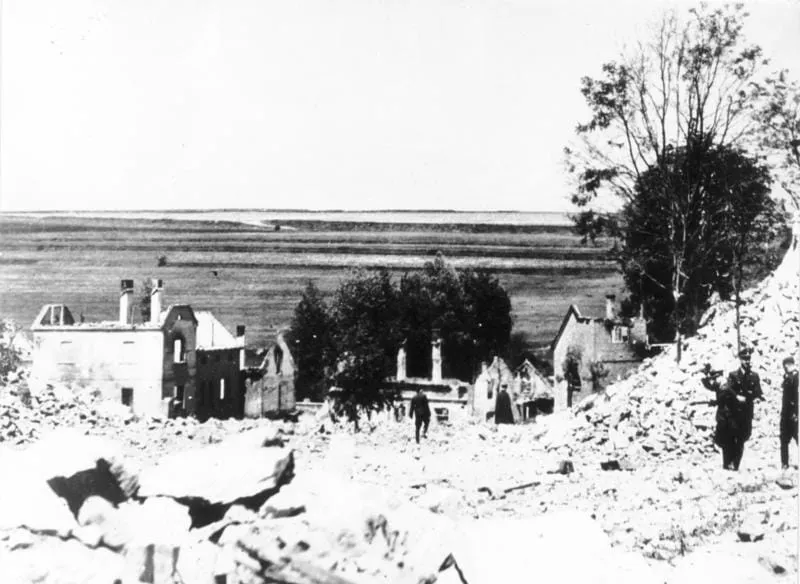
On 10 June 1942 German police and the SS destroyed the village of Lidice in the Protectorate of Bohemia and Moravia, some 20 kilometres west of Prague. From dawn until the afternoon, 173 men and boys were shot in the yard of one of the farms. The women and children were taken to nearby Kladno, from where the women were sent to Ravensbrück concentration camp and the children to Łódź; most of the children were murdered a few weeks later in the Chełmno nad Nerem extermination camp. The houses were burned and blown up, and the site of the village was levelled. It was a reprisal for the assassination of Reinhard Heydrich, with which the people of Lidice had had nothing to do.
It is often said that “all the adult men and children” were killed and “all the women” deported to camps. That is a simplification. Men over 15 were shot on the spot or in the following days, but the children were separated from their mothers and did not die in Lidice: 82 of them were gassed at Chełmno at the beginning of July, a few were selected for Germanisation, and seventeen survived the war. Most of the women were taken to Ravensbrück, but several were shot in Prague, and pregnant women were held back until they had given birth.
The village and the pretext
Lidice was a mining and steelworking village near Kladno. In 1942 it had 503 inhabitants and about a hundred houses, a few farms, a mill, inns and the baroque church of St Martin. Most of the men worked in the Kladno mines and steelworks.
Heydrich’s death on 4 June, more than a week after the attack, found the German police with no trace of the perpetrators, even though a state of emergency was in force in the Protectorate and summary courts were sentencing people to death every day. Lidice found its way into the Gestapo’s files by chance. On 3 June the owner of a factory in nearby Slaný opened a letter addressed to one of his workers, who was off sick that day. The writer, who signed only with his first name, wrote in vague terms that he had done “what he wanted to do” and that they would not see each other again. The owner informed the gendarmerie, which informed the Gestapo in Kladno. It turned out that a married labourer, Václav Říha, had wanted in this way to end an affair with nineteen-year-old Anna Maruščáková and had nothing to do with the assassination. Under interrogation, however, Maruščáková mentioned that he had asked her to pass on his regards to the Horák family in Lidice. The Horáks’ son Josef, like the son of another family from the village, Josef Stříbrný, was serving in the Czechoslovak air force in Britain.
The Gestapo searched the Horáks’ house on 4 June and found nothing. For the Germans that did not matter. On 9 June, the day of Heydrich’s state funeral in Berlin, Adolf Hitler demanded exemplary punishment. The State Secretary and Higher SS and Police Leader in the Protectorate, Karl Hermann Frank, passed on from Berlin to Prague the order concerning a village that had allegedly helped the assassins: all adult men were to be shot, the women sent to a concentration camp, the children suitable for Germanisation handed over to SS families in the Reich and the rest “brought up in another way”, and the village burned and razed to the ground. The task was entrusted to the head of the Security Police in Prague, SS-Standartenführer Horst Böhme.
The night and day of 10 June
On the evening of 9 June units of the German Order Police, the Sicherheitsdienst and the Kladno Gestapo surrounded the village, and the Protectorate’s Czech gendarmerie guarded the access roads. No one could leave. After midnight the inhabitants were led out of their houses. The mayor had to hand over the parish registers and the cash box. The women and children were locked in the local school and taken by lorry to Kladno towards morning. The men over 15, and one fourteen-year-old whose father had brought him along, were herded into the cellar, barn and cowshed of the Horák farm on the edge of the village.
The executions began at about seven in the morning. Mattresses from neighbouring houses were propped against the barn wall to stop bullets ricocheting. At first the men were shot five at a time, then, when those in charge decided that this was taking too long, ten at a time. Each new group stood in front of the bodies of those shot before them. The shooting was done mainly by members of the Order Police, under the supervision of SD and Gestapo officers. According to some accounts Frank also appeared at the scene. Among the dead were the local parish priest, Josef Štemberka, who need not have returned to the village but wished to stay with his parishioners, and the mayor, František Hejma, who had earlier been forced to confirm the victims’ identities. By the afternoon 173 men had been killed; the oldest was 84. The bodies were buried in a mass grave by prisoners brought from Terezín.
Death did not spare those who had not been in the village on 10 June. Men working the night shift in the mines, one man who was in hospital and two boys who had just turned fifteen were arrested in the following days. On 16 June, at the firing range in Prague’s Kobylisy district, 26 people from Lidice were shot: nineteen men and seven women, including relatives of the Horáks and the Stříbrnýs, who had been arrested earlier as families of soldiers of the Czechoslovak army in exile. In all, according to the findings of the Lidice Memorial, 192 men from the village died. Three survived: the two airmen in Britain and one man who was then serving a prison sentence.
The women and children
In Kladno the women and children were held for three days in the gymnasium of a secondary school. There the children were separated from their mothers. On 12 June 184 women were taken by train to Ravensbrück concentration camp, which they reached on 14 June; in the following months a dozen or so more joined them, so that various tallies give between 184 and 195 women prisoners from Lidice. They worked in leather and textile workshops, on road building and in munitions factories. The pregnant women were taken to Prague; their newborn babies were taken from them, and they themselves were later sent to the camp. Of the 203 women of Lidice, 53 died in the camps and on death marches, and seven were shot. After the war 143 returned.
The fate of the 105 children was the cruellest. In Kladno racial officials picked out three considered “Nordic”, and several infants were taken to a children’s home in Prague. On 13 June 88 children were taken to Łódź, to a transit camp set up in a former factory on what was then Gneisenaustraße. A telegram from Böhme’s office in Prague announced that the children had only what they were wearing and that “no special care is desired”. On arrival, officials of the SS Race and Settlement Main Office selected another seven children for Germanisation; they were sent to a centre in Puszczykowo near Poznań and then to German families. No decision was taken on the rest for several weeks. At the end of June, according to investigators’ findings, the order to kill them was issued by Adolf Eichmann’s section of the RSHA. In 1961, however, the court in Jerusalem found that Eichmann’s personal involvement in this crime had not been proved beyond reasonable doubt.
On 1 July the children were allowed to write letters to their families, which were never delivered. On 2 July the Łódź Gestapo handed over 81 children to the Chełmno nad Nerem extermination camp (Kulmhof), some 70 kilometres from Łódź, where they were murdered with exhaust fumes in gas vans, the same vehicles in which Jews from the Łódź Ghetto had been dying since the winter. One of the girls previously selected for Germanisation was later deemed “unsuitable” and died at Chełmno together with the children of Ležáky. Of the Lidice children, 82 were murdered, six died during the war of other causes, and seventeen were found after the war, most of them with German families. According to the findings of the Lidice Memorial, a total of 340 inhabitants of the village died at German hands: 192 men, 60 women and 88 children.
A village razed to the ground
After the inhabitants had been taken away, the village was set on fire and its walls were blown up. The animals were killed. The cemetery was dug up and the graves plundered. Over the following weeks labour units – mainly from the Reich Labour Service, according to German researchers – cleared away the rubble, filled in the pond, diverted the stream and the roads, and ploughed and sowed the site. The area was surrounded with barbed wire bearing signs threatening to shoot anyone who approached. The name of the village was removed from German maps. The entire operation was filmed for the occupation authorities.
Unlike most German crimes, which were hidden from the world, this one the Germans did not conceal. On the evening of 10 June, and in the newspapers the next day, an official communiqué was published: because the inhabitants of Lidice had allegedly supported the perpetrators of the assassination and hidden weapons and a radio transmitter, “the adult men have been shot, the women placed in a concentration camp and the children handed over to suitable educational institutions”, the buildings razed, “and the name of the community erased”. The communiqué was meant to terrorise the Czechs. None of the accusations was true. The Gestapo found in Lidice no weapons, no transmitter and no trace of help for the parachutists; nor were any found in a separate investigation into the Horák family. Říha and Maruščáková were murdered in Mauthausen concentration camp in October 1942.
Ležáky and further reprisals
Lidice was not the last. On 16 June the parachutist Karel Čurda, wishing to save himself and his family, went to the Gestapo and named the Prague families who had helped the assassins. On 18 June several hundred SS men besieged the crypt of the Cathedral of Saints Cyril and Methodius in Prague, where after several hours of fighting seven parachutists died, among them Jozef Gabčík and Jan Kubiš. On 24 June the Germans destroyed the hamlet of Ležáky near Chrudim, where the radio transmitter of the Silver A parachute group had been hidden in a quarry. All 33 adult inhabitants, men and women, were shot in Pardubice. Of the thirteen children, two were selected for Germanisation and eleven died at Chełmno. The state of emergency was lifted on 3 July. According to Czech historians, some 1,600 people were executed while it lasted, and nearly three hundred more from the families and circle of the parachutists were later murdered in Mauthausen. Other authors put the total number of victims of the reprisals for the assassination at no fewer than 1,300. The discrepancies arise mainly from who is counted.
“Lidice shall live”
The German communiqué was immediately taken up by Allied radio stations and newspapers. The British Prime Minister, Winston Churchill, shaken by the scale of the reprisal, proposed that for every village destroyed in this way the RAF should burn three German ones. Some ministers, among them Anthony Eden, supported him, but most of the Cabinet persuaded him that this would be a waste of effort and an invitation to German reprisals against British towns and villages. President Edvard Beneš and the Czechoslovak government-in-exile made Lidice a symbol of their nation’s fate.
As early as July 1942 the Stern Park neighbourhood in Illinois, home to immigrants from Bohemia, took the name Lidice; it was later incorporated into the city of Crest Hill. The village’s name was given to the San Jerónimo Lídice district of Mexico City and to places in Brazil, Panama and Venezuela. In September 1942 miners in Stoke-on-Trent in England, encouraged by the doctor and later MP Barnett Stross, founded the “Lidice Shall Live” movement, which raised money to rebuild the village after the war. The American poet Edna St. Vincent Millay wrote the poem The Murder of Lidice; in 1943 came the Hollywood films Hitler’s Madman and Fritz Lang’s Hangmen Also Die!, as well as the British dramatised documentary The Silent Village, filmed in a Welsh mining village; and Bohuslav Martinů composed the orchestral work Memorial to Lidice.
Its place in the war
The Lidice massacre was not the largest German crime in the occupied territories. In the east the Germans burned villages together with their inhabitants by the hundred, and in Poland and Belarus the pacification of villages went on throughout the war. Lidice nevertheless became a symbol, because the perpetrators themselves boasted of the crime, and because the victims were inhabitants of a country in the heart of Europe, collectively punished for a deed with which they had no connection. The reprisal had the opposite effect to the one intended: it strengthened the position of the Czechoslovak government-in-exile. On 5 August 1942 Britain declared that it no longer considered itself bound by the Munich Agreement, and in September the French National Committee declared the agreement null and void from the outset.
After the war the surviving women returned, and from 1949 they lived in the new Lidice, built next to the site of the old village. On the site of old Lidice the Lidice Memorial was created, with the grave of the executed men and a sculpture of the 82 children murdered at Chełmno. Karl Hermann Frank was sentenced in 1946 by a Czechoslovak court for, among other things, the destruction of Lidice and Ležáky, and was hanged in Prague. Horst Böhme never stood trial: in April 1945 he went missing in the fighting near Königsberg. In the last weeks of the war the Germans repeated the Lidice method in four Moravian settlements accused of helping partisans. The village’s name passed into the history of the war as a byword for terror against civilians and the principle of collective responsibility.
Sources
Meanwhile
(04)Elsewhere, within a week.
- 11 June 1942 · MediterraneanOperation HarpoonOn 11 June 1942 two convoys set out for Malta. Of the six Harpoon ships sailing from Gibraltar, only two reached Valletta.
- 12 June 1942 · Eastern FrontThe third assault on SevastopolOn 12 June 1942, after five days of attacks, Manstein's 11th Army was biting into the northern sector of Sevastopol's defences. Both sides lost heavily.
- 7 June 1942 · BalkansThe first action of ELASOn 7 June 1942, in the village of Domnista in Evrytania, Aris Velouchiotis and a dozen partisans announced the start of ELAS's fight against Greece's occupiers.
- 7 June 1942 · PacificThe end of the Battle of MidwayOn 5–7 June 1942 Yamamoto called off the Midway attack, US planes sank the cruiser Mikuma, and a Japanese submarine finished off Yorktown, which sank on 7 June.
Related events
(04)The same battle, people or subject.
- 27 May 1942 · Central and Eastern EuropeThe assassination of HeydrichOn 27 May 1942 in Prague the Czechoslovak parachutists Gabčík and Kubiš gravely wounded Reinhard Heydrich. He died on 4 June; the Germans answered with terror.
- 4 June 1942 · Central and Eastern EuropeThe death of HeydrichOn 4 June 1942 Reinhard Heydrich, wounded eight days earlier, died in a Prague hospital. The Germans gave him two funerals and stepped up the terror.
- 13 January 1942 · DiplomacyThe St James's Declaration on war crimesOn 13 January 1942, at St James's Palace, nine occupied countries made the punishment of crimes against civilians one of the principal aims of the war.
- 30 September 1942 · PoliticsHitler's Sportpalast speech of 1942On 30 September 1942 Hitler opened the Winter Relief drive at the Sportpalast, vowing Stalingrad would fall and threatening that the Jews would “stop laughing”.