Germany
Karl Hermann Frank
Deputy leader of the Sudeten German Party (1937–1938), State Secretary in the Office of the Reich Protector and Higher SS and Police Leader in the Protectorate of Bohemia and Moravia (1939–1945), German Minister of State for Bohemia and Moravia (1943–1945)
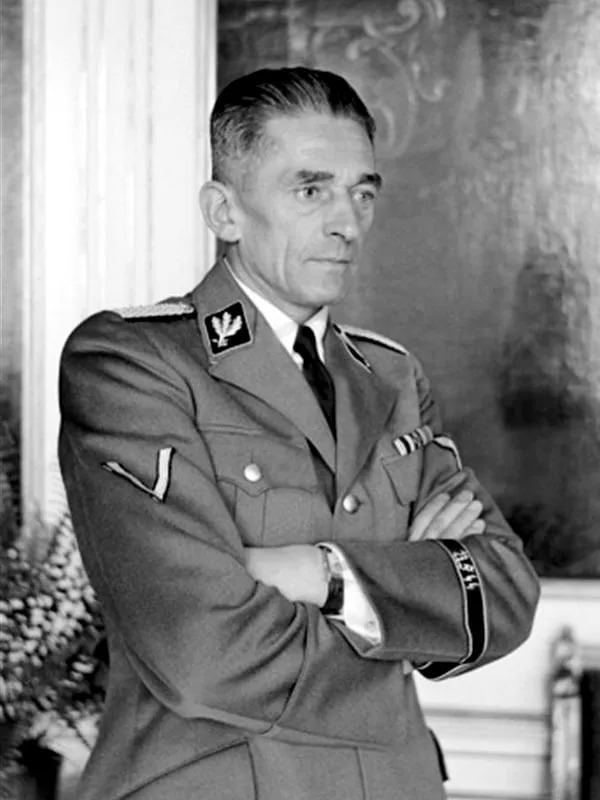
- Born:
- 24 January 1898, Karlovy Vary (Bohemia, Austria-Hungary)
- Died:
- 22 May 1946, Prague (Czechoslovakia)
- Author:
- Natalia
- Photo:
- autor nieznany, domena publiczna, Wikimedia Commons

Karl Hermann Frank was the man of the occupation whom the Czechs hated most. A Sudeten German from Karlovy Vary, a bookseller and nationalist activist, in the 1930s he became Konrad Henlein’s right-hand man in the Sudeten German Party and one of those who in 1938 helped Hitler break Czechoslovakia apart from within. After the occupation of Bohemia and Moravia in March 1939 he became State Secretary in the Office of the Reich Protector and head of the SS and police in the Protectorate, and in time its de facto ruler. He was responsible for the crackdown on Czech students in November 1939, for the terror after the assassination of Heydrich and for the destruction of the villages of Lidice and Ležáky. After the war a Czechoslovak court sentenced him to death, and his execution in a Prague prison was watched by several thousand people. He should not be confused with Hans Frank, the Governor-General in occupied Poland.
Youth in Karlovy Vary
He was born on 24 January 1898 in Karlovy Vary, then Karlsbad, in the German-speaking part of Bohemia, which belonged to Austria-Hungary. His father, Heinrich, was an elementary school teacher and a follower of Georg von Schönerer, leader of the pan-German, anti-Slav and antisemitic movement in the Habsburg monarchy. According to his biographers, Frank absorbed hatred of Czechs and Jews at home. As a child he lost the sight of his right eye; he later claimed that Czech schoolmates had injured him, a story propaganda was happy to repeat, but it cannot be confirmed. From 1918 he wore a glass eye. For this reason he was not accepted into the army during the First World War.
He took his school-leaving examinations under wartime conditions, completed a course at the German commercial academy in Prague and studied law for a year at the German University in Prague, but did not finish his degree. When Czechoslovakia came into being in 1918 and the Sudeten Germans became a minority of more than three million people within it, Frank was from the outset among those who refused to recognise the new state. He worked as a clerk at the ironworks in Vítkovice and on the railways, then as an assistant at a publishing house in Saxony, and finally as a bookseller in Loket and in Karlovy Vary. His bookshop distributed nationalist and National Socialist literature.
In Henlein’s movement
In the early 1920s Frank belonged to the Sudeten German National Socialist Workers’ Party (DNSAP) and was also active in the German gymnastics association. When the Czechoslovak authorities banned the DNSAP in 1933, he moved to the Sudeten German Home Front founded by Henlein and rose quickly in its leadership. In 1935 the Front became the Sudeten German Party (SdP), which won about two-thirds of the German vote in the elections. Frank became a deputy in the parliament in Prague and chairman of the party’s parliamentary group; by 1936 he was already second only to Henlein, and in 1937 formally his deputy. Within the party he represented the most radical wing, linked to the former DNSAP and to the SS, which wanted not autonomy within Czechoslovakia but its break-up and the annexation of the Sudetenland to the Reich.
During the crisis of 1938 that led to the Munich Agreement, Frank acted on Hitler’s instruction to present Prague with demands it could not accept. When at the beginning of September the Czechoslovak government agreed to almost all the Sudeten demands, the Henleinists broke off the talks on the pretext of an incident in Ostrava; Frank was among those who most consistently torpedoed any agreement. After the failed attempt to stir up a rising in the Sudetenland in mid-September he crossed into Germany, and from 17 September to 10 October he was deputy commander of the Sudetendeutsches Freikorps, the units that attacked Czechoslovak border posts. After the annexation of the Sudetenland to the Reich he became Henlein’s deputy as Gauleiter of the Reichsgau Sudetenland. His radicalism was appreciated by Heinrich Himmler, who on 1 November 1938 admitted him to the SS with the rank of SS-Brigadeführer. In December Frank became a member of the Reichstag, and he was admitted to the NSDAP backdated to 1 November 1938.
State Secretary in Prague
After the creation of the Protectorate of Bohemia and Moravia Hitler appointed the former Foreign Minister Konstantin von Neurath Reich Protector, and Frank State Secretary in his office. At the end of April 1939 Frank also became Higher SS and Police Leader in the Protectorate, which gave him control of the Gestapo, the SS Security Service and the police. Neurath was meant to be the world’s face of a moderate policy; Frank, who knew the country and had Himmler’s backing, pressed from the start for iron-fisted rule and undermined his superior’s position.
The first great test came with the national demonstrations of the autumn. On 28 October 1939 German police under his command opened fire on demonstrators in Prague; the worker Václav Sedláček was killed and the student Jan Opletal mortally wounded. When Opletal’s funeral on 15 November turned into another demonstration, and demonstrators beat up the driver of his car, Frank went with Neurath to Berlin for a meeting with Adolf Hitler. The result was Sonderaktion Prag on 17 November: nine student activists were shot without trial, more than twelve hundred students were deported to Sachsenhausen, and all Czech institutions of higher education were closed for the rest of the war. Frank was its chief executor and, according to most historians, its instigator. Under interrogation after the war he admitted that by human law the execution of the students had been murder. On 9 November 1939 he had been promoted to SS-Gruppenführer.
In August 1940 Frank submitted a memorandum on the “solution of the Czech problem”. In it he rejected the idea of the mass expulsion of all Czechs as impracticable in wartime and proposed a policy of “stick and carrot”: the depoliticisation of society, the Germanisation of the “racially valuable” part of the population, and the removal or destruction of the rest, above all the intelligentsia. The Czech administration was to carry on the day-to-day work under German supervision, and the Protectorate’s industry was to work for the war. In the autumn of 1940 Hitler adopted this concept as the guideline for policy towards the Czechs.
Frank persistently sought the removal of the Protectorate’s Prime Minister, Alois Eliáš, who the Gestapo knew was in contact with the resistance and with Edvard Beneš’s government-in-exile. He hoped that when Hitler lost patience with Neurath, he himself would become Protector. In September 1941 Hitler did indeed sideline Neurath, but he entrusted his duties to the head of the Reich Main Security Office, Reinhard Heydrich.
Heydrich and Lidice
Despite his disappointment, Frank worked well with Heydrich. Immediately on arriving at the end of September 1941, the new Deputy Reich Protector declared a state of emergency, had Eliáš arrested and sentenced to death, and within a few months brought about thousands of arrests and hundreds of executions. The deportations of Jews from the Protectorate also began, first to Łódź and from November 1941 to the Theresienstadt ghetto, from where most were later sent on to extermination camps. Adolf Eichmann later described Frank as a rabid antisemite who conducted the persecution with exceptional brutality.
On 27 May 1942 Czechoslovak parachutists sent from London gravely wounded Heydrich, who died on 4 June. On the very day of the attack Frank declared a state of emergency and directed the first manhunts. Once again Hitler did not make him Protector: the duties were taken over by the police general Kurt Daluege. The two men organised a wave of terror in which summary courts sentenced hundreds of people to death. It was Frank who passed on Hitler’s order concerning the village of Lidice, wrongly linked to the assassins: on 10 June 1942 all the men were shot, the women were deported to Ravensbrück concentration camp, and the children, apart from a few selected for Germanisation, were murdered. The village was razed to the ground. On 24 June a similar fate befell the hamlet of Ležáky, where the parachutists’ radio transmitter had been hidden.
Minister of State
In June 1943 Frank became an SS-Obergruppenführer, and on 20 August 1943 German Minister of State for Bohemia and Moravia, with a rank equal to that of a Reich minister. On the same day Wilhelm Frick, the former Interior Minister, was appointed Protector, but the office was a ceremonial one. Until the end of the war it was Frank who ruled the Protectorate, answerable directly to Hitler. He made sure that Czech industry worked for the Wehrmacht and that hundreds of thousands of people were sent to forced labour in the Reich. Towards the increasingly infirm President Emil Hácha and the Protectorate government he behaved as a superior. In 1944 he personally directed operations against the partisans in Moravia, accompanied by executions of civilians suspected of supporting them.
In the spring of 1945, as the front approached Bohemia, Frank warned over the radio that any uprising would be drowned in blood. When the Prague Uprising broke out on 5 May, he still tried to manoeuvre: he proposed forming a transitional Czech government that would include prisoners brought from Terezín, and sought contact with the Americans, hoping to surrender to them rather than to the Red Army. No one would talk to him. In the early morning of 9 May he fled west from Prague with his family, and the same day he was detained by American troops near Rokycany.
Trial and execution
The Americans interrogated him in Wiesbaden and in August 1945 handed him over to Czechoslovakia. Frank’s trial before the Extraordinary People’s Court in Prague began on 22 March 1946 and was broadcast on the radio. The defendant argued that he had served the German nation, carried out the Führer’s orders and been unaware of the consequences of his decisions. The court found him guilty of war crimes, including the action against the students in 1939, the executions during the state of emergency and the destruction of Lidice and Ležáky, as well as of treason against the state of which he was a citizen. The death sentence was read out on 21 and 22 May 1946. A few hours later, on 22 May 1946, Frank was hanged in the courtyard of Pankrác Prison in front of some five thousand spectators. His body was buried in an unmarked grave in the cemetery at Ďáblice.
Assessment
Frank was a typical representative of borderland nationalism, which found in the Third Reich a tool for settling scores with its neighbours. He was neither a great strategist nor an ideologue, but an effective, ruthless executor who understood Czech society better than the newcomers from the Reich and used that knowledge to break it. His path, from activist of a national minority in democratic Czechoslovakia to the executioner of Lidice, shows how Nazism turned the national conflicts of Central Europe into a policy of terror. For the Czechs he has remained the symbol of the occupation; his trial was one of the most important post-war trials in Czechoslovakia, and he recurs as a figure in documentaries and feature films.
Sources
Mentioned in battles
(01)Often appears with
People who appear in the same events.