Equipment
The Consolidated B-24 Liberator
The most-produced American military aircraft: a bomber over Germany, Ploiești and the Pacific, a U-boat hunter over the Atlantic and a transport.
- Role:
- heavy bomber
- State:
- United States
- Maker:
- Consolidated
- First flight:
- 29 December 1939
- Built:
- between about 18,200 and 18,500
- Author:
- Łukasz
- Updated:
- 1 November 2026
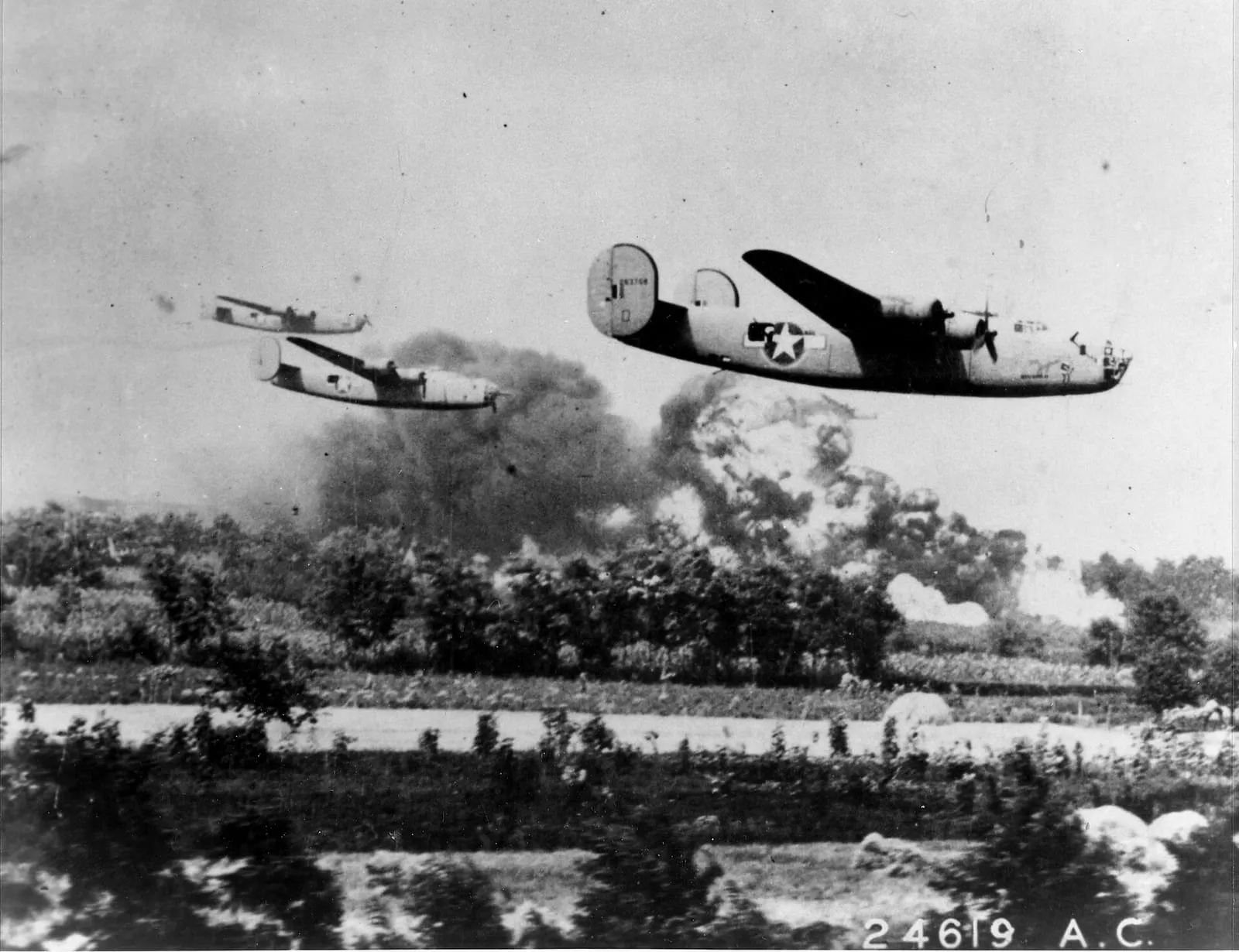
The Consolidated B-24 Liberator lived in the shadow of the Flying Fortress, although more of them were built than of any other American military aircraft. It was faster than the B-17, flew further and carried more bombs, but pilots complained of its heavy controls and gunners of its fragile wing, which caught fire easily. It was range that made it a machine for everything: a bomber over Germany, Romania and the Pacific, a patrol aircraft that closed the gap over the Atlantic, a transport that carried prime ministers and dropped supplies to Warsaw in revolt.
The Davis wing
In 1938 the Army Air Corps asked the Consolidated works in San Diego to build Boeing’s bombers under licence. The company answered with a design of its own. It took the long, narrow, low-drag wing of the designer David Davis and the twin tail of a flying boat it was already building, and added a nosewheel undercarriage and a deep fuselage with two bomb bays. The XB-24 prototype flew on 29 December 1939. The first batches were ordered by France, and after its fall they were taken over by the British, who gave the aircraft the name Liberator.
Its strengths and weaknesses came from the same wing. It gave range and speed, but, mounted high and heavily loaded, it coped badly with icing and with hits, and in formation at high altitude the Liberator handled worse than the Fortress. Aircrews generally preferred the Fortress, but staff officers valued the Liberator because it could be used for many tasks. The first RAF Liberators flew as transports across the Atlantic, from Canada to Scotland, and in August 1942 one of them, Commando, carried Churchill to Moscow.
From Ploiești to Wilhelmshaven
The Americans first used Liberators in Europe in the south. On the night of 11–12 June 1942 thirteen aircraft of Colonel Harry Halverson’s detachment bombed the Ploiești refineries from Egypt, shortly after the United States declared war on Romania. In England the 93rd Bombardment Group went into action in the autumn of 1942, and its first missions over France were part of the test in the dispute over whether to bomb by day. On 27 January 1943 Liberators flew with B-17s on the first American raid on Germany, but they lost their way and had two aircraft shot down over the Netherlands.
The Liberators’ most famous mission was prepared in Libya. On 1 August 1943, 177 bombers from airfields around Benghazi flew in Operation Tidal Wave to Ploiești, to destroy the source of Germany’s oil from a height of a few dozen feet. A navigational error took part of the formation over Bucharest, the defences proved far stronger than expected, and the Americans lost 53 or 54 aircraft, depending on how they are counted. The refineries were back in production within a few weeks. From the autumn of 1943 the Liberators of the Fifteenth Air Force flew from airfields in southern Italy, and in February 1944, during Big Week, those from England lost 33 aircraft over Gotha in a single day.
The gap over the Atlantic
For the British the Liberator mattered above all over the sea. Stripped of some armour and fitted with extra tanks, it could circle for several hours over a convoy hundreds of miles from land, where U-boats had until then attacked with impunity. For most of 1942 only one Coastal Command squadron, No. 120 Squadron RAF, had such aircraft, because Liberators were also wanted by the bombers and in the Pacific. Patrick Blackett of the Admiralty calculated that one Liberator over a convoy saved more ships than many aircraft over German cities. In the spring of 1943, under pressure from Roosevelt and Churchill, maritime patrol received more of them, and Canadian Liberators began flying from Newfoundland. In May the air gap ceased to exist, one of the reasons for the defeat of the U-boats in the Battle of the Atlantic. Earlier, in September 1942, an American Liberator from Ascension Island attacked U-boats rescuing survivors of the Laconia, which led Dönitz to forbid the rescue of survivors.
Willow Run
Five factories built the Liberator, but one became the symbol of American war production: Willow Run near Detroit, where Ford wanted to make bombers the way it made cars. The beginnings were hard. Charles Lindbergh served as an adviser at the plant, and the first complete Liberator left the hall only in September 1942. By the spring of 1944 Willow Run was turning out roughly one bomber an hour, and by June 1945 it had produced 8,685 aircraft, counting the kits of parts sent for assembly at other plants. In all, between about 18,200 and 18,500 Liberators were built, depending on whether such kits and unfinished airframes are counted.
The Pacific, Warsaw and the end
In the Pacific range settled the matter: in 1943 the B-24 replaced the B-17 there as the standard heavy bomber. Liberators attacked Rabaul, Truk and Borneo, and from December 1944 Liberators from the Marianas bombed Iwo Jima every day until the landing. The navy used them for patrol as the PB4Y, and in Burma and China, converted into tankers, they carried fuel across the Himalayas.
For Poles the Liberator is tied to two events. On 4 July 1943 an RAF Liberator converted into a transport crashed just after take-off at Gibraltar, killing General Władysław Sikorski. A year later, from the night of 4–5 August 1944, the Polish No. 1586 Special Duties Flight and British and South African squadrons flew from Italy in Halifaxes and Liberators over Warsaw in revolt, suffering heavy losses. Earlier the same routes had been used to drop the Cichociemni, the parachuted agents of the Home Army, into Poland. After Japan’s surrender the Liberators quickly went for scrap; their place was taken by the B-29 Superfortress, and of the bombers over Europe popular memory has kept the B-17 rather than the Liberator.
Sources
Battles
(03)- 3 September 1939 – 8 May 1945Battle of the AtlanticThe longest campaign of the Second World War. For almost six years U-boats tried to cut Britain's sea lanes, while the Allies defended them with convoys.
- 4–16 September 1943Capture of LaeOn 4–16 September 1943 Australian sea and air landings took Lae, and Salamaua on the 11th; the Japanese 51st Division escaped over the Saruwaged Range.
- 27 May – 17 August 1944Battle of BiakFrom 27 May to 17 August 1944 the Americans fought for Biak's airfields. Colonel Kuzume's Japanese, hidden in caves, denied them their use for over three weeks.
In the chronicle
(37)1942
- 1 February 1942The end of civilian car production
- 3 March 1942The attack on Broome
- 5 June 1942The US declares war on Bulgaria, Hungary and Romania
- 14 June 1942Operation Vigorous
- 12 August 1942Churchill in Moscow
- 12 September 1942The sinking of the Laconia
- 14 September 1942Convoys PQ 18 and ON 127
- 6 October 1942The dispute over day and night bombing
- 4 December 1942The first American raid on Naples
1943
- 27 January 1943The first American raid on Germany
- 10 March 1943The Fourteenth Air Force formed in China
- 17 March 1943The battle for convoys HX 229 and SC 122
- 28 April 1943Closing the Atlantic air gap
- 22 May 1943The raids on Sicily and Sardinia
- 24 May 1943Black May
- 4 July 1943The death of General Sikorski
- 19 July 1943The first bombing of Rome
- 23 July 1943The B-36 bomber ordered
- 1 August 1943Operation Tidal Wave
- 17 August 1943The Schweinfurt–Regensburg raid
- 12 October 1943Air raids on Rabaul
- 14 October 1943Black Thursday over Schweinfurt
- 16 November 1943The raid on Vemork
- 20 November 1943The landing on Tarawa
- 25 November 1943The raid on Rangoon