United States
Charles Lindbergh
Aviator, first solo transatlantic flight (1927), spokesman of the America First Committee (1941), civilian pilot in the Pacific (1944)
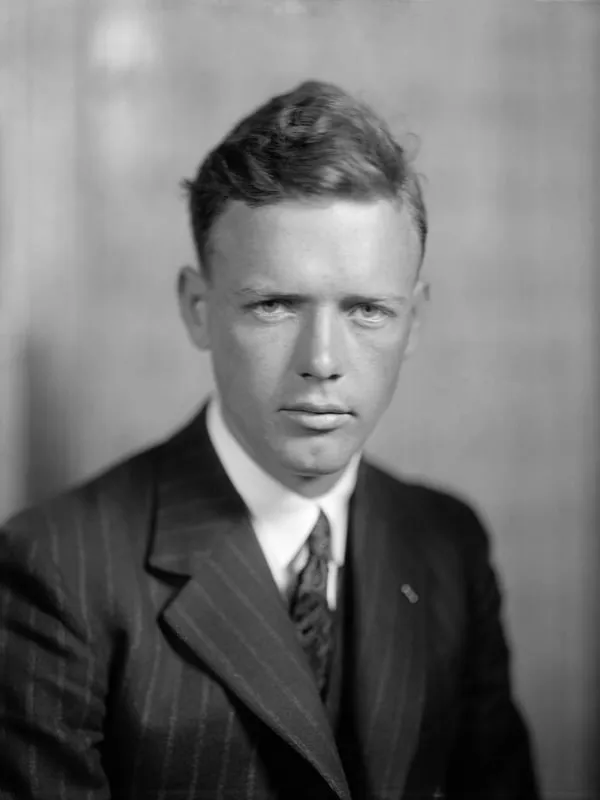
- Born:
- 4 February 1902, Detroit (Michigan, United States)
- Died:
- 26 August 1974, Kipahulu (Maui, Hawaii, United States)
- Author:
- Natalia
- Photo:
- autor nieznany, domena publiczna, Wikimedia Commons

Charles Augustus Lindbergh was the most famous aviator of his age and one of the most admired Americans of the twentieth century. In May 1927 he became the first man to fly solo and non-stop from New York to Paris, which made him a hero on both sides of the Atlantic. The kidnapping and murder of his infant son in 1932 became the “crime of the century”. In the 1930s, while living in Europe, he visited Germany several times, inspected the Luftwaffe and became convinced of its superiority, and from September 1939 he was the best-known spokesman of American isolationism. He fought every form of aid to Britain, testified against the Lend-Lease bill and in 1941 was the leading speaker of the America First Committee, until his speech in Des Moines, which accused the Jews of pushing America into war, destroyed his reputation. After Pearl Harbor he served the war effort as a civilian, and late in life he was a champion of nature conservation. His career shows how strong the current of opposition to a war with Hitler was in America at the turn of the 1930s and 1940s, and how close to it racist and antisemitic views circulated.
Childhood and early flying
He was born on 4 February 1902 in Detroit, but grew up mainly on a farm at Little Falls, Minnesota, and in Washington. His father, Charles August Lindbergh, the son of a Swedish immigrant, was a lawyer and from 1907 to 1917 a Republican congressman for Minnesota. He was one of the few politicians who opposed America’s entry into the First World War, accusing bankers and industrialists of dragging the country into war for profit. His mother, Evangeline Lodge Land, was a chemistry teacher. His parents lived apart, and the boy changed schools more than a dozen times.
In 1920 he began studying engineering at the University of Wisconsin, but after a year and a half he dropped out to learn to fly. From 1922 he performed as a wing-walker and parachutist in travelling air shows, and in 1923 he bought his own war-surplus biplane, a Curtiss JN-4 “Jenny”. In 1924 he enrolled in the Army’s pilot training course in Texas, and in March 1925 he graduated first among the 18 who finished, out of 104 cadets who had begun the course, with a commission as a second lieutenant in the Air Service Reserve. The Army, however, had no need of pilots on active duty, so he became an instructor and an airmail pilot on the route from St. Louis to Chicago. Twice he had to bail out by parachute at night from an aircraft that had run out of fuel.
The Atlantic flight
In 1919 the New York hotelier Raymond Orteig offered a prize of 25,000 dollars for the first non-stop flight between New York and Paris. By 1927 several crews had died trying to win it in large multi-engined aircraft. Lindbergh bet on the opposite: a light single-engined monoplane and a single pilot. With the help of St. Louis businessmen he ordered from the small Ryan company in San Diego an aircraft named the Spirit of St. Louis, in which the fuel tank was placed in front of the cockpit, so that the pilot could see ahead only through a periscope and the side windows.
On the morning of 20 May 1927 he took off from the muddy Roosevelt Field on Long Island. He flew over Nova Scotia and Newfoundland, and during the night over the ocean he battled fog, icing and, above all, drowsiness. He navigated by dead reckoning alone, without a radio. After about 33 and a half hours, on the evening of 21 May, he landed at Le Bourget airfield outside Paris, where a crowd estimated at the time at about 150,000 was waiting for him. He had covered almost 5,800 kilometres.
Overnight the 25-year-old pilot became the most famous man in the world. The President of France presented him with the Legion of Honour, and in Washington President Calvin Coolidge awarded him the Distinguished Flying Cross. Congress awarded him the Medal of Honor, the highest American military decoration, normally reserved for heroes of combat, and Time magazine named him its first Man of the Year. The press called him the “Lone Eagle” and “Lucky Lindy”. Lindbergh used his fame to promote civil aviation: he toured every state in the Spirit of St. Louis and then Latin America, advised airlines on laying out their routes and helped to raise funds for Robert Goddard’s rocket research. Within a few years the number of passengers and pilots in the United States had multiplied.
Family and tragedy
On a journey to Mexico he met Anne Morrow, the daughter of the US ambassador and banker Dwight Morrow. They married on 27 May 1929. Anne learned to fly and, as radio operator and navigator, accompanied her husband on long survey flights over the Arctic and Asia; she also became a respected writer. They had six children. In these years Lindbergh also turned to science: with the French surgeon and Nobel laureate Alexis Carrel he built at the Rockefeller Institute a glass perfusion pump that made it possible to keep organs alive outside the body. Carrel, an advocate of eugenics and elitism, had a strong influence on his views.
On 1 March 1932 the Lindberghs’ 20-month-old son, Charles Jr., was kidnapped from their home at Hopewell, New Jersey. The parents paid a ransom of 50,000 dollars, but on 12 May the child’s body was found in woods near the house. The case shook America; Congress passed the so-called Lindbergh Law, which made kidnapping a federal crime. In 1934 a German immigrant carpenter, Bruno Richard Hauptmann, was arrested with part of the ransom money in his possession. Convicted at a trial that the press turned into a spectacle, he was executed on 3 April 1936, although his guilt is disputed to this day. Hounded by journalists and fearing for the safety of their second son, the Lindberghs sailed secretly for England in December 1935. They settled in a country house in Kent, and in 1938 on the small island of Illiec off the coast of Brittany.
In Hitler’s Germany
In 1936 the American military attaché in Berlin, Major Truman Smith, who was struggling to obtain information about the expansion of German air power, hit on the idea of using Lindbergh’s fame. Through Hermann Göring he obtained an invitation for him. In July 1936, just before the Berlin Olympics, the aviator came to the Third Reich for the first time. The Germans, who had only recently begun building the Luftwaffe openly, showed him units, airfields and factories, and he spoke about aviation’s responsibility for civilisation. He returned in 1937 and 1938, flew the Messerschmitt Bf 109 fighter and inspected the new Junkers Ju 88 bomber, the first American to do so. The reports he wrote for Smith went to the US Army General Staff and, although they were considered somewhat exaggerated, they were valuable to an air arm that was only beginning to rearm. In 1938 he also visited the Soviet Union, whose air force he spoke of dismissively.
The impression Germany made on him, however, had political consequences. During the Sudeten crisis in September 1938, Lindbergh assured British and French interlocutors – partly at the instigation of the US ambassador in London, Joseph Kennedy – that the Luftwaffe was stronger than the air forces of all the other European states combined and could, in the event of war, raze their cities to the ground. His estimates of German strength were clearly inflated, and historians believe they confirmed politicians in London and Paris in their conviction that it was too early for war.
On 18 October 1938, at a dinner at the American embassy in Berlin, Göring unexpectedly decorated him on Hitler’s behalf with the Order of the German Eagle. Ambassador Hugh Wilson later took the view that refusing it would have insulted the host. A few weeks later the Germans carried out Kristallnacht. Lindbergh noted in his diary that he did not understand these riots, which ran counter to the German sense of order, but added that the Germans had had “a difficult Jewish problem”. He did not return the decoration, believing that this would be a needless insult, and Americans never stopped holding it against him. For the winter of 1938/1939 he even considered moving to Berlin, but gave up the idea.
The voice of the isolationists
In April 1939 Lindbergh returned to the United States at the request of the chief of the Army Air Corps, General Henry Arnold, and for several months, as a reserve colonel on active duty, assessed the readiness of the air arm and new aircraft types. After war broke out in Europe he went public. In a radio address carried by all the major networks on 15 September 1939 he urged America to stay out of the European conflict, and in later speeches he opposed the lifting of the arms embargo. At the same time Albert Einstein and Leó Szilárd were wondering whether to ask him to deliver to Roosevelt their letter about the atomic bomb; Lindbergh did not reply, and after his speech Szilárd concluded that he was “not our man”.
His arguments were strategic – America, strong and armed, was unassailable across the ocean, and aid to Britain weakened its own defence – but they were also racial. In October 1939 he said that America’s bond with Europe was one of race, not of ideology, and that the time would come to fight side by side with the English, the French and the Germans if the “white race” were threatened. In an article in Reader’s Digest in November 1939 he wrote of an “inheritance of European blood” that had to be protected against “dilution by foreign races”. He regarded communism and the Soviet Union as the greatest threat to the West, and the war between Britain and Germany as fratricidal.
When the America First Committee was founded in September 1940, Lindbergh spoke at its rallies, and on 23 January 1941 he testified before the House Foreign Affairs Committee against the Lend-Lease bill. He said that he wished for the victory of neither side, that a negotiated peace was in America’s interest and that even American entry into the war would not make it possible to defeat Germany. On 6 February he repeated this before the Senate. In April he joined the committee’s leadership and became its star, drawing tens of thousands of listeners in New York, Chicago and Los Angeles. Roosevelt, who said privately that he was absolutely convinced Lindbergh was a Nazi, compared him at a press conference on 25 April to Clement Vallandigham, the leader of the opponents of the war during the Civil War. Three days later Lindbergh resigned his commission as a reserve colonel.
On 11 September 1941, in Des Moines, Iowa, he gave a speech in which he named three forces pushing America towards war: the British, the Roosevelt administration and the Jews. He conceded that the persecution of the Jews in Germany could not be condoned, but warned that their “greatest danger to this country” was their influence in films, the press, radio and the government. The outrage was universal. Wendell Willkie called his words the most un-American talk he had heard from a man of national reputation, and the journalist Dorothy Thompson wrote that she was certain of his pro-Nazi sympathies. Even former sympathisers turned away from the committee.
The war
The Japanese attack on Pearl Harbor on 7 December 1941 ended the argument. America First cancelled a planned rally at which Lindbergh was to speak, called for support of the war effort and, on 11 December, the day Germany and Italy declared war on the United States, dissolved itself. Lindbergh declared that, since the country had been attacked, it had to fight. In January 1942 he asked the Secretary of War, Henry Stimson, to be restored to active duty, but Stimson refused, and the administration discouraged aircraft manufacturers from employing him. The exception was Henry Ford, himself notorious for his antisemitism, who took him on as an adviser at the gigantic Willow Run plant near Detroit, where mass production of B-24 Liberator bombers was being launched. In 1943 he moved to United Aircraft, the maker of the Corsair fighter.
In 1944 he went to the Pacific as a civilian technical representative to study how aircraft performed in combat conditions. He flew with Marine Corps and Army Air Forces pilots, formally as an observer but in practice as a combat pilot, taking part in some 50 missions. He taught pilots of the twin-engined P-38 Lightning fighter an engine-setting technique that greatly reduced fuel consumption and extended their range, which General Douglas MacArthur appreciated. On 28 July 1944 he shot down a Japanese Mitsubishi Ki-51 reconnaissance aircraft. In his diary from these months he recorded with disgust cases of Americans killing prisoners and desecrating the bodies of Japanese soldiers.
In May and June 1945, as a member of a naval technical mission studying German achievements in jet aircraft and rockets, he visited defeated Germany. In the underground works near Nordhausen, where prisoners of the Mittelbau-Dora camp had produced V-2 rockets, he saw the crematorium and heard the accounts of survivors. He noted that it seemed impossible that civilised men could sink so low, and yet they had. In the same entry, however, he compared the German crimes with American atrocities against the Japanese in the Pacific.
After the war
After 1945 Lindbergh lived in Darien, Connecticut, advised the Chief of Staff of the Air Force and, for many years, Pan American. He supported the Nuremberg trials and aid for a Europe threatened by communism, although he never publicly admitted that his pre-war position had been wrong. In 1953 he published his memoir of the Atlantic flight, The Spirit of St. Louis, for which he received the Pulitzer Prize in 1954. In the same year President Dwight Eisenhower appointed him a brigadier general in the US Air Force Reserve. In 1970 he published his diaries of 1938–1945, which revealed both his perceptive observations and his prejudices.
As he grew older, the aviator became increasingly troubled by the effects of the technology he had himself helped to develop. He campaigned for the protection of nature, of whales, of the Philippine eagle and of tribal peoples in the Philippines and Africa, and supported the WWF and the Nature Conservancy. He wrote that, if he had to choose, he would rather have birds than aeroplanes. He died of lymphoma on 26 August 1974 at Kipahulu on the island of Maui and was buried beside the local church. Almost thirty years later it emerged that from 1957 he had led a double life: with three women in Germany and Switzerland he had fathered seven children, who knew him under an assumed name. In 2003 DNA tests confirmed his paternity.
Significance
Lindbergh remains one of the most contradictory figures in American history. His flight of 1927 was a great feat of courage and technology and, more than any other event, convinced the world that the aeroplane could link continents. The same fame made him the most effective spokesman of isolationism in 1939–1941. Historians generally do not regard him as an agent or a believer in Nazism: he belonged to no Nazi organisation and condemned the persecutions. He was, however, a man of racist and antisemitic views, fascinated by the strength and efficiency of the Third Reich, who never grasped that the war against Hitler was not an ordinary dispute between great powers. His biographer A. Scott Berg saw him as a stubborn and politically naive man rather than a supporter of Hitler; critics such as Max Wallace argue that his activities did real harm to the victims of Nazism, because they weakened America’s will to stand up to Germany.
The isolationists whose face he was failed to stop either the “destroyers for bases” deal or the Lend-Lease Act, but according to many historians they reduced support for Roosevelt’s policy and forced him to act cautiously throughout 1941. His memory returns in American debates about the country’s place in the world, and the slogan “America First” has evoked his name for decades. The question of what would have happened had he become president gave Philip Roth the subject of his novel The Plot Against America.
Sources
Often appears with
People who appear in the same events.