Equipment
Boeing B-17 Flying Fortress
The four-engined bomber on which the Americans built their daylight “precision” bombing of the Reich, and which paid for that doctrine with heavy losses.
- Role:
- heavy bomber
- State:
- United States
- Maker:
- Boeing
- First flight:
- 28 July 1935
- Built:
- about 12,700
- Author:
- Łukasz
- Updated:
- 1 November 2026
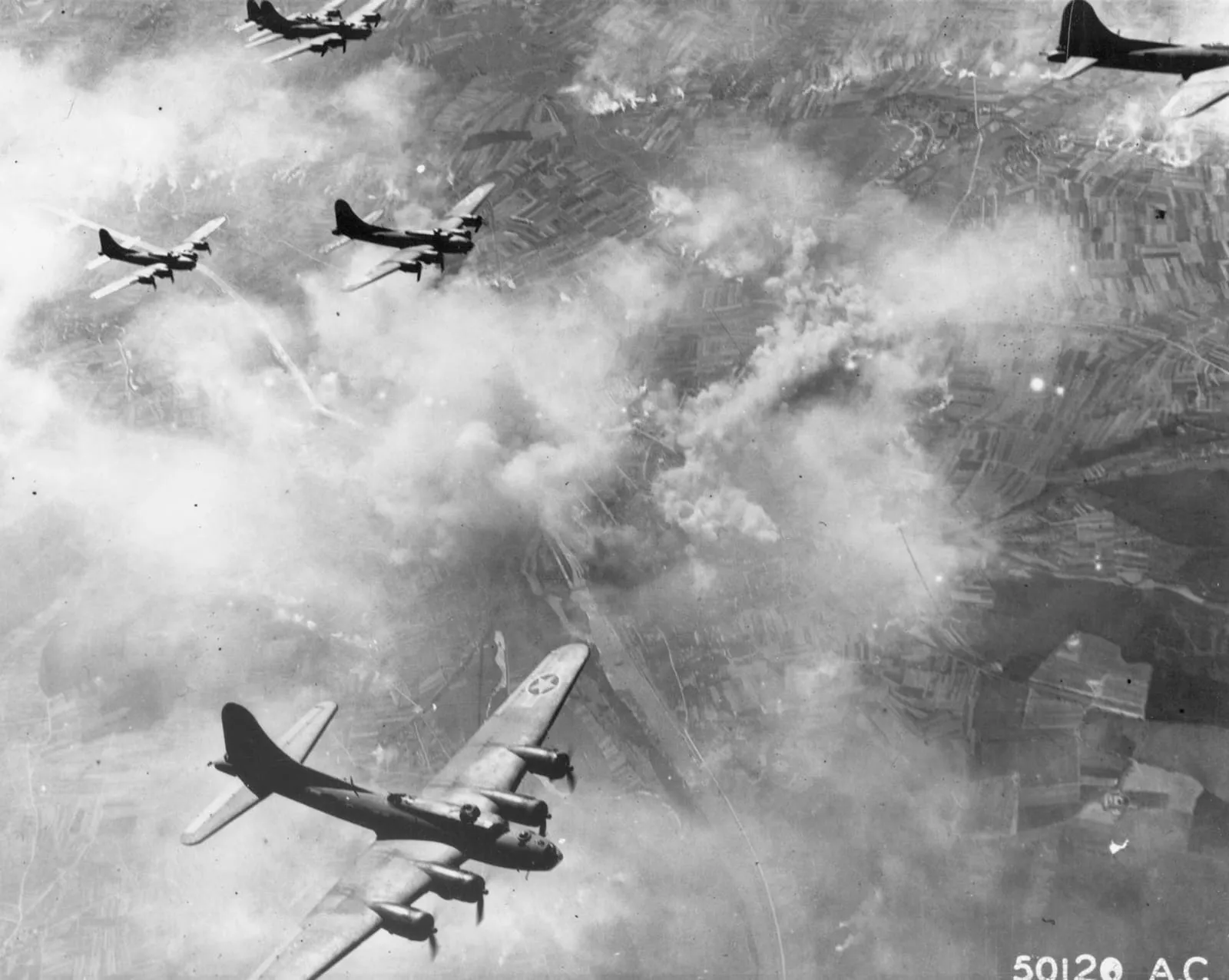
The Boeing B-17 Flying Fortress was the aircraft on which American military aviation staked its whole faith in strategic bombing. Before the war the Army’s airmen argued that heavy bombers bristling with machine guns, flying by day in close formation, would fight off enemy fighters and hit a single factory. For three years the B-17 put that idea into practice over France, Germany, Italy and the Pacific. The war also showed where the idea was wrong: the Fortresses did come home with terrible damage, but left without cover they were lost by the dozen in a single day.
The prototype and the name
In 1934 the Army Air Corps was looking for a coastal-defence bomber able to fly far out to sea to meet an approaching fleet. Boeing took a gamble and gave its design four engines instead of two. The prototype, known within the company as the Model 299, was first flown over Seattle on 28 July 1935 by Boeing’s chief test pilot, Leslie Tower. When the aircraft was presented, Richard Williams, a reporter for the Seattle Times, looked at the gun positions jutting from its fuselage and called it a flying fortress. The name stuck to the aircraft for good.
In August the aircraft flew non-stop to the Army’s test base in Ohio and outclassed its rivals. On 30 October 1935, however, it crashed just after take-off because the crew had not released the control lock; the Army pilot and Tower were killed. The large contract went to the cheaper twin-engined Douglas B-18 Bolo, and the Army ordered only thirteen service-test aircraft. The accident also gave rise to the written pilot’s checklist, now required in every cockpit. In 1937 the first aircraft reached the 2nd Bombardment Group, where a young navigator named Curtis LeMay was serving.
The first lessons
The B-17 first went into action under British markings. The RAF received twenty early B-17Cs, named Fortress I, and from July 1941 sent them by day at great height over Germany, France and Norway. The bombs seldom hit, the guns froze, and German fighters reached the bombers all the same. Eight aircraft had been lost by September, and the British handed the rest over to maritime aviation. The Americans concluded that the fault lay in weak defensive armament and too few aircraft, not in the principle itself; the new B-17E received a tail gunner’s position and turrets.
In the Pacific the Fortresses were meant to deter Japan. In the summer and autumn of 1941 some thirty-five were sent to the Philippines, but on 8 December Japanese bombers destroyed about half of them on the ground at Clark Field, and during the Philippines campaign the rest flew off to Australia. From there the B-17s bombed Rabaul and Japanese shipping. At the Battle of Midway they dropped hundreds of bombs from high altitude on manoeuvring warships and hit none. Only when they came down lower, as in the Battle of the Bismarck Sea in March 1943, did they begin to sink ships. Over the vast Pacific, however, range mattered most, and in 1943 the bomber groups there switched to the B-24 Liberator.
The daylight offensive from England
In Europe the B-17 became the backbone of the Eighth Air Force, whose bomber command was built up in England from February 1942 by Ira Eaker, with Carl Spaatz in overall command. On 17 August 1942 twelve B-17Es bombed the railway yards near Rouen; the co-pilot of the lead aircraft was Paul Tibbets, three years later the pilot of the Enola Gay. All of them came back, but a raid under Spitfire cover proved nothing yet. The British urged their ally to join the night raids on cities; in the dispute over day and night bombing Eaker defended his doctrine.
In the winter of 1942–43 the Germans learned to attack the Fortresses head-on, where they were most weakly armed. Group commanders, LeMay first among them, answered with tight “boxes” of bombers in which a dozen or more aircraft covered one another with their fire, and with bombing on the leader’s signal. On 27 January 1943 the B-17s struck Germany for the first time, at Wilhelmshaven, and then went ever deeper, beyond the reach of the escort fighters. The bill came on 17 August 1943 over Schweinfurt and Regensburg: of 376 bombers, 60 did not return. Two months later, on Black Thursday, 14 October, another 60 out of 291 were missing. Losses of up to a fifth of the force on a single mission meant that few crews could hope to complete the required 25 missions, and for several months the Eighth Air Force stopped sending unescorted raids deep into the Reich.
Escort and victory
The crisis was solved by fighters, not bombers. The last version of the Fortress, the B-17G, with a turret under its nose and thirteen machine guns, still could not defend itself. The P-51 Mustangs could: from the turn of 1943 and 1944 they flew with the bombers all the way to the target, and James Doolittle let them loose to hunt German fighters. During Big Week in February 1944 more than a thousand Fortresses and Liberators struck the aircraft industry in a single day, and the Luftwaffe began to lose pilots faster than it could train them. In August 1944, according to post-war tables, the American air forces had 4,574 B-17s.
Fortresses also flew from Italy, with the Fifteenth Air Force: in February 1944 they destroyed the abbey of Monte Cassino, and on 2 June they flew in Operation Frantic against Debrecen and landed at Poltava. The shuttle flights through Soviet bases brought them on 18 September 1944 over Warsaw in revolt: 107 B-17s dropped 1,284 containers, of which, by Polish reckoning, about a quarter reached the insurgents. In 1945 B-17s bombed Dresden and central Berlin, and in the last days of the war they dropped food to the starving Dutch.
They were built by three manufacturers: Boeing, Douglas and Vega, a Lockheed subsidiary. Most tallies give 12,731 aircraft, some slightly fewer. According to American figures the Fortresses dropped more than 640,000 tons of bombs on Europe, more than any other American aircraft, and between 4,735 and over 4,750 were lost in combat, depending on the source. After the war most went to the scrapyard, and their place was taken by the B-29 Superfortress. In American memory, though, the B-17 remained the symbol of the air war: the aircraft that came home riddled with holes, and of a doctrine that cost its crews very dear.
Sources
Battles
(06)- 7 December 1941Attack on Pearl HarborOn 7 December 1941 aircraft from Nagumo's six carriers struck the Pacific Fleet at Pearl Harbor. 2,403 Americans were killed and four battleships sank.
- 8 December 1941 – 8 May 1942Philippines campaign (1941–1942)From 8 December 1941 to May 1942 Japan conquered the Philippines. The defenders of Bataan and Corregidor held out longer than planned but were taken prisoner.
- 4–8 May 1942Battle of the Coral SeaOn 4–8 May 1942 carriers fought carriers for the first time in the Coral Sea. The Americans lost Lexington, but Japan called off the landing at Port Moresby.
- 3–7 June 1942Battle of MidwayOn 3–7 June 1942 off Midway Atoll American aircraft sank Nagumo's four carriers. Japan abandoned the operation; the United States lost Yorktown.
- 12–15 November 1942Naval Battle of GuadalcanalFrom 12 to 15 November 1942, in two night actions and a series of air strikes, the Americans sank two Japanese battleships and most of a Guadalcanal convoy.
- 4–16 September 1943Capture of LaeOn 4–16 September 1943 Australian sea and air landings took Lae, and Salamaua on the 11th; the Japanese 51st Division escaped over the Saruwaged Range.
In the chronicle
(56)1941
1942
- 3 February 1942Air raids on Java and Port Moresby
- 20 February 1942The Japanese on Bali and Timor
- 21 February 1942The American air force in Britain
- 22 February 1942Roosevelt orders MacArthur out of the Philippines
- 3 March 1942The attack on Broome
- 8 March 1942The Japanese at Lae and Salamaua
- 11 March 1942MacArthur leaves Corregidor
- 7 May 1942The sinking of Shōhō
- 3 June 1942The Battle of Midway begins
- 4 June 1942The sinking of Nagumo's carriers
- 3 July 1942The Japanese on Guadalcanal
- 4 July 1942The first USAAF missions in Europe
- 20 July 1942The Japanese land at Buna and Gona
- 12 August 1942Americans in the New Hebrides
- 17 August 1942The first B-17 raid on Rouen
- 24 August 1942The Battle of the Eastern Solomons
- 15 September 1942Americans in Port Moresby
- 29 September 1942The Eagle Squadrons join the USAAF
- 6 October 1942The dispute over day and night bombing
- 22 October 1942Clark's mission to Algeria
- 1 November 1942The Matanikau offensive and Koli Point
- 13 November 1942The night battle off Guadalcanal
- 18 November 1942RAF raids in November 1942
1943
- 27 January 1943The first American raid on Germany
- 9 February 1943Bombing raids in February 1943
- 2 March 1943The Battle of the Bismarck Sea
- 17 March 1943The battle for convoys HX 229 and SC 122
- 10 April 1943The Eighth Army in Sfax
- 22 May 1943The raids on Sicily and Sardinia
- 11 June 1943The capture of Pantelleria
- 13 June 1943The raids on Kiel and Bremen
- 19 July 1943The first bombing of Rome
- 24 July 1943Operation Gomorrah
- 17 August 1943The Schweinfurt–Regensburg raid
- 17 August 1943The Azores Agreement
- 31 August 1943The raid on Pisa
- 8 September 1943The Italian surrender announced
- 14 October 1943Black Thursday over Schweinfurt
- 9 November 1943The fake Le Soir
- 16 November 1943The raid on Vemork
1944
- 15 February 1944The destruction of the Abbey of Monte Cassino
- 26 February 1944Big Week
- 17 March 1944The raid on Vienna
- 22 March 1944The raids on Frankfurt
- 3 April 1944The raids on Budapest and Bucharest
- 5 April 1944The first raids on Ploiești from Italy
- 2 June 1944Operation Frantic
- 26 July 1944The first jets in combat
- 11 September 1944The air battle over the Ore Mountains