Equipment
Consolidated PBY Catalina
A slow flying boat that spotted the Bismarck and the Japanese fleet off Midway, hunted U-boats, raided shipping by night and rescued the shipwrecked.
- Role:
- patrol flying boat
- State:
- United States
- Maker:
- Consolidated Aircraft
- First flight:
- 21 March 1935
- Built:
- over 3,300 (by some estimates about 4,000)
- Author:
- Łukasz
- Updated:
- 1 November 2026
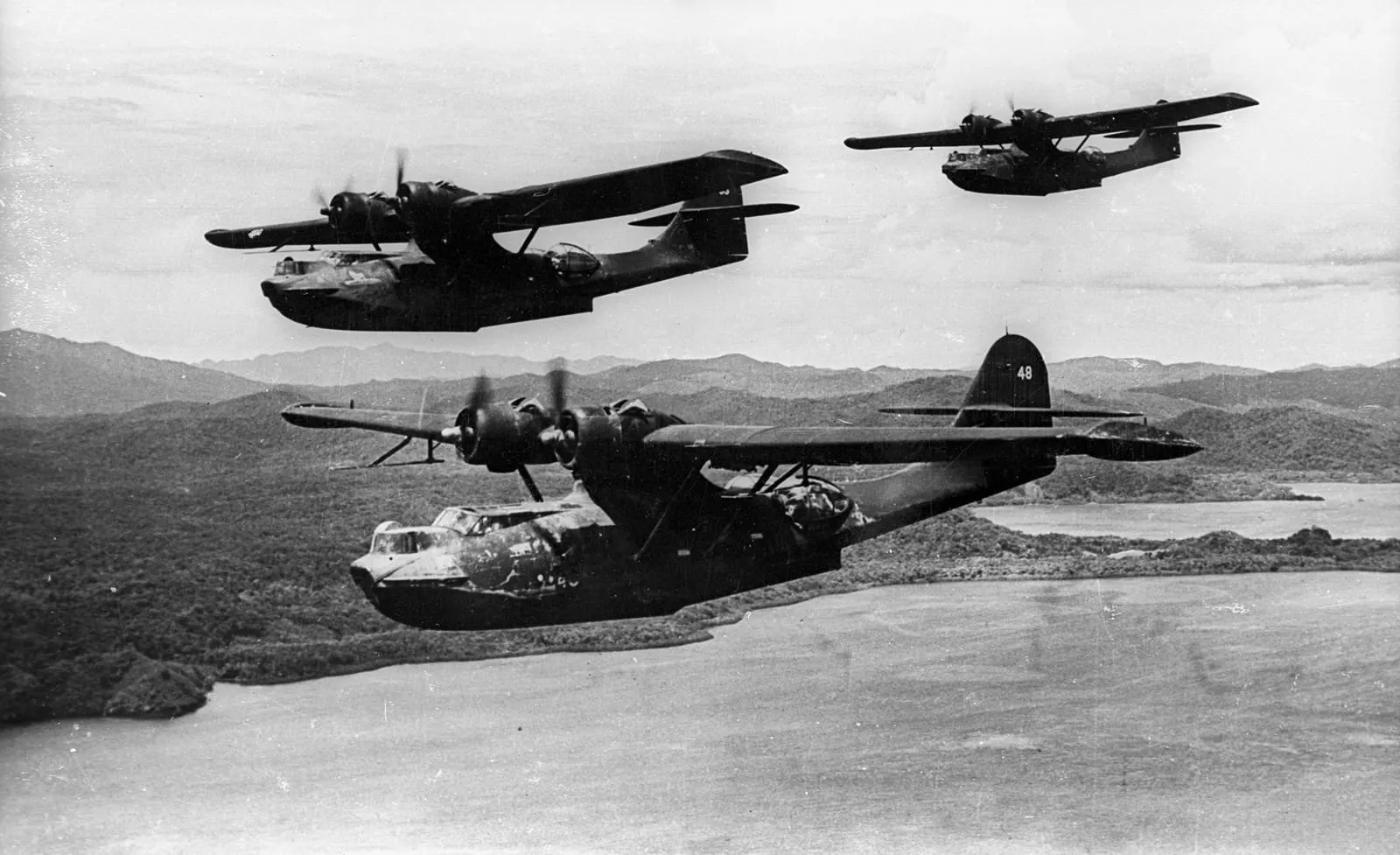
The Consolidated PBY Catalina was slow, lightly armed and defenceless against fighters, and yet it is hard to name an aircraft that had a greater influence on the war at sea. Its strength was its range: it could circle over the ocean for well over ten and even more than twenty hours, far beyond the reach of land-based aircraft. It was a Catalina that in 1941 found the Bismarck after the Royal Navy had lost her, and Catalinas that in June 1942 spotted the Japanese fleet heading for Midway. Between those great moments thousands of crews patrolled the convoy routes, hunted submarines, attacked Japanese shipping by night and plucked downed airmen from the sea.
A flying boat from San Diego
Isaac Laddon’s team at Consolidated Aircraft designed it to a US Navy order of 1933 as the successor to older biplane patrol boats. It was a monoplane with its wing mounted high on a short pylon, two radial engines and wingtip floats that retracted after take-off to form the wingtips. The prototype first flew in March 1935; most sources give 21 March, the National Naval Aviation Museum in Pensacola 15 March. The first production aircraft entered service in October 1936, and by the outbreak of war in Europe it had become the US Navy’s standard patrol aircraft. Later came the PBY-5A, an amphibian with retractable wheeled undercarriage, the most numerous version of all.
The name Catalina, after the Californian island of Santa Catalina, was settled in 1941 with the British orders: from the start of that year flying boats of the type were reaching RAF Coastal Command, and the US Navy soon adopted the name as well. The Canadians built amphibians at home as the Canso, and the USSR bought a licence and produced its own variant. Top speed was about 300 km/h, cruising speed about 200 km/h, and range more than 4,000 km.
The Atlantic
On the morning of 26 May 1941 a Catalina of No. 209 Squadron RAF, which had taken off from Lough Erne in Northern Ireland, found the battleship Bismarck, which British warships had lost more than a day earlier. At the controls at that moment was an American naval ensign, Leonard Smith, one of the still-neutral Americans training British crews. The report allowed aircraft from the Ark Royal to cripple the battleship, which went to the bottom the next day. In August 1941 Catalinas from Iceland stood guard over U-570, which had surrendered to a Hudson, until British warships took her over.
In the Battle of the Atlantic Catalinas escorted convoys and combed the sea for U-boats. Later they received radar and magnetic anomaly detectors; according to various tallies they sank about forty submarines. Two Catalina pilots were awarded the Victoria Cross in 1944: the Canadian David Hornell, posthumously, and the Scot John Cruickshank, who brought his aircraft back to base despite dozens of wounds.
The Pacific and the Indian Ocean
For the British, the war with Japan began with a Catalina: on 7 December 1941 Japanese fighters shot down a No. 205 Squadron flying boat that was shadowing the invasion convoy bound for Malaya, before its crew could send a report. In the first months of the war Catalinas were lost in the air and on the water; at Broome on 3 March 1942 Japanese fighters burned eight of them on the bay, along with evacuees from Java. Even so, contact with besieged islands often depended on them alone: on 20 December 1941 a Catalina landed in the lagoon at Wake, bringing the defenders their first news from the outside world.
On 4 April 1942 the Catalina of the Canadian squadron leader Leonard Birchall spotted the Japanese carrier force heading for Ceylon and managed to send a warning before Zeros shot it down. Two months later, on 3 June, Jack Reid of patrol squadron VP-44 sighted the Japanese transports heading for Midway; that night four torpedo-armed Catalinas damaged a tanker, and on the morning of 4 June another crew reported two carriers. That report allowed Spruance and Fletcher to launch their aircraft in the decisive battle.
During the fighting for Guadalcanal a Catalina was the first aircraft to land on Henderson Field, on 12 August 1942. Crews from Espiritu Santo and the Santa Cruz Islands located Japanese forces before the Battle of the Eastern Solomons and the Battle of the Santa Cruz Islands, although their reports sometimes arrived hours late. In October Major Jack Cram slung two torpedoes under a staff Catalina and hit a Japanese transport off the island.
Black Cats and Dumbos
From December 1942 American squadrons in the Solomons painted their Catalinas matt black and attacked Japanese shipping, bases and supply convoys by night. The Australians of the Royal Australian Air Force bombed Rabaul from Port Moresby from early 1942, in January 1943 sank a transport carrying reinforcements for Lae, and from 1943 to 1945 their black Catalinas laid mines in the harbours of the Netherlands East Indies, sometimes only a few metres above the water.
The second role, rescue, earned the Catalinas the nickname “Dumbo”. Navy Lieutenant Nathan Gordon landed four times under fire in Kavieng harbour and picked up fifteen airmen, for which he received the Medal of Honor. On 2 August 1945 Adrian Marks, against orders, put down on a heavy swell beside the survivors of the cruiser Indianapolis and pulled 56 men from the water, lashing those who would not fit in the hull to the wings.
The balance
More than 3,300 Catalinas were built, several hundred of them in Canada, and some estimates that also include Soviet production put the figure at nearly 4,000; no other flying boat was built in such numbers. After Japan’s surrender Australian Catalinas carried prisoners home from Japanese camps, and the type flew on in air-sea rescue units long after the war. Catalinas won no battle on their own, but almost every battle at sea began with a report from one of them.
Sources
Battles
(04)- 18–27 May 1941Operation RheinübungFrom 18 to 27 May 1941 Bismarck and Prinz Eugen tried to break out into the Atlantic. Bismarck sank Hood but went down herself after a three-day chase.
- 8–23 December 1941Battle of Wake IslandOn 8–23 December 1941 the Wake Atoll garrison repulsed a first Japanese landing and sank two destroyers, but, with no relief, fell to a second landing.
- 31 March – 10 April 1942Indian Ocean raidFrom 31 March to 10 April 1942 Nagumo's carriers struck Ceylon and sank Hermes and two cruisers, but Somerville's Eastern Fleet survived.
- 3–7 June 1942Battle of MidwayOn 3–7 June 1942 off Midway Atoll American aircraft sank Nagumo's four carriers. Japan abandoned the operation; the United States lost Yorktown.
In the chronicle
(20)1941
1942
- 3 February 1942Air raids on Java and Port Moresby
- 3 March 1942The attack on Broome
- 5 April 1942The Easter Sunday raid on Colombo
- 3 May 1942The Japanese on Tulagi
- 3 June 1942The attack on Dutch Harbor
- 3 June 1942The Battle of Midway begins
- 4 June 1942The sinking of Nagumo's carriers
- 12 August 1942Americans in the New Hebrides
- 21 August 1942The Battle of the Tenaru
- 24 August 1942The Battle of the Eastern Solomons
- 13 October 1942The bombardment of Henderson Field
- 26 October 1942The Battle of the Santa Cruz Islands