- Category:
- Military operations
- Front:
- Pacific
- Date:
- 4 June 1942
- Author:
- Natalia
- Battle:
- Battle of Midway
- Tags:
- United States, Japan, Chūichi Nagumo, Raymond Spruance
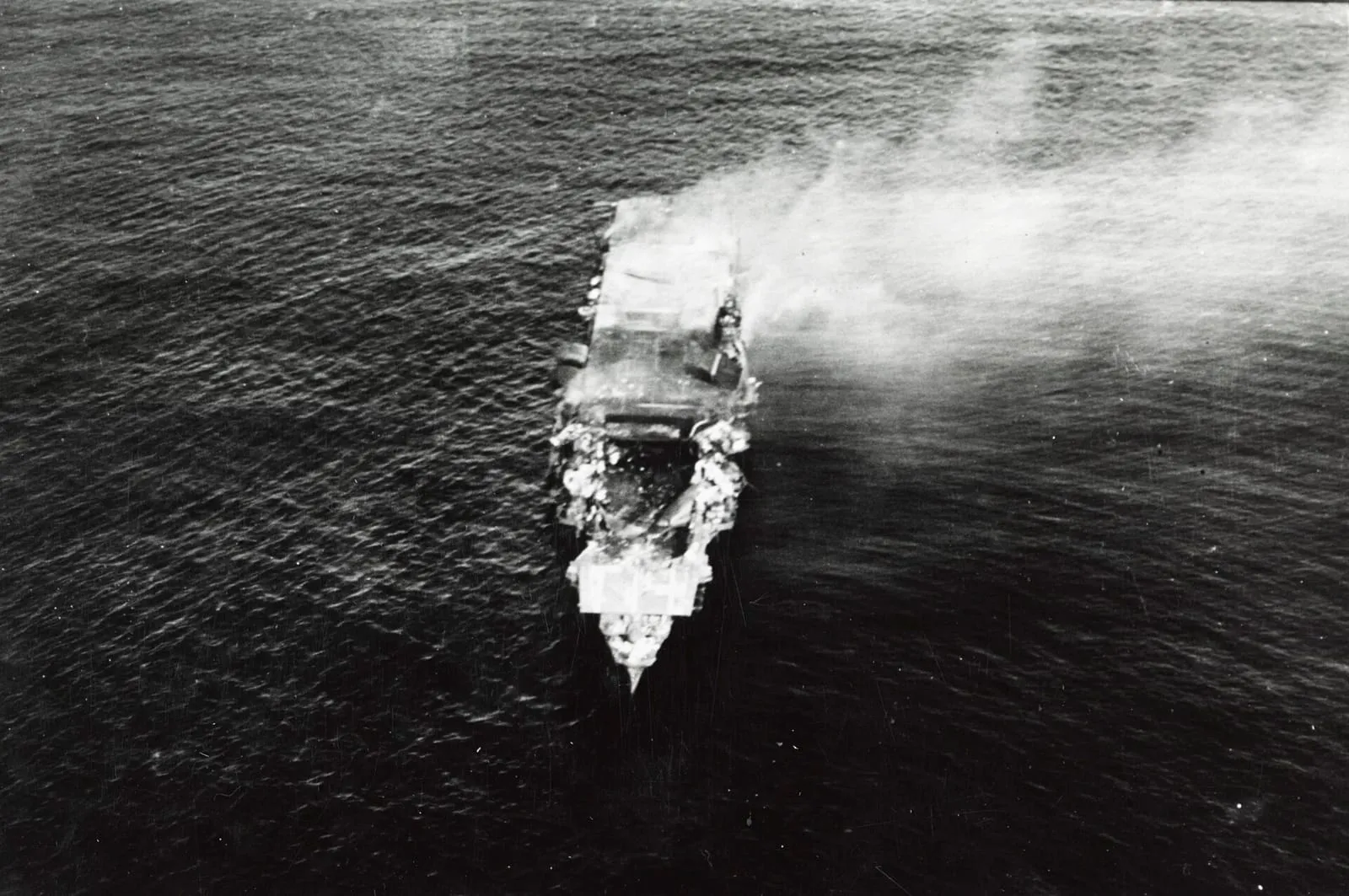
4 June 1942 was the decisive day of the Battle of Midway and one of the most important days of the entire Pacific War. In the morning the four carriers of Vice Admiral Chūichi Nagumo bombed Midway Atoll and beat off successive attacks by American aircraft without losing a single ship. A few minutes after 10.20 a.m. three squadrons of American dive-bombers appeared over the Japanese force and in about six minutes turned Akagi, Kaga and Sōryū into blazing wrecks. The last carrier, Hiryū, managed to strike Yorktown twice and put her out of action, but in the late afternoon she was hit herself and set on fire. All four ships that six months earlier had attacked Pearl Harbor went to the bottom or were finished off by their own destroyers.
Times are given in local Midway time, as used in American studies. The Japanese fleet kept Tokyo time; in its documents it was already 5 June, and all the clocks showed times shifted by 21 hours.
The raid on Midway
The Japanese were approaching the atoll from the north-west, unaware that three American carriers were waiting for them north-east of Midway. The day before, flying boats and bombers from the atoll had sighted and attacked the transports coming from the south-west, but Nagumo’s force had not yet been found. At 4.30 a.m. 108 aircraft took off from the four carriers: 36 each of Aichi D3A dive-bombers, Nakajima B5N bombers and Zero fighters, under the command of Lieutenant Jōichi Tomonaga (PL) of Hiryū. At the same time Nagumo sent out seven reconnaissance aircraft, too few to search their assigned sectors thoroughly. Floatplane No. 4 from the cruiser Tone, which had been allotted the sector in which the American ships actually were, took off about half an hour late.
At 5.34 a.m. an American Catalina reported two Japanese carriers, and a quarter of an hour later a second one reported incoming aircraft. Radar on the atoll detected the strike at 5.53. The Marine fighters of squadron VMF-221, mostly obsolete Buffalos, suffered heavy losses against the Zeros: of 26 machines, 15 were shot down, and of the rest only two were fit to fly. From 6.34 the Japanese bombed both islands of the atoll, Sand and Eastern. They destroyed the power plant, fuel tanks, hangars and some of the buildings, but heavy anti-aircraft fire shot down several aircraft and damaged many others, and the airfield remained usable. At 7.00 Tomonaga reported to Nagumo that a second strike was needed.
The attacks from Midway
Before the Japanese arrived, all the strike aircraft on the atoll had taken off against Nagumo’s force. They attacked without escort, without co-ordination and one after another: six new Avenger torpedo bombers of VT-8 and four torpedo-armed B-26 bombers at about 7.10; sixteen Marine Dauntless dive-bombers under Major Lofton Henderson at about 7.55; fifteen B-17 Flying Fortresses, which bombed from high altitude; and eleven old Vindicators. They scored not a single hit. One Avenger returned, badly damaged; Henderson and half his squadron were killed; two B-26s were shot down. One of them, hit, flew just over the bridge of Akagi, where Nagumo stood with his staff. The American submarine Nautilus also fired a torpedo at a Japanese battleship, without result.
The attacks from land scored no hits, but they mattered. They convinced Nagumo that the base on Midway was still operating and had to be bombed again, and throughout the morning they forced the Japanese carriers to manoeuvre and to launch and recover combat air patrol fighters continually, preventing them from spotting a new strike on their decks.
Nagumo’s dilemma
In accordance with Yamamoto’s orders, Nagumo was holding half his strike aircraft in reserve, ready in case the American fleet appeared: the torpedo bombers of Akagi and Kaga, armed with torpedoes, and the dive-bombers of Hiryū and Sōryū. At 7.15, after Tomonaga’s report and the attacks from Midway, he ordered the torpedo aircraft to be rearmed with bombs for land targets. Work in the hangars had been going on for half an hour when, at 7.40, the floatplane from Tone reported ten ships, “apparently enemy”, to the north-east, without saying what they were. Nagumo, who according to some studies received this report only at about 8.00, halted the rearming and demanded details. Only at about 8.20 did the airman from Tone report that the ships were “accompanied by what appears to be a carrier”.
Nagumo faced a difficult choice. Rear Admiral Tamon Yamaguchi, commander of the 2nd Carrier Division, advised launching everything at hand immediately. But Tomonaga’s strike, returning from Midway with damaged aircraft and empty tanks, was circling over the force, and the decks had been busy since morning with fighters taking off and landing. Launching the reserve would have required at least half an hour of spotting aircraft on deck, and the bombers would have gone without fighters and partly with the wrong weapons; Nagumo had just seen how easily the Zeros shot down unescorted American aircraft. Japanese doctrine called for a single full, well-organised strike rather than piecemeal attacks. Nagumo decided first to recover Tomonaga’s aircraft, rearm the reserve with torpedoes again and strike in full strength. Between 8.37 and about 9.18 his carriers recovered the returning aircraft, after which the force turned north-east, towards the Americans.
For decades this decision has been regarded as fatal, but it did not decide the outcome. The American aircraft that were to decide the battle were already in the air.
The Americans launch
Rear Admiral Frank Jack Fletcher, who as senior officer commanded the whole force from Yorktown, ordered Rear Admiral Raymond Spruance, commander of Task Force 16, to strike as soon as possible after the Catalina’s morning report. He held back Yorktown’s aircraft for the time being, as it was assumed that the Japanese might have more carriers in a second group. Spruance, who had taken over command of the task force a week earlier from the sick Halsey, decided to strike at long range, hoping to catch the Japanese just as they were recovering the aircraft returning from Midway. From about 7.00 more than a hundred aircraft took off from Enterprise and Hornet. The launch took more than an hour, and the machines circling over the ships were using up fuel, so Spruance ordered the squadrons to fly to the target without waiting for the rest. He knew that piecemeal attacks would be costly, but judged it more important to give the Japanese no breathing space. Yorktown sent off her strike, smaller but better co-ordinated, between about 8.40 and 9.05.
Finding the enemy proved difficult, all the more so because Nagumo had changed course. Hornet’s air group under Commander Stanhope Ring flew a course of 265°, due west, instead of in the direction indicated by the report of the Japanese force. Hornet’s dive-bombers found nothing and returned to the carrier or flew to Midway, and all ten of the Wildcat fighters accompanying them ditched with empty tanks. This “flight to nowhere” remains controversial to this day, because for years Hornet’s reports obscured what had happened.
The sacrifice of the torpedo squadrons
Lieutenant Commander John Waldron, with torpedo squadron VT-8, broke away from Ring’s course. He led it straight to the Japanese, and at 9.20 his fifteen obsolete, slow Devastators attacked without fighter cover. The Zeros shot them all down before any of them scored a hit. Of the thirty airmen only Ensign George Gay survived; he launched his torpedo at Sōryū, was shot down and, hiding under a floating seat cushion, watched the rest of the battle from the water; a Catalina picked him up the next day. After him, at about 9.40, came Enterprise’s VT-6 under Lieutenant Commander Eugene Lindsey, which lost ten of its fourteen aircraft, and at about 10.00 Yorktown’s VT-3 under Lieutenant Commander Lance Massey, which had ten of its twelve machines shot down. Of the 41 Devastators sent from the carriers that morning, only a few returned to their decks. Not a single torpedo hit; the unreliable Mark 13 torpedoes also often failed to explode.
The sacrifice of the torpedo squadrons was nevertheless not in vain, though not in the way the popular version has it. The attacks went on almost without a break for an hour, forcing the carriers into violent turns and preventing them from spotting a strike on their decks. The Japanese fighter cover, directed only by visual observation and communicating by unreliable radios, threw itself at each successive threat. When VT-3 came in from the south-east at about 10.00, most of the fighters dropped low and flew off in that direction, and many of them were already running out of ammunition and fuel. Over Nagumo’s force there were no fighters left at the height from which dive-bombers attack.
Six minutes
At the same time, largely by chance, three squadrons of dive-bombers were approaching from two directions. Enterprise’s air group commander, Lieutenant Commander Clarence Wade McClusky, with squadrons VB-6 and VS-6, had not found the Japanese where expected and, despite his dwindling fuel, kept searching. At about 9.55 he spotted the destroyer Arashi, racing to rejoin the force after hunting Nautilus, and followed her wake. Nimitz later wrote that this decision decided the fate of the American carriers and of Midway. From Yorktown’s direction came VB-3 under Lieutenant Commander Maxwell Leslie, who had lost his own bomb because of a faulty electrical release but led his airmen on.
At 10.22 Enterprise’s bombers began their dives. Through a misunderstanding both squadrons went for Kaga, which took four or five hits; a bomb that fell just in front of the bridge killed the captain and most of the officers. Lieutenant Richard Best, with his two wingmen, pulled out of the dive, turned and attacked Akagi. Nagumo’s flagship took only one direct hit, almost certainly from Best’s bomb, but the bomb pierced the deck by the midships lift and exploded in the upper hangar among fuelled and armed aircraft. A near miss astern jammed the rudder. At the same time Leslie’s squadron hit Sōryū three times. In about six minutes three carriers were in flames. Hiryū, sailing some distance away, escaped the attack.
Many popular accounts repeat the picture fixed by the memoirs of Mitsuo Fuchida, who survived the attack on Akagi: the bombs supposedly fell on flight decks “crowded” with aircraft ready for take-off, fuel lines and ammunition, and the Japanese were just five minutes from launching their strike. Research by Jonathan Parshall and Anthony Tully, based on Japanese documents, has shown this to be untrue. At that moment the decks held mainly combat air patrol fighters, and the Japanese strike was still far from ready and could not have taken off for several tens of minutes. What proved fatal was what was happening below deck: in the enclosed hangars stood the fuelled and armed reserve aircraft, and beside them, as a result of the hasty rearming, lay bombs and torpedoes that there had been no time to return to the magazines. The explosions of the American bombs ignited the fuel and this ordnance, and the fires quickly got out of control. The “five minutes” myth suggested that the Japanese had lost through bad luck; in reality they were defenceless because of the limitations of their doctrine and of the way they operated their carriers.
Nagumo did not want to leave the burning Akagi. His chief of staff, Rear Admiral Ryūnosuke Kusaka, persuaded him to leave the ship, however, and at 10.46 the admiral transferred his flag to the light cruiser Nagara. Sōryū and Kaga sank that same evening, at about 7.10–7.25 p.m.; according to some sources, Kaga was finished off by torpedoes from a Japanese destroyer. Akagi, which stayed afloat for a long time, was scuttled by Japanese destroyers on Yamamoto’s orders before dawn on 5 June.
Hiryū’s counter-attack
Yamaguchi did not wait. Before Nagumo resumed command, Rear Admiral Hiroaki Abe in the cruiser Tone, the senior officer on the spot, ordered Hiryū to attack the American carriers. Contrary to what is often written, it was not Nagumo who sent these strikes but Yamaguchi, who was preparing a strike anyway. At about 10.50 eighteen dive-bombers under Lieutenant Michio Kobayashi (PL) and six fighters took off. Following the returning American aircraft, they reached Yorktown at about noon. American Wildcats and anti-aircraft fire shot most of them down, Kobayashi included, but three bombs hit: one exploded in the funnel and put out most of the boilers. The ship came to a stop. Fletcher, who could not direct the battle from a smoking carrier deprived of communications, transferred to the heavy cruiser Astoria.
Yorktown’s damage-control parties achieved something remarkable. In little more than an hour they patched the deck and restarted the boilers; the carrier was again making almost 20 knots and refuelling fighters. So when a second wave from Hiryū arrived at about 2.40 p.m. – ten torpedo aircraft and six fighters led by Tomonaga – the Japanese airmen believed they were attacking a different, undamaged carrier. Although Tomonaga knew that one of his tanks had been holed during the morning raid on Midway and that he might not get back, he flew; he was killed in the attack. Two torpedoes hit Yorktown on the port side. The ship lost power and listed more than 20 degrees, and her captain, Captain Elliott Buckmaster, fearing she would capsize, ordered her abandoned. The Japanese reported having sunk two American carriers and reckoned that only one was left.
In the afternoon Fletcher, who could not conduct carrier operations from a cruiser, handed further direction of the battle to Spruance, signalling that he would conform to his movements.
The end of Hiryū
Even before the second attack on Yorktown, her scout aircraft had found Hiryū. At about 3.30 p.m. Enterprise launched 24 dive-bombers, including fourteen from Yorktown that had landed on her deck. At about 5.00 p.m. they attacked the last Japanese carrier, defended by a dozen or so Zeros, and hit her with four, perhaps five bombs. The forward lift was blown up against the island, and fire engulfed the hangars. A belated strike from Hornet and B-17 bombers from Midway could add nothing more.
Hiryū burned all night. When the fire could not be brought under control, the crew went over to the destroyers, and the destroyer Makigumo fired a torpedo into the carrier. Yamaguchi and the ship’s captain, Captain Tomeo Kaku, decided to remain on board. Hiryū stayed afloat for several more hours and sank on the morning of 5 June; her later fate and the end of the battle belong to the following days. Of the four carriers of the Kidō Butai that had sent their aircraft against Midway at dawn, not one was fit to fight by the evening of 4 June.
The day’s balance
The price of this victory was, above all, the deaths of airmen. On 4 June the Americans lost more than a hundred carrier and Midway-based aircraft, including almost all their torpedo planes; the hardest hit were VT-8, VT-6 and VT-3 and the Marine aviation on the atoll. The Japanese lost four fleet carriers with almost all the aircraft aboard them. According to Parshall and Tully’s tally, about 2,200 men died in total on the four carriers, among them many trained mechanics and deck crews; the airmen killed numbered only about 110, fewer than the legend of the “slaughtered elite” of Japanese naval aviation would have it.
For Spruance, a surface-ship officer who had never before commanded carriers, it was his first day of such a battle. His decision to strike early and at long range was paid for with the dispersion of the attacks and the deaths of the torpedo squadrons’ airmen, but it gave the Americans what they needed: catching the enemy at a moment when he could not respond. In the evening Spruance turned east for the night so as not to expose his carriers to a night encounter with Japanese battleships, and this was one of the key choices of the following day.
Place in the war
A few hours on 4 June 1942 destroyed the core of the Japanese carrier fleet – the same fleet that had struck Pearl Harbor in December 1941 and in the spring of 1942 had ranged from Darwin to Ceylon. After the loss of his carriers Isoroku Yamamoto called off the operation during the night of 4–5 June, and in the following days the Americans also sank the cruiser Mikuma, while the Japanese finished off the Yorktown, under tow, with a submarine. A month earlier, in the Coral Sea, the two sides had exchanged blows almost evenly; at Midway the blow was one-sided.
The battle is widely regarded as the turning point of the Pacific War. This must, however, be understood with caution. Japan still had carriers, including Shōkaku and Zuikaku, and for months to come the fighting over Guadalcanal was evenly matched. Midway did not destroy Japanese naval aviation, but it took away an advantage that Japan could not rebuild: at the same time American shipyards were beginning to build dozens of carriers, which Japan had no means of matching. After Midway Japan never again launched a major strategic offensive in the Pacific. The initiative it had held since Pearl Harbor passed to the Americans over the following year, and the Commander-in-Chief of the Pacific Fleet, Chester Nimitz, could begin preparing the first counter-stroke, which in August 1942 was directed at the Solomon Islands.
The Japanese command long concealed the scale of the defeat. Surviving sailors from the carriers were isolated, the wounded were kept in hospitals without contact with their families, and the public was told that one carrier had been lost in the battle and another damaged. In the United States news of the victory spread quickly, and the names of McClusky, Best, Waldron and Gay entered the legend of the US Navy.
Sources
Meanwhile
(04)Elsewhere, within a week.
- 3 June 1942 · EconomyState control of coal miningOn 3 June 1942 Churchill's government published a White Paper on coal. The state took over the running of the mines; private companies still owned them.
- 5 June 1942 · MediterraneanOperation AberdeenOn 5–6 June 1942 the Eighth Army attacked the Cauldron at Gazala. The attack broke down under gunfire; Rommel's riposte shattered HQs and Indian brigades.
- 5 June 1942 · DiplomacyThe US declares war on Bulgaria, Hungary and RomaniaOn 5 June 1942 Roosevelt signed Congress's resolutions on a state of war with Bulgaria, Hungary and Romania – the last formal US declarations of war.
- 2 June 1942 · Western FrontThe thousand-bomber raid on EssenOn the night of 1–2 June 1942 the RAF sent 956 bombers to Essen. Haze and cloud scattered the raid, Krupp's works survived and bombs fell on neighbouring towns.
Related events
(04)The same battle, people or subject.
- 7 June 1942 · PacificThe end of the Battle of MidwayOn 5–7 June 1942 Yamamoto called off the Midway attack, US planes sank the cruiser Mikuma, and a Japanese submarine finished off Yorktown, which sank on 7 June.
- 25 May 1942 · PacificPreparations for MidwayAt the end of May 1942 Japanese forces sailed for the Aleutians and Midway, while the Americans, knowing their plan, repaired the Yorktown in three days.
- 8 May 1942 · PacificThe carrier clash in the Coral SeaOn 8 May 1942 US and Japanese carriers struck at each other. Lexington sank, Shōkaku was damaged and the landing at Port Moresby was called off.
- 1 February 1942 · PacificThe Marshalls–Gilberts raidsOn 1 February 1942 aircraft from Enterprise and Yorktown struck Japanese bases in the Marshall and Gilbert Islands, the first US offensive of the war.