Equipment
The Mitsubishi A6M "Zero"
The Japanese navy's carrier fighter: agile and long-ranged, it ruled the Pacific sky in 1942 and ended the war as a kamikaze aircraft.
- Role:
- carrier-based fighter
- State:
- Japan
- Maker:
- Mitsubishi
- First flight:
- 1 April 1939
- Built:
- between about 10,900 and 11,300
- Author:
- Natalia
- Updated:
- 1 November 2026
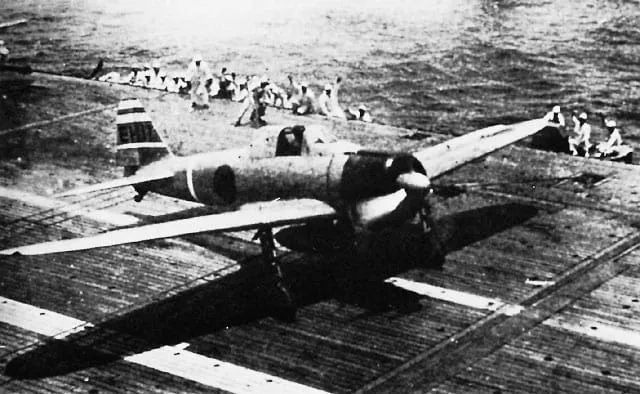
The Mitsubishi A6M, known simply as the Zero, was the fighter with which Japan began the war in the Pacific and with which it ended it. For the first six months no Allied aircraft could match it in a turning fight, and its range let the Japanese navy strike where no one expected it. That advantage was bought at a price that in time proved too high: the machine was light because it protected neither its pilot nor its fuel. Once the Americans had learned how to fight it and received better fighters, the Zero became an aircraft Japan had nothing to replace with, and in the end a weapon for suicide pilots.
An aircraft without armour
In 1937 the Japanese naval staff called for a carrier fighter faster than the land-based machines of the day, with two cannon, the agility of the older A5M and the range to escort bombers on very long routes. Nakajima soon withdrew from the competition. Mitsubishi’s chief designer, Jirō Horikoshi, met the requirements in the only way open to him: he pared the structure wherever he could, used a new and exceptionally light aluminium alloy, and did without armour plate behind the seat and without the rubber linings that seal bullet holes in fuel tanks. The first prototype took to the air on 1 April 1939. Production aircraft were designated Type 0, from the last digit of the Japanese year 2600, that is 1940, and that is where the name the whole world knew came from. The Allies later gave it the code name “Zeke”, though they usually called it the Zero anyway.
Its armament, two 20 mm cannon in the wings and two machine guns in the fuselage, was heavy for a carrier fighter of the time. With an extra tank under the fuselage the Zero could fly more than 2,600 kilometres and stay aloft for many hours, something Allied staffs long found hard to believe.
China and the first months of the war
The first production aircraft reached units fighting in China in the summer of 1940. On 13 September thirteen of them attacked Chinese aircraft over Chongqing and, according to Japanese reports, destroyed them without loss. Over the following year the navy’s pilots claimed about a hundred victories, and the Chinese air force began to avoid combat. In the West no one drew any conclusions from this.
In December 1941 the navy had about 330 of them in front-line units. Forty-three Zeros escorted the first wave of the attack on Pearl Harbor, and fighters taking off from Taiwan flew to Luzon and back to strafe American aircraft on the ground during the attack on Clark Field. In the weeks that followed, Zeros accompanied the Japanese landings in the Netherlands East Indies, and flew over Darwin and the Indian Ocean. British Hurricanes, American Buffalos and P-40s, and Dutch and Australian aircraft lost to it whenever their pilots tried to fight on its terms, in tight turns and at low speed.
Midway and Guadalcanal
At Midway in June 1942 the covering fighters shot down almost all the American torpedo aircraft, but in doing so they came down low and were not over the carriers when the dive bombers arrived. Japan lost four ships and many experienced airmen. The same day, in the Aleutians, a damaged Zero made a forced landing on Akutan Island; the pilot was killed, but the aircraft survived almost intact. The Americans shipped it to California, repaired it and tested it thoroughly in the air, and so their pilots learned where the Zero was weak: at high speed it lost control response, it dived less well and it caught fire from a short burst.
Even earlier, Lieutenant Commander John Thach had devised a manoeuvre for the Wildcats in which two pairs of fighters crossed paths and covered each other. The Americans stopped accepting turning fights and attacked from above, then escaped in a dive. Over Guadalcanal the Japanese pilots flew some thousand kilometres each way from Rabaul, fought tired and short of fuel, and every one shot down over the island was lost to the navy. According to American tallies, from August to mid-November 1942 both sides lost more than a hundred fighters each there, but the Japanese were losing men they could not train quickly. In April 1943 six Zeros failed to protect Admiral Isoroku Yamamoto’s bomber over Bougainville.
The advantage fades
Mitsubishi improved the aircraft in successive versions. The Model 32 received a more powerful engine and clipped wings, at the expense of range; the Model 22 restored the original wingspan; and from 1943 the A6M5 was built, with shorter wings and better in a dive; its later sub-types received armoured glass and heavier armament. None of this could offset the enemy’s new machines: the P-38 Lightning, the Corsair and, from August 1943, the Hellcat, faster, better armed and far tougher. The Zero’s successor was delayed by engine troubles, so the factories went on building the old model until the end of the war. In June 1944 over the Marianas American pilots called the battle the “Great Marianas Turkey Shoot”: bomb-carrying fighters and their escorts fell into the sea by the dozen before they reached their targets, and the Battle of the Philippine Sea ended the story of Japanese carrier aviation.
Kamikaze and the end
In the autumn of 1944 in the Philippines, Vice Admiral Takijirō Ōnishi decided that his few dozen serviceable aircraft could still achieve something only if the pilots crashed their machines into ships. The Zero with a 250-kilogram bomb, by then too weak to fight Hellcats, suited the task well: it was fast, easy to fly and available. On 25 October Lieutenant Yukio Seki’s group sank the escort carrier St. Lo, and from then on the Zero remained the most common kamikaze aircraft, right through to Okinawa. The factories in Nagoya that turned out some of these machines came under American bombs in the spring of 1945.
More Zeros were built than any other Japanese combat aircraft. Mitsubishi produced just under 3,900, and Nakajima built more than 6,500 under licence; with the trainers and floatplanes, sources give between about 10,900 and 11,300 machines. The figure also speaks of failure: an industry still building in 1945 a fighter designed in 1937 could not keep pace with the war Japan had started.
Sources
Battles
(07)- 7 December 1941Attack on Pearl HarborOn 7 December 1941 aircraft from Nagumo's six carriers struck the Pacific Fleet at Pearl Harbor. 2,403 Americans were killed and four battleships sank.
- 8–23 December 1941Battle of Wake IslandOn 8–23 December 1941 the Wake Atoll garrison repulsed a first Japanese landing and sank two destroyers, but, with no relief, fell to a second landing.
- 11 January – 9 March 1942Dutch East Indies campaignBetween 11 January and 9 March 1942 Japan conquered the Dutch East Indies and their oil. The ABDA fleet perished in the Java Sea, and Java capitulated.
- 31 March – 10 April 1942Indian Ocean raidFrom 31 March to 10 April 1942 Nagumo's carriers struck Ceylon and sank Hermes and two cruisers, but Somerville's Eastern Fleet survived.
- 3–7 June 1942Battle of MidwayOn 3–7 June 1942 off Midway Atoll American aircraft sank Nagumo's four carriers. Japan abandoned the operation; the United States lost Yorktown.
- 15 August – 7 October 1943Battle of Vella LavellaFrom 15 August to 7 October 1943 Americans and New Zealanders took Vella Lavella, bypassing strongly held Kolombangara – the first deliberate “leapfrog”.
- 19–20 June 1944Battle of the Philippine Sea19–20 June 1944. Spruance's and Mitscher's carriers shattered the air groups of Ozawa's Mobile Fleet, and submarines sank Taihō and Shōkaku.
In the chronicle
(28)1941
1942
- 23 January 1942The Japanese take Rabaul
- 3 February 1942Air raids on Java and Port Moresby
- 19 February 1942The bombing of Darwin
- 3 March 1942The attack on Broome
- 5 April 1942The Easter Sunday raid on Colombo
- 9 April 1942The attack on Trincomalee
- 7 May 1942The sinking of Shōhō
- 8 May 1942The carrier clash in the Coral Sea
- 4 June 1942The sinking of Nagumo's carriers
- 21 August 1942The Battle of the Tenaru
- 24 August 1942The Battle of the Eastern Solomons