Equipment
The aircraft carrier HMS Ark Royal
Britain's most modern carrier of 1939: she hunted raiders, covered Malta and stopped the Bismarck, until U-81 sank her in November 1941.
- Role:
- aircraft carrier
- State:
- United Kingdom
- Maker:
- Cammell Laird (Birkenhead)
- Launched:
- 13 April 1937
- Author:
- Natalia
- Updated:
- 1 November 2026
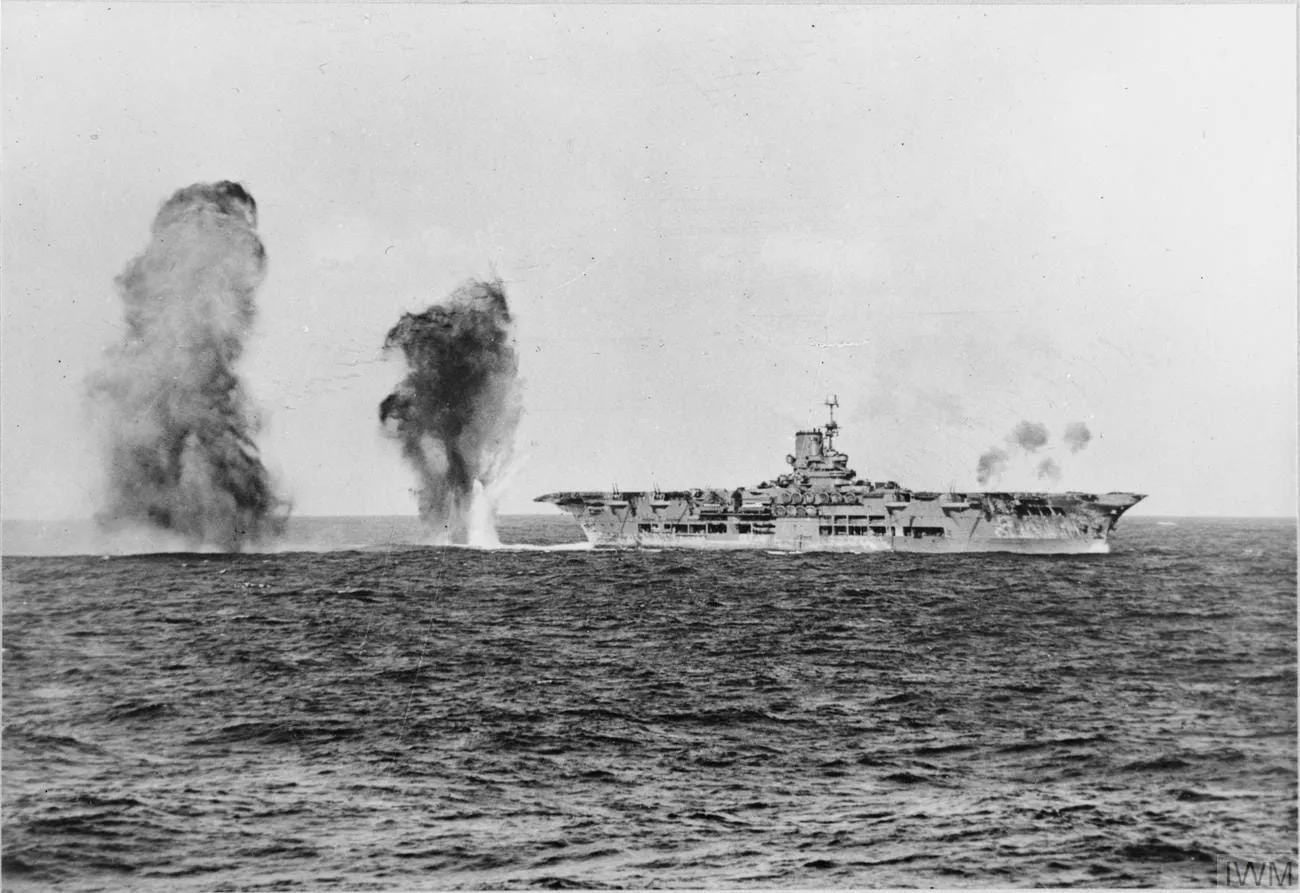
HMS Ark Royal was the first large carrier the Royal Navy built from the keel up as a carrier, and in 1939–1941 its hardest-worked aviation ship. She hunted German raiders in the South Atlantic, covered the troops in Norway and, from the summer of 1940, as the core of Force H at Gibraltar, fought in the western Mediterranean and carried fighters to besieged Malta. Her aircraft sealed the fate of the Bismarck. To the British she was a lucky ship, and German propaganda announced her sunk more than two years before she actually went down.
A new kind of carrier
The ship was designed in 1934 to fit an expected treaty limit of about 22,000–23,000 tons. Her keel was laid at Cammell Laird in Birkenhead on 16 September 1935, she was launched on 13 April 1937, and in December 1938 the carrier was commissioned. Most earlier British carriers had been converted from battlecruisers or merchant ships; in Ark Royal the flight deck and two levels of hangars were part of the structure of the hull. The design allowed for 72 aircraft; in practice she carried between fifty and sixty, mainly Swordfish torpedo bombers and Skua fighter dive bombers, replaced from 1940 by Fulmar fighters. She could make more than 30 knots, because without heavy guns speed was her main defence against surface ships. The price of saving weight was an unarmoured flight deck and, as 1941 would show, an arrangement of boiler rooms and power supply that coped badly with flooding.
The first months of the war
In September 1939 the Admiralty sent carriers into the Western Approaches to search for submarines with their aircraft. On 14 September U-39 fired torpedoes at Ark Royal, which missed because lookouts saw their tracks in time, and the escorting destroyers sank the attacker: she was the first U-boat lost in the war. Three days later U-29 sank the carrier Courageous and the hunts with carriers were abandoned. On 26 September, over the North Sea, Skuas from Ark Royal shot down a German flying boat, and a Ju 88’s bomb fell into the sea about thirty metres from the carrier’s bow. Berlin announced that the ship had sunk, and for weeks German radio mockingly asked the British where the Ark Royal was.
The answer came from the South Atlantic. In October the carrier and the battlecruiser Renown formed one of the hunting groups chasing the Admiral Graf Spee, working from Freetown and intercepting German merchant ships. In December both ships were thousands of kilometres from the River Plate, but the British spread word of their approach so skilfully that Captain Hans Langsdorff believed they were waiting for him at the mouth of the estuary and scuttled his own ship.
In April 1940 Skuas of the carrier’s squadrons, left ashore in Orkney, sank the cruiser Königsberg at Bergen, the first major warship destroyed by dive bombers. Ark Royal herself returned to Norway at the end of April and covered the evacuation of the Allied troops from the sea. When on 8 June Scharnhorst and Gneisenau sank Glorious, her aircraft failed to find the German ships, and a raid by fifteen Skuas on the Scharnhorst at Trondheim cost eight aircraft and produced one hit with a bomb that did not explode.
Force H
At the end of June 1940 Ark Royal joined Force H at Gibraltar under Vice-Admiral James Somerville. The first task was the attack on the French fleet at Mers-el-Kébir: the talks with the French admiral were conducted by the carrier’s captain, Cedric Holland, and when they failed Ark Royal‘s aircraft laid mines at the harbour entrance and spotted for the battleships’ guns. In August they bombed the airfield near Cagliari during Operation Hurry, and in September, on the expedition to Dakar, they attacked the battleship Richelieu without success. In November the carrier’s Swordfish took part in the inconclusive battle with the Italian fleet off Cape Spartivento, and in February 1941 Force H bombarded Genoa while Ark Royal’s aircraft bombed Livorno and mined La Spezia.
In May 1941 Force H was sent into the Atlantic against the Bismarck of Admiral Günther Lütjens. On 26 May aircraft from Ark Royal found the battleship, and in the evening the second wave of fifteen Swordfish hit her with two torpedoes; one jammed her rudders. In Operation Rheinübung it was this attack, not the duel of the battleships, that allowed the Home Fleet to catch the German ship the next morning.
Most often, however, Ark Royal carried aircraft for Malta. In the spring and summer of 1941 group after group of Hurricanes took off from her deck for the island, from the April operation to Operation Rocket and beyond, often together with Furious, Victorious or Argus. Her fighters also covered convoys, among them Operation Substance in July. Thanks to these voyages Malta could go on defending itself and attacking the Axis shipping bound for Libya.
The end
On 13 November 1941, returning from another run with aircraft for Malta, Ark Royal was torpedoed by U-81 under Kapitänleutnant Friedrich Guggenberger, some tens of miles east of Gibraltar. A single torpedo tore open her starboard side below the island. Most of the crew were quickly taken off, and the damage-control parties returned on board only after some time. Water spread through the boiler rooms, the ship lost power, and she had no standby diesel generators. Under tow towards Gibraltar, she capsized and sank early on 14 November, about 30 nautical miles from port. Only one sailor was killed.
A court martial found her captain, Loben Maund, guilty of negligence in the salvage effort, but the committee that examined the loss pointed above all to design faults, which were corrected in the carriers then being built. The wreck, lying at a depth of about a thousand metres, was found in December 2002. The name Ark Royal was later given to further British carriers.
Sources
Battles
(03)- 13–17 December 1939Battle of the River PlateOn 13 December 1939 Commodore Harwood’s three British cruisers drove the Admiral Graf Spee into Montevideo. On 17 December the Germans scuttled the ship.
- 23–25 September 1940Battle of DakarOn 23–25 September 1940 a British fleet and de Gaulle's Free French tried to take Dakar. Vichy forces repelled them and the attempt was abandoned.
- 18–27 May 1941Operation RheinübungFrom 18 to 27 May 1941 Bismarck and Prinz Eugen tried to break out into the Atlantic. Bismarck sank Hood but went down herself after a three-day chase.
In the chronicle
(21)1939
- 14 September 1939The sinking of U-39
- 17 September 1939The sinking of HMS Courageous
- 26 September 1939The first German aircraft shot down by the British
- 5 October 1939Hunting groups against the raiders
- 22 November 1939The Shoeburyness mine
- 13 December 1939The Battle of the River Plate
- 17 December 1939The scuttling of the Admiral Graf Spee