- Category:
- Military operations
- Front:
- Western Front
- Date:
- 21 October 1944
- Author:
- Łukasz
- Battle:
- Battle of Aachen
- Tags:
- United States, Third Reich, Adolf Hitler, civilians
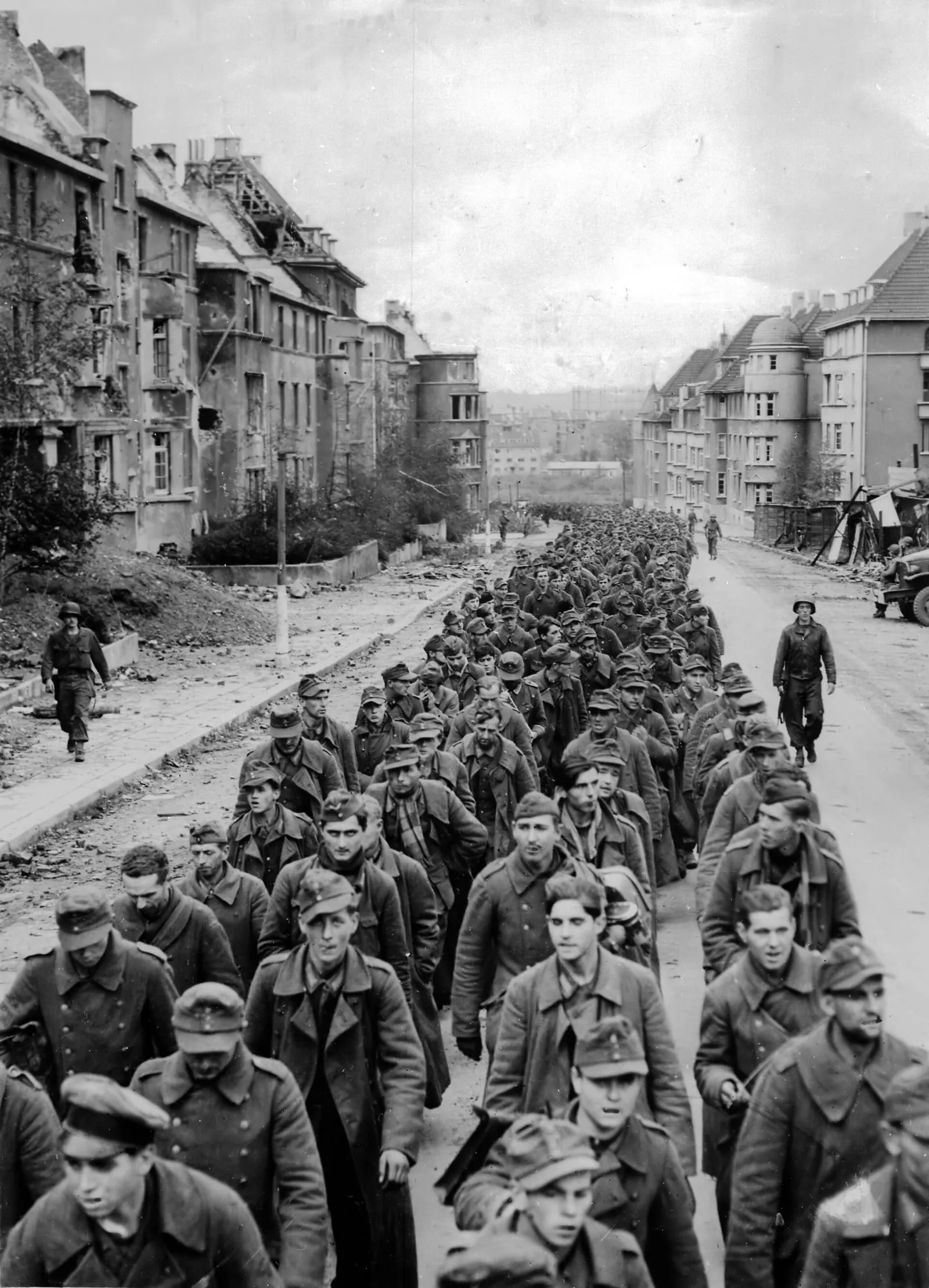
Late on the morning of 21 October 1944 soldiers of the 3rd Battalion of the US 26th Infantry Regiment approached a large concrete air-raid bunker on the Lousbergstrasse in the northern part of Aachen. The battalion commander, Lieutenant Colonel John Corley, called up a 155 mm self-propelled gun that had been demolishing the city building by building for a week. He did not know that the bunker housed the command post of the city’s defence. The commandant, Colonel Gerhard Wilck, was still assuring his superiors by radio of his “unshakeable faith in victory”, but he was already prepared to surrender. Two Germans who came out of the bunker with a white flag were killed in the confusion of the fighting. Wilck therefore sent out two American prisoners – Staff Sergeant Ewart Padgett and Private James Haswell of the 1106th Engineer Group – who ran into the street with a white flag, stopped the shooting and brought back an officer. At Corley’s headquarters the surrender was accepted by the assistant commander of the 1st Infantry Division, Brigadier General George A. Taylor. At 12.05 p.m. the fight for Aachen was over.
War chronologies record the battle twice. Under 15 October they state that the “Allied bombardment of Aachen, the first major battle on German soil” is under way, and under 21 October that the city was taken by the US First Army and that it was the first large German city captured by the enemy. The second statement is accurate. The first needs two qualifications. The air raids on the city lasted essentially three days, from 11 to 13 October, after which Aachen was shelled mainly by artillery. Nor was it the first battle on German soil: the Americans had already been fighting near Stolberg and in the Hürtgen Forest in September, and from 16 October the Red Army was attacking in East Prussia. Aachen was, however, the first large city of the Reich over which a regular battle was fought.
The ring around the city
The battle began on 2 October, when Major General Charles H. Corlett’s XIX Corps broke through the West Wall on the Wurm north of the city and moved south towards Würselen. Since September Aachen had been enclosed in a semicircle to the east and south by General Joseph Lawton Collins’s VII Corps, which during the first fighting for the Siegfried Line had driven into the fortifications south-east of the city. Both corps belonged to General Courtney Hodges’s First Army, part of General Omar Bradley’s 12th Army Group.
Before dawn on 8 October Major General Clarence Huebner’s 1st Infantry Division attacked northwards from Eilendorf. The 18th Infantry Regiment, using the cover of darkness, took Verlautenheide, that same afternoon Crucifix Hill (Hill 239), and during the night of 9–10 October, without firing a shot, the Ravelsberg (Hill 231) – two bare heights bristling with bunkers above the road to Jülich. On Crucifix Hill Captain Bobbie E. Brown, wounded three times, personally destroyed three bunkers; he was awarded the Medal of Honor for it. Between the positions of the two American corps, however, there remained a gap through which the Germans were still supplying the garrison.
Ultimatum and bombardment
On 10 October three Americans – Lieutenant Cedric A. Lafley, Lieutenant William Boehme and Private First Class Ken Kading – walked up the Trierer Strasse with a white flag and handed the Germans an ultimatum. The city, General Huebner wrote, was completely surrounded; if it did not surrender immediately and unconditionally, American ground and air forces would “ruthlessly” bomb and shell it. Twenty-four hours were allowed for a reply. The inhabitants learned the terms of the ultimatum from Radio Luxembourg, from loudspeakers and from leaflets fired by the artillery. The city commandant at the time, Colonel Leyherr, rejected it in accordance with Adolf Hitler’s order to defend it to the last soldier. Two days later he was replaced by the commander of the 246th Volksgrenadier Division, Colonel Gerhard Wilck, who set up his command post in the luxurious Quellenhof spa hotel in the Farwick Park.
On 11 October, shortly after the deadline expired, some 300 P-38s and P-47s of IX Tactical Air Command flew over the city and dropped more than 62 tons of bombs on targets marked by the infantry, mainly on the outskirts. Twelve artillery battalions of VII Corps and the 1st Division fired nearly 4,900 rounds that day, and about 5,000 on 12 October. The air attack was repeated on 12 October, and on 13 October two groups dropped a further eleven and a half tons of bombs; after that Aachen became a secondary target for the air forces. Patrols sent out on the evening of 11 October found no clear slackening of German fire. Wilck had some 5,000 men in the city, mostly from his own division, along with fortress units and 125 policemen, but only five tanks and a few dozen guns.
The shelling continued over the following days, while the heaviest fighting of the battle flared up in the approaches. The Germans threw fresh divisions into a counter-attack: the 3rd Panzergrenadier Division and the 116th Panzer Division. On 15 and 16 October the 3rd Panzergrenadier Division attacked the 1st Division’s positions at Verlautenheide and on Crucifix Hill, but was beaten off by artillery and air power. Major General Leland Hobbs’s 30th Infantry Division, which had lost more than 2,000 men since 2 October, was struggling forward towards Würselen under the pressure of German counter-attacks. Hodges pressed Corlett, and Corlett pressed Hobbs. At 3.44 p.m. on 16 October men of the 18th Infantry on the Ravelsberg saw Americans on the south-western edge of Würselen. Two scouts of the 119th Infantry, Privates Edward Krauss and Evan Whitis, reached them despite the fire that had pinned down the rest of their patrol. At 4.15 p.m. the ring around Aachen was closed.
Street fighting
The assault on the city itself began on 13 October. General Huebner could spare for it only two battalions of Colonel John F. R. Seitz’s 26th Infantry Regiment. Lieutenant Colonel Derrill Daniel’s 2nd Battalion swept through the centre on a front nearly two kilometres wide, while Lieutenant Colonel Corley’s 3rd Battalion advanced north towards the Lousberg and Salvatorberg hills and the Farwick Park. Daniel split his battalion into small assault groups; each platoon was accompanied by a tank or tank destroyer, which fired into a building before the infantry went in. The soldiers blasted their way through walls from house to house so as not to have to go out into the streets, threw grenades into cellars, and checkpoints designated each day – crossroads and larger buildings – allowed the companies to keep in contact. The 155 mm self-propelled gun, which demolished whole tenement blocks at close range, made an enormous impression on both sides. The Americans removed civilians from every quarter they took and left no Germans behind their lines.
On 15 October Corley took the Kurhaus in the Farwick Park, but a sharp German counter-attack, supported by an SS battalion brought into the city, threw his men back from in front of the Quellenhof hotel. Gerd von Rundstedt reminded Wilck “with the utmost emphasis” that he was to defend the city to the last man. Collins sent reinforcements: two battalions of the 3rd Armored Division (Task Force Hogan) and a battalion of the 110th Infantry Regiment from the 28th Division. On 18 October Second Lieutenant William Ratchford’s platoon broke into the lobby of the Quellenhof and, after a fight with grenades at the entrances to the cellars, forced the defenders to surrender. On 19 October the Salvatorberg and the Lousberg fell. That day Wilck issued an order of the day: the defenders of Aachen were to fight “to the last man, the last shell, the last bullet, in accordance with the Führer’s orders”. On 20 October the Americans took the fortified building of the Technical University and reached the western railway line, pushing the last Germans back into the western suburbs.
The surrender
On 21 October Wilck, cut off from most of his units – owing to the breakdown of communications he knew the whereabouts of only some 500 soldiers – surrendered in the bunker on the Lousbergstrasse. He took leave of his superiors in a tone that the US official history (Charles B. MacDonald, The Siegfried Line Campaign) calls melodramatic: the last defenders of Aachen, “compressed into the smallest space”, were to fight their “last battle” with faith in victory. By evening the Americans, combing every district, had rounded up some 1,600 prisoners. Among them was the battalion adjutant to whom Lafley and Boehme had handed the ultimatum eleven days earlier.
A ruined city and its inhabitants
Much of Aachen had already been destroyed before the battle. The British had bombed it in the spring of 1944, and at the end of May raided it three days running. Of some 165,000 pre-war inhabitants, according to MacDonald, fewer than 20,000 remained in the city. In September Hitler had ordered a compulsory evacuation, but many people did not obey – they did not want to leave their homes or set off into the interior of Germany, and the party officials who were supposed to carry out the evacuation had themselves been the first to flee. The inhabitants survived the fighting in cellars and in the great concrete shelters. The Americans led them out of every district they occupied and sent them to camps outside the combat zone. Studies state that most of the city’s buildings were destroyed after the battle – according to some, about 85 per cent.
The cathedral, with the Palatine Chapel of Charlemagne – the coronation place of German kings and a symbol to which Nazi propaganda had so readily appealed – came through the battle damaged but without major destruction.
Losses
According to the US official history, the 30th Infantry Division with its attached units lost about 3,000 men from 2 October, and the 1st Division about 800 up to 16 October; the two battalions of the 26th Infantry fighting in the city lost 498 men, including 75 killed and 9 missing. The two American divisions reported nearly 11,700 prisoners in all (the 30th Division 6,000, the 1st Division 5,637, of whom 3,473 were taken in the city itself). By their own figures the Germans lost 45 tanks. Other studies put total American losses in the whole battle at more than 7,000, and German losses likewise at over 5,000 killed and wounded plus some 5,600 prisoners; these figures vary according to the time frame and area assigned to the battle.
Significance
Aachen was the first large German city taken by the Western Allies, and also the first in which the Americans faced the problem of governing a German population. On 22 October XIX Corps came under the command of General William Hood Simpson’s Ninth Army, and the exhausted General Corlett lost his command. Soon afterwards the Americans appointed a lawyer, Franz Oppenhoff, as mayor of the city; in March 1945 he was murdered by an SS commando team acting under the Werwolf plan.
For the Germans the defence of Aachen was a defeat, but – as MacDonald observes – the costly delay they imposed had its price for the Allies. The garrison held out in encirclement for only five days, but three weeks of fighting for the city absorbed the strength of two American corps. A few days earlier Hitler had called the Volkssturm into being to strengthen the defence of the Reich’s borders. South of the city, meanwhile, the gruelling Battle of the Hürtgen Forest was under way, and the autumn drive to the Rhine bogged down on the plain along the Roer. The Ruhr, to which the road through Aachen was meant to lead, was encircled by the Allies only in April 1945.
Sources
Meanwhile
(04)Elsewhere, within a week.
- 20 October 1944 · PacificThe landing on LeyteOn 20 October 1944 the US Sixth Army landed on Leyte. General MacArthur waded ashore and told the Filipinos by radio: “I have returned”.
- 23 October 1944 · DiplomacyThe recognition of de Gaulle's governmentOn 23 October 1944 the USA, Britain, the USSR and Canada formally recognised de Gaulle's administration as the Provisional Government of the French Republic.
- 23 October 1944 · PacificB-29s in the MarianasIn autumn 1944 B-29 bombers arrived on Saipan to raid Japan. The first landed on 12 October; the first raid on Tokyo came on 24 November. Tinian opened in 1945.
- 23 October 1944 · BalkansThe liberation of Novi SadOn 23 October 1944 Yugoslav Partisans, followed by Red Army soldiers, entered Novi Sad, the capital of Bačka, which Hungary had seized in 1941.
Related events
(04)The same battle, people or subject.
- 2 October 1944 · Western FrontThe attack on AachenOn 2 October 1944 the US XIX Corps attacked the West Wall on the Wurm north of Aachen, opening the manoeuvre to encircle the city.
- 13 September 1944 · Western FrontThe Allies at the Siegfried LineOn 11 September 1944 the first American patrol crossed the German border; on 12–13 September VII Corps attacked the Siegfried Line near Aachen.
- 26 December 1944 · Western FrontThe relief of BastogneOn 26 December 1944 tanks of Patton’s 4th Armored Division broke through to encircled Bastogne, opening a narrow corridor to the 101st Airborne Division.
- 17 September 1944 · Western FrontOperation Market Garden beginsOn 17 September 1944 the Allies dropped three airborne divisions in the Netherlands and XXX Corps set off towards the Rhine. The goal was the bridge at Arnhem.