Equipment
Lockheed P-38 Lightning
A twin-engine long-range fighter with distinctive tail booms: it disappointed over Europe, but in the Pacific it was the US Army Air Forces' best fighter.
- Role:
- long-range heavy fighter
- State:
- United States
- Maker:
- Lockheed
- First flight:
- 27 January 1939
- Built:
- 10,037
- Author:
- Natalia
- Updated:
- 1 November 2026
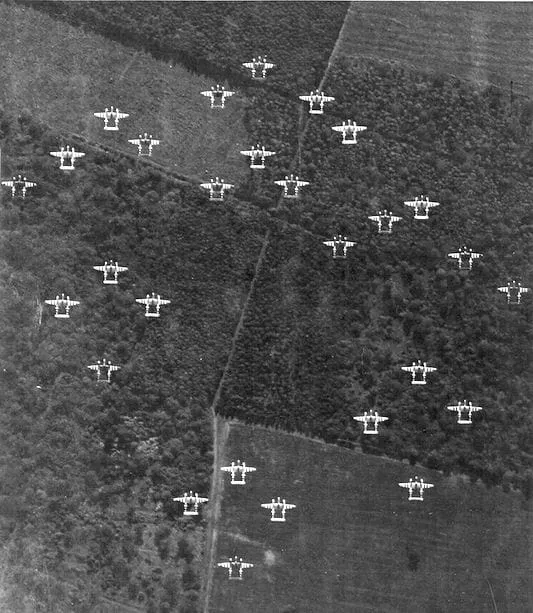
The Lockheed P-38 Lightning, with two engines in long tail booms and the pilot’s nacelle between them, was the most unusual American fighter of the war. It was the first US Army fighter with the range to accompany bombers deep over enemy territory. In the cold, damp air over Germany it fell short of expectations, but in the Pacific, where what counted were hundreds of kilometres over sea and jungle and a second engine for the way home, it became the American Army’s best fighter. The two highest-scoring American aces of the war flew it, and it was Lightnings that shot down the aircraft carrying Admiral Isoroku Yamamoto.
An interceptor on twin booms
In February 1937 the Army Air Corps issued specification X-608 for an interceptor that was to climb faster and fly higher than anything built so far. The Lockheed (PL) team led by Hall Hibbard and the young Clarence “Kelly” Johnson answered with a design powered by two turbosupercharged Allison V-1710 (PL) engines. A 20 mm cannon and four 12.7 mm machine guns were grouped in the nose of the nacelle, so the streams of fire ran parallel instead of converging on a single point as with wing-mounted guns. Lieutenant Benjamin Kelsey first flew the XP-38 prototype on 27 January 1939, and in February, during an attempt at a record transcontinental flight, he wrecked it on landing near New York. The Army ordered a service-test batch all the same.
According to the Army Air Forces’ official history it was Lockheed’s first big military contract, and production went slowly: on the eve of the attack on Pearl Harbor the Army’s air arm had only 69 of them. The aircraft also had a flaw that nobody yet understood. In a high-speed dive it ran into air compressibility (PL): the tail shook, the nose tucked under and the controls seemed to freeze. In November 1941 the test pilot Ralph Virden was killed in this way. The dive flaps that solved the problem only went into production in June 1944.
From Iceland to Tunisia
Its range allowed Lightnings to fly to England under their own power in the summer of 1942, by way of Greenland and Iceland. Along the way, on 14 August 1942, a P-38 pilot from Iceland, together with a P-40 pilot, shot down a Focke-Wulf Fw 200 over the Atlantic, the first German aircraft destroyed by the US Army Air Forces. A few days earlier, on 9 August, Lightnings had downed two Japanese flying boats over the Aleutians.
After Operation Torch P-38s went to North Africa. The winter brought heavy losses, but in the spring of 1943 Lightnings cut the Axis air bridge to Tunisia: from 5 April they patrolled the Gulf of Tunis and broke up formations of Ju 52 and SM.82 transports over Cape Bon. The Germans supposedly called them the “fork-tailed devil”, though the authenticity of the nickname is doubtful. In May and June P-38s strafed trains, ports and power stations during the raids on Sardinia and Sicily, and on 19 July they escorted the bombers over Rome.
The Pacific
In the South-West Pacific General George Kenney, commander of the Fifth Air Force, constantly asked for more P-38s, but Washington gave priority to Europe. Over New Guinea in January 1943, in the fight over the Japanese reinforcements for Lae, Richard Bong became an ace; he ended the war with 40 victories. Thomas McGuire, killed over the Philippines in January 1945, had 38.
The most famous mission was flown on 18 April 1943. Thanks to the breaking of a Japanese code, the Americans knew the route of Admiral Yamamoto’s inspection tour; sixteen P-38s with extra tanks flew from Guadalcanal low over the sea on a roundabout course and over Bougainville shot down the bomber, a Mitsubishi G4M, carrying the admiral. The Americans lost one aircraft.
In the autumn of 1943 Lightnings escorted heavy bombers over Rabaul: on 12 October 125 of them took part in the attack. In the spring of 1944 Kenney deliberately kept the P-38s with their new tanks away from Hollandia so that the Japanese would not discover their range, then threw them against the airfields there just before the landing. That summer Charles Lindbergh, a civilian adviser, taught the pilots of the 475th Group a way of setting the engines that greatly extended their range. In December 1944 P-38s from Leyte shot down kamikaze aircraft over Mindoro, and in May 1945 they dropped napalm on Japanese positions on Tarakan.
Europe and reconnaissance
The Eighth Air Force sent P-38s into action on 15 October 1943, the day after Black Thursday. With drop tanks they reached further than the Thunderbolts, but high up in the freezing air their engines failed and the cockpits were bitterly cold. By September 1944 every Eighth Air Force fighter group but one had switched to Mustangs. The figures were not as bad as the reputation, though: in some 130,000 sorties over Europe losses came to 1.3 per cent per sortie, against 1.1 per cent for the Mustang. Lightnings stayed on in the tactical air forces and in the Fifteenth Air Force in Italy, which in 1944 used them to escort raids on Ploiești; an attempt to bomb the refineries there with diving P-38s in June ended in heavy losses.
Some 1,200 Lightnings were built or converted as unarmed F-4 and F-5 reconnaissance aircraft, with cameras instead of guns. According to Lockheed they supplied 90 per cent of the aerial photographs taken over Europe. In such an F-5B the writer and French air force pilot Antoine de Saint-Exupéry (PL) took off from Corsica on 31 July 1944 and vanished over the sea; the wreckage of his aircraft was found near Marseille in 2000.
The balance
By 1945 10,037 P-38s had been built in more than a dozen versions, up to the P-38L with rockets under the wings. It was expensive, complicated and hard for young pilots, but no other American Army fighter combined such range, speed and firepower throughout the war. Over Germany it gave way to the Mustang; over the Pacific it gave the Americans an edge that Japanese pilots could not overcome.
Sources
Battles
(02)- 4–16 September 1943Capture of LaeOn 4–16 September 1943 Australian sea and air landings took Lae, and Salamaua on the 11th; the Japanese 51st Division escaped over the Saruwaged Range.
- 22 April – 6 June 1944Landings at Hollandia and Aitape22 April – 6 June 1944. US troops landed at Hollandia and Aitape far behind the New Guinea front, cutting off the Japanese 18th Army and winning a major base.
In the chronicle
(19)1943
- 7 January 1943Japanese reinforcements at Lae
- 18 April 1943The death of Admiral Yamamoto
- 18 April 1943The Palm Sunday massacre
- 22 May 1943The raids on Sicily and Sardinia
- 19 July 1943The first bombing of Rome
- 12 October 1943Air raids on Rabaul
- 14 October 1943Black Thursday over Schweinfurt
- 25 November 1943The raid on Rangoon
1944
- 5 February 1944The bombardment of the Kuril Islands
- 26 February 1944Big Week
- 17 March 1944The raid on Vienna
- 3 April 1944The raids on Budapest and Bucharest
- 5 April 1944The first raids on Ploiești from Italy
- 21 May 1944The locomotive hunt
- 8 December 1944The bombardment of Iwo Jima
- 14 December 1944The Palawan massacre
- 15 December 1944The landing on Mindoro
- 23 December 1944Clear skies over the Ardennes