1944–1945: The liberation of Western Europe
Battle of Metz
- Dates:
- 27 September – 13 December 1944
- Front:
- Western Front
- Location:
- France, Lorraine (the Moselle department, de facto annexed to the Third Reich in 1940–1944): the fortress of Metz with its ring of forts on both banks of the Moselle and the Seille – Fort Driant above Ars-sur-Moselle, Fort Jeanne d’Arc near Gravelotte, Fort Kœnigsmacker – and the crossings at Uckange, Cattenom, Malling and ThionvilleOn the battle map →
- Sides:
- United StatesGeorge Patton, Walton WalkerNazi GermanyOtto von Knobelsdorff, Heinrich Kittel
- Result:
- An American victory bought at heavy cost. After failed attacks on Fort Driant (27 September – 13 October), XX Corps encircled Metz in its November offensive; it entered the city on 18 November, and organised resistance there ceased on 22 November. The cut-off forts went on fighting – the last, Jeanne d’Arc, surrendered on 13 December. According to XX Corps, some 14,400 prisoners were taken. The Germans, however, gained nearly three months to strengthen their defences on the Saar.
- Author:
- Łukasz
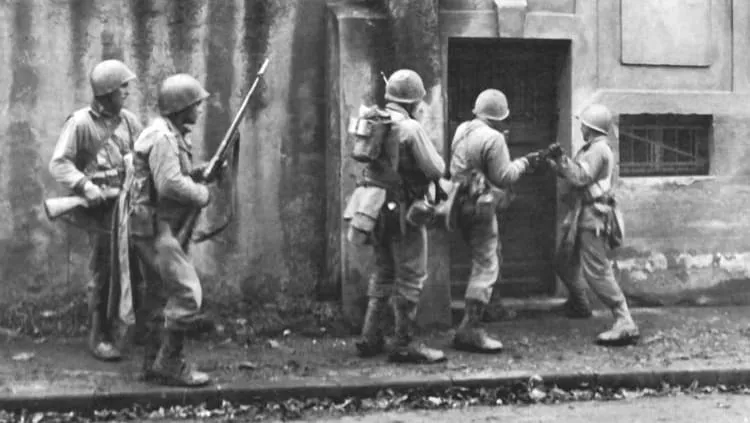
The Battle of Metz was the struggle of General George Patton’s US Third Army for the Lorraine fortress city of Metz in the autumn of 1944. It was fought by General Walton Walker’s XX Corps, and the defenders were the German First Army under General Otto von Knobelsdorff. Metz lies on the Moselle at the mouth of the Seille, and ever since it passed to the German Empire after the war of 1870–1871 it had been surrounded by a ring of forts – older ones from the 1870s and newer, massive fortress groups built by the Germans at the turn of the 20th century. In the autumn of 1944 these fortifications, obsolete on paper, combined with rain, flooding and the tenacity of the defenders, held up for nearly three months the army that had crossed France that summer faster than any other.
The battle fell into two clearly distinct parts. In September and October the Americans tried to take the fortifications with small forces and on the move; the best-known episode of these attempts was the twice-repeated, bloody and unsuccessful assault on Fort Driant. In November, after a pause to replenish supplies, XX Corps encircled the fortress with four divisions, crossing the swollen Moselle north of the city and attacking from the south. The city fell on 18–22 November, but the cut-off forts surrendered one by one until 13 December. After the war Metz became for American historians the symbol of the Lorraine campaign: a victory, but one bought at great cost and disproportionately slow.
Name and dates
The name “Battle of Metz” covers fighting defined in different ways in the literature. The American official history, Hugh M. Cole’s The Lorraine Campaign (1950), does not treat it as a single battle but describes in turn XX Corps’ September fighting on the Moselle, the October attacks on Fort Driant and Maizières-lès-Metz, and “the November battle for Metz”. Most accounts adopt the framework of 27 September to 13 December 1944 (others speak in general terms of “nearly three months”). The starting date is marked by the first attack on Fort Driant, the first blow aimed at the ring of forts itself; the closing date by the surrender of Fort Jeanne d’Arc, the fortress’s last point of resistance.
The September fighting for the Moselle crossings south of Metz – especially the failed bridgehead at Dornot on 8–11 September and the bridgehead held at Arnaville – forms the background to the battle and belongs to the story of the liberation of Nancy. The city is usually said to have been taken on 22 November, when organised resistance in it ceased, although the first American units entered Metz as early as 18 November. At the time the city was formally part of France, but since 1940 the Moselle department had been de facto annexed to the Reich.
Background
The fortress
Metz was one of the most heavily fortified places in Europe. After the Franco-Prussian War, when the French capitulated in the besieged city in October 1870, Metz passed to Germany and became the Reich’s principal fortress in the west. To the older ring of forts (including Queuleu, Saint-Julien, Plappeville, Saint-Quentin and Saint-Privat) the Germans added in 1899–1916 extensive fortress groups (Feste) scattered several kilometres from the city: concrete barracks and shelters connected by tunnels, armoured gun turrets, ditches, wire entanglements and infantry positions. They included Feste Kronprinz, renamed Fort Driant (PL) by the French after 1918, Feste Kaiserin (Fort Jeanne d’Arc) and Feste Graf Haeseler (Fort Verdun). After 1918 the French maintained the forts as a rear base for the Maginot Line, built further east, but by and large did not modernise them, and after 1940 the Germans removed some of their armament.
In 1944, therefore, the forts were in worse condition than before 1914, but they were still proof against field artillery and medium bombs. Many positions were so well camouflaged that neither air reconnaissance nor informants from the French Resistance had detected them. The terrain favoured the defence: west of the Moselle rises a wooded plateau cut by ravines, where the bloody Battle of Gravelotte had been fought as long ago as August 1870, and the river itself was an obstacle that spread far across the valley during the autumn rains.
After France’s defeat in 1940, Metz and the whole Moselle department came under German civil administration and were de facto annexed to the Reich, although the Armistice of Compiègne made no mention of this. Part of the French-speaking population was expelled, and from 1942 young men were conscripted into the Wehrmacht. To the German command Metz was a German city, and its defence was the defence of the Reich’s frontier.
Pursuit and halt
After the breakthrough in Normandy and the encirclement at Falaise, the Third Army raced east in the second half of August 1944, crossed the Marne and the Meuse and reached Verdun. At the turn of August and September, however, it ran out of fuel: supplies were still coming from Normandy, more than 600 km by road, and the Supreme Commander, Dwight Eisenhower, gave priority to the northern wing – Bernard Montgomery’s British 21st Army Group and the US First Army. A few days’ halt at the beginning of September was enough for the Germans to man the Moselle line.
The German First Army, subordinated to Army Group G (commanded from 21 September by General Hermann Balck, previously by Colonel General Johannes Blaskowitz), received reinforcements from the Reich and from Italy. In November the Metz sector was defended by General Hermann Priess’s XIII SS Corps. A special role was played by units assembled in the city itself: schools for non-commissioned officers and officer candidates, from which Division No. 462 was formed, later the 462nd Volksgrenadier (PL) Division, under Lieutenant General Walther Krause. In September the young officer cadets fought with a determination that the American official history makes a point of stressing. Adolf Hitler declared Metz a “fortress” (Festung): under his order of March 1944, the fortress commandant could surrender only with the Führer’s consent, which in practice was never given. The aim was to gain time to rebuild the Siegfried Line, which had been stripped of its armament in previous years.
Course of the battle
The September attempts
XX Corps reached the Moselle at the beginning of September 1944 with the 7th Armored Division, the 5th Infantry Division and the 90th Infantry Division. Walker hoped to seize crossings on the move, as in August. On 8 September the 5th Division’s 11th Infantry Regiment crossed the river at Dornot, south of Metz, but under fire from the forts and constant counter-attacks it had to withdraw to the west bank on the night of 10/11 September. A little further south, at Arnaville, the 10th Infantry Regiment seized a bridgehead and held it – it later became the starting position for the attack from the south. On the plateau west of the city the 90th Division and part of the 5th fought for many days among the ravines near Gravelotte against the officer cadets from Metz, advancing hundreds of metres at a time.
At the end of September the supply situation along the whole front grew even worse, because Operation Market Garden had begun and was swallowing fuel and ammunition. On 25 September Omar Bradley, commander of the 12th Army Group, ordered the Third Army to go over to the defensive. Patton was permitted only “limited attacks” to improve his position – and he decided to use this permission to take Fort Driant, whose guns dominated the Moselle valley and the Arnaville bridgehead.
Fort Driant
Fort Driant (Feste Kronprinz) stood on a hill above Ars-sur-Moselle, on the west bank of the river, a few kilometres south-west of Metz. It consisted of concrete barracks, several batteries of guns in revolving armoured turrets and infantry blocks, linked by underground passages and surrounded by a dry moat and a belt of barbed wire. American reconnaissance knew its outline, but not the layout of its tunnels and positions.
On 27 September P-47 Thunderbolt fighter-bombers dropped high-explosive bombs and tanks of napalm on the fort, after which the 2nd Battalion of the 11th Infantry Regiment went into the attack. The bombs did not dent the concrete, and the infantry, held up by the wire and fire from the casemates, withdrew that same day. A second, more carefully prepared assault began on 3 October. This time the battalion, supported by tanks and bulldozers, broke into the fort and took some of the surface works. It could not, however, capture the underground sections: the Germans emerged from the tunnels in the Americans’ rear and fired on them from the casemates, while their artillery in neighbouring forts (including Jeanne d’Arc) pounded the occupied ground. Further companies were fed into the fight, and on 7 October command passed to a task force under Brigadier General Alan Warnock, assistant commander of the 5th Division.
After ten days of fighting in the rain, on the surface of the fort and in its ruined casemates, the command concluded that any further attack would require forces that were not available. On the night of 12/13 October the troops withdrew from the fort and the engineers blew up the bunkers they had taken. According to Cole, the operation against Fort Driant cost 64 killed, 547 wounded and 187 missing, and on 3–8 October alone losses amounted – by preliminary count – to 21 officers and 485 men; German losses are not known precisely. The failed assault served as a warning: the forts of Metz could be taken neither by bombing nor by the attack of a single battalion.
The October pause
For the rest of October XX Corps conducted only limited-objective operations. From 3 to 30 October the 90th Division, commanded from the middle of the month by General James Van Fleet, fought heavy street battles for Maizières-lès-Metz north of the city, building by building, including for a large steelworks. The 95th Infantry Division arrived at the front. Meanwhile units of XX Corps practised assaulting fortifications on old forts in the rear: infantry–engineer cooperation and the use of demolition charges, flamethrowers and direct-fire guns. Supplies gradually improved, and the Third Army stockpiled artillery ammunition for an autumn offensive.
The November plan
XX Corps’ new plan assumed that Metz would be neither besieged nor assaulted frontally. The fortress was to be enveloped by two pincers: from the north the 90th Infantry Division, crossing the Moselle east of Thionville, and from the south the 5th Division, attacking from its bridgehead on the Seille. The 95th Division was to pin down the Germans on the west bank and feint a crossing at Uckange, and the 10th Armored Division was to cross the river behind the 90th Division and drive deep towards the Saar. The Third Army’s offensive began on 8 November with an attack by XII Corps east of Nancy; XX Corps moved off a day later.
On the German side, the Metz sector was held by the 462nd Volksgrenadier Division in the city itself and the forts, the 19th Volksgrenadier Division and the 416th Infantry Division in the north, and the 17th SS Panzergrenadier Division Götz von Berlichingen, with the 25th Panzergrenadier Division in reserve. The German divisions were understrength and poorly equipped, but they were fighting from prepared positions.
Crossing the swollen Moselle
The 95th Division was the first across the river: on the evening of 8 November a battalion of the 377th Infantry Regiment crossed at Uckange. On the morning of 9 November the 90th Division’s 358th Regiment crossed the Moselle at Cattenom and the 359th Regiment at Malling, north of Thionville. The first battalions took the few German outposts by surprise, but their situation soon became dramatic. After weeks of torrential rain the Moselle had burst its banks in one of the worst floods in years: at Cattenom it spread to almost a kilometre wide, and in places the flooded valley was more than two kilometres across. The current swept boats away, German artillery destroyed footbridges and ferries, and after a few days only about twenty of the eighty assault boats remained. For several days the Uckange bridgehead was cut off and supplied by small liaison aircraft.
The 90th Division nevertheless widened its bridgehead. On 11 November its infantry took Fort Kœnigsmacker, attacking at dawn and destroying the positions with demolition charges and thermite grenades. At three o’clock in the morning on 12 November two battalions of the 25th Panzergrenadier Division counter-attacked at Kerling and drove in the American outposts, but fire from artillery, tank destroyers and infantry inflicted heavy losses on them and threw them back. The engineers had finished a footbridge at Malling around midnight on 11 November, and on 14 November a Bailey bridge was opened at Thionville – according to Cole, the largest such bridge in the European theatre. That day and during the night of 14/15 November the 10th Armored Division crossed the river and assembled near Kerling.
The encirclement
From 15 November the 90th Division turned south along the east bank of the Moselle, behind the defenders of Metz, while the 10th Armored Division attacked east, towards the Reich frontier and the Saar, covering the encirclement from outside. From the south the 5th Division crossed the Seille and advanced north, bypassing the forts on the eastern side of the city. From the west the 95th Division, after many days of fighting in the woods and among the forts on the plateau, began to push the Germans back towards the city.
The German command realised that the fortress was about to be sealed off. From 17 November the main forces of XIII SS Corps withdrew east towards the Saar, leaving in Metz a garrison drawn mainly from the 462nd Division. From mid-November the fortress commandant was Lieutenant General Heinrich Kittel, regarded as a specialist in the defence of fortified towns; Krause continued to command the division. On 19 November the ring closed: soldiers of the 5th Division met cavalry units of the 90th Division north of Retonfey, east of the city.
The capture of the city
On 18 November the first units of the 5th Division, bypassing Fort Queuleu, entered Metz from the south; on 19 November patrols of the 95th Division entered the city from the north-west. Over the following days fighting went on for barracks, bunkers and individual buildings, and the American infantry cleared the city district by district. On 21 November the Americans found Kittel in an underground field hospital – badly wounded and under morphine – and took him prisoner. On 22 November organised resistance in the city ceased. The American press announced the capture of a fortress which, it was stressed, no invader had taken by storm since the days of Attila; in 1870 the French had surrendered it after a siege, and in 1918 and 1940 it had changed hands without any fighting for the forts themselves.
The forts
The capture of the city did not end the battle. More than a dozen forts and fortress groups around Metz, cut off from one another and from the city, were still holding out. XX Corps had no intention of storming them: artillery ammunition was short, and its divisions were due to push on to the Saar. The forts were surrounded, shelled and called upon to surrender, in the expectation that hunger and lack of water would do the rest. Fort Verdun surrendered on 26 November, and on 29 November – after a bombardment by four artillery battalions – Fort Saint-Privat. Saint-Quentin capitulated on 6 December, Plappeville on 7 December and, on the afternoon of 8 December, Fort Driant – the same fort that had been fought over in vain in October. In the meantime the siege had been taken over from XX Corps by III Corps, which had arrived on the Lorraine front in October. The last to surrender, on 13 December, was Fort Jeanne d’Arc, held by grenadiers of the 462nd Division. Three days later the German Ardennes offensive began, and III Corps, which only moments before had been besieging the forts of Metz, was soon thrown north towards Bastogne.
Conditions of the fighting
The Battle of Metz, like the fighting in the Hürtgen Forest going on at the same time, was fought in the worst possible season. October and November 1944 were exceptionally wet in Lorraine; swollen rivers, sodden fields and mud immobilised tanks, and for many days aircraft could not take off. The American infantry spent weeks in flooded foxholes, with no way of drying their boots and clothing. Cases of trench foot and frostbite in the Third Army ran into the thousands and made up a considerable part of its losses.
The forts confronted the attackers with a problem for which the US Army was not prepared. It lacked heavy siege artillery, and its 155 mm guns and 8-inch howitzers, though accurate, could not penetrate thick concrete. Air bombardment, even with heavy bombs, wrecked the surface but not the underground works. What finally proved effective were painstaking tactics: isolating a fort, firing direct-fire guns into its embrasures and turrets, and then sending in engineers with demolition charges and flamethrowers, supported by infantry clearing the trenches. The American official history notes that after the experience of Fort Driant the divisional commanders acted cautiously and slowly in November, concentrating an overwhelming superiority in men, guns and tanks wherever resistance was strongest.
Losses
There is no complete tally of losses in the Battle of Metz, and different studies count them for differently defined periods and units. The American official history gives partial figures: the operation against Fort Driant alone cost nearly 800 killed, wounded and missing; the 5th Division lost about 185 killed and more than 1,100 wounded in November (not counting the sick), and the 95th Division about 2,200 men up to 22 November. To these must be added the losses of the 90th Division during the crossings and the September fighting near Gravelotte and Dornot. According to American figures, the Third Army paid for the whole Lorraine campaign from September to December – an advance of 60–100 km – with some 50,000 men, including many thousands of sick and frostbite cases; Metz was one of its costliest sectors.
German losses cannot be established precisely. XX Corps reported that it took 14,368 prisoners over the whole Metz operation; German sources give lower figures. The number of defenders killed and wounded is not known. The 462nd Division ceased to exist, and the 19th and 416th Divisions and the 17th SS Panzergrenadier Division emerged from the battle badly bled. The city and the surrounding villages, across which the front rolled back and forth repeatedly, also suffered, although Metz itself escaped destruction on the scale of the Norman towns.
The dispute over the cost and Patton’s methods
The Battle of Metz has long divided historians. Critics accuse Patton of allowing himself to be drawn into a fight for a fortress that could have been bypassed. In post-war accounts given to American historians, German commanders, among them Blaskowitz, maintained that a direct attack on Metz had been unnecessary and that a turn north, towards Luxembourg, would have brought better results. Basil Liddell Hart remarked acidly that the Third Army had begun crossing the Moselle as early as 5 September and two months later was not much further on. The October attacks on Fort Driant came in for particular criticism: they were made with weak forces, without thorough reconnaissance, against an objective whose capture would have changed little, at a time when the Third Army was formally supposed to be on the defensive. Some authors see them as a sign of the ambition of Patton, who did not want to stand still while others were advancing.
Patton’s and Walker’s defenders stress the constraints over which neither had any control. The Third Army stood at the back of the queue for fuel and ammunition, its front was wide, and bypassing the fortress would have required forces it did not have in September. The November operation – encirclement instead of assault, river crossings in flood, pincers closed within ten days – is regarded as well conceived and efficiently executed in conditions that ruled out quick success. The decision not to storm the isolated forts but to starve them out spared many soldiers’ lives. Cole, in the official history, judges the matter cautiously: he points out that the slowness of the November operations stemmed largely from the weather and from the commanders’ caution after their earlier setbacks.
Significance
The capture of Metz opened the Third Army’s road to the Saar and the Saar basin. At the end of November and in December XX Corps reached the Reich frontier and attacked the Siegfried Line fortifications near Saarlautern. The offensive was cut short, however, by the Ardennes offensive of 16 December: within a few days Patton turned a large part of his army north, and on 26 December he broke through to encircled Bastogne. The Germans lost the fortress of Metz, which Hitler had ordered to be held to the last man, but they gained from it what they had wanted – time. For nearly three months it tied down the strongest American army, and in that time the defences on the Saar were rebuilt and forces were assembled for the Ardennes offensive.
Among the soldiers of the Third Army and in American collective memory, the Battle of Metz has remained in the shadow of Normandy, the Ardennes and the Hürtgen Forest. For the people of Lorraine it meant the end of four years of annexation and Germanisation; the inhabitants of Metz welcomed the Americans as liberators, and French administration was soon restored in the city. For military historians it became an example of how well-defended, if obsolete, fortifications, aided by weather and terrain, can hold up an enemy with overwhelming superiority for many weeks.