The Soviet invasion of Manchuria
- Dates:
- 9–20 August 1945
- Front:
- Far East
- Location:
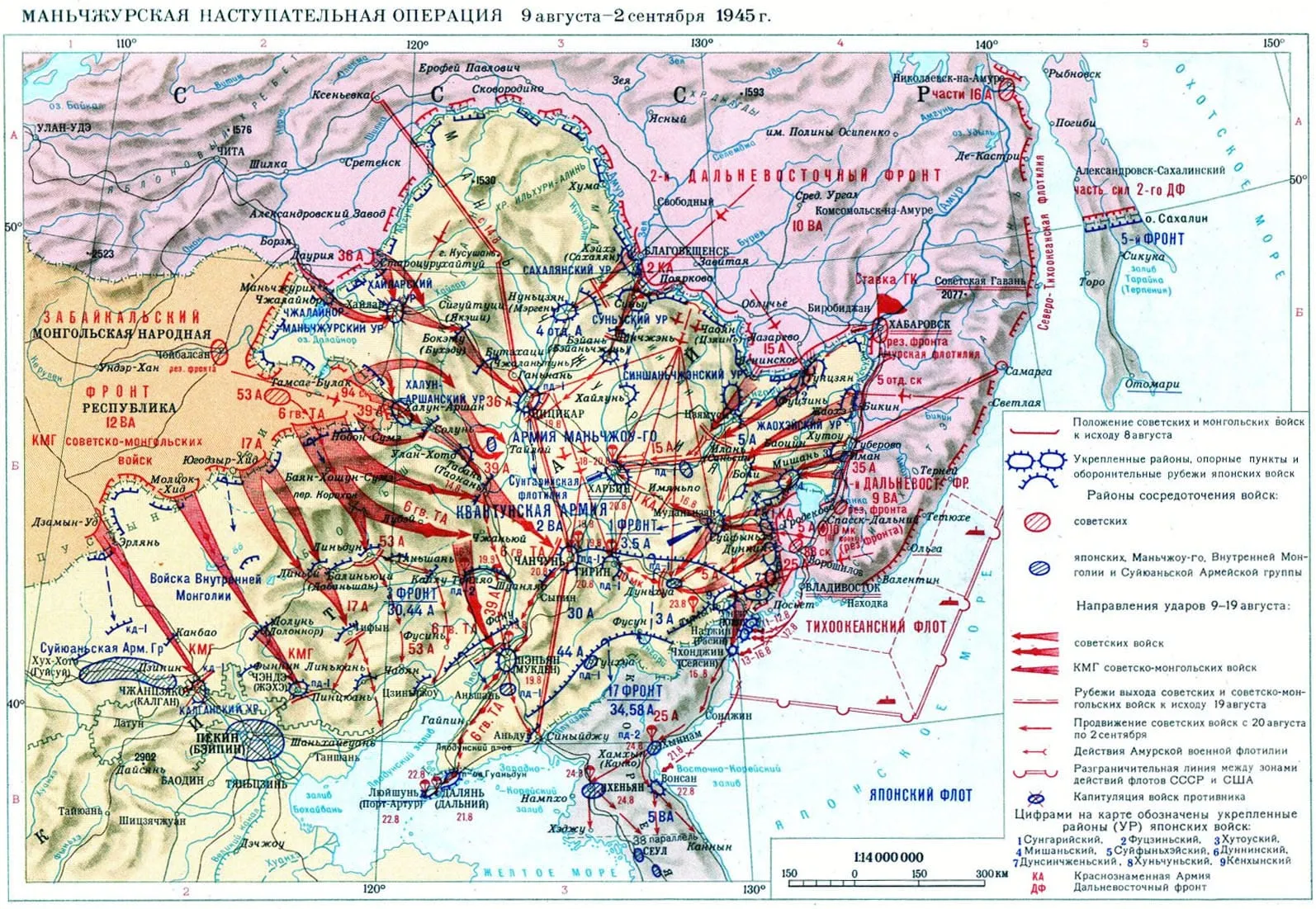
- Manchuria (Manchukuo) and Inner Mongolia (Mengjiang) – from the Gobi Desert and the Greater Khingan mountains in the west, through the valleys of the Amur and the Songhua in the north, to the border with the Soviet Maritime Province on the Ussuri and Lake Khanka in the east; related operations on the north-eastern coast of Korea, in southern Sakhalin and in the Kuril IslandsOn the battle map →
- Sides:
- Soviet Union and the Mongolian People's RepublicAleksandr Vasilevsky, Rodion Malinovsky, Kirill MeretskovJapan (and Manchukuo)Otozō Yamada
- Result:
- Soviet victory. Within a fortnight or so the Red Army broke through the defences of Manchuria, took its main cities and forced the Kwantung Army to surrender; in related operations it occupied northern Korea up to the 38th parallel, southern Sakhalin and the Kurils. According to G. F. Krivosheev's figures the three Soviet fronts lost about 12,000 killed and 24,400 wounded (other tallies give from 9,800 killed). Estimates of Japanese losses vary widely – from about 21,000 killed according to Japanese medical records to about 84,000 according to Soviet data; some 600,000 soldiers were taken prisoner, most of them deported to labour camps in the USSR.
- Author:
- Natalia
Name and dates
The Manchurian operation (in Russian Маньчжурская стратегическая наступательная операция – the Manchurian Strategic Offensive Operation) is the name given to the great Red Army offensive against the Japanese Kwantung Army in Manchuria, launched just after midnight Trans-Baikal time on 9 August 1945. It is also known as the Kwantung operation; Western literature also speaks of the “Soviet invasion of Manchuria” and of “August Storm”, the title of the classic studies by the American historian David Glantz. It was the main and largest part of the brief Soviet–Japanese War of 1945.
The starting date is marked by the crossing of the borders of Manchukuo by troops of three Soviet fronts at 0.10 a.m. Trans-Baikal time on 9 August – a little over an hour after the Soviet Union declared war on Japan in Moscow. By European time it was still the evening of 8 August, which is why some accounts give that date as the start of the offensive. The operation is taken to have ended on 20 August 1945: by that day the Kwantung Army had accepted the terms of surrender and begun to lay down its arms, while Soviet ground and airborne troops had occupied Mukden (Shenyang), Changchun, Harbin, Jilin and Qiqihar. Soviet and Russian historiography extends the operation to 2 September, the day Japan signed its surrender, because isolated garrisons kept fighting for several more days (the Hutou fortress until 26 August), and the disarming and occupation of Manchuria went on until the end of the month.
The Manchurian operation was accompanied by actions which in Soviet plans formed part of it or its direct continuation: the landings of the Pacific Fleet in north-eastern Korea (from 11–12 August), the offensive in southern Sakhalin (11–25 August) and the landing in the Kuril Islands (from 18 August). These are usually treated as related operations, although they partly fall outside the accepted dates.
Background
Russia and Japan had competed for Manchuria since the end of the 19th century. Defeat in the war of 1904–1905 and the Treaty of Portsmouth cost Russia Port Arthur, the southern section of the Chinese Eastern Railway and the southern half of Sakhalin; in 1910 Japan annexed Korea. After the Mukden Incident of September 1931 the Kwantung Army seized the whole of Manchuria, and in 1932 Manchukuo was proclaimed – formally an empire under Puyi, in practice a state dependent on the Japanese army. From then on there were clashes along the long border with the USSR and Mongolia, the largest being the fighting at Lake Khasan in 1938 and the Battle of Khalkhin Gol in 1939, where the troops of Georgy Zhukov destroyed the Japanese 23rd Division.
In April 1941 the two sides concluded a neutrality pact, which allowed the USSR to concentrate on the war with Germany and Japan on expansion to the south. Even so, large Soviet forces remained in the Far East throughout the war, and until 1942 the Kwantung Army kept preparing plans to attack Siberia. At the Tehran Conference in 1943 Joseph Stalin announced that the USSR would enter the war against Japan once Germany had been defeated. In the secret Far Eastern agreement signed at the Yalta Conference in February 1945 he undertook to do so “in two or three months” after Germany’s surrender; in return the Allies promised him the return of southern Sakhalin, the transfer of the Kurils, a lease on Port Arthur, “pre-eminent interests” in the port of Dalian (Dairen) and joint management of the Manchurian railways.
On 5 April 1945 Vyacheslav Molotov informed the Japanese ambassador that the USSR would not renew the neutrality pact, while assuring him that the agreement would remain in force until April 1946. As late as July the government of Kantarō Suzuki still hoped that Moscow would agree to mediate peace talks with the Americans and the British, and tried to send Prince Fumimaro Konoe there. Stalin delayed his reply, and in the meantime armies released from the German front were being moved east along the Trans-Siberian Railway. After Germany’s surrender on 8 May, the Yalta deadline fell on 8–9 August; on 3 August Vasilevsky reported to Stalin that, if necessary, he could attack as early as 5 August. The backdrop to those final weeks was formed by the Potsdam Declaration of 26 July, which the USSR did not sign, Truman’s conversation with Stalin about the new weapon and, finally, the atomic bombing of Hiroshima on 6 August. According to some historians (among them Tsuyoshi Hasegawa), the news of Hiroshima prompted Stalin to bring the attack forward by about two days compared with the earlier plan, so that the USSR could enter the war before Japan surrendered. On the evening of 8 August, Moscow time, Molotov handed Ambassador Naotake Satō the declaration of war.
Plans and forces
For the war with Japan the Red Army set up the only theatre-level command it created in the Second World War – the High Command of Soviet Forces in the Far East. At its head stood Marshal Aleksandr Vasilevsky, until recently Chief of the General Staff and the conqueror of Königsberg, who arrived in Chita under an assumed name. The plan was simple in concept and enormous in scale: the two arms of a giant pincer were to strike from the west and the east, converge in the area of Changchun and Jilin and cut the Kwantung Army off from Korea and China proper, while a third thrust from the north was to tie down Japanese forces and take Harbin.
- The Trans-Baikal Front under Marshal Rodion Malinovsky (the 17th, 36th, 39th and 53rd Armies, the 6th Guards Tank Army of General Andrei Kravchenko, the Soviet–Mongolian Cavalry-Mechanised Group of General Issa Pliyev and the 12th Air Army) – the main blow from Mongolia across the desert and the Greater Khingan mountains onto the central Manchurian plain, towards Mukden and Changchun.
- The 1st Far Eastern Front (PL) under Marshal Kirill Meretskov (the 1st Red Banner Army, the 5th, 25th and 35th Armies, the 10th Mechanised Corps and the 9th Air Army) – an attack from the Maritime Province through the mountainous, forested border zone and its fortifications towards Mudanjiang, Jilin and Harbin, with the 25th Army striking towards Korea.
- The 2nd Far Eastern Front under General of the Army Maksim Purkayev (the 2nd Red Banner Army, the 15th and 16th Armies, the 5th Separate Rifle Corps, the 10th Air Army and the Amur Flotilla) – crossing the Amur and the Ussuri, advancing along the Songhua towards Harbin and Qiqihar and, with the 16th Army, attacking in southern Sakhalin.
At sea the operation was supported by the Pacific Fleet under Admiral Ivan Yumashev. The army of the Mongolian People’s Republic under Marshal Khorloogiin Choibalsan also fought on the Soviet side; Mongolia declared war on Japan on 10 August. According to figures cited by Glantz, Vasilevsky had about 1.5 million men in 89 divisions, some 3,700 tanks, 1,850 self-propelled guns and 3,700 aircraft – most of them veterans of the war with Germany, brought east within a few months.
The Kwantung Army of General Otozō Yamada was by now only a shadow of the formation that in the 1930s had been regarded as the elite of the Japanese army. From 1942 onwards it had been stripped of its best divisions, heavy equipment and aircraft for the Pacific front, and in 1944 also for Operation Ichi-Go in China. In the summer of 1945 it numbered about 700,000 men in Manchuria alone and – according to various estimates – about 900,000 or more together with the troops in Korea, Sakhalin and the Kurils, in 31 divisions and a dozen or so brigades; but most units had been formed in the preceding months from conscripts, reservists and settlers called to the colours. By Japanese assessments not a single division was fully combat-ready; there was a shortage of anti-tank guns capable of penetrating the armour of the T-34, and of roughly a thousand aircraft in Manchuria only a small fraction were fit for combat. The armed forces of Manchukuo and Mengjiang (over 200,000 men in all) were of negligible fighting value and largely disintegrated in the first days.
The Japanese staff did not expect an attack before the autumn of 1945 and was in the middle of reorganising its defences: instead of holding the borders, the main forces were to withdraw into the interior, to a “redoubt” in south-eastern Manchuria and on the Korean border around Tonghua, leaving weak screening forces and fortified zones along the frontier. The regrouping was not due to be completed until September, so the offensive caught the Kwantung Army in mid-change. The Japanese also regarded the Greater Khingan as hard going for large armoured formations and expected the main blow to come from the east.
Course: across the Greater Khingan (9–14 August)
The offensive opened simultaneously on all axes, along a front of about 4,500 km – from the deserts of Inner Mongolia to the Pacific coast. In the west the Trans-Baikal Front attacked without an artillery preparation, counting on surprise. The deepest thrust was made by the 6th Guards Tank Army: within two days its columns crossed the passes of the Greater Khingan, which Japanese staffs had considered impassable for tanks, and on 11–12 August descended onto the central Manchurian plain, ahead of schedule. The greatest problem proved to be not resistance but fuel – tanks came to a halt halfway, and supplies had to be flown in by transport aircraft. Even so, over the following days the Soviets took Lubei, Taonan and Tongliao, heading for Mukden and Changchun.
To their north, the 36th Army crossed the border near Manzhouli and took the town of Hailar as early as 10 August, but the garrison of the fortified zone around it held out until 18 August, when, according to Max Hastings, 3,827 survivors surrendered. The fortifications near Halun-Arshan, where the 39th Army was attacking, put up similarly stubborn though short-lived resistance. On the far right flank Pliyev’s Soviet–Mongolian group pushed across the Gobi deep into Inner Mongolia, towards Dolonnur and Kalgan (Zhangjiakou), reaching the vicinity of the Great Wall over the following days.
The speed of the advance spelt tragedy for the Japanese civilian population. Some 1.5 million Japanese then lived in Manchuria, including more than 200,000 settlers from agricultural colonies (kaitakudan) in the border areas, many of whose men had only just been called up. Fleeing columns of women, children and old people came under fire; the most notorious case is the Gegenmiao massacre of 14 August, where, according to Japanese accounts, a Soviet tank unit killed about a thousand refugees. Elsewhere settlers committed mass suicide, often under pressure from the army or from the colony leaders. Russian authors stress that some accounts of mass atrocities are exaggerated and that offenders were punished; there is no doubt, however, that rape and looting directed at the Japanese population, and later at Chinese and Koreans too, accompanied the occupation of Manchuria and Korea for weeks on end.
Course: Mudanjiang, Hutou and the Amur (9–17 August)
Meretskov’s 1st Far Eastern Front also began its attack at night, in torrential rain and without an artillery preparation. Assault detachments bypassed or blockaded the Japanese fortified zones on the border, which had been under construction since the 1930s. The most famous of them was the Hutou fortress on the Ussuri, whose garrison – together with civilians sheltering in its underground galleries – held out until 26 August, long after the surrender had been announced; by Japanese estimates only a few dozen of some 1,400 people survived. The front’s main forces – the 1st Red Banner Army and the 5th Army – forced their way through mountainous, wooded terrain towards Mudanjiang, where the Japanese 5th Army organised the most serious defence of the entire campaign. The fighting for the town lasted from 12 to 16 August; Japanese suicide squads carrying explosive charges threw themselves under tanks, and their ferocity impressed even veterans of the war with Germany. The Soviets took Mudanjiang on 16 August and pressed on towards Harbin and Jilin. On the front’s southern wing the 25th Army advanced on Wangqing and Yanji, cutting the roads to Korea, while the 35th Army took Hulin and Mishan.
Purkayev’s 2nd Far Eastern Front crossed the Amur and the Ussuri with the support of the Amur Flotilla’s vessels. Its armies took Heihe (Sakhalyan), opposite Blagoveshchensk, and the Sunwu fortified zone, while the flotilla led the advance up the Songhua towards Jiamusi and Harbin. On this axis the Japanese resisted mainly in the border zone; further inland their resistance weakened by the day.
The Kwantung Army command lost control of the battle within the first few hours. Some senior officers were away on staff exercises when the attack came, communications with the front-line units quickly broke down, and on 10–12 August Yamada’s headquarters began moving from Changchun (Xinjing, the capital of Manchukuo) to Tonghua in the mountains near the Korean border. Emperor Puyi and his court left the capital with it.
The surrender of the Kwantung Army (15–20 August)
At noon on 15 August Emperor Hirohito announced on the radio that Japan accepted the terms of the Potsdam Declaration. The broadcast, delivered in archaic court language, did not speak of surrender in so many words, and the ceasefire order reached the Kwantung Army late. Vasilevsky took the view that the Emperor’s statement alone did not amount to a surrender, and kept up the offensive. On 16–17 August Yamada decided to lay down arms and asked the Soviet command for a truce; Vasilevsky demanded that Japanese units begin surrendering by 12 noon on 20 August. On 19 August the Kwantung Army’s chief of staff, General Hikosaburō Hata, came to talks with the Soviet command (according to Soviet accounts, at the command post of the 1st Far Eastern Front, in the presence of Vasilevsky and Meretskov) and accepted the terms of surrender.
Before the armoured columns reached the big cities, the Soviets sent airborne landings ahead of them. On 18 August they landed in Harbin, and on 19 August in Mukden, Changchun and Jilin; most Japanese garrisons laid down their arms without a fight. At Mukden airfield Soviet paratroopers detained Puyi, who – having abdicated on 17/18 August – was waiting there for a plane to Japan; the former emperor was taken into captivity in the USSR. By 20 August the spearheads of the fronts had linked up in central Manchuria, taking Qiqihar as well, and on 22 August airborne and seaborne landings seized Port Arthur (Lüshunkou) and Dalian – places Russia had lost in 1905. Despite the surrender, isolated Japanese units, unaware of the order or refusing to obey it, fought on for a few more days.
Related operations: Korea, Sakhalin and the Kurils
Korea. Ships and naval infantry of the Pacific Fleet landed on 11–12 August in the ports of Unggi (Yuki) and Najin – today Rasŏn – on the north-eastern coast of Korea. From 13 to 16 August heavy fighting went on for the port of Ch’ŏngjin (Seishin), where the first, too weak landing force was pushed almost back into the sea before reinforcements arrived. The 25th Army came overland from Manchuria; on 21 August a landing force took Wŏnsan, and on 24 August airborne troops landed at Hamhŭng and Pyongyang. In line with an American proposal accepted by Stalin, Soviet troops halted at the 38th parallel; the Americans did not land in the south of the peninsula until 8 September.
Sakhalin. On 11 August the 56th Rifle Corps of the 16th Army attacked the Japanese fortifications on the border along the 50th parallel, in the Koton (Haramitogi) area. Breaking through the position took almost a week; the defenders of the 88th Division surrendered after 18 August. Seaborne landings at Toro (16 August), Maoka – today Kholmsk (20 August) and Ōtomari – today Korsakov (25 August) completed the occupation of the island; on 25 August the Soviets entered Toyohara, the capital of Karafuto – today Yuzhno-Sakhalinsk. On 22 August, off the coast of Hokkaido, ships evacuating refugees from Sakhalin were attacked – it is generally assumed by Soviet submarines – and sunk; according to Japanese estimates about 1,700 people died.
The Kurils. On 18 August troops from Kamchatka landed on Shumshu, the northernmost island of the chain. The Japanese 91st Division, supported by tanks, put up fierce resistance; the fighting stopped only on 21 August, and the garrison formally surrendered on 23 August. According to Soviet data, Soviet losses exceeded 1,500 killed and wounded – more than the Japanese suffered. Over the following days the Soviets occupied the rest of the Kurils without a fight, and by 5 September also the Habomai group off the coast of Hokkaido, in what is known as the Kuril landing operation. Stalin also demanded from Truman the right to accept the surrender of the Japanese in the northern part of Hokkaido; after Truman refused, on 22 August he called off the landing being prepared on the island.
Losses
Casualty figures differ depending on the source and on whether they cover only the fighting in Manchuria or also Korea, Sakhalin and the Kurils. According to the tally compiled by G. F. Krivosheev’s team, the three Soviet fronts lost 12,031 killed and dead and 24,425 wounded and sick in the Manchurian operation; other tallies give about 9,800 killed. According to the same data the Mongolian army lost 72 killed and 125 wounded. Glantz puts Soviet armour losses at more than 300 tanks and self-propelled guns, most of them damaged rather than destroyed.
Japanese losses are much harder to establish. According to Japanese medical records cited by Alvin Coox, 21,389 soldiers were killed in the fighting; the Soviet side gave a figure of 83,737 killed. According to Soviet data, between 594,000 and 609,000 soldiers and officers were taken prisoner, including 148 generals – and close to 640,000 together with those captured in Korea, Sakhalin and the Kurils. There are no reliable figures for the losses of the forces of Manchukuo and Mengjiang, many of whose men simply went home. Japanese civilians formed a separate and grievous category: according to Japanese estimates, some 180,000–250,000 civilians died in Manchuria in 1945–1946 – during the fighting, the flight and the winter spent in refugee camps – among them a great many settlers from the agricultural colonies.
Prisoners, the dismantling of industry and the division of Korea
On 23 August 1945 the Soviet State Defence Committee ordered that about 500,000 Japanese prisoners fit for work be selected and sent to camps in Siberia, Kazakhstan, Mongolia and other parts of the USSR – contrary to the Potsdam Declaration, which provided for disarmed soldiers to return home. They worked on railway construction, in mines and in forests. According to Russian data about 60,000 of them died; some Japanese and Western historians estimate the death toll to be much higher. The last large groups did not return to Japan until 1950, and those convicted of war crimes (including members of Unit 731, tried at Khabarovsk in 1949) not until 1956. General Yamada was sentenced at Khabarovsk to 25 years in the Gulag and returned to Japan in 1956.
Manchuria was the most industrialised region of China: the Japanese had built steelworks, mines, power stations and factories there. In the few months of their occupation Soviet troops dismantled a large part of the equipment and shipped it to the USSR as “war booty”. In 1946 the American mission led by Edwin Pauley put the direct damage at about 858 million dollars at the time, and the total losses of Manchurian industry – including destruction and looting during the interregnum – at about 2 billion dollars. On 14 August, in the middle of the offensive, the USSR signed a treaty of friendship and alliance with the government of Chiang Kai-shek, recognising the Nationalist government and undertaking to withdraw its troops from Manchuria; in practice it delayed the withdrawal until May 1946, handed a large part of the captured Japanese weapons to Mao Zedong’s Communists and helped their forces take over territory. Manchuria became the base from which the Communists won the Chinese Civil War.
In Korea the line along the 38th parallel, drawn in haste as the boundary between zones for accepting the Japanese surrender, turned into the border between two states. In the Soviet zone power gradually passed to Kim Il Sung, a former partisan who during the war had served in the Soviet 88th Separate Rifle Brigade; in 1948 the Democratic People’s Republic of Korea was proclaimed in the north. Southern Sakhalin and the Kurils were incorporated into the USSR, and the dispute over the four southernmost Kuril islands still prevents the conclusion of a peace treaty between Russia and Japan.
Significance
The Manchurian operation was the last great land operation of the Second World War and one of the fastest victories of that war. In a fortnight or so the Red Army advanced hundreds of kilometres across deserts, mountains and marshes, destroyed an army that had dominated Manchuria for fourteen years and occupied an area of more than a million square kilometres. Military scholars, led by David Glantz, regard it as a model example of Soviet operational art in the final phase of the war: careful concealment of preparations, a blow from the least expected direction, the use of large armoured formations as spearheads, and airborne landings deep behind the enemy’s defences. It should be remembered, however, that the opponent was an army weakened by years of transferring its best forces to other fronts, and that the rapid collapse of resistance was hastened by Tokyo’s decision to surrender.
The most contested question is what contributed more to Japan’s surrender – the atomic bombs or the Soviet entry into the war. The traditional interpretation, accepted especially in the United States, gives the decisive role to Hiroshima and Nagasaki. Some historians, among them Tsuyoshi Hasegawa, argue that it was the Soviet declaration of war that deprived Japan’s leaders of their last hope of Moscow’s mediation and of defending the country in a decisive battle, and that it therefore shook them more than the bombs did. Others point out that both shocks came within three days of each other and are hard to separate. In the Soviet and Russian narrative the offensive was the “liberation” of Manchuria and Korea and revenge for 1905; in Japan it is remembered above all for the tragedy of the settlers, for the “orphans left behind in China” and for the years of captivity in Siberian camps.
The political consequences of the operation outlasted the war itself. The USSR regained what Russia had lost in 1905 and gained the Kurils as well; it kept a base at Port Arthur until 1955. The handing of Manchuria to the Chinese Communists and the emergence of a communist state in northern Korea shaped East Asia for decades to come – from Mao Zedong’s victory in 1949 to the Korean War of 1950–1953. The short, two-week campaign of August 1945 thus became one of the first chapters of the Cold War in Asia.