- Category:
- Diplomacy
- Front:
- Far East
- Date:
- 8 August 1945
- Author:
- Łukasz
- Tags:
- Soviet Union, Japan, Manchuria, Joseph Stalin
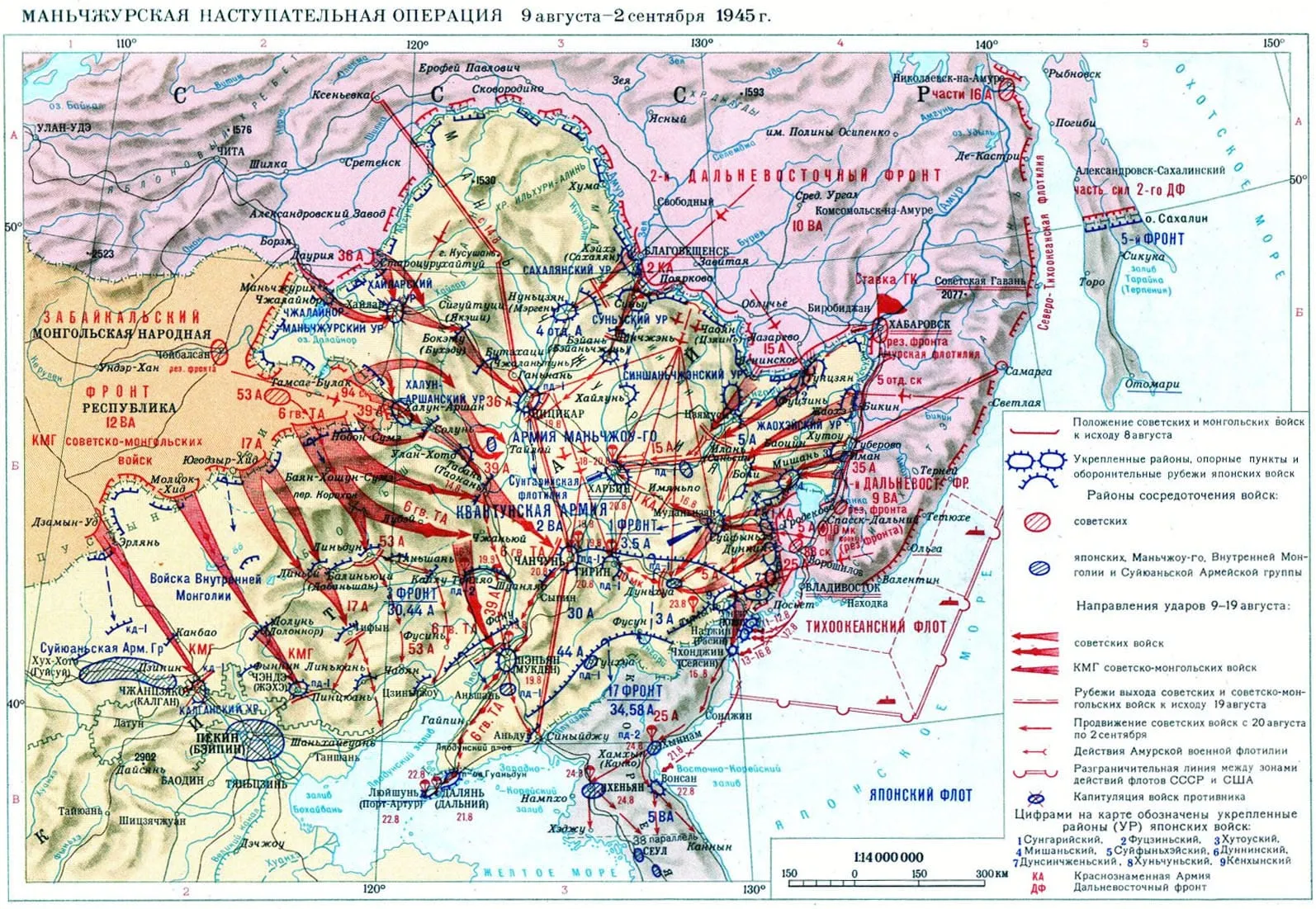
At 5 p.m. Moscow time on 8 August 1945 the People’s Commissar for Foreign Affairs, Vyacheslav Molotov, received the Japanese ambassador, Naotake Satō, in the Kremlin. The ambassador had been seeking this meeting for weeks, hoping at last to hear an answer about the peace mission of Prince Fumimaro Konoe. Instead, Molotov read him a statement from the Soviet government: as from the following day, 9 August, the Soviet Union would consider itself at war with Japan. Two days after the atomic bomb had been dropped on Hiroshima, Tokyo lost its last hope that Moscow would help it out of the war on tolerable terms. A few hours later, as 9 August dawned over Manchuria, a Red Army more than one and a half million strong crossed the borders of Manchukuo.
The promise of Yalta
The Americans had been pressing for Soviet entry into the Pacific war since 1941. Joseph Stalin promised it in general terms at Tehran in 1943, and in concrete terms in October 1944, in talks in Moscow with Churchill and the American ambassador Averell Harriman. He named his price at the Yalta Conference. On 11 February 1945 Stalin, Franklin Delano Roosevelt and Winston Churchill signed a secret agreement: the USSR would declare war on Japan “two or three months” after Germany’s surrender. In return it was to regain the southern part of Sakhalin, lost in 1905, receive the Kuril Islands, obtain a lease on Port Arthur as a naval base and a pre-eminent position in the internationalised port of Dairen and on the Manchurian railways, while the status quo in the Mongolian People’s Republic was to be preserved. The agreement was concluded without the knowledge of China, whose territory it concerned; Roosevelt undertook to obtain the consent of Chiang Kai-shek.
The American Chiefs of Staff wanted the Red Army to pin down Japan’s Kwantung Army in Manchuria and prevent it from being moved to the home islands before the planned invasion. Germany had surrendered on 8 May, so the three-month deadline expired on 8 August. Stalin kept to it to the day.
A pact that no longer protected
Since April 1941 Japan and the USSR had been bound by a neutrality pact concluded for five years. On 5 April 1945 Molotov told Satō that the pact had “lost its meaning”, because Japan, as Germany’s ally, was waging war on the USSR’s allies, and that the Soviet Union did not intend to renew it. Under Article 3, however, the pact formally remained in force until April 1946, and according to Satō’s account Molotov confirmed this. In Tokyo some politicians read the announcement as a warning sign; others – especially in the army – concluded that the eastern frontier would remain quiet until the spring of 1946.
Japanese diplomacy in the final months of the war rested on that assumption. In May the Supreme Council for the Direction of the War decided to seek Soviet neutrality and then Moscow’s mediation in talks with the Allies. In June the former prime minister Kōki Hirota sounded out the Soviet ambassador, Yakov Malik, and on 12 July the Foreign Minister, Shigenori Tōgō, instructed Satō to announce Konoe’s visit as the personal envoy of Emperor Hirohito. Moscow played for time: the Russians replied that the proposal was too vague, and at Potsdam Stalin told Harry Truman about the Japanese soundings. Satō cabled Tokyo that the only way out was a surrender close to unconditional, but Kantarō Suzuki’s government waited for the Kremlin’s answer – even after the Potsdam Declaration was issued on 26 July, which the USSR did not sign at the time.
Preparations in the east
From the spring of 1945 the Trans-Siberian Railway carried whole armies eastwards from around Königsberg and from Czechoslovakia. According to Soviet figures cited by, among others, the American historian David Glantz, some 400,000 troops with tanks and artillery were moved there in a few months; altogether, by August the Red Army had about 1.58 million men, more than 5,500 tanks and self-propelled guns and several thousand aircraft on the Manchurian border. On 30 July the High Command of Soviet Forces in the Far East was created under Marshal Aleksandr Vasilevsky. It controlled three fronts – Rodion Malinovsky’s Trans-Baikal Front, Kirill Meretskov’s 1st Far Eastern Front and Maksim Purkayev’s 2nd Far Eastern Front – as well as the Pacific Fleet.
A formal question remained. Stalin wanted the Allies officially to invite the USSR into the war, which would allow the breach of the pact to be presented as the fulfilment of an obligation to its allies. The Americans, who after the successful atomic test had stopped courting Soviet help, were unwilling to issue such an invitation. According to American documents, towards the end of the Potsdam Conference Truman gave Stalin a letter pointing merely to a legal basis: the Moscow Declaration of 30 October 1943 and Articles 103 and 106 of the United Nations Charter, which had not yet been ratified.
Hiroshima brought the date of the attack forward. According to the research of the historian Tsuyoshi Hasegawa, the offensive was originally due to begin around 11 August. On 6 August the first atomic bomb fell on Hiroshima, and at 4.30 p.m. the next day Stalin and the Chief of the General Staff, Aleksei Antonov, signed a directive ordering the three fronts to open operations on 9 August. Hasegawa interprets this haste as a race: Stalin wanted to enter the war before Japan surrendered and to secure the gains promised at Yalta. Other historians stress that preparations were nearing completion anyway and that the change of date was small.
In the Kremlin
Satō had been asking to see Molotov since July. When he was finally given an appointment for 8 p.m. on 8 August, the Kremlin unexpectedly moved it to 5 p.m. According to the ambassador’s account, Molotov cut short his greeting, asked him to sit down and read out the statement. It declared that after the defeat and surrender of Hitlerite Germany, Japan remained “the only great power” still in favour of continuing the war, and that it had rejected the demand of the United States, Great Britain and China of 26 July. Japan’s request for Soviet mediation in the Far East therefore “loses all basis”. The Allies – the text went on – had approached the Soviet government with a proposal that it join the war against Japanese aggression, and the Soviet government, “true to its duty as an ally”, had accepted the proposal and acceded to the declaration of 26 July. It considered this the only way to hasten peace, to free the peoples from further sacrifice and suffering, and to enable the Japanese people to avoid the destruction that Germany had suffered after refusing unconditional surrender. Finally, the Soviet government declared that “from tomorrow, that is, from 9 August”, the Soviet Union would consider itself at war with Japan.
The claim of an Allied “invitation” was a stretch – Washington had issued no such appeal – but it became the official justification for breaking the pact. According to his own account, Satō received the news calmly and said that he had expected things to take this turn. Molotov agreed that the ambassador might send a cipher telegram to Tokyo. That telegram, according to Japanese findings, never arrived – the Moscow telegraph office did not transmit it. According to Hasegawa, the embassy’s telephone lines were cut soon afterwards.
In the evening Molotov informed Harriman and the British ambassador, Archibald Clark Kerr, of the decision. In Washington Truman called a press conference in the afternoon, at which he said briefly that he had just one simple announcement to make: Russia had declared war on Japan.
The first hours of the war
In practice the formula “from 9 August” was meant literally. The Trans-Baikal Front moved off ten minutes after midnight Trans-Baikal time, and the Far Eastern fronts at around 1 a.m. local time – when in Moscow it was still only about 6–7 p.m. on 8 August. Roughly an hour therefore passed between the reading of the statement to Satō and the first shots, and Japan had no opportunity to respond to the declaration before the fighting began. An attack from three directions – across the desert and the Greater Khingan mountains from the west, from Primorye in the east and across the Amur from the north – was to cut Manchuria apart within a few weeks and encircle the Kwantung Army. On the morning of 9 August Soviet aircraft bombed Harbin and Changchun (then Xinjing, the capital of Manchukuo).
Tokyo learned of the declaration of war at about 4 a.m. on 9 August from an intercepted Radio Moscow broadcast. A few hours later the Supreme Council for the Direction of the War met, and Suzuki declared that in this situation Japan had to accept the Potsdam Declaration; during the meeting news arrived of the second bomb, dropped on Nagasaki. On 10 August Malik delivered the text of the declaration to Tōgō in Tokyo. The minister protested that the USSR had attacked while the pact was still in force and that Moscow had not replied to Japan’s request for mediation. The same day Marshal Khorloogiin Choibalsan’s Mongolian People’s Republic, whose troops fought alongside the Trans-Baikal Front, declared war on Japan.
The Kwantung Army and the Japanese in Manchuria
Contrary to what is sometimes written, the Japanese did not evacuate Manchuria in anticipation of the Soviet attack. The Kwantung Army, once the elite of the Japanese military, had since 1943 been giving up its best divisions, tanks and aircraft to the Pacific and then to the home islands. Its shortfalls were made good with new divisions raised from reservists in 1945, and in the summer a so-called total mobilisation was carried out that also took in men from the settlers’ villages. In August General Otozō Yamada’s army numbered, by various reckonings, between about 700,000 and a million men, including the forces of Manchukuo, but – as its own staff later judged – its fighting value was a fraction of what it had been, and ammunition was short.
The plan adopted on 30 May 1945 provided for the troops on the border merely to delay the advance, while the main forces withdrew south-east to the mountainous area around the city of Tonghua near the Korean border and defended themselves there. In practice this meant abandoning most of Manchuria without a fight. The fortifications at Tonghua, however, were not ready, and the headquarters was moved there only while the fighting was under way. Japanese intelligence knew of the Soviet concentration but – according to Japanese studies – expected an attack at the end of August or in September at the earliest, while the staff in Tokyo even reckoned with the spring of 1946.
Some 1.5 million Japanese civilians lived in Manchuria, including more than 200,000 agricultural settlers in villages along the northern border. They were not evacuated in advance – according to the later accounts of officers, for fear that population movements would betray Japanese plans to the Russians and cause panic. When the offensive began on 9 August, the first evacuation trains to leave Xinjing, according to Japanese figures, carried mainly the families of soldiers, officials and employees of the South Manchuria Railway. The settlers from the border areas – mostly women, children and the elderly, since the men had been conscripted – were left to fend for themselves. According to Japanese estimates, more than 100,000 Japanese civilians in Manchuria died during the flight, in the fighting, by suicide and violence, and then of hunger and disease in the winter of 1945–1946.
The Kurils and Sakhalin came later
The declaration of war of 8 August is sometimes linked with the landings in the Kurils, but these came only ten days later. At the outbreak of war the Red Army attacked Manchuria alone. The offensive against the Japanese southern part of Sakhalin began on 11 August, on 12–13 August the Pacific Fleet put the first landing parties ashore in the ports of north-eastern Korea, and in the Kurils the first landing came on 18 August on the island of Shumshu – after the Emperor had already announced the decision to surrender. The occupation of the archipelago lasted until the first days of September. The Kuril landings were therefore not part of the attack launched on the night of 8–9 August.
Significance
The Soviet declaration of war and the atomic bombs together delivered the shock that brought Japan to surrender within a week. Historians still argue about which factor weighed more heavily. Hasegawa contends that it was the Soviet attack – which wrecked Tokyo’s only diplomatic strategy and the army’s hopes of a decisive battle in the home islands – that settled the Emperor’s decision. Other scholars, including Richard Frank and Sadao Asada, point out that Hirohito and Suzuki justified the surrender above all by reference to the new weapon. Most accept that the two blows worked together.
For Stalin the war, which formally lasted less than a month, was short and profitable. On 14 August the USSR signed a treaty in Moscow with Chiang Kai-shek’s government, in which China agreed to recognise Mongolian independence after a plebiscite, as well as Soviet rights to Port Arthur, Dairen and the Manchurian railways. The Red Army occupied Manchuria, northern Korea up to the 38th parallel, southern Sakhalin and the Kurils. Truman rejected Stalin’s request of 16 August for an occupation zone in the north of Hokkaido. More than half a million Japanese prisoners were taken to labour camps in the USSR, where, by various estimates, tens of thousands of them died; the last returned in 1956. The Russians stripped Manchuria of its factory equipment, and the handover of captured weapons helped Mao Zedong’s Communists take control of the region in the civil war. The division of Korea along the 38th parallel, agreed as a stopgap in August 1945, has lasted to this day.
The most enduring consequence of 8 August is the dispute over the Kurils. Japan regards the Soviet attack as a violation of a neutrality pact that was still in force and demands the return of the archipelago’s four southern islands. Moscow and Tokyo restored diplomatic relations through a joint declaration in 1956, but to this day they have not signed a peace treaty ending the war that began that evening in the Kremlin.
Sources
Meanwhile
(04)Elsewhere, within a week.
- 10 August 1945 · PacificJapan accepts the Potsdam Declaration with a reservationOn 10 August 1945 Japan agreed to accept the Potsdam Declaration on one condition: that it did not prejudice the Emperor’s prerogatives as sovereign ruler.
- 2 August 1945 · DiplomacyThe end of the Potsdam ConferenceOn the night of 1–2 August 1945 Truman, Stalin and Attlee signed at Potsdam a protocol and communiqué on Germany, reparations and the Oder–Neisse frontier.
- 14 August 1945 · PacificThe Kyūjō incidentOn the night of 14–15 August 1945 War Ministry officers seized the Imperial Palace to stop the surrender broadcast. The coup collapsed by morning.
- 14 August 1945 · PacificThe last raids on JapanOn 14 August 1945 over a thousand US aircraft struck Japan in the last great B-29 operation; air combat still went on on 15 and 18 August.
Related events
(04)The same battle, people or subject.
- 14 August 1945 · Far EastThe Sino-Soviet treatyOn 14 August 1945 in Moscow China and the USSR concluded a treaty of friendship and alliance that put into effect the Yalta concessions at China's expense.
- 26 July 1945 · DiplomacyThe Potsdam DeclarationOn 26 July 1945 the US, Britain and China called on Japan to surrender its armed forces unconditionally under threat of “prompt and utter destruction”.
- 22 August 1945 · Far EastThe surrender of the Kwantung ArmyBy 22 August 1945 the Kwantung Army had surrendered to the Red Army; the Soviets took Manchuria down to Port Arthur and sent over 500,000 POWs to the USSR.
- 17 July 1945 · DiplomacyThe Potsdam Conference beginsOn 17 July 1945 Truman, Churchill and Stalin opened the last Big Three conference at Cecilienhof Palace in Potsdam, devoted to Germany and Poland.