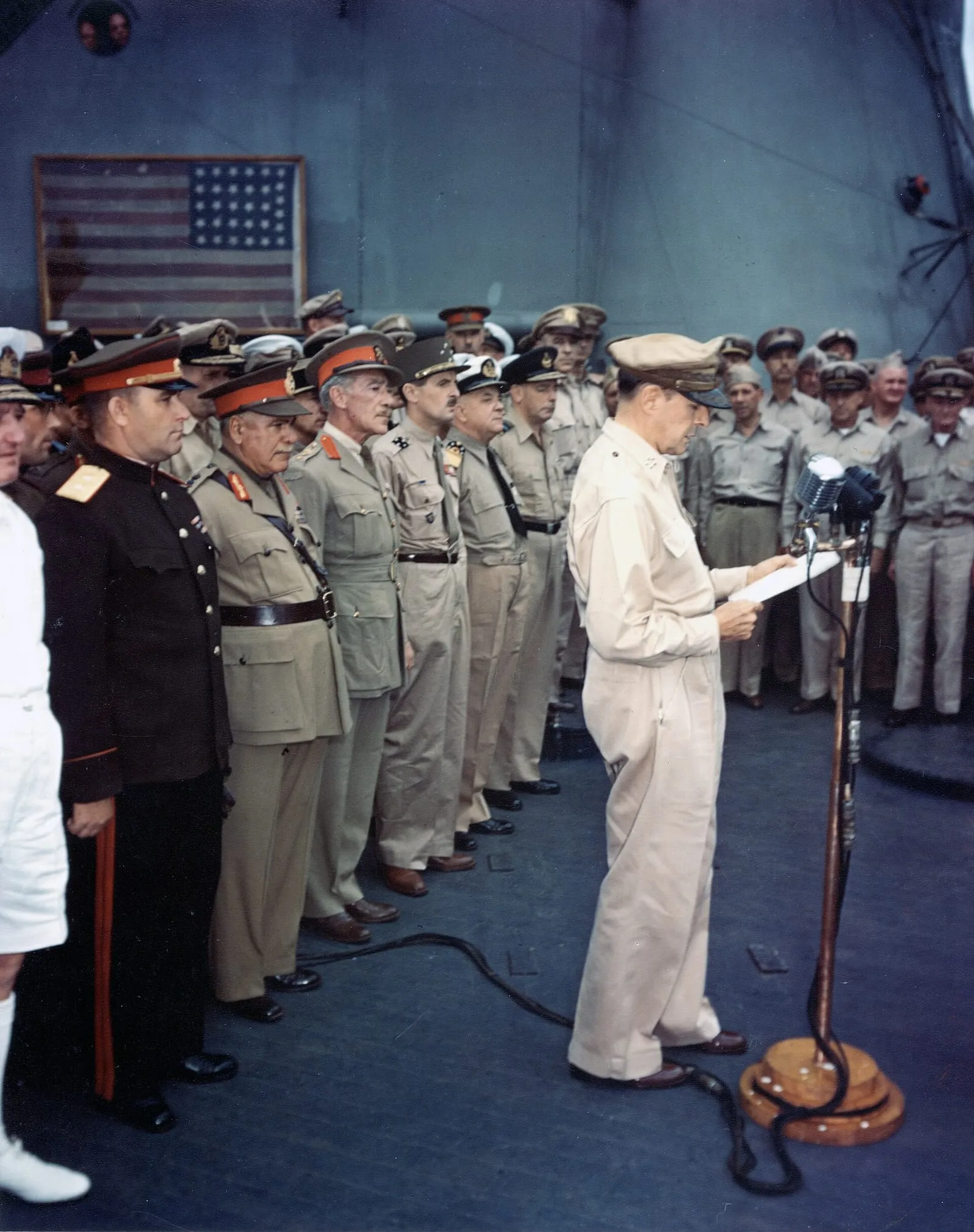
On the overcast Sunday morning of 2 September 1945, aboard the battleship USS Missouri, anchored in Tokyo Bay, Japan’s representatives signed the instrument of unconditional surrender. Foreign Minister Mamoru Shigemitsu signed on behalf of the Emperor and the government, and the Chief of the Army General Staff, General Yoshijirō Umezu, on behalf of Imperial General Headquarters. The surrender was accepted by General Douglas MacArthur as Supreme Commander for the Allied Powers, after whom representatives of nine Allied nations signed. According to US Navy records, the ceremony began at around 9.02 a.m. Tokyo time and ended at 9.25 a.m.
This act formally ended the Second World War – six years and one day after Germany’s attack on Poland and more than eight years after the Marco Polo Bridge Incident, which had begun open war between Japan and China. Fighting still went on in places, and the regional surrenders of Japanese armies dragged on over the following weeks, but for most of the Allies 2 September became the date on which the war ended. Four months earlier, on 8 May, the surrender at Karlshorst had ended the war in Europe.
The road to Tokyo Bay
Emperor Hirohito had announced the decision to surrender to his subjects in a radio broadcast on 15 August. Japan had then accepted the terms of the Potsdam Declaration of 26 July, but the surrender still had to be formalised. President Harry Truman appointed MacArthur Supreme Commander for the Allied Powers (SCAP), and on 17 August approved General Order No. 1, which specified to which Allied commanders the Japanese forces in each area were to surrender. On 19 August a Japanese delegation flew to Manila, where MacArthur’s staff handed it the draft instrument of surrender and the plan for the arrival of the occupation forces. The text had been prepared by a team under Colonel LeGrande Diller; according to American accounts, even suitable paper was hard to come by in ruined Manila.
At the end of August Admiral William Halsey’s Third Fleet entered Tokyo Bay, and on 30 August MacArthur landed at Atsugi airfield and took up residence in Yokohama. Halsey’s flagship was chosen as the venue for the ceremony. The Missouri bore the name of Truman’s home state, and in January 1944 the ship had been christened by the daughter of the then senator, Margaret Truman. Around the battleship, according to various tallies, some 250 Allied warships – American, British, Australian, New Zealand and Dutch – lay in the bay.
On the Japanese side, finding signatories proved difficult. The prime minister, Prince Naruhiko Higashikuni, could not sign the surrender as a member of the imperial family, and Prince Fumimaro Konoe refused. The task was accepted, only at the Emperor’s personal request, by Shigemitsu, who since mid-August had once again been in charge of foreign policy, and by Umezu. According to Japanese accounts, the general regarded signing the surrender as a humiliation and agreed solely out of obedience to the Emperor. The delegation was completed by nine army and navy officers and diplomats, among them Toshikazu Kase of the Foreign Ministry, who later wrote a report for the Emperor on the course of the ceremony.
The ceremony on deck
The eleven members of the delegation left Tokyo by car early on the morning of 2 September, driving through suburbs devastated by bombing. At Yokohama they boarded the American destroyer USS Lansdowne, which took them out to the Missouri. On deck the Allied commanders were already waiting, hundreds of sailors had clambered onto the superstructure and the gun barrels, and radio microphones and cameras had been set up around a table covered with green baize. The ceremony was broadcast around the world; the colour film shot that day by the navy cameraman George Kosco was made public only in 2010.
Shigemitsu, who had lost a leg in a bomb attack in Shanghai in 1932, climbed the gangway with difficulty, on an artificial leg and with a cane. He wore a morning coat and top hat; Umezu and the officers were in uniform, unarmed. On the bulkhead of the superstructure hung, in a frame, an old American flag with 31 stars. According to the US Navy, it was the ensign under which Commodore Matthew Perry’s squadron had sailed into Tokyo Bay in 1853–1854, forcing Japan to open its ports and to conclude the Convention of Kanagawa. It had been brought from the museum of the Naval Academy at Annapolis. Because the fabric was so fragile, it had been backed with lining and was displayed reverse side out. The often-repeated story that the Missouri also flew the flag that had flown over the White House or the Capitol on 7 December 1941 is unconfirmed. The ship’s commanding officer, Captain Stuart Murray, recalled that they were ordinary flags from the ship’s stores.
After a chaplain’s prayer and the national anthem, MacArthur stepped up to the microphone. In a short speech he said that the issues between differing ideals and ideologies had been “determined on the battlefields of the world” and were no longer a matter for discussion. He expressed the hope that out of this solemn occasion “a better world shall emerge”, founded upon faith and understanding and dedicated to the dignity of man and to his wish for freedom, tolerance and justice. He also announced that, as Supreme Commander, he would carry out the terms of surrender “with justice and tolerance”, but firmly.
He then called on the Japanese to sign. At 9.04 a.m. Shigemitsu signed “by command and in behalf of the Emperor of Japan and the Japanese Government”. According to witnesses, for a moment he did not know where to sign, and MacArthur told his chief of staff, General Richard Sutherland, to show him. Two minutes later Umezu signed “by command and in behalf of the Japanese Imperial General Headquarters”. Each signatory signed two copies: one bound in leather for the Allies and one bound in canvas for the Japanese.
At 9.08 a.m. MacArthur signed as Supreme Commander for the Allied Powers. Behind him stood two generals who had been forced to surrender to the Japanese in 1942 and had survived more than three years of captivity: Jonathan Wainwright, the defender of Corregidor, and Arthur Percival, the commander at Singapore. MacArthur used several pens. According to tradition, he gave the first to Wainwright and the second to Percival.
The Allied signatories
After MacArthur, the representatives of the individual nations signed. At 9.12 a.m. Fleet Admiral Chester Nimitz, commander of the Pacific Fleet, signed for the United States, with Halsey and Admiral Forrest Sherman standing beside him. Then came General Xu Yongchang for China – the country that had fought Japan the longest; Admiral Bruce Fraser, commander of the British Pacific Fleet, for the United Kingdom; Lieutenant General Kuzma Derevyanko for the Soviet Union, which had declared war on Japan only on 8 August; General Thomas Blamey for Australia; Colonel Lawrence Moore Cosgrave for Canada; General Philippe Leclerc for France; Admiral Conrad Helfrich for the Netherlands; and finally Air Vice-Marshal Leonard Isitt for New Zealand, at 9.22 a.m. Australia won the right to its own signature thanks to MacArthur’s support, against the original British idea that the dominions should appear as part of the United Kingdom’s delegation.
A mistake was made on the Japanese copy. Cosgrave signed one line lower than he should have – according to a common explanation, because he had been blind in one eye since the First World War. As a result, the subsequent signatories had to sign above the names of countries other than their own, and Isitt was left with no designated place and signed beneath the last line. The Japanese pointed out the irregularities. Sutherland therefore struck out the printed names of the countries, wrote them in by hand in the correct places and initialled the corrections, which the delegation accepted. That copy is now held by the Diplomatic Archives of the Japanese Foreign Ministry, and the Allied copy by the National Archives in Washington.
What Japan signed
The instrument of surrender was a short document in English. In it Japan accepted the terms of the Potsdam Declaration, issued on 26 July by the heads of government of the United States, China and the United Kingdom and later adhered to by the USSR. It proclaimed the unconditional surrender of Imperial General Headquarters, of all Japanese armed forces and of all forces under Japanese control, wherever they might be. It undertook to cease hostilities immediately and to preserve ships, aircraft and military and civilian property intact, and it required commanders at every level to surrender unconditionally. Civil and military officials were to obey the orders of the Supreme Commander, and all Allied prisoners of war and civilian internees were to be released at once and cared for.
The most important was the final sentence: the authority of the Emperor and the Japanese government to rule the state was to be subject to the Supreme Commander for the Allied Powers, who would take such steps as he deemed proper to carry out the terms of surrender. This did not decide the fate of the monarchy. Japan kept its Emperor and its own government, but it became an occupied country in which MacArthur had the last word. On the same day the Emperor issued a rescript ordering his subjects to comply with the instrument, and Imperial General Headquarters passed the text of General Order No. 1 to the armed forces.
“Today the guns are silent”
After the last signature MacArthur said: “Let us pray that peace be now restored to the world, and that God will preserve it always.” He then declared the proceedings closed. As the Japanese left the ship, hundreds of aircraft flew over the bay – carrier planes and heavy B-29 bombers from the Marianas. The figures given in accounts vary, from several hundred to more than 800 aircraft, including, according to some tallies, 462 B-29s. The fly-past was also a show of strength; during the ceremony the carriers kept aircraft at readiness in case of a kamikaze attack, which never came.
In a radio address broadcast from the ship, MacArthur said: “Today the guns are silent.” A great tragedy, he went on, had ended, and a great victory had been won. He remembered the fallen and called for the building of an order in which war would no longer be a means of settling disputes; he warned that in the age of the atomic bomb the next war might bring annihilation. Toshikazu Kase, according to his later recollections, wrote in his report to the Emperor that he had expected humiliation but had been struck by the magnanimity of the victors.
In Washington it was still the evening of 1 September when Truman addressed the nation. He proclaimed Sunday 2 September the official Victory over Japan Day (VJ Day) – the day of the formal surrender – while making clear that it was not yet the day for the formal proclamation of the end of the war. He also recalled Pearl Harbor, where America’s war had begun. In many Commonwealth countries, however, victory over Japan was celebrated on 14–15 August.
In the USSR, on 2 September, Joseph Stalin delivered an address in which he presented the victory as revenge for the defeat in the Russo-Japanese War: “We, the people of the older generation, have waited forty years for this day.” The Presidium of the Supreme Soviet of the USSR made 3 September a holiday celebrating victory over Japan and a day off work. It was kept as a day off, however, only for a short time. In China under Chiang Kai-shek, 3 September was likewise made the day of victory in the war against Japan.
Surrenders on the other fronts
The act signed in Tokyo Bay was a general one, and Japanese forces scattered from Manchuria to New Guinea laid down their arms before local Allied commanders. On 2 September itself, Vice Admiral George Murray accepted the surrender of the Caroline Islands aboard the cruiser USS Portland off Chuuk (Truk), and in the Philippines General Tomoyuki Yamashita came down from the mountains of the Cordillera Central. Further ceremonies followed over the next days in Baguio, Seoul, Nanjing, Singapore, Borneo and Hong Kong. In Nanjing on 9 September General Yasuji Okamura surrendered more than a million men of the China Expeditionary Army to the Chinese commander He Yingqin. In the Kuril Islands Soviet troops were completing the occupation of the islands in early September. Individual Japanese soldiers, cut off in the jungle, fought on for years.
The toll of the war
The war that ended aboard the Missouri was the bloodiest conflict in history. The exact number of victims cannot be established – documents are missing, the borders and populations of many states changed, and historians count deaths from war-induced famine and disease in different ways. The most commonly cited estimates speak of 70–85 million dead, although some studies give a more cautious “more than 60 million”. Most of the victims were civilians: killed in bombing raids and massacres, dead from hunger and exhaustion, murdered in camps. The Germans and their helpers murdered some six million Jews in the Holocaust.
According to historians’ estimates, the heaviest losses were suffered by the Soviet Union – official Russian figures speak of around 27 million – and by China, where the figures given range from well over ten million to more than 20 million, and official Chinese figures are higher still. Germany lost, according to various estimates, from around 6.5 million to more than 8 million people, Japan around 2.5–3.1 million, including hundreds of thousands of civilians in Hiroshima, Nagasaki and the burned-out cities. Millions died in Japanese-occupied South-East Asia – in Indonesia, Indochina and the Philippines – and in British Bengal the famine of 1943–1944, to which the war contributed, killed an estimated 2 to 3 million people.
Poland at the end of the war
Poland, the attack on which in September 1939 had begun the war in Europe, had no representative aboard the Missouri. The Polish government-in-exile had declared a state of war with Japan in December 1941, but Poles fought in the Pacific only as individuals, and by 1945 the great powers no longer recognised the London government. The toll was especially heavy for Poland. In 1947 the War Compensation Office gave a figure of around 6 million citizens of the Second Polish Republic killed. A 2009 study by the Institute of National Remembrance (IPN) estimates Poland’s human losses at 5.6–5.8 million, about half of them Polish Jews. To this were added the destruction of Warsaw and hundreds of other towns and the loss of the country’s elites, murdered by both occupiers.
Poland found itself in the camp of the victors, but the decisions of the Yalta Conference and of Potsdam shifted it westwards. It lost its eastern territories to the USSR and received former German lands, while power was held by communists dependent on Moscow. Hundreds of thousands of soldiers of the Polish Armed Forces in the West faced a choice between returning to such a country and emigration. For Poles, the end of the war did not mean the recovery of full independence.
Significance
The instrument of surrender closed the war but opened the period of its consequences. Japan faced several years of occupation, demilitarisation, reforms and a new constitution, and its leaders a trial before the International Military Tribunal for the Far East, in which both signatories from the Missouri, among others, sat in the dock. The state of war with most of the Allies was formally ended only by the Treaty of San Francisco, which came into force in 1952, and with the Soviet Union by the Joint Declaration of 1956. The dispute over the Kuril Islands continues to this day.
A new era was beginning for the world. The Charter of the United Nations, signed in June 1945, was meant to safeguard peace. At the same time the division of Europe and Korea between American and Soviet spheres of influence heralded the Cold War, and the return of the European powers to Asia foreshadowed wars for colonial independence. Atomic weapons meant that another world conflict could spell annihilation.
For the half-century history of wars in the Far East, 2 September 1945 is the end point. That history begins in 1895 with the assassination of Korea’s Queen Min by Japanese assassins, and leads through the Mukden Incident and Japanese expansion in Asia to Tokyo Bay, where half a century of Japanese conquest ended with a signature on the deck of an American battleship.
Sources
Meanwhile
(01)Elsewhere, within a week.
Related events
(04)The same battle, people or subject.
- 17 August 1945 · PacificGeneral Order No. 1On 17 August 1945 Truman approved General Order No. 1: to whom Japanese forces were to surrender, including the division of Korea at the 38th parallel.
- 16 August 1945 · PacificThe ceasefire orderOn 16 August 1945 Imperial General Headquarters ordered Japanese forces to cease fighting at once. Three princes were sent to the commands overseas.
- 8 August 1945 · Far EastThe USSR declares war on JapanOn 8 August 1945 Molotov handed Japan's ambassador a declaration of war. A few hours later, on 9 August local time, the Red Army entered Manchuria.
- 14 August 1945 · PacificThe last raids on JapanOn 14 August 1945 over a thousand US aircraft struck Japan in the last great B-29 operation; air combat still went on on 15 and 18 August.