- Category:
- Military operations
- Front:
- Eastern Front
- Date:
- 6 November 1943
- Author:
- Łukasz
- Battle:
- Battle of the Dnieper
- Tags:
- Red Army, Wehrmacht, Ukraine, Joseph Stalin
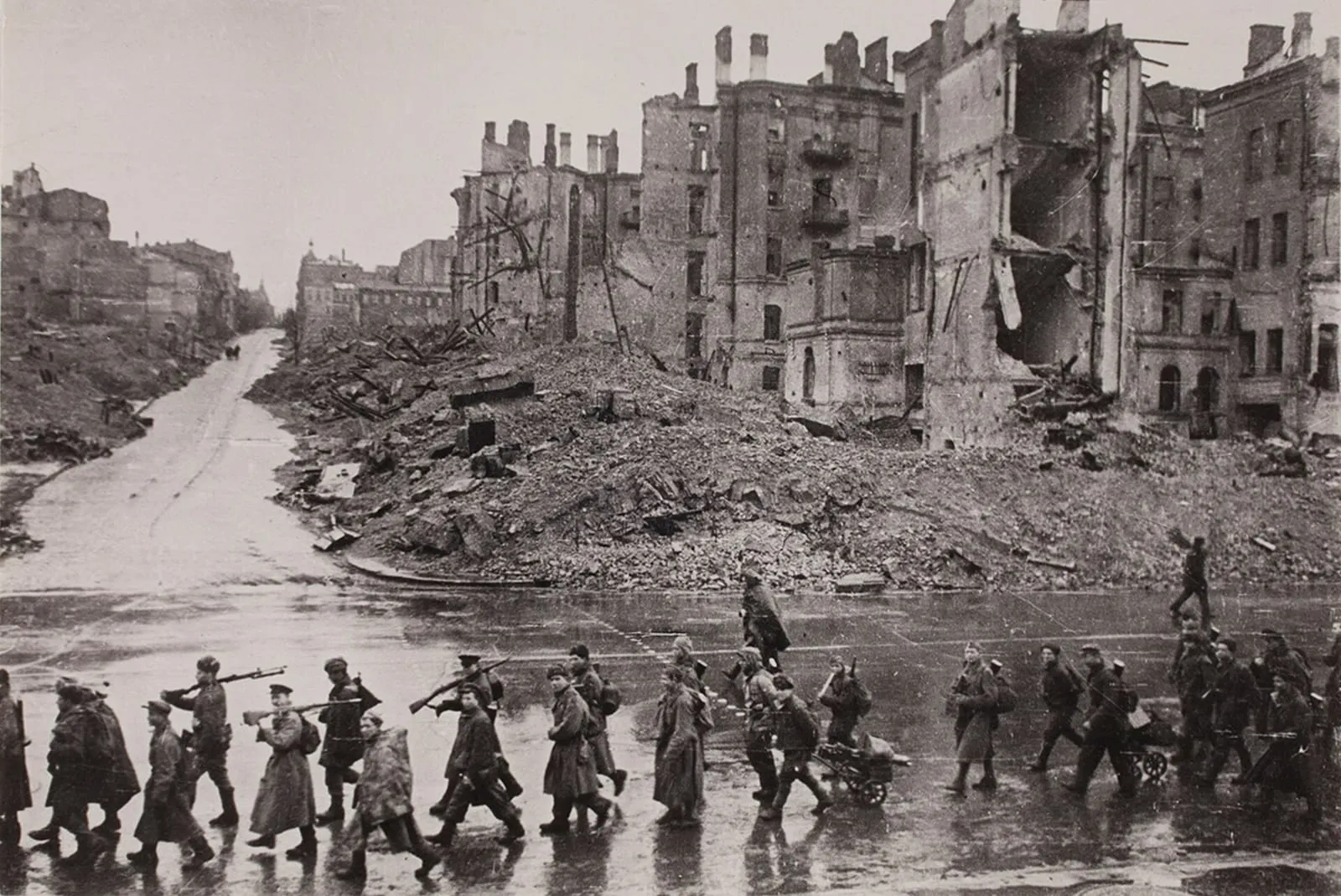
Early on the morning of 6 November 1943 units of General of the Army Nikolai Vatutin’s Soviet 1st Ukrainian Front took Kiev, capital of the Ukrainian SSR and the third-largest city of the Soviet Union. The German occupation, which had lasted since September 1941, ended after a three-day offensive from a small bridgehead near the village of Lyutezh, north of the city. That evening Moscow celebrated the capture of Kiev with an artillery salute, and Joseph Stalin announced it in his speech marking the anniversary of the revolution.
The capture of Kiev is usually linked with the anniversary of the October Revolution of 1917. This needs a small clarification: the anniversary – the twenty-sixth – fell on 7 November (25 October in the Julian calendar), and Kiev fell a day earlier, on its eve. It was no coincidence. Stalin wanted the city before the holiday, and the haste that Moscow forced on its commanders left its mark on the whole course of the autumn fighting on the Dnieper.
Kiev under occupation
German troops entered Kiev on 19 September 1941, after the greatest encirclement of the war, in which most of the Soviet South-Western Front was destroyed or captured. The occupation of the city was marked from the outset by destruction and atrocity. A few days after the Germans arrived, charges left behind by Soviet sappers and the NKVD exploded; the main street, the Khreshchatyk, burned down along with the adjoining blocks. The Germans used the explosions as a pretext: on 29 and 30 September 1941, in the ravine of Babi Yar on the outskirts of the city, Sonderkommando 4a and police battalions shot more than 33,000 of Kiev’s Jews. Over the following two years the ravine remained a place of execution for prisoners of war, hostages, members of the underground, Roma and psychiatric patients.
Kiev was the seat of civil government in name only – Rivne had been made the capital of the Reichskommissariat Ukraine – but under the occupiers it endured two winters of hunger. The Germans restricted food deliveries to the city and deported people from the countryside and the city for forced labour in the Reich. When in the autumn of 1943 the front approached the Dnieper, the occupation authorities declared the belt along the river a combat zone and ordered the population to leave a large part of the city. Before the war Kiev had had nearly 900,000 inhabitants; at the moment of liberation, according to the most frequently cited Soviet estimates, about 180,000 remained.
Bukrin and Lyutezh
After the Battle of Kursk the Red Army advanced along the whole length of the southern wing of the front. At the end of September Vatutin’s Voronezh Front reached the Dnieper north and south of Kiev and seized two bridgeheads on the right bank: a large one in a bend of the river near Velykyi Bukryn (the Bukrin bridgehead), some tens of kilometres south of the city, and a small one near Lyutezh and Vyshhorod to the north. On the lower Dnieper, meanwhile, the fighting for bridgeheads was under way that would bring the liberation of Dnipropetrovsk at the end of October; in the west the front had already moved beyond Smolensk.
The main blow against Kiev was originally to come from Bukrin. Twice, on 12–15 and 21–24 October, Vatutin’s armies – the 40th, the 27th and the 3rd Guards Tank Army – tried to break out from there, and twice they stalled. The bridgehead was cramped and cut by deep ravines, while the Germans held the heights above it and had the panzer divisions of XXIV Panzer Corps close at hand. The tanks had no room to deploy. On 20 October the Voronezh Front was renamed the 1st Ukrainian Front, and on 24 October the Stavka, acknowledging failure, ordered the main effort to be shifted north to the Lyutezh bridgehead.
There followed a regrouping that Soviet historiography later held up as a model. General Pavel Rybalko’s 3rd Guards Tank Army, together with a rifle corps and a breakthrough artillery corps, moved north from Bukrin – at night, under radio silence, crossing the Dnieper twice and the Desna once. Dummy tanks and guns were left in the abandoned positions, and radio stations continued to transmit as though nothing had changed. Some 2,000 guns and mortars and several hundred rocket launchers were brought up to Lyutezh; sappers built crossings, some of them just below the surface of the water so that they would be harder to spot from the air. According to Soviet historians the Germans were deceived; the war diary of the German 4th Panzer Army, however, shows that its command expected an attack from the north but did not know its strength or objectives.
The offensive from the Lyutezh bridgehead
To pin down the German reserves in the south, on 1 November the 40th and 27th Armies attacked from Bukrin again. They advanced little, but they did their job. On the morning of 3 November, after a powerful artillery preparation and strikes by the 2nd Air Army, the main offensive from the Lyutezh bridgehead began: General Kirill Moskalenko’s 38th Army with the 5th Guards Tank Corps struck straight at Kiev, while General Ivan Chernyakhovsky’s 60th Army covered its right flank to the west. Facing them was the German VII Army Corps of General Hermann Hoth’s 4th Panzer Army – a few badly depleted infantry divisions with scant armoured reserves.
On the first day the Soviet troops advanced 5–12 kilometres, and the leading division of the 38th Army reached the woods on the north-western outskirts of the city. The German defence did not crack at once, however; on 4 November the advance was slow, amid counter-attacks by German motorised infantry. That day Vatutin committed the 3rd Guards Tank Army and the 1st Guards Cavalry Corps. On the night of 4–5 November Rybalko’s tanks – driving, according to Soviet accounts, with headlights blazing and sirens wailing – broke through the positions around Sviatoshyn and cut the Kiev–Zhytomyr highway. At the same time, south of the city, one of the rifle divisions crossed the Dnieper near the village of Vita-Lytovska and reached the riverside road along which the Germans could have brought up reinforcements from Bukrin.
The threat of encirclement settled the matter. On 5 November the German command began evacuating Kiev along the road to Vasylkiv. Before leaving, sappers blew up bridges, depots and power stations, and buildings set on fire burned in the centre, among them the main building of the university. The Soviet troops who broke into the suburbs on the evening of 5 November now met mainly rearguards. By dawn they had passed through the whole city and reached the Dnieper. Vatutin and the member of the front’s military council Nikita Khrushchev reported to Stalin that Kiev was in Soviet hands; according to Soviet publications the report was sent at around 5 a.m. on 6 November.
Czechoslovaks in Kiev
Among the units of the 38th Army fought Colonel Ludvík Svoboda’s 1st Czechoslovak Independent Brigade, formed in May 1943 from veterans of the battalion that had fought at Sokolovo in the spring. It numbered more than 3,300 men; many of them were Rusyns and Ukrainians from what had been Czechoslovakia’s Subcarpathian Ruthenia, released from Soviet labour camps. The brigade, which had its own tank battalion, went into the attack on the afternoon of 5 November, passed through the western suburbs, and its soldiers were among the first to reach the city centre and the Dnieper. The brigade’s losses were light – according to Czech studies, a few dozen killed and missing and a few dozen wounded. The Czechoslovak part in the liberation of Kiev later became one of the pillars of the legend of the Czechoslovak forces in the east and of their ties with the Soviet Union.
A salute in Moscow
On 6 November Stalin issued an order of the day announcing the capture of “the capital of Ukraine”, naming the divisions singled out for distinction and ordering a salute in their honour. That evening Moscow fired 24 salvoes from 324 guns. The same day, at a ceremonial meeting marking the anniversary of the revolution, Stalin reviewed the year: from Stalingrad through Kursk to the Dnieper. Kiev was the most eloquent symbol of this turn. For the crossing of the Dnieper in the autumn of 1943 more than two thousand soldiers, many of them from the Kiev sector, received the title of Hero of the Soviet Union.
The city after liberation
The soldiers and the first arrivals found a devastated, almost empty city. The ruins of the Khreshchatyk had stood since the autumn of 1941; hundreds of buildings blown up or set on fire during the retreat also lay in ashes, along with many of the Dnieper bridges and industrial plants. In the grounds of the Kiev Pechersk Lavra lay the rubble of its main church, the Cathedral of the Dormition, blown up in November 1941 in circumstances that have never been fully explained. Those inhabitants who had survived emerged from cellars and hiding places in the suburbs, where they had fled to escape deportation.
It soon came to light what had happened at Babi Yar in the last months of the occupation. In the summer of 1943, as part of the secret Aktion 1005 directed by Paul Blobel, the Germans had begun erasing the traces of their crimes. From August some 300 prisoners from the nearby Syrets camp, in chains, dug up the mass graves, stacked the corpses on pyres of rails and timber and burned them; the bones were crushed and the ashes scattered. On the night of 28–29 September the prisoners, knowing that they would be killed once the work was done, attempted to escape. Most were killed, but a dozen or so got away. After the liberation they gave evidence to Soviet investigators, and in November a group of Western correspondents was taken to the site. The Soviet commission investigating the occupiers’ crimes, however, spoke of murdered “peaceful Soviet citizens”, passing over in silence the fact that those killed at Babi Yar had been above all Jews – a harbinger of the policy of silence that would last for decades.
The burdens of the new regime also fell on Kiev and its inhabitants. From the very first days the NKVD screened those who had lived through the occupation; people suspected of collaboration were arrested, and many men of military age were immediately conscripted into the army.
Manstein’s counter-stroke
The capture of Kiev was the beginning, not the end, of the operation. Vatutin immediately pushed west and south-west to cut the links between Army Group Centre and Army Group South. On 7 November Rybalko’s tanks took Fastiv, an important railway junction, where they beat off a counter-attack by the newly formed and inadequately trained German 25th Panzer Division. On 12 November Soviet troops entered Zhytomyr, and on 17 November Korosten. Within ten days the breach in the German front was 150 kilometres deep.
Erich von Manstein, commander of Army Group South, asked Hitler for reinforcements to retake Kiev. Hitler blamed the defeat on Hoth, who was soon sent on leave, and command of the 4th Panzer Army passed to Erhard Raus. Between Bila Tserkva and Fastiv Manstein assembled General Hermann Balck’s XLVIII Panzer Corps with several panzer divisions, including the Leibstandarte SS Adolf Hitler. From 15 November the corps struck the overextended flank of the 1st Ukrainian Front, retook Zhytomyr on 19 November and Korosten at the end of the month. The German counter-stroke, resumed in early December once the mud had frozen, brought local successes but neither recovered Kiev nor destroyed Vatutin’s forces. By 22 December the front had stabilised some tens of kilometres west of the city.
Its place in the war
According to the tally of losses compiled under the direction of Grigori Krivosheev, the Kiev offensive operation (3–13 November) cost the Red Army some 6,500 killed and missing and more than 24,000 wounded and sick, out of a strength of about 670,000 men. German losses are harder to establish; historians regard Soviet reports of destroyed equipment and enemy dead as inflated. The figures, however, do not convey the weight of the event. The loss of Kiev dashed German hopes of halting the front on the Eastern Wall, and the broad bridgehead west of the city became the starting point for a further advance.
The victory came three weeks before the Tehran Conference (28 November – 1 December 1943), where Stalin talked with Roosevelt and Churchill as the leader of a state that had been driving the Germans westwards without a break since Stalingrad. On 24 December the 1st Ukrainian Front broke out of the Kiev bridgehead in the Zhytomyr–Berdychiv operation. In early January 1944 its troops crossed the pre-war Polish–Soviet border near Sarny, and by the spring of 1944 almost the whole of Ukraine was in Soviet hands. Vatutin did not live to see all these victories: at the end of February 1944 he was badly wounded in an ambush by the Ukrainian Insurgent Army and died in April in a Kiev hospital; he was buried in the city he had liberated. Ludvík Svoboda later commanded the 1st Czechoslovak Army Corps and in 1968–1975 was President of Czechoslovakia. Kiev, rebuilt over the following years, was formally awarded the title of Hero City in 1965, together with the Order of Lenin and the Gold Star.
Sources
Meanwhile
(04)Elsewhere, within a week.
- 3 November 1943 · PolandOperation Harvest FestivalOn 3–4 November 1943 the SS and police shot about 42,000 Jews at Majdanek, Trawniki and Poniatowa – the last forced labourers of the Lublin region.
- 9 November 1943 · PoliticsDe Gaulle becomes sole President of the CFLNOn 9 November 1943 de Gaulle reshaped the Committee of National Liberation. Giraud left it, remaining only Commander-in-Chief of the French army.
- 9 November 1943 · Western FrontThe fake Le SoirOn 9 November 1943 the Belgian underground distributed in Brussels a fake issue of the collaborationist Le Soir, mocking German defeats in the east.
- 2 November 1943 · PacificThe Battle of Empress Augusta BayOn the night of 1–2 November 1943 Admiral Merrill's cruisers drove back a Japanese force bound for the Bougainville beachhead. The Japanese lost two ships.
Related events
(04)The same battle, people or subject.
- 25 October 1943 · Eastern FrontThe liberation of DnipropetrovskOn 25 October 1943 troops of Malinovsky's 3rd Ukrainian Front took ruined Dnipropetrovsk and Dniprodzerzhynsk on the lower Dnieper.
- 16 December 1943 · Eastern FrontThe Eastern Front in mid-December 1943In mid-December 1943 the Red Army was eliminating the Gorodok salient, holding the Kiev bridgehead against Manstein and preparing a winter offensive in Ukraine.
- 26 November 1943 · Eastern FrontThe liberation of GomelOn 26 November 1943 Rokossovsky's Belorussian Front took the ruined city of Gomel, the first Belarusian regional centre recaptured from the Germans.
- 28 January 1944 · Eastern FrontThe Korsun pocketOn 28 January 1944 tanks of the 1st and 2nd Ukrainian Fronts met at Zvenyhorodka, trapping two German corps – some 56,000–60,000 men – near Korsun.