Soviet Union
Ivan Chernyakhovsky
Commander of the 28th Tank Division (1941), the 60th Army (1942–1944) and the 3rd Belorussian Front (1944–1945), General of the Army (from 1944), twice Hero of the Soviet Union
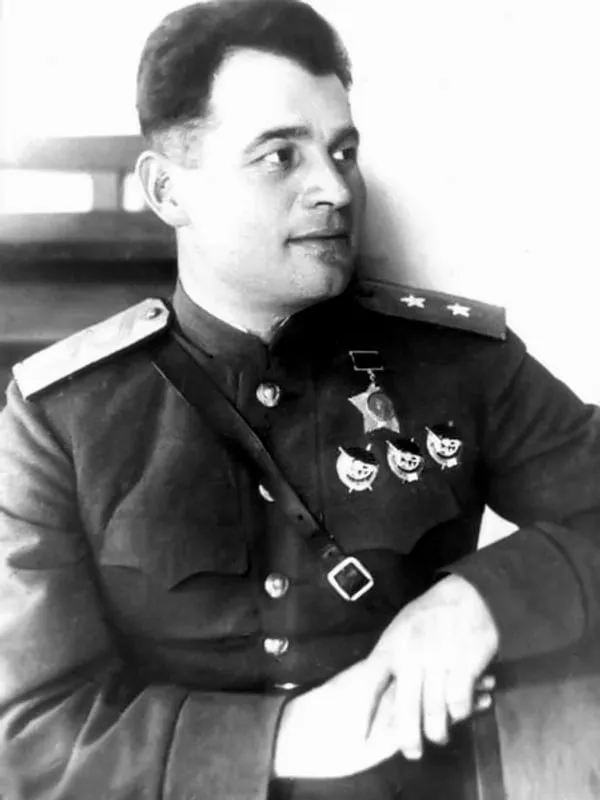
- Born:
- 29 June 1907, Oksanino near Uman (Russian Empire)
- Died:
- 18 February 1945, Pieniężno (Mehlsack, East Prussia)
- Author:
- Natalia
- Photo:
- autor nieznany, domena publiczna, Wikimedia Commons

Ivan Chernyakhovsky was the youngest front commander in the history of the Red Army and one of the fastest-rising generals of the German–Soviet war. A Ukrainian orphan from a railwayman’s family, in 1941 he commanded a tank division that was destroyed in the first days of the war; in 1943 his 60th Army took Kursk and forced the Dnieper; and from the spring of 1944 he led the 3rd Belorussian Front through Vitebsk, Minsk, Wilno and Kaunas all the way to East Prussia. At 36 he held the rank of General of the Army and two Gold Stars of a Hero of the Soviet Union. He was killed on 18 February 1945 near Pieniężno, struck by a shell splinter. In Russia he remains one of the heroes of the war; in Lithuania and Poland he is also associated with the disarming and arrest of soldiers of the Home Army near Wilno in July 1944.
Childhood and the road to the army
He was born on 29 June 1907 (16 June by the Julian calendar) in the village of Oksanino near Uman, in what was then Kiev Governorate; some sources give the year as 1906. He was Ukrainian, the son of a railwayman who, after returning from the front in the First World War, worked as a steward on an estate in Podolia. In the spring of 1919, during the Civil War, both his parents died of typhus, leaving six children orphaned. Ivan abandoned his studies at a railway school and herded cows, and in 1921 he set up a Komsomol cell in the village whose members fought in special-purpose units (ChON) against anti-Bolshevik bands in the surrounding forests. He then worked on the railway and at a cement works in Novorossiysk.
In 1924 he volunteered for the Red Army. He attended the infantry school in Odessa, and in 1928 graduated from the artillery school in Kiev and joined the Bolshevik party. He served for several years in the artillery in Ukraine, and in 1931–1936 studied in Leningrad and Moscow in the mechanisation faculty from which the Military Academy of Mechanisation and Motorisation was formed. While he was a student he was denounced for having “concealed his social origins” as the son of an estate steward; the affair did not interrupt his career. He graduated from the academy with distinction and moved to the armoured forces.
Like many officers of his generation, he rose rapidly into posts left vacant by the Great Purge. In 1937 he commanded a tank battalion, in 1938 an independent light tank regiment in Belarus, and in 1940 he was deputy commander of the 2nd Tank Division in the Baltic Special Military District, created on the territory of newly occupied Lithuania. On 11 March 1941, aged 33, he took command of the 28th Tank Division of the 12th Mechanised Corps.
1941–1942: from Šiauliai to Voronezh
After the German attack on the USSR, the 28th Tank Division, equipped mainly with obsolete BT-7 light tanks, took part in the North-Western Front’s counter-attacks south-west of Šiauliai on 23–25 June 1941, during the Battle of Raseiniai. The counter-attack ended in defeat and the division lost almost all its tanks, but its remnants withdrew in good order through Latvia to the Daugava and on towards Novgorod. In the summer of 1941 it fought as infantry near Soltsy and Novgorod, and in December it was re-formed as the 241st Rifle Division. Chernyakhovsky was made a colonel, and in the winter of 1941/1942 his division took part in encircling the German grouping at Demyansk. On 5 May 1942, not yet 35, he became a major general.
In June 1942 he took over the 18th Tank Corps and, thrown with it into the fighting at Voronezh in the first days of the German summer offensive, tried to halt the advance on the city. On 26 July 1942 the Stavka gave him the 60th Army of the Voronezh Front, which was defending the bridgehead and the outskirts of Voronezh. He commanded it for almost two years.
The 60th Army: Kursk, the Dnieper and Ukraine
In the winter of 1943, in the offensive that followed the encirclement of the German forces at Stalingrad, Chernyakhovsky’s army took part in the Voronezh–Kastornoye operation and the liberation of Voronezh, and then, outpacing its neighbours, struck swiftly across the snow-covered steppe and on 8 February 1943 took Kursk – the city the Germans had captured in November 1941. On 14 February 1943 he was promoted to lieutenant general. In the summer of 1943 the 60th Army, by then part of Konstantin Rokossovsky’s Central Front, held the western face of the Kursk salient and in the Battle of Kursk was not at the centre of the German attack.
Fame came to him in the autumn of 1943. At the end of August, in the Chernigov–Pripyat operation, the 60th Army was supposed to deliver a supporting attack on a secondary axis, but it broke through the weak German defences and drove westwards: on 30 August it took Glukhov, and within three weeks it covered more than 200 kilometres, through Konotop and Nezhin towards the Dnieper. Rokossovsky, having assessed the situation on the spot, shifted the main effort of the whole front into its sector. At the end of September the army’s units forced the Dnieper and the Pripyat north of Kiev. In the Battle of the Dnieper and the liberation of Kiev on 6 November 1943, by then as part of the 1st Ukrainian Front, the 60th Army covered the right flank of the attack on the city from the west. By a decree of 17 October 1943 Chernyakhovsky was made a Hero of the Soviet Union for the crossing of the Dnieper.
In the winter and spring of 1944 his army fought in the Zhitomir–Berdichev and Rovno–Lutsk operations, and on 4 March 1944, together with the 1st Guards Army, it opened the Proskurov–Chernovtsy offensive, which carried the 1st Ukrainian Front all the way to the foothills of the Carpathians. In March 1944 Chernyakhovsky became a colonel general.
The 3rd Belorussian Front: Vitebsk, Minsk, Wilno
In April 1944 Joseph Stalin gave Chernyakhovsky the Western Front, renamed the 3rd Belorussian Front on 24 April. He was 36 and the youngest front commander in the Red Army. In Operation Bagration, launched on 22–23 June 1944 and coordinated in his sector by Marshal Aleksandr Vasilevsky, the 3rd Belorussian Front, together with Ivan Bagramyan’s 1st Baltic Front, struck at Vitebsk, which was encircled and taken on 26–27 June, while its left wing took Orsha and opened the road to Minsk. Pavel Rotmistrov’s 5th Guards Tank Army crossed the Berezina and on 3 July, together with troops of the 1st Belorussian Front, entered Minsk, closing a pocket that held more than 100,000 German soldiers. On 28 June, in the course of the operation, Chernyakhovsky was promoted to General of the Army.
The next objective was Wilno (Vilnius). From 7 July units of the Home Army’s Wilno and Nowogródek Districts were fighting for the city in Operation Ostra Brama, and Chernyakhovsky sent against it the 5th Army of General Nikolai Krylov and Rotmistrov’s tank army; after heavy street fighting Wilno was taken on 13 July. Immediately afterwards came the episode that shapes how he is remembered in Poland. The commander of the Home Army’s Wilno District, Lieutenant Colonel Aleksander Krzyżanowski (“Wilk”), was holding talks with the front command on further cooperation; according to the Polish participants, Chernyakhovsky received him and agreed that a Polish division would be re-formed from the Home Army units, and the Polish units were concentrated on the edge of the Rudniki Forest. Meanwhile the Deputy People’s Commissar for Internal Affairs, Ivan Serov, arrived in Wilno with NKVD troops. On 17 July “Wilk”, invited to talks at Bogusze near Wilno, was arrested there together with his chief of staff; that evening most of his officers were detained near Wołkorabiszki, and over the following days NKVD and front troops surrounded and disarmed thousands of Home Army soldiers. According to Serov and Chernyakhovsky’s report to Stalin, more than 6,000 men were disarmed within a few days, of whom some 4,000 were sent to the camp at Miedniki Królewskie; Lavrentiy Beria reported a total of 7,924 detained. The operation was planned in Moscow and carried out by Beria’s men, but the front commander took part in it and co-signed the report – Polish historiography holds him, alongside Serov, responsible for the deception that ended Operation Tempest in the Wilno region.
Kaunas and the Prussian border
The front pressed on to the Niemen: on 16 July it took Grodno, and on 1 August it captured Kaunas. On 29 July 1944 Chernyakhovsky received his second Gold Star as Hero of the Soviet Union for Vitebsk, Minsk and Wilno. On 17 August divisions of his 5th Army reached the border of East Prussia on the Šešupė – the first time in this war that Soviet troops had stood on the frontier of the Reich. In the autumn the front supported the drive to the Baltic, and on 16 October it launched the Gumbinnen–Goldap operation, the first attempt to break deep into East Prussia. After two weeks the attack came to a halt before Gumbinnen; it was in its sector, at Nemmersdorf, that Soviet soldiers killed – according to the research of Bernhard Fisch – between 19 and about 30 civilians, which German propaganda publicised and exaggerated.
East Prussia and death
On 13 January 1945 Chernyakhovsky’s armies went over to the attack between Pillkallen and Stallupönen, opening the East Prussian operation. On the first day they penetrated the German defences by only 2–3 kilometres; only when the front commander shifted the weight of the attack to the 39th Army’s flank and committed the 1st Tank Corps and the 11th Guards Army to the breach did the defence of the 3rd Panzer Army crack. Tilsit fell on 19–20 January, then Gumbinnen, and on the night of 21–22 January Insterburg. By the end of January the troops of the 3rd Belorussian Front had reached Königsberg and cut it off from Samland, while Rokossovsky’s 2nd Belorussian Front, which reached the Vistula Lagoon near Tolkmicko on 26 January, sealed off East Prussia from the west. Behind the front the flight of the civilian population was under way, delayed by Erich Koch’s ban on evacuation, and the violence of Soviet soldiers against Germans – killings, rapes and looting – became one of the darkest chapters of the campaign.
In February Chernyakhovsky’s front was tightening its grip on the German Fourth Army grouping, pinned against the Vistula Lagoon around Lidzbark Warmiński, Pieniężno and Braniewo. On 18 February 1945 the general was driving to the command post of General Alexander Gorbatov’s 3rd Army. At a road junction on the edge of Pieniężno (Mehlsack) a single artillery shell exploded beside his car. According to Gorbatov’s account there were five people in the car, and a splinter struck only the front commander – in the chest. He died shortly afterwards at a nearby medical battalion. Unconfirmed versions also circulated of a shot fired from a Soviet tank in revenge; most historians regard a stray German shell as the most likely explanation. Command of the 3rd Belorussian Front passed to Marshal Vasilevsky, who in April brought about the capture of Königsberg.
Chernyakhovsky was buried with military honours in Wilno, in one of the city’s central squares, which was named after him. In 1946 Insterburg was renamed Chernyakhovsk.
Memory
In the Soviet Union Chernyakhovsky was held up as the model of a young, educated commander whose career had been complicated neither by defeats nor by post-war intrigues in the Kremlin; a town, streets and schools bore his name. In Lithuania and Poland he is remembered differently. In Wilno a monument by Nikolai Tomsky stood over his grave. After Lithuania regained independence, the authorities regarded the grave and the monument as a symbol of Soviet occupation: on 19 November 1991 the general’s remains were moved to Moscow and reburied in the Novodevichy Cemetery, and the dismantled monument was taken to Voronezh, where it was unveiled again in May 1993.
In Pieniężno, where he died, there stood a Soviet monument to the general. In 2014 the town authorities decided to remove it, on the grounds that for Poles it was a symbol of communism and Sovietisation; the disarming of the Wilno Home Army was also recalled in the debate. The monument was dismantled on 17 September 2015, the 76th anniversary of the Soviet invasion of Poland. Russia protested strongly. These two ways of remembering him cannot be reconciled: to some Chernyakhovsky was the young victor of Vitebsk, Wilno and Königsberg; to others he was the commander of an army that drove out the Germans but brought a new occupation to Lithuania and the Wilno region, and the general who talked with “Wilk” before the NKVD arrested him.
Sources
Commanded in battles
(02)Mentioned in battles
(01)Often appears with
People who appear in the same events.