- Category:
- Crimes and repression
- Date:
- 28 September 1941
- Author:
- Łukasz
- Tags:
- Holocaust, Soviet Union, Third Reich, Wehrmacht
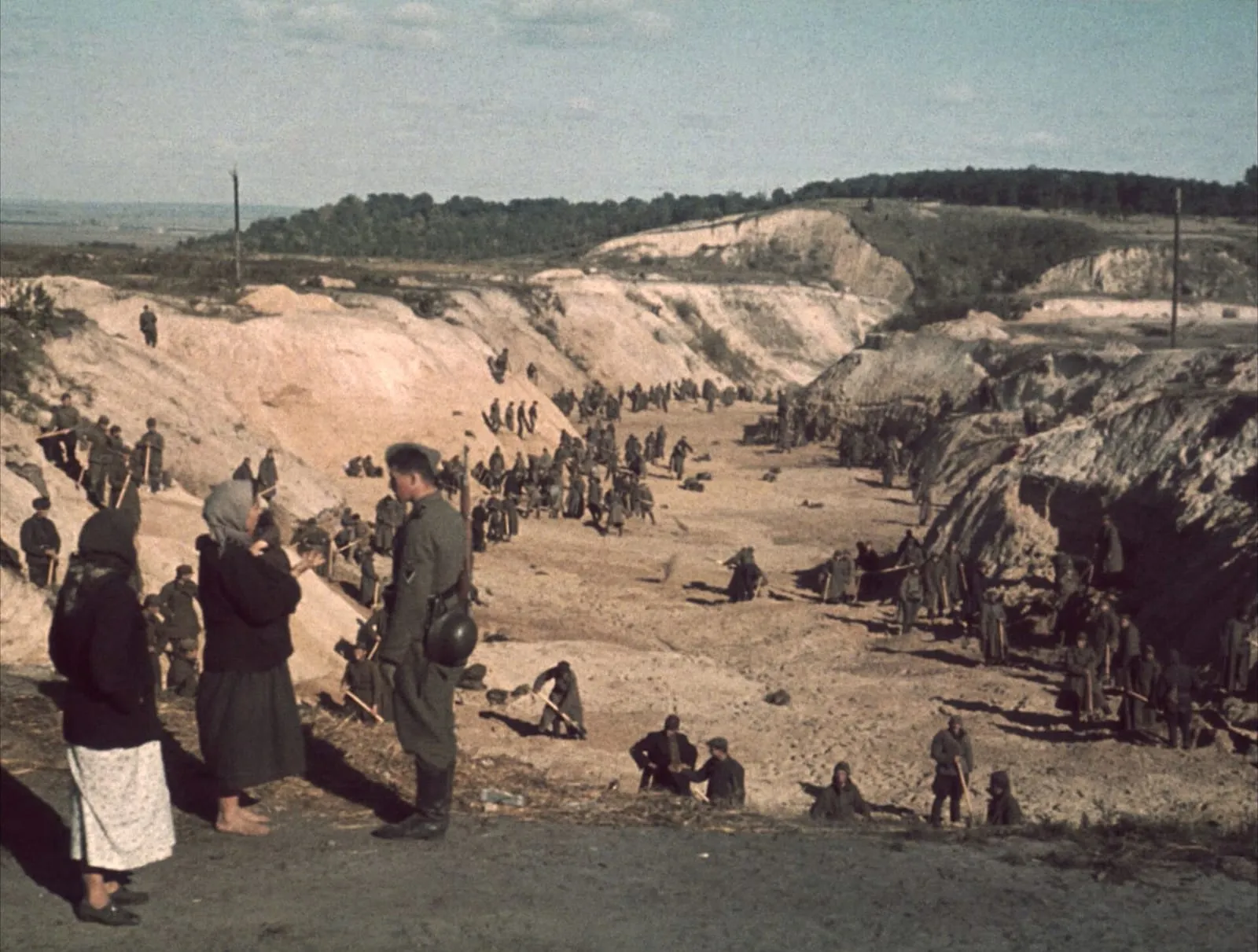
On Sunday 28 September 1941, nine days after the Germans entered Kiev, posters in Russian, Ukrainian and German appeared on the walls of the city. They ordered all the Jews of Kiev and its environs to report the next day, Monday 29 September, by 8 a.m. at the corner of Melnykova and Dehtiarivska streets, near the cemeteries. They were to bring documents, money, valuables, warm clothing and underwear. Failure to appear was punishable by death. Those who obeyed the summons, mostly women, children and the elderly, believed they were to be resettled. From the assembly point they were led to the ravine of Babi Yar on the edge of the city. For two days, 29 and 30 September, Paul Blobel’s Sonderkommando 4a of Einsatzgruppe C and battalions of the German Order Police shot them there with automatic weapons. According to the Einsatzgruppe’s own report, 33,771 people were killed. It was the largest single massacre of Jews since the start of the war, and Babi Yar remains to this day one of the symbols of the Holocaust.
It is often said that SS units killed more than 30,000 Jews “in retaliation for acts of sabotage which the Germans attributed to the local Jews”. That formulation repeats the German pretext, not the cause of the crime. The explosions that had been destroying the centre of Kiev since 24 September were the work of mines laid by Soviet sappers and the NKVD before the retreat, not of local Jews; the Germans knew this or could easily have guessed it. The murder of the Jews of Ukraine, moreover, had been going on for weeks regardless of any explosions. The question of who carried it out also needs qualifying: besides the SS and the Security Police, German policemen of the Ordnungspolizei battalions did the shooting, Wehrmacht soldiers secured the area, and the Ukrainian auxiliary police assisted. The decision itself was taken at a meeting attended by the city’s military commandant.
A crime foretold
From the first day of the German attack on the USSR four Einsatzgruppen – task forces of the Security Police and SD under Reinhard Heydrich – followed the troops. In the south, in the zone of Army Group South, operated SS-Brigadeführer Otto Rasch’s Einsatzgruppe C. One of its units was Sonderkommando 4a, made up of several dozen SD and Security Police men reinforced by a Waffen-SS company and a police platoon, and commanded by SS-Standartenführer Blobel, an architect by profession from Solingen. In the summer of 1941 this unit murdered Jews in Łuck (Lutsk), Zhytomyr, Berdychiv and dozens of small towns in western Ukraine. As near Wilno, the killers at first targeted mainly Jewish men, communists and people deemed “suspicious”. From August, when Heinrich Himmler reinforced the killing forces with SS brigades and police battalions and Hermann Göring authorised Heydrich to prepare a “total solution of the Jewish question”, entire communities began to be murdered, women and children included.
In Ukraine this turning point is associated with the name of Friedrich Jeckeln, Higher SS and Police Leader attached to Army Group South. At the end of August his staff and the police battalions under him murdered more than 23,000 Jews at Kamianets-Podilskyi, including Jews expelled from Hungary. In the same days Blobel’s men shot the Jewish adults of Bila Tserkva and then, with the approval of the commander of the 6th Army, Field Marshal Walter von Reichenau, some 90 children they had orphaned. In mid-September more than ten thousand Jews of Berdychiv were killed, and on 19 September Sonderkommando 4a liquidated the ghetto in Zhytomyr, killing more than three thousand people. When the Wehrmacht entered Kiev, the murder of its Jewish inhabitants was thus, for the SS and police, another task of the same kind – only on an unprecedented scale.
Kiev in September 1941
Before the war Kiev was the third-largest city of the USSR and one of the largest concentrations of Jews in Europe. According to the United States Holocaust Memorial Museum, some 160,000 Jews lived there, roughly a fifth of the population; other studies give higher figures, up to about 220,000. Most had managed to flee before the Germans arrived or had been evacuated together with their workplaces, and men of military age had been drafted into the Red Army. Some 50,000–60,000 Jews, by various estimates, remained in the city, mostly elderly people, women and children, as well as those who had nowhere to go or no means to leave. Many of the older people remembered the German occupation of 1918 as a time of relative calm and did not believe rumours of killings.
The city fell after the great Battle of Kiev. Joseph Stalin had forbidden to the last the withdrawal of the South-Western Front, whose armies the armoured pincers of Heinz Guderian and Ewald von Kleist closed in a gigantic pocket east of the Dnieper. On 19 September units of the German 6th Army entered Kiev. Generalmajor Kurt Eberhard, commander of Field Command 195, became the city’s commandant. In the very first days of the occupation arrests and shootings of individual Jews, communists and prisoners of war began, and the staff of Einsatzgruppe C and Sonderkommando 4a arrived in the city.
The explosions on Khreshchatyk
Before leaving the city, Soviet sappers and NKVD groups had mined dozens of buildings in the centre where German headquarters and offices were expected. The first explosion came on 20 September in the old citadel by the Pechersk Lavra, where German headquarters had been set up. On the afternoon of 24 September a building blew up at the corner of Khreshchatyk, Kiev’s main street, and Prorizna Street, which according to most accounts housed the German field command. In the following days more mines exploded, some reportedly detonated remotely by radio signal, and fires that the fire brigade, deprived of water, could not control consumed almost the whole of Khreshchatyk and the neighbouring blocks. According to a German report from early October, some 50,000 people were left homeless. How many died is not known; the victims included German soldiers and sappers, but also many of the city’s inhabitants.
The Germans immediately gave these events a political meaning. Since the start of the war their propaganda had identified Jews with “Bolshevism”, so the explosions could easily be presented as “Jewish sabotage”, although nothing pointed to the involvement of local Jews. On 26 September a meeting was held at the city commandant’s headquarters, attended, according to historians’ findings, by Eberhard, Jeckeln, Rasch and Blobel. It was decided, by way of reprisal, to kill the Jews of Kiev. The operation was to be carried out by Sonderkommando 4a with the staff of Einsatzgruppe C, under the overall direction of Jeckeln. Far from protesting, the Wehrmacht took part: one of the Sonderkommando’s officers, August Häfner, testified after the war that Eberhard told the SS men bluntly, “You will have to do the shooting.” In its report to Berlin, Einsatzgruppe C noted that the Wehrmacht “welcomes these measures and asks for radical action”. The 6th Army’s propaganda company printed some two thousand posters, and soldiers were assigned to secure the area. Historians who have studied the crime, such as Hartmut Rüß and Karel Berkhoff, stress that the decision was a joint one and that it could not have been carried out without the army.
The summons of 28 September
The posters were put up on Sunday 28 September; according to some accounts the first appeared a day earlier. The text began not with the ordinary word for “Jews” but with a contemptuous Russian term once used by the tsarist authorities and by pogromists. At the same time, rumours of a census and resettlement were spread through caretakers and building managers. The assembly point, near the goods station and the cemeteries of Lukianivka, lent credibility to the story of deportation by rail. Many Jews, even if they sensed the worst, saw no way out: hiding required the help of neighbours, and the poster also threatened death to anyone who entered the abandoned flats. Some non-Jews accompanied relatives and spouses from mixed families to the assembly point, and some went along with them.
The Germans themselves had not expected such a response. Einsatzgruppe C later reported that it had counted on 5,000–6,000 Jews turning up, but more than 30,000 came, who “until the moment of their execution believed in resettlement, thanks to exceptionally skilful organisation”.
29 and 30 September
From dawn on 29 September thousands of people moved through the streets of Kiev towards Lukianivka with bundles, prams and children in their arms. At the Jewish cemetery the crowd came up against a cordon and a barbed-wire barrier. Beyond it small groups were let through. Ukrainian policemen and German officials took their luggage, ordered them to hand over valuables and strip naked, and beat with truncheons those who hesitated. The driver of a lorry from the unit that carted away the victims’ belongings later testified that everything happened very quickly. The naked people were driven between lines of guards into the ravine, a long gully a dozen or more metres deep. At the bottom they were made to lie face down on the bodies of those already killed, and the gunmen, walking over the corpses, killed them with a shot in the back of the neck from a submachine gun. The bodies lay in layers, periodically covered with earth. Those who could not be killed on the first day were locked overnight in nearby garages and shot the next day. When the executions were over, Wehrmacht sappers blew up the sides of the ravine to bury the corpses; the wounded who were still alive were buried along with them.
The shooting was done by members of Sonderkommando 4a and of Major Martin Besser’s Police Battalion 45 of Police Regiment South; men of Police Battalion 303 formed the cordon. Also taking part were the 3rd Company of the Waffen-SS Special Purpose Battalion and the Ukrainian auxiliary police, whose members guarded the crowd, took away belongings and stripped the victims; the exact number of Ukrainians involved in the crime is hard to establish, and some later claims about the participation of particular nationalist units, such as the so-called Bukovinian Kurin, are disputed by historians. On 2 October, in Operational Situation Report USSR No. 101, Einsatzgruppe C reported that Sonderkommando 4a, together with the group staff and two detachments of Police Regiment South, had shot 33,771 Jews in Kiev on 29 and 30 September. This figure, which comes from the perpetrators, is today generally accepted by historians. According to some studies it does not include small children, who were killed together with their mothers. The clothing of the dead was loaded onto 137 lorries and handed over to the National Socialist welfare organisation, and some of the property was distributed among local ethnic Germans.
Only a few dozen people survived; at least 29 names are known. The most famous of them, Dina Pronicheva, an actress at the Kiev puppet theatre, jumped into the ravine just before a volley, pretended to be dead beneath the earth being shovelled over her and climbed out of the ravine at night. Her account was later written down by the writer Anatoly Kuznetsov, who as a boy had lived nearby and heard the shots, and in 1946 Pronicheva testified before a court in Kiev.
The ravine of death
Babi Yar did not cease to be a killing ground. At the beginning of October further groups of Jews rounded up in the city were shot there, and then, throughout two years of occupation, everyone the Germans regarded as enemies or as superfluous: Soviet prisoners of war, communists and members of the underground, hostages, Roma from several camps, patients of the Kiev psychiatric hospital. In January 1942 about a hundred sailors of the Soviet river flotilla were murdered there. In February 1942 the Germans, who were already cracking down on Ukrainian nationalists demanding independence, killed many activists of the Melnyk faction of the Organisation of Ukrainian Nationalists in Kiev, among them the poet Olena Teliha; according to the generally accepted version, they died at Babi Yar. In the spring of 1942 the Syrets concentration camp was set up next to the ravine, holding prisoners of war, suspected members of the underground and Jews who had survived the first massacres. Exactly how many people were murdered at Babi Yar in 1941–1943 is not known. The Soviet commission investigating the occupiers’ crimes, and after it the Soviet prosecutor at Nuremberg, spoke of about 100,000 victims; historians’ estimates range from about 70,000 to 150,000–200,000.
In the summer of 1943, as the Red Army approached the Dnieper, Paul Blobel returned to Kiev, this time as head of Aktion 1005, the secret operation to erase the traces of mass murder. From August some 300 prisoners of the Syrets camp, in chains, dug up the pits, stacked the corpses on pyres of railway rails, wood and gravestones from the nearby Jewish cemetery, and burned them; the bones were crushed and the ashes scattered. The prisoners knew they would be killed when the work was done. During the night of 28–29 September 1943, the second anniversary of the massacre, they attempted to escape. Most were killed by the guards’ bullets, but a dozen or so got away. On 6 November 1943 the Red Army retook Kiev, and the survivors gave evidence to Soviet investigators and to Western journalists who were brought to the scene of the crime.
The perpetrators on trial
Most of the perpetrators were never punished. Jeckeln, tried by a Soviet military tribunal in Riga, was hanged in February 1946, but he was tried mainly for crimes committed in the Baltic states. In January 1946 fifteen German policemen and gendarmes stood trial in Kiev; twelve were sentenced to death and publicly hanged in the city centre. Blobel, indicted at the Einsatzgruppen trial before an American tribunal in Nuremberg, was sentenced to death in April 1948 and hanged in June 1951. Proceedings against Rasch were discontinued because of his illness; he died in 1948. Eberhard committed suicide in American custody in 1947, and Reichenau had died as early as January 1942. In 1967–1968 a court in Darmstadt sentenced seven former members of Sonderkommando 4a to terms of four to fifteen years’ imprisonment, and in 1971 a court in Regensburg convicted one of the officers of Police Battalion 45. None of the Wehrmacht officers who shared in the decision and helped carry out the crime ever stood trial for it.
Memory
For decades the Soviet authorities refused to speak of Babi Yar as a site of the murder of Jews. In the official communiqué of the Extraordinary State Commission the word “Jews” was replaced by “peaceful Soviet citizens”. In the 1950s the ravine began to be filled with waste from nearby brickworks; on 13 March 1961 a dam burst, and the mudslide of the Kurenivka disaster killed 145 people in Kurenivka according to official figures, and by later estimates as many as 1,500–2,000. In September 1961 Yevgeny Yevtushenko published the poem “Babi Yar”, which opens with the words “No monument stands over Babi Yar”, and in 1962 Dmitri Shostakovich made it the first movement of his Thirteenth Symphony. In 1966 Kuznetsov’s documentary novel was published, in censored form. The monument erected in 1976 commemorated “citizens of Kiev and prisoners of war”, without mentioning the Jews. Only in 1991, on the fiftieth anniversary of the massacre, was a menorah erected at Babi Yar, followed later by further monuments to victims of various nationalities.
Place in the war
Babi Yar was the high point of the wave of murder that swept across the German-occupied territories of the USSR in the summer and autumn of 1941. It showed that the German apparatus of terror could murder tens of thousands of people from a great city within two days, and that in doing so it could count on the cooperation of the army, the local police and the administration. In the same weeks Jews were being murdered in Wilno, Kaunas, Minsk and hundreds of smaller places. On 10 October 1941 Reichenau, in an order to the soldiers of the 6th Army, called for a “severe but just atonement on Jewish subhumanity”, and Adolf Hitler judged it exemplary, so the order was circulated to other armies. In October Romanian and German perpetrators killed more than 50,000 Jews in Odessa, and at the end of the year Jeckeln, transferred to the north, carried out a massacre on the Kiev model at Rumbula near Riga.
Babi Yar belongs to the so-called Holocaust by bullets, which by historians’ estimates claimed some one and a half to two million Jews in the occupied Soviet territories before the death camps in occupied Poland had even begun operating. For the perpetrators, however, mass shootings proved a burden: they required thousands of executioners, could not be concealed and took a toll on the minds of the gunmen. As early as the autumn of 1941 experiments began with gas vans, and in January 1942, at the Wannsee Conference, Heydrich presented the plan to exterminate all the Jews of Europe. Kiev and its ravine have remained in the world’s memory as one of the most terrible symbols of that crime: a place where almost the entire Jewish community of a great city was annihilated in two days, and which for half a century was then denied even a monument.
Sources
Meanwhile
(02)Elsewhere, within a week.
- 2 October 1941 · Eastern FrontOperation TyphoonOn 2 October 1941 Army Group Centre advanced on Moscow. Within days Bock’s tanks broke through and were encircling Soviet armies at Vyazma and Bryansk.
- 5 October 1941 · Eastern FrontThe Germans take the Estonian islandsOn 5 October 1941 Saaremaa fell after three weeks of fighting, and Hiiumaa on 21 October. The Germans took the islands from which bombers had flown to Berlin.
Related events
(04)The same battle, people or subject.
- 22 June 1941 · Eastern FrontGermany invades the Soviet UnionAt dawn on 22 June 1941 Germany and its allies attacked the USSR. Operation Barbarossa broke the pact of 1939 and opened the Eastern Front.
- 1 September 1941 · Crimes and repressionThe Star of David in the ReichOn 1 September 1941 Heydrich signed a decree requiring Jews aged six and over in the Reich and the Protectorate to wear a yellow “Jude” star from 19 September.
- 31 July 1941 · Crimes and repressionGöring’s order to HeydrichOn 31 July 1941 Göring authorised Heydrich to prepare a “total solution of the Jewish question” in the German sphere of influence in Europe.
- 6 November 1941 · PoliticsStalin’s speech of 6 NovemberOn 6 November 1941 Stalin spoke in Mayakovskaya metro station, and on 7 November he took the parade on Red Square, from which troops marched to the front.