1943: From Kursk to the Dnieper
Battle of the Dnieper
- Dates:
- 26 August – 23 December 1943
- Front:
- Eastern Front
- Location:
- Left-Bank Ukraine and the Donbas, the Dnieper line from the mouth of the Pripyat to Zaporizhzhia, the Kiev and Zhytomyr area, the Nogai Steppe and the Kerch Peninsula (USSR)On the battle map →
- Sides:
- Soviet UnionGeorgy Zhukov, Aleksandr Vasilevsky, Konstantin Rokossovsky, Nikolai Vatutin, Ivan Konev, Rodion Malinovsky, Fyodor TolbukhinNazi GermanyErich von Manstein, Ewald von Kleist, Günther von Kluge
- Result:
- Soviet victory. The Red Army recovered Left-Bank Ukraine and the Donbas, forced the Dnieper along a stretch of several hundred kilometres, liberated Kiev (6 November), Zaporizhzhia and Dnipropetrovsk, cut the Crimea off from the mainland and held bridgeheads on the right bank, from which the offensive into Right-Bank Ukraine was launched in December. The German plan to halt the front on the “Eastern Wall” collapsed.
- Author:
- Łukasz
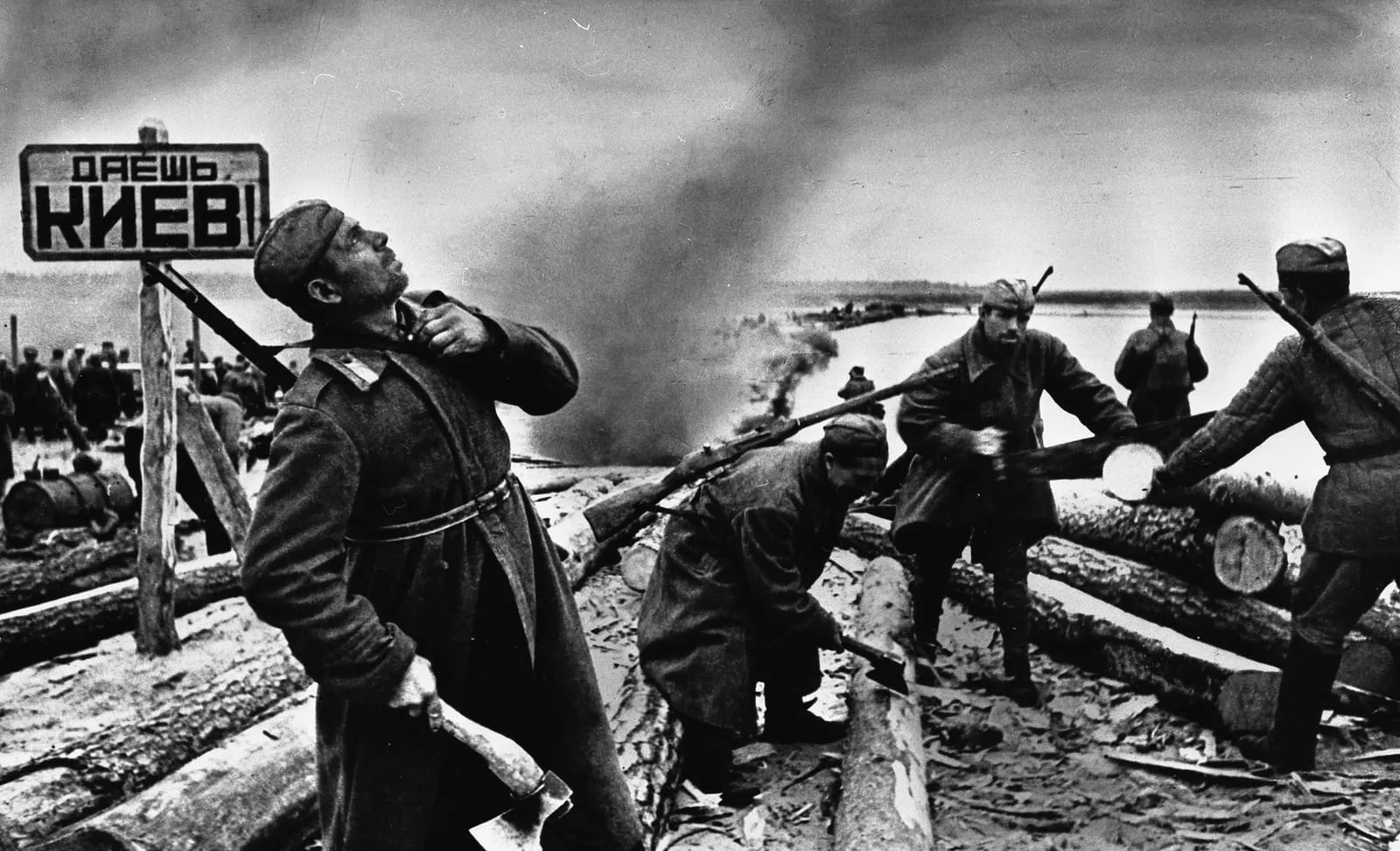
The Battle of the Dnieper was a series of Soviet offensive operations on the southern wing of the Eastern Front, conducted from the end of August to December 1943, immediately after the Battle of Kursk. Five Soviet fronts, with more than two and a half million men in all, moved west along a sector stretching from the Bryansk area to the Sea of Azov. Within four months they drove the German forces out of Left-Bank Ukraine (the part of Ukraine east of the Dnieper) and the Donets Basin, reached the Dnieper in a race with the retreating enemy, forced this broad river from the march at dozens of points and, on 6 November, liberated Kiev.
Hitler had counted on the front coming to a halt on the Dnieper, one of the largest rivers in Europe, for the winter and perhaps longer. That hope collapsed within a few weeks. At the cost of enormous losses the Red Army carried the war to the right bank of the river and secured the jumping-off positions for the offensive that in 1944 drove the Germans out of the whole of Ukraine.
Name and dates
Soviet and Russian historiography (Russian Битва за Днепр) applies this name to the operations between 26 August and 23 December 1943. It was not a single operation but several successive and partly simultaneous strategic offensives:
- the Chernigov–Poltava operation (26 August – 30 September): the advance of the Central, Voronezh and Steppe Fronts across Left-Bank Ukraine towards the Dnieper;
- the Donbas operation (13 August – 22 September): the advance of the South-Western and Southern Fronts in the Donets Basin; it began earlier but is counted as the battle’s southern wing;
- the Lower Dnieper operation (26 September – 20 December): the fighting for bridgeheads in the Dnieper bend, for Zaporizhzhia, Melitopol and Dnipropetrovsk, and the advance to the Crimea;
- the Kiev offensive operations (October and 3–13 November) and the Kiev defensive operation (13 November – 22 December): the capture of Kiev and the repulse of the German counter-offensive at Zhytomyr.
The battle also includes the failed airborne landing in the Dnieper bend near Kaniv (24–25 September). The closing date, 23 December, marks the end of the fighting in the Dnieper bend south of Kremenchuk; the very next day the 1st Ukrainian Front opened a new operation, the Zhitomir–Berdichev operation, regarded as the start of the next campaign.
In the course of the battle, on 20 October 1943, the fronts were renamed: the Voronezh Front became the 1st Ukrainian Front, the Steppe Front the 2nd Ukrainian Front, the South-Western Front the 3rd Ukrainian Front and the Southern Front the 4th Ukrainian Front. The Central Front was renamed the Belorussian Front.
Background
In the summer of 1943 the Wehrmacht lost its third successive campaign in the East. Operation Citadel collapsed in July in the Kursk salient, and Soviet counter-offensives retook Oryol and Belgorod and, on 23 August, Kharkiv – a city the Germans had recovered only five months earlier in the Third Battle of Kharkov. Field Marshal Erich von Manstein’s Army Group South, stretched from Bryansk to the Sea of Azov, had no reserves left, and after Kursk its panzer divisions had a few dozen serviceable tanks each.
Even so, Adolf Hitler would not hear of giving up eastern Ukraine. The Donets Basin supplied coal, the area around Nikopol manganese indispensable to the armaments industry, Kryvyi Rih iron ore, and the Ukrainian black earth grain. The loss of the Crimea would open the way for the Soviet air force to the Romanian oilfields, and Hitler also feared that another retreat would shake the Reich’s allies, Romania and Hungary. Only in mid-August, when the outcome of the Battle of Kursk had been decided, did he agree to the construction of a defensive line in the rear. An order of 11–12 August 1943 directed the building of the Eastern Wall (Ostwall): from the Gulf of Finland through Vitebsk and Gomel (Homel), then along the Dnieper to Zaporizhzhia, and from there south along the Molochna river through Melitopol to the Sea of Azov. The northern section was called the Panther position, the southern one the Wotan position.
This line, however, existed mainly on maps. The Germans had neither the men, nor the materials, nor the time to build genuine fortifications over a length of more than a thousand kilometres. Work began only at the end of August, carried out mainly by local people driven out to dig trenches, and when the German troops reached the river they found little more than marked-out positions along most of it. Nature, though, was on their side: for much of its length the right, western bank of the Dnieper is high and steep, while the left bank is low, sandy and marshy. In its middle course the river is from several hundred metres to more than a kilometre wide.
On the Soviet side Joseph Stalin and the Stavka wanted to exploit the momentum gained at Kursk before the Germans could dig in behind the river. The aim was to recover the country’s richest regions and to deny the enemy the time to devastate them and deport their population. Coordination of operations on the Kiev and Poltava axes was entrusted to Marshal Georgy Zhukov, and in the south, in the Donbas and on the lower Dnieper, to Marshal Aleksandr Vasilevsky, the Chief of the General Staff.
The forces were unequal. According to the German official history (Das Deutsche Reich und der Zweite Weltkrieg, vol. 8), on 26 August the five Soviet fronts had some 2.63 million men, more than 51,000 guns and mortars, about 2,400 tanks and self-propelled guns and 2,850 combat aircraft. Army Group South, the German 2nd Army of Army Group Centre and the 6th Army, which in the autumn passed to Army Group A, together had some 1.1–1.2 million men; to these were added Romanian units in the Crimea and the Kuban.
On the Soviet side the following fought:
- the Central Front under General of the Army Konstantin Rokossovsky, on the northern wing, on the Chernihiv axis;
- the Voronezh Front under General of the Army Nikolai Vatutin, on the Kiev axis;
- the Steppe Front under General of the Army Ivan Konev, from Kharkiv towards Poltava and Kremenchuk;
- the South-Western Front under General of the Army Rodion Malinovsky, on the Donets and in the Donbas;
- the Southern Front under General Fyodor Tolbukhin, on the Mius, towards the Sea of Azov.
Facing them were the German 2nd Army (of Field Marshal Günther von Kluge’s Army Group Centre) and Manstein’s four armies: Hermann Hoth’s 4th Panzer Army, the 8th Army, the 1st Panzer Army and the 6th Army. In the Kuban and the Crimea stood the 17th Army of Field Marshal Ewald von Kleist’s Army Group A.
Course of the battle: the race to the Dnieper (August – September)
The Donbas
In the south the fighting began even before the fall of Kharkiv. On 13 August the South-Western Front attacked on the Donets, and on 18 August the Southern Front broke through the German defences on the Mius – the same line it had attacked in vain in the winter and spring. The German 6th Army, threatened with encirclement, began to fall back. On 30 August Tolbukhin’s troops took Taganrog, and at the beginning of September Hitler, against his own inclinations, agreed to a withdrawal from the Donets Basin. On 8 September the Red Army entered Stalino (Donetsk), and on 10 September, supported by a landing by the Azov Flotilla, Mariupol. By 22 September both fronts had reached the Wotan position on the Molochna, where the advance came to a halt.
Left-Bank Ukraine
On 26 August the Central Front went into action. Its attack north of Kursk made heavy going at first, but Rokossovsky quickly shifted the weight of his thrust to the junction of the German 2nd Army and 4th Panzer Army, where the defence was weakest, and drove a wedge into the gap between Army Group Centre and Army Group South. On 6 September his troops took Konotop, on 15 September Nizhyn and on 21 September Chernihiv; a day later they reached the Dnieper and the mouth of the Pripyat.
Vatutin’s Voronezh Front and Konev’s Steppe Front advanced in parallel west of Kharkiv, through Okhtyrka, Sumy (2 September), Romny and Pryluky. After heavy street fighting the Steppe Front took Poltava (23 September), and on 29 September the left-bank part of Kremenchuk.
The decision to retreat
Throughout August and September Manstein warned that without a dozen or more fresh divisions he could not hold the front on the open steppe east of the Dnieper, and demanded either reinforcements or freedom of manoeuvre. Hitler replied that there were no reinforcements – troops were needed in Italy, which was just then dropping out of the war – and rejected a retreat. Only on 15 September, at a conference at his headquarters in East Prussia, did he agree to the withdrawal of Army Group South behind the Dnieper. Manstein had issued preliminary orders a day earlier.
The retreat was a difficult manoeuvre: several hundred thousand men with heavy equipment, supply trains and wounded had to cross the river by only a handful of bridges – at Kiev, Kaniv, Cherkasy, Kremenchuk, Dnipropetrovsk and Zaporizhzhia – and then deploy on the western bank along a front of several hundred kilometres. The Germans managed it by the end of September without any sizeable forces being encircled, but the divisions that took up positions behind the river were bled white and spread thin. On the lower Dnieper, moreover, Hitler ordered a strong bridgehead to be held on the left bank at Zaporizhzhia and Nikopol, for the sake of the manganese mines there and to cover the Crimea.
Scorched earth
The retreat was accompanied by a scorched-earth policy. Under orders issued at the beginning of September (including Heinrich Himmler’s guidelines of 7 September to the Higher SS and Police Leader in Ukraine), German troops were to remove or destroy everything that might be of use to the enemy: grain, livestock, machinery, railway track, bridges, industrial plants and houses. Hundreds of thousands of civilians were driven west, especially men fit for work and military service. According to accounts from both sides, many villages and small towns between the Donets and the Dnieper were burned to the ground, and in the cities power stations, waterworks and factories were blown up. The Soviet command also saw speed as a way of saving what was still left, and mobile units tried to outrun the German demolition squads.
At the same time partisans were active in the German rear: in September and October Soviet partisan units carried out massed attacks on the railways (the so-called “rail war”, Operation Concert), hampering both supply and the retreat.
On 9 September the Stavka issued a directive that promised the highest decorations for crossing major rivers, including the Dnieper – up to the title of Hero of the Soviet Union for the commanders and soldiers who were first to reach the far bank and hold on there.
Course of the battle: forcing the river (September – October)
Straight across from the march
The Stavka faced a choice. It could halt its troops at the river, bring up crossing equipment, artillery and supplies, and only then strike at one or two selected points. That, however, would have given the Germans several weeks to dig in and bring up reserves. The second option was chosen: to force the Dnieper immediately, from the march, across the whole width of the front, wherever an opportunity arose. The main advocate of this course was Stalin, who was anxious to recover Kiev quickly.
There was almost no crossing equipment – pontoons and engineer bridges had been left far behind, and before leaving the Germans destroyed every boat on the left bank. The first units therefore crossed in fishing boats brought out of hiding by local people, on rafts knocked together from planks, doors and barrels, on bundles of straw wrapped in tent sheets, and sometimes by swimming. On the right bank the soldiers dug themselves into clay ravines and slopes under fire from above. The first bridgehead was established on 22 September at the mouth of the Pripyat, and others followed in the next few days: in the great bend of the river at Velykyi Bukryn south of Kiev (22–23 September), at Kamianske (then Dniprodzerzhynsk) on 24 September, near Dnipropetrovsk on 25 September and near Kremenchuk on 28 September. By the end of the month there were 23 bridgeheads on the right bank, some of them several kilometres wide and barely one or two kilometres deep.
The landing at Kaniv
The most promising bridgehead was at Bukryn. Pavel Rybalko’s 3rd Guards Tank Army reached the river here on the night of 21–22 September, and on the far side there were at first only small German units hastily scraped together. To enlarge the bridgehead before German reserves arrived, the Voronezh Front launched an airborne landing on the night of 24–25 September: the 3rd and 5th Guards Airborne Brigades were dropped in the area between Kaniv and Rzhyshchiv.
The operation, prepared in three days, ended in disaster. There were too few aircraft and too little fuel, orders reached company commanders at the last moment, and air reconnaissance failed to detect that German divisions, including the 19th Panzer Division, were just then moving into the drop zone. Flying singly at night, the aircraft scattered the paratroopers over an area several dozen kilometres across, many of them straight onto German positions. According to David Glantz’s calculations, about 4,500 men were dropped out of the more than 6,500 planned; many were killed or captured on the first night and the following day. The survivors gathered in several dozen scattered groups, and some joined the partisans. Under the command of Colonel Pyotr Sidorchuk they formed a force in the forests to the south that fought in the German rear until mid-November and linked up with the front-line troops near Cherkasy. It was the last large Soviet airborne operation of the war.
The fight for the bridgeheads
The Germans counter-attacked the bridgeheads at once, to drive them back into the river before heavy equipment could cross. Aircraft bombed the crossings, and German artillery on the high bank fired at every boat. Only after several days did Soviet fighter aircraft and artillery organise effective support. All the more important bridgeheads were held, but at enormous cost: at the beginning of October many Soviet divisions were at 25–50 per cent of their establishment strength. At Bukryn the Voronezh Front twice, on 12–15 and 21–24 October, tried to break through towards Kiev from the south; each time the attack collapsed in difficult terrain cut by ravines, under the fire of German panzer divisions.
For forcing the Dnieper, 2,438 soldiers and officers received the title of Hero of the Soviet Union. Many of the awards were posthumous, and the figure itself became a symbol of the battle in the USSR.
Course of the battle: the lower Dnieper and the Crimea (September – December)
Melitopol and the Nogai Steppe
In the south the German 6th Army was holding the Wotan position on the Molochna. On 26 September the Southern Front opened the Melitopol operation. The fighting for this line and for Melitopol itself lasted almost a month; the town was taken only on 23 October, after protracted street fighting. Then the defence cracked. The 4th Ukrainian Front pushed tank corps and cavalry into the gap, and in a pursuit across the Nogai Steppe they reached the Perekop Isthmus at the beginning of November and seized a bridgehead on the southern shore of the Sivash. The German 17th Army, which by 9 October had evacuated the Kuban bridgehead to the Taman Peninsula and on to the Crimea, was cut off from the mainland. Hitler forbade the evacuation of the peninsula; the army held out there, supplied by sea, until the spring of 1944.
On the left bank of the Dnieper, however, the Germans held on to a bridgehead at Nikopol covering the manganese mines. Soviet attempts to eliminate it in November and December failed; the bridgehead fell only in February 1944.
Zaporizhzhia and Dnipropetrovsk
Zaporizhzhia, with its great dam and power station on the Dnieper – one of the symbols of Soviet industrialisation, already partly blown up by the retreating Red Army in 1941 – was for Hitler the key to the defence of the lower Dnieper. The South-Western Front took the German Zaporizhzhia bridgehead in a night assault on 14 October; before withdrawing, the Germans once again blew up part of the dam and the power-station equipment.
On the middle course of the river, Konev’s Steppe Front broke out of the Kremenchuk bridgehead on 15 October and struck south, deep into the great bend of the Dnieper, towards Pyatykhatky and Kryvyi Rih. The threat of encirclement forced the German troops in the Dnieper bend to abandon their positions on the river. On 25 October Malinovsky’s 3rd Ukrainian Front liberated Dnipropetrovsk (today Dnipro) and Dniprodzerzhynsk. From 27 October, however, a German counter-attack by the 1st Panzer Army, reinforced with fresh divisions, stopped the 2nd Ukrainian Front on the approaches to Kryvyi Rih and pushed it back several dozen kilometres. The fighting in the Dnieper bend, for Cherkasy (taken on 14 December), Oleksandriia and Znamianka, went on until 23 December, which is taken as the closing date of the battle.
The Kerch landing
In the far south General Ivan Petrov’s North Caucasus Front carried out the Kerch–Eltigen landing operation from 31 October. On the night of 31 October – 1 November a landing force of the 18th Army went ashore at Eltigen, south of Kerch, and on 3 November the main body of the 56th Army (from 20 November the Separate Coastal Army) landed north-east of the town. The Eltigen bridgehead, cut off from the sea by German motor boats, artillery barges and aircraft and surrounded on land by German and Romanian troops, held out for more than a month; at the beginning of December its remnants broke through to Kerch and were evacuated. The northern bridgehead survived and in April 1944 served as a base for the liberation of the Crimea.
Course of the battle: Kiev and Zhytomyr (October – December)
Regrouping to Liutizh
After two failed attacks from the Bukryn bridgehead, the Stavka changed its plan on 24 October. Kiev was now to be attacked from the north, from a small bridgehead near the village of Liutizh which units of the 38th Army had seized at the end of September. Around the turn of October and November Rybalko’s 3rd Guards Tank Army, together with artillery and support units, moved secretly north from Bukryn – by night, crossing the Dnieper twice and the Desna once, under radio silence. Dummy tanks and guns were left in the abandoned positions, and on 1 November the troops remaining at Bukryn renewed their attack to tie down the German reserves there.
The liberation of Kiev
On 3 November the 1st Ukrainian Front struck from the Liutizh bridgehead with General Kirill Moskalenko’s 38th Army and the 60th Army, and on 5 November the 3rd Guards Tank Army was committed to the breakthrough. The defence of the German 4th Panzer Army cracked. On the night of 5–6 November Soviet units forced their way into the city, and on the morning of 6 November Kiev was free – on the eve of the anniversary of the October Revolution, by which Stalin had wanted to have it. The 1st Czechoslovak Independent Brigade under Colonel Ludvík Svoboda took part in the fighting for the city.
Kiev, captured by the Germans in September 1941 after the great encirclement, was in ruins and depopulated. Its main street, the Khreshchatyk, had been blown up back in 1941 by charges left behind by the NKVD, and in the ravine of Babi Yar the Germans had murdered tens of thousands of Kiev’s Jews in September 1941, and later thousands of other victims. In the summer and autumn of 1943, before the retreat, a special commando under Paul Blobel dug up the mass graves there and burned the bodies to cover up the traces of the crime. In the autumn of 1943 the Germans expelled most of the population that had remained in the city, declaring the area along the Dnieper a prohibited zone.
After the capture of Kiev, Vatutin’s troops pressed their advance west and south-west: on 7 November they took Fastiv, an important railway junction, on 12 November Zhytomyr and on 17 November Korosten. The breach in the German front was now more than a hundred kilometres deep.
Manstein’s counter-offensive
Hitler blamed Hermann Hoth for the loss of Kiev and soon removed him from command of the 4th Panzer Army. Manstein meanwhile gathered his last reserves in the area of Bila Tserkva and Fastiv: General Hermann Balck’s XLVIII Panzer Corps with several panzer divisions, including the Waffen-SS divisions Leibstandarte and Das Reich. On 15 November it struck at the overextended flank of the 1st Ukrainian Front. On 19 November the Germans retook Zhytomyr, then Brusyliv, and at the end of the month Korosten. At the beginning of December Manstein made a further attempt to encircle Soviet forces in the area of Radomyshl and Malyn. He achieved local successes but managed neither to destroy Vatutin’s grouping nor to recover Kiev. By 22 December the front had stabilised west of the city, and the 1st Ukrainian Front held on to a broad bridgehead on the right bank.
On the northern wing Rokossovsky’s Belorussian Front took Gomel on 26 November in the Gomel–Rechitsa operation (10–30 November). Kluge, commander of Army Group Centre, had been seriously injured in a car accident at the end of October and had had to hand over his command to Field Marshal Ernst Busch.
Losses
The exact losses of both sides are hard to establish, because the battle consisted of many operations with differing limits in time and space. According to a compilation based on the data of General Grigori Krivosheev’s team, Soviet losses came to about 1.29 million men, including about 349,000 killed, missing and dead of other causes and about 937,000 wounded and sick. These were among the heaviest losses suffered by the Red Army in a single campaign; the forcing of the river and the defence of the bridgeheads were particularly bloody.
Estimates of German losses vary widely. The ten-day reports of the German Army’s chief medical officer (Heeresarzt) for Army Group South and the 2nd Army for the period 20 August – 20 December 1943 show some 280,000 casualties, including about 47,700 killed, 31,500 missing and about 200,000 wounded and sick. Robert Forczyk puts them at more than 370,000, including about 102,000 killed and missing. Older Soviet estimates gave much higher figures. Romanian losses in the Crimea and on the Sea of Azov are not known precisely.
Civilian losses and material destruction were enormous: hundreds of towns and thousands of villages in Left-Bank Ukraine were burned or ruined, and industrial plants, the mines of the Donbas and power stations were destroyed – by both sides in 1941 and again by the Germans in 1943.
Significance
The Battle of the Dnieper put an end to German hopes of stabilising the Eastern Front. The Eastern Wall, which was to have been the Reich’s final line of defence in the East, was breached within a few weeks, before it had really come into existence. The Red Army recovered the Donbas, Left-Bank Ukraine and Kiev – regions of enormous economic and political importance – and cut off the 17th Army in the Crimea. The bridgeheads held on the western bank at Kiev, Cherkasy, Kremenchuk and Dnipropetrovsk gave it starting points for a further advance.
The battle also showed how the nature of the war in the East had changed. The Red Army sustained the momentum of its offensive for four months, from late summer into winter, and forced one of the largest rivers in Europe from the march. It paid a very high price for this: the bridgeheads were bought with blood, and the failed landing at Kaniv and the two attacks at Bukryn bore witness to the haste imposed by Stalin. The Germans showed great skill in mobile defence and in counter-attacks, but they no longer had the reserves to turn the tide, and Hitler increasingly forbade withdrawals from positions that could not be held, such as the Nikopol bridgehead and the Crimea.
The liberation of Kiev on 6 November was an event of great propaganda value for the USSR and strengthened Stalin’s position at the Tehran Conference (28 November – 1 December 1943), where the future borders in Central and Eastern Europe were already being discussed. On 24 December the 1st Ukrainian Front broke out of the Kiev bridgehead in the Zhitomir–Berdichev operation, opening the Dnieper–Carpathian campaign, which by the spring of 1944 had driven the Germans out of almost the whole of Ukraine. At the beginning of January 1944, in the Sarny area, Soviet troops crossed the pre-war Polish–Soviet border, which raised the question of the future of the eastern territories of the Polish Republic. In the winter of 1944 the battle of the Korsun pocket was fought on the right bank of the Dnieper, and Manstein, after further retreats, was dismissed in March 1944. Vatutin, the principal victor of Kiev, was mortally wounded in February 1944 in an ambush by a unit of the Ukrainian Insurgent Army (UPA) and died in April.