Germany
Paul Blobel
Commander of Sonderkommando 4a of Einsatzgruppe C (1941–1942), head of Aktion 1005 (1942–1944), SS-Standartenführer
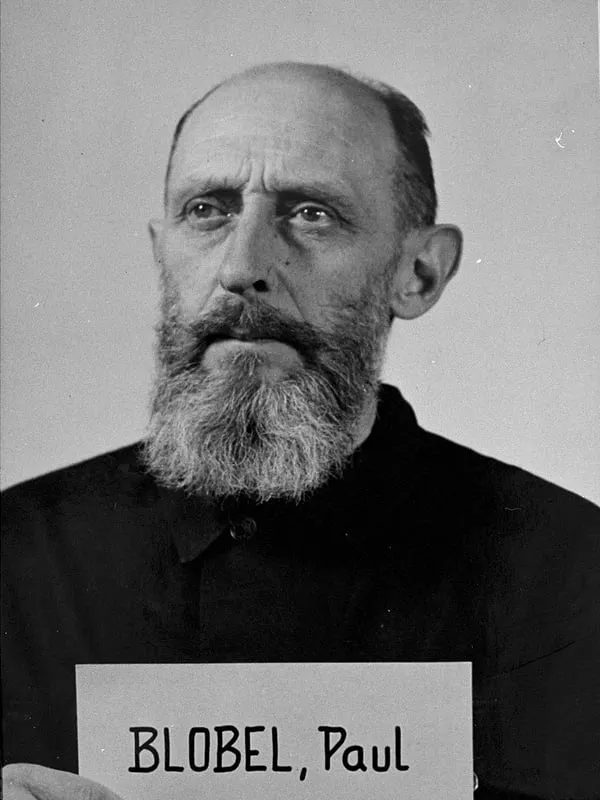
- Born:
- 13 August 1894, Potsdam (German Empire)
- Died:
- 7 June 1951, Landsberg am Lech (Germany)
- Author:
- Natalia
- Photo:
- autor nieznany, domena publiczna, Wikimedia Commons

Paul Blobel was one of the bloodiest perpetrators of the Holocaust in the occupied Soviet territories. An architect from the Rhineland who lost his work in the Great Depression and found a career in the SS and its security service, the SD, in the summer of 1941 he took command of Sonderkommando 4a, one of the units of Einsatzgruppe C. His men murdered Jews in Volhynia and central Ukraine, and on 29 and 30 September 1941, together with the German police, they shot 33,771 people in the Babi Yar ravine in Kiev. The American tribunal at Nuremberg held him responsible for the deaths of about 60,000 people. From 1942 Blobel directed the secret Aktion 1005, whose aim was to dig up the mass graves and burn the bodies in order to erase the traces of the crime. In 1948 he was sentenced to death, and in 1951 he was hanged.
Carpenter and architect
He was born on 13 August 1894 in Potsdam, the son of a carpenter, Wilhelm Blobel. He grew up in Remscheid in the Rhineland, where he went to school and until 1912 trained as a bricklayer and carpenter. He then studied architecture at the building school in Barmen-Elberfeld (today part of Wuppertal) and worked as a carpenter. During the First World War he fought on the Western Front in an engineer unit, where he became familiar with explosives, flamethrowers and trench mortars. He ended the war as a Vizefeldwebel, decorated with the Iron Cross First and Second Class.
After the war he was unemployed for a time, but he finished his studies and obtained his diploma in 1920. In 1921 he married; the marriage produced two sons. He worked for several building firms, and in 1924 opened his own architectural practice in Solingen, where he built a house for his family. The Great Depression deprived him of commissions; in 1930–1933 he was registered as unemployed and lived on benefits and casual work for the municipal authorities.
In the SS and the SD
Like many people whom the Depression had stripped of their social standing, Blobel attached himself to the Nazi movement. According to German biographers he joined the NSDAP on 1 December 1931 and the SS in January 1932; other sources give slightly earlier dates and an earlier episode in the SA. After the war he claimed in court that in 1931 he had belonged to the SPD, which the documents belie. After the Nazis came to power he worked as an official at Solingen town hall, and in June 1935 he joined the staff of the Sicherheitsdienst, the SS party security service headed by Reinhard Heydrich. He was promoted rapidly, rising to head of the SD section in Düsseldorf. He compiled information on Jewish organisations in the region into a card index that was used during the mass arrests of Jews after Kristallnacht in November 1938; at that time he also coordinated the seizure of documents and objects from the destroyed synagogues in Solingen, Wuppertal and Remscheid. His superiors praised his zeal, but he was already known for his heavy drinking.
Sonderkommando 4a
Before the German attack on the USSR the Reich Main Security Office appointed Blobel, with the rank of SS-Standartenführer, commander of Sonderkommando 4a, one of the units of Einsatzgruppe C under Otto Rasch. The group followed Army Group South, and its task, like that of all the Einsatzgruppen, was to murder Jews, communist officials and all those deemed enemies of the Reich. Sonderkommando 4a operated first in the former eastern territories of Poland. According to German reports, by the end of June it had already shot hundreds of Jews and communists in Sokal and Lutsk, and at the beginning of July in Lutsk, in reprisal for the NKVD’s murder of prisoners, more than a thousand Jewish men. The unit then advanced deeper into Ukraine through Zhytomyr and Berdychiv. On 7 August, in the market square in Zhytomyr, under Blobel’s personal supervision and before a crowd of soldiers and local people, Jews accused of collaborating with the Soviet authorities were publicly executed, and more than 400 others were then shot.
In August 1941 the killing came to encompass whole communities. After a conference with the Higher SS and Police Leader Friedrich Jeckeln, Blobel’s units also began shooting women and children. In Bila Tserkva his men murdered the Jewish adults, leaving some 90 children in a building on the edge of the town without food or water. Army chaplains and a staff officer of the local Wehrmacht division, Helmuth Groscurth, tried to save them, but the commander of the Sixth Army, Field Marshal Walter von Reichenau, decided that the action must be completed, and on 22 August the children were shot. According to testimony given years later by Blobel’s subordinate August Häfner, Blobel wanted SS men to carry out the execution, but in the end the shooting was done by Ukrainian militiamen. In September Sonderkommando 4a liquidated the Zhytomyr ghetto.
Babi Yar
On 19 September 1941 the Wehrmacht entered Kiev. When from 24 September mines planted by the retreating Soviets began to destroy the city centre, the Germans used this as a pretext to murder the Jews of Kiev. On 26 September Blobel took part in a conference with the city commandant, General Kurt Eberhard, Jeckeln and Rasch, at which the decision was taken. His unit, reinforced by Order Police battalions and with the help of the Wehrmacht and the Ukrainian auxiliary police, shot 33,771 Jews in the Babi Yar ravine on 29 and 30 September. Blobel directed the executions on the spot. Albert Hartl, a former Catholic priest and later an SD official, told the journalist Gitta Sereny after the war that in the summer of 1942 Blobel, driving with him past the ravine, where the earth was still heaving from the gases of decomposition, pointed to it and said: “Here lie my thirty thousand Jews.”
After Kiev the unit moved further east, murdering Jews in the towns of left-bank Ukraine, among them Yahotyn and Poltava. In a report of mid-October, Einsatzgruppe C credited Sonderkommando 4a with killing more than 51,000 people since the start of the war. According to some sources, in November 1941 Blobel received and tested the first gas vans in Poltava – lorries in which the victims were killed with exhaust fumes. On 13 January 1942 he was relieved of his post, officially on health grounds, in reality because of his alcoholism.
Aktion 1005
In the spring of 1942, according to post-war testimony, Heydrich entrusted him with a new, top-secret task. After the assassination of Heydrich in June 1942 the order was confirmed by the head of the Gestapo, Heinrich Müller. Blobel was to erase the traces of the mass murders: to dig up the graves, burn the bodies and dispose of the ashes. Orders were given only orally, and the operation was given the code name 1005. Officially Blobel was head of the SD in Nuremberg.
He began work in the summer of 1942 with experiments at the Chełmno extermination camp on the Ner. Attempts to burn the corpses with incendiary bombs ended in a forest fire, and after many trials Blobel devised the method of huge pyres on which alternating layers of wood and bodies were laid on a grate of railway rails; the bones were then ground in special mills. In September 1942 his work at Chełmno was inspected by the commandant of Auschwitz, Rudolf Höss, who later described the visit in his memoirs. According to the testimony of Dieter Wisliceny, an associate of Adolf Eichmann, in November 1942 Blobel gave a lecture in Eichmann’s Berlin office on the corpse-burning devices he had designed himself.
From 1943 the Aktion 1005 commandos, made up of SD and police personnel, returned to the sites of earlier executions in the occupied Soviet territories, in Poland and in the Baltic states. The work at the graves was done by prisoners, mainly Jews and Soviet prisoners of war, often in chains, who were shot when the work was finished. In the summer of 1943 Blobel personally returned to Babi Yar, where prisoners from the Syrets camp spent several weeks burning the bodies of tens of thousands of people; on the night of 28–29 September 1943 some of them tried to escape, and a dozen or so survived. Similar operations were carried out at Ponary (Paneriai) near Wilno (Vilnius), in the forts of Kaunas and at hundreds of other killing sites. The rapid advance of the Red Army meant that the operation only partly achieved its aim, and the survivors of the commandos became some of the most important witnesses of the Holocaust.
The end of the war and the trial
In the last year of the war Blobel commanded a unit fighting the Yugoslav partisans in Styria and Carinthia. From the winter of 1944/1945 he was treated in hospital in Marburg an der Drau (Maribor), and in the last weeks of the war he spent a few days in Berlin and Salzburg. In 1945 he fell into Allied hands. The Americans indicted him in the Einsatzgruppen trial, the ninth of the Nuremberg trials before American military tribunals, for crimes against humanity, war crimes and membership of criminal organisations. He was charged with responsibility for the murder of about 60,000 people. Blobel claimed that his unit had killed at most 10,000–15,000 people, and that the executions of “agents, partisans and saboteurs” had been lawful under the laws of war. The tribunal found him guilty on all counts and on 10 April 1948 sentenced him to death by hanging.
The execution was delayed by appeals and by a campaign for clemency for the convicted war criminals, waged in West Germany by politicians and the churches. Blobel was not pardoned. He was hanged in the war crimes prison at Landsberg shortly after midnight on 7 June 1951 (some sources give 8 June), together with Otto Ohlendorf, Erich Naumann and Werner Braune, as well as Oswald Pohl and two men convicted in the Dachau trials. These were the last death sentences carried out on the territory of the Federal Republic of Germany.
Significance
Paul Blobel was not one of the architects of the policy of extermination, but he was one of the men who put it into practice with the greatest ruthlessness. His biography, from unemployed architect to commander of a unit that murdered the Jews of Kiev in two days, has become for historians one of the examples of how ordinary members of the German middle class became mass murderers. His second role, as head of Aktion 1005, shows in turn that from 1942 the perpetrators understood that they were committing a crime that had to be hidden from the world. That it could not be hidden was due in great part to the survivors of Babi Yar and of the commandos forced to burn the bodies. Most of the men who did the shooting under Blobel’s orders in Bila Tserkva, Zhytomyr and Kiev escaped punishment; only a few of them were convicted by a court in Darmstadt in 1968.
Sources
Mentioned in battles
(01)Often appears with
People who appear in the same events.