- Category:
- Military operations
- Front:
- Mediterranean
- Date:
- 15 August 1942
- Author:
- Łukasz
- Battle:
- Operation Pedestal
- Tags:
- Royal Navy, Italy, Luftwaffe, United Kingdom
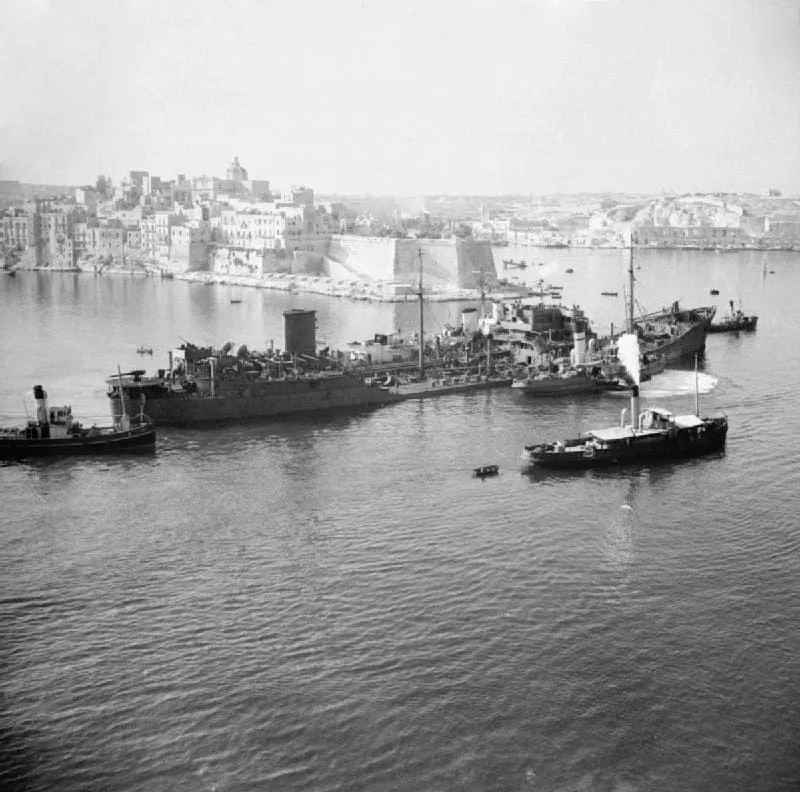
On the morning of 15 August 1942 the tanker Ohio was brought into the Grand Harbour at Valletta. Her keel was broken, her deck almost awash and her rudder gone. For two days she had not moved under her own power: two destroyers lashed to her sides carried her along as if on a stretcher. Crowds of Maltese lined the bastions and quays, and a band played “Rule, Britannia!”. She was the last of the five merchant ships of Operation Pedestal to fight their way through to Malta. Of the fourteen that had entered the Mediterranean, nine had been sunk, and the escort had lost an aircraft carrier, two cruisers and a destroyer. At that price the besieged island received food for the coming months and the fuel without which its aircraft and submarines could not have attacked Axis shipping to Africa.
War chronologies record under 13 August the “disastrous end” of the convoy, from which “one tanker and four merchant ships” got through, and under 15 August that Malta was resupplied by Operation Pedestal. The tally is correct, but it was spread over three days: three ships entered Valletta on 13 August, a fourth on 14 August, and the tanker not until the morning of 15 August.
After the loss of Eagle
Convoy WS 21S – fourteen fast merchant ships covered by two battleships, three aircraft carriers, seven cruisers and more than thirty destroyers – passed through the Strait of Gibraltar on the night of 9–10 August. On the first day of fighting it lost the carrier Eagle, sunk by the German submarine U-73. Everyone knew that the real test would come on 12 and 13 August, when the ships came within range of the airfields on Sardinia and Sicily and then entered the narrow waters of the Sicilian Channel, where the heavy ships were no longer to accompany them. It was remembered that in June only two of the six merchant ships of the Harpoon convoy had reached Malta, and that its only tanker, the American Kentucky, had gone to the bottom. Ohio, her sister from the same series of Texas Company tankers, was this time the most important ship in the convoy. Requisitioned for British use in July, with a British crew under Captain Dudley Mason, she carried about 11,500 tons of kerosene and diesel oil. To prepare her for air attack she had been strengthened in a Glasgow yard: her engines were mounted on rubber pads, her steam pipes supported with springs and baulks of timber, and her anti-aircraft armament increased.
12 August: a day of air attacks
From dawn on 12 August German and Italian reconnaissance aircraft shadowed the convoy. At about 9.15 a.m. the first wave of German Ju 88 bombers was intercepted by carrier fighters and lost several aircraft without hitting a single ship. At noon came the heaviest attack of the day, in several waves from Sardinia: Italian bombers, torpedo bombers and fighter-bombers, and among them German Ju 88s from Sicily. The Regia Aeronautica also tried out some novelties. Bombers dropped special circling torpedoes ahead of the convoy, which forced the ships to turn away but hit nothing. A radio-controlled SM.79 bomber packed with a ton of explosives, which was meant to dive onto a carrier, lost contact with its control aircraft and crashed in the mountains of Algeria. Two Re.2001 fighter-bombers, mistaken for British Hurricanes, hit the carrier Victorious, but one bomb bounced off her armoured deck and exploded in the sea. The only merchant ship damaged in the midday attacks was Deucalion, which left the convoy with one destroyer and made her way along the Tunisian coast.
In the afternoon the destroyers fought off Italian submarines. Ithuriel forced Cobalto to the surface and rammed her, being badly damaged herself. In the evening, at about 6.30 p.m. north of Bizerta, the most dangerous wave arrived: Italian and German Ju 87 dive bombers and SM.79 torpedo bombers from Sicily and Pantelleria. German Ju 87s, diving out of the sun, hit the flight deck of the carrier Indomitable with two heavy bombs. About 50 men were killed, and the ship, though she stayed afloat, could no longer operate aircraft. A torpedo struck the destroyer Foresight, which had to be scuttled the next day. Of the three carriers, only one remained in action.
At about 7 p.m. Vice Admiral Neville Syfret turned west with the battleships and carriers, as planned, a little earlier than intended so as to take the damaged Indomitable out of range of Axis aircraft. From there, for the last 250 miles to Malta, the convoy was led by Rear Admiral Harold Burrough with four cruisers and a dozen or so destroyers. The merchant ships no longer had fighter cover, since aircraft from Malta could reach them only the following day.
The evening of 12 August: Axum’s torpedoes
The convoy was changing from four columns to two in order to pass through the narrow channel between the Skerki Bank and the Tunisian coast when, shortly before 8 p.m., the Italian submarine Axum fired a salvo of four torpedoes. It was one of the most successful salvoes of the war. They struck the cruiser Nigeria, Burrough’s flagship, the anti-aircraft cruiser Cairo and Ohio. Cairo had to be scuttled. Nigeria, which lost about 50 men, turned back for Gibraltar, and Burrough transferred to the destroyer Ashanti. The convoy had thus lost both its fighter-direction ships, its commander and the leaders of both columns.
The torpedo tore a hole some 7 by 8 metres in Ohio’s side in the area of the pump room. Kerosene gushed from the ruptured tanks and a fire broke out. Mason ordered the engines stopped, and the crew put out the fire. The gyrocompass and steering gear were damaged, so she was steered from the emergency position aft. After several tens of minutes the tanker got under way again, at first at a few knots.
German bombers took advantage of the confusion. Between 8.30 and 9 p.m. some thirty Ju 88s and a few torpedo-carrying He 111s struck at the scattered convoy. Empire Hope caught fire and sank, Clan Ferguson blew up after a torpedo hit, Brisbane Star was damaged, and Deucalion, sailing on her own along the coast, was sunk by torpedo bombers. A quarter of an hour later the submarine Alagi hit the cruiser Kenya in the bow with a torpedo, but she managed to stay with the convoy. Alagi’s commander noted that he had seen “an unbroken line of flames” from burning and sinking ships.
Night off Cape Bon
Around midnight the strung-out convoy, broken up into groups, was rounding Cape Bon in Tunisia, hugging the coast to avoid the minefields between Africa and Sicily. The lighthouse on the cape gave away the ships’ position. There Italian MS and MAS motor torpedo boats and German S-boats lay in wait for them. At about 1 a.m. two Italian MS boats torpedoed the cruiser Manchester, which came to a stop with her engine room flooded and was scuttled by her own crew towards morning. Most of her sailors made it to the Tunisian shore and were interned by the Vichy authorities.
Between 3 and 4.30 a.m. the boats sank, one after another, four merchant ships trying to catch up with the convoy: Wairangi, Glenorchy and the American Almeria Lykes and Santa Elisa. Rochester Castle was also hit, but carried on. By morning three merchant ships remained with Burrough – Rochester Castle, Melbourne Star and Waimarama – with Ohio, Port Chalmers and Dorset following separately. Brisbane Star was sheltering off the Tunisian coast.
The Italian cruisers turn back
The greatest danger was expected at dawn on 13 August. Two divisions of Italian cruisers were steaming to meet the convoy: three heavy and three light cruisers with a dozen or so destroyers. Against Burrough’s two light cruisers, one of them damaged, they could have finished off what was left. No engagement took place. The Italian navy wanted air cover, and Albert Kesselring refused, because he needed his fighters to escort the bombers attacking the convoy. Marshal Ugo Cavallero and the Italian command decided that the cruisers could not be exposed to attack by aircraft from Malta, and the operation was called off during the night. The British also tried a bluff: the command on Malta sent orders in plain language to a non-existent force of B-24 bombers, and a Wellington dropped flares over the Italian ships. According to most accounts, however, the decision to turn back had been taken before the Italians picked up these signals.
On the morning of 13 August the returning cruisers were steaming east along the north coast of Sicily towards Messina. Among the Aeolian Islands the British submarine Unbroken, commanded by Alastair Mars, lay in wait for them. At about 8 a.m. she fired four torpedoes. One hit the heavy cruiser Bolzano, which caught fire and was beached off the island of Panarea; another blew the bow off the light cruiser Muzio Attendolo. Neither ever returned to full service. Some accounts mention the famous Upholder at this point, but that boat had been lost in April 1942. The success was Unbroken’s.
13 August: three ships in Valletta
In daylight the convoy came within range of Malta, but also of the airfields on Sicily. At about 8 a.m. German Ju 88s hit Waimarama, which was carrying aviation spirit in drums on deck. The ship blew up and sank within minutes. Of her crew of over a hundred, the destroyer Ledbury, steaming through the burning water, rescued 27 men. A quarter of an hour or so later Italian Ju 87s attacked Ohio. One of them, shot down, crashed onto the tanker’s deck and exploded. When this was reported to Mason by telephone, he is said to have replied that it was nothing, since a Junkers 88 had already been lying on the foredeck for half an hour. Bombs also hit Dorset, which was abandoned and finished off in the evening, and damaged Port Chalmers.
In the afternoon minesweepers came out from Malta to meet the convoy. Under their cover Port Chalmers, Rochester Castle and Melbourne Star entered the Grand Harbour late in the afternoon of 13 August, greeted by crowds. Unloading began at once. Burrough turned back for Gibraltar with the rest of his warships, still under air attack, which drew some of the Axis aircraft away from the last merchant ships. That same day in Egypt General Bernard Montgomery took command of the Eighth Army; his army was to feel the effects of the convoy on the other side of the front.
Brisbane Star, with a hole in her bow, sailed alone along the Tunisian coast, partly through French territorial waters. Off Sousse, officials of Vichy France came aboard intending to intern her, but Captain Frederick Riley persuaded them to let him go on. The ship reached Valletta on the afternoon of 14 August.
Towing the Ohio
Ohio was by then several tens of miles from Malta. On the morning of 13 August near misses had put out her boiler fires, and although the engineers twice relit them, before noon the tanker came to a final stop. The crew transferred to the destroyer Penn, whose captain tried to take the tanker in tow. The damaged ship, many times heavier than the destroyer, sheered to port and turned in circles. In the evening another bomb struck where the torpedo had hit earlier and broke her back. Penn was joined by the minesweeper Rye and the destroyers Ledbury and Bramham, and sailors returned aboard Ohio, among them volunteers from sunk merchant ships, Americans included, who manned her anti-aircraft guns. The tow lines parted again and again, and further air attacks damaged the stern and rudder. Twice Mason ordered the ship abandoned and twice he went back on board.
On the morning of 14 August Spitfires from Malta, sent by Keith Park, appeared over the group and broke up successive waves of bombers. One bomb, however, fell just astern of the tanker, buckling her plating. Then a solution was found: two destroyers were lashed to either side of Ohio so as to hold her up with their hulls, while a third warship and the minesweeper helped to steer. At a few knots the group worked its way round the island so as to enter harbour by the safe swept channel. Water was already washing over her midships. On the approach, tugs came out from Malta.
On the morning of 15 August – sources give times from about 8 to 9.30 a.m. – Ohio entered the Grand Harbour. It was the Feast of the Assumption of the Blessed Virgin Mary, in Malta the feast of Santa Marija, and the Maltese named the whole convoy the “Santa Marija convoy” (il-Konvoj ta’ Santa Marija). Accounts describe how, at the sight of the tanker, the crowd on the walls of Valletta and Senglea first cheered and then fell silent, the men taking off their hats and the women crossing themselves. The tanker was moored alongside the wreck of another tanker, and the fuel was pumped from her tanks into the auxiliary oiler Boxol; as they were emptied they were filled with water so that the hull would not break up. When the last of the fuel had been pumped out, Ohio settled on the bottom.
The balance
Of the fourteen merchant ships, five reached Malta: Port Chalmers, Rochester Castle, Melbourne Star, Brisbane Star and Ohio. According to various tallies they brought some 30,000–32,000 tons of supplies – flour, grain, meat, ammunition – as well as Ohio’s fuel and the drums of petrol carried by the other ships. Some three thousand soldiers unloaded them, and the cargo was dispersed among storehouses. The island’s stocks, which had been due to run out at the turn of August and September, would by British calculations last roughly ten weeks longer, and with strict rationing until December. The Governor, John Vereker, Lord Gort, could push back the date of surrender through starvation.
The price was very high. Nine merchant ships were sunk, along with the carrier Eagle, the cruisers Manchester and Cairo and the destroyer Foresight, while Indomitable, Nigeria, Kenya and several destroyers needed long repairs. According to British tallies, more than 400 men of the Royal Navy and the Merchant Navy and airmen were killed. Some authors give a figure of over 500. The Axis lost two submarines, and two cruisers were put out of action. British gunners and airmen claimed 74 aircraft shot down; post-war figures speak of about 42 aircraft brought down by the convoy’s defenders and about sixty lost from all causes.
The Italians regarded the “Battle of mid-August” (battaglia di mezzo agosto) as their victory, and some historians grant that it was one at the tactical level: it was the Axis’s last major success in the struggle for the Mediterranean. Strategically, however, the British won. The German Admiral Eberhard Weichold, the Kriegsmarine’s liaison officer with the Italian navy, wrote in the autumn that although the British losses looked like a great Axis victory, it was in reality a “strategic defeat of the first order” for the Axis, because Malta could fight again.
Place in the war
Ohio saved not only the island’s population but also its role in the war. Her fuel allowed Malta’s aircraft and submarines to resume their attacks on the convoys sailing to Libya. In August alone the Axis lost about a third of the tonnage sent to Africa, and at the end of the month and in September several tankers carrying fuel for Erwin Rommel’s army were sunk. The shortage of fuel weighed heavily on his last offensive in Egypt, at Alam Halfa at the turn of August and September, and on the course of the Battle of El Alamein in the autumn. When in October Kesselring threw the Luftwaffe into a last great air offensive against Malta, Park’s Spitfires inflicted such heavy losses that the attacks were broken off after a week. The siege of Malta ended on 20 November 1942 when, after the victory at El Alamein and the Allied landings in North Africa, the convoy of Operation Stoneage reached Valletta without loss.
In September 1942 Captain Dudley Mason received the George Cross, the same decoration with which the whole island had been honoured a few months earlier. Ohio’s crew received a dozen or so other awards. The tanker herself never went to sea again. Broken in two, she served as a store, and in 1946 both halves were scuttled off Malta. Ohio’s entry into harbour became the climax of the 1953 film Malta Story, and every 15 August the Maltese remember the “Santa Marija convoy”. For the British, Operation Pedestal remained a symbol of the endurance of the merchant seamen, without whom no fleet, however strong, could have held Malta.
Sources
Meanwhile
(04)Elsewhere, within a week.
- 17 August 1942 · PacificThe Makin Island raidOn 17 August 1942 Carlson’s Marines, landed from two submarines, struck the Japanese garrison on Makin. The withdrawal was a drama; nine men were left behind.
- 12 August 1942 · PacificAmericans in the New HebridesOn 11 August 1942 a US Navy construction battalion landed on Espiritu Santo. The New Hebrides were becoming the rear base for the fight for Guadalcanal.
- 12 August 1942 · DiplomacyChurchill in MoscowOn 12 August 1942 Churchill flew to Moscow and told Stalin in the Kremlin that there would be no second front in France in 1942.
- 19 August 1942 · Western FrontThe Dieppe RaidOn 19 August 1942 over 6,000 troops, mostly Canadians, landed at Dieppe. After the defeat 3,367 Canadians had been killed, wounded or captured.
Related events
(04)The same battle, people or subject.
- 11 August 1942 · MediterraneanThe sinking of HMS EagleOn 11 August 1942 U-73 torpedoed the carrier Eagle, escorting the Pedestal convoy to Malta. She sank within minutes; about 130 men were lost.
- 11 November 1942 · MediterraneanConvoy StoneageOn 11 November 1942 the minelayer Manxman was bound for Malta. The real convoy from Alexandria, Operation Stoneage, arrived on 20 November and lifted the siege.
- 11 June 1942 · MediterraneanOperation HarpoonOn 11 June 1942 two convoys set out for Malta. Of the six Harpoon ships sailing from Gibraltar, only two reached Valletta.
- 9 May 1942 · MediterraneanOperation BoweryOn 9 May 1942, 64 Spitfires flew off Wasp and Eagle for Malta. This time they went straight into action and the defenders began to win back the skies.