Germany
Albert Kesselring
Chief of the Luftwaffe General Staff (1936–1937), commander of Luftflotte 1 and Luftflotte 2 (1939–1941), Commander-in-Chief South and in Italy (1941–1945), Field Marshal (1940)
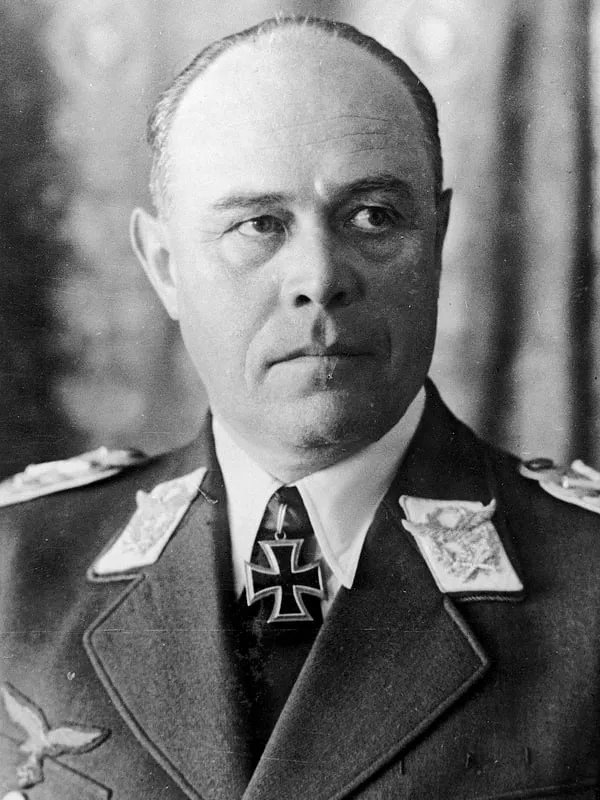
- Born:
- 30 November 1885, Marktsteft (Bavaria, German Empire)
- Died:
- 16 July 1960, Bad Nauheim (West Germany)
- Author:
- Łukasz
- Photo:
- autor nieznany, domena publiczna, Wikimedia Commons

Albert Kesselring was an artilleryman who learned to fly at the age of forty-eight and became one of the founders of the Luftwaffe. In the first years of the Second World War he commanded the air fleets that bombed Warsaw, Rotterdam and London, and from 1941, for almost four years, he directed Germany’s war in the Mediterranean and in Italy. As the commander defending the Italian peninsula he was regarded as one of the Wehrmacht’s most skilful generals, who with the slenderest forces held off the superior Allies for a long time, Monte Cassino included. The same man bore responsibility for orders under which Italian hostages were shot and whole villages burned. A British military court sentenced him to death for this, but after five years he was released, and to the end of his life he never renounced his loyalty to Hitler.
The Bavarian artilleryman
He was born on 30 November 1885 in Marktsteft in Lower Franconia, into the family of a schoolteacher who later became a school inspector in Bayreuth. There he finished his Gymnasium, and in 1904 he joined the 2nd Bavarian Foot Artillery Regiment, stationed in the fortress of Metz, as an officer candidate. He was commissioned as a second lieutenant in 1906. In 1910 he married Pauline Keyssler, the daughter of a Bayreuth pharmacist. The marriage was childless; the couple later adopted a son. In 1912 Kesselring took a course as a balloon observer, his first contact with aviation.
During the First World War he served as an adjutant in artillery units on the Western Front, and in 1916, by then a captain, he was posted to divisional and corps staffs, although he had not attended the war academy. After the war he oversaw the demobilisation of the Bavarian artillery in Nuremberg and was accepted into the 100,000-strong Reichswehr. For most of the 1920s he worked in the defence ministry in Berlin on training and army organisation, and in 1931–1933 he commanded an artillery battalion in Dresden. He had a reputation as an efficient organiser and administrator.
Builder of the Luftwaffe
When, after Hitler came to power, Hermann Göring began secretly building a military air force, he needed officers capable of creating it from scratch. On 1 October 1933 Kesselring, promoted to colonel, transferred from the army to the aviation commissariat, which was soon turned into the Reich Air Ministry. He took over the administrative office responsible for building airfields, barracks and the whole infrastructure of the new service, and along the way obtained his pilot’s licence. In 1934 he formally left the army and received the rank of Generalmajor in the air force, which was revealed to the world in 1935 as the Luftwaffe.
After General Walther Wever was killed in an air crash in June 1936, Kesselring became chief of the Luftwaffe General Staff. He did not last even a year in the post. He was in constant conflict with the state secretary, Erhard Milch, the de facto manager of the air force, and in 1937 he asked for another assignment. Historians judge that he lacked his predecessor’s strategic imagination. During his tenure the Luftwaffe began to concentrate on medium and dive bombers and on support for the ground forces, and in 1937 the programme for a heavy long-range bomber was abandoned. In June 1937 Kesselring, by then a General der Flieger, took over the air district in Dresden, and in 1938 the command of an air group in Berlin, which was converted into Luftflotte 1.
Poland, the Netherlands and the Battle of Britain
In September 1939 Kesselring’s Luftflotte 1 supported Fedor von Bock’s Army Group North in the invasion of Poland: it attacked airfields and railway junctions and the bridges over the Vistula and the Narew, and in the last week of the campaign, bombing Warsaw, it tried to break the capital’s resistance. A massive raid on the city planned for 1 September, Operation Wasserkante, did not take place at the time because of bad weather. On 30 September Kesselring received the Knight’s Cross.
In mid-January 1940, after the Mechelen incident, Göring dismissed the commander of Luftflotte 2, General Hellmuth Felmy, and entrusted it to Kesselring. In the offensive in the West the air fleet was to support Army Group B, again under Bock, including Kurt Student’s airborne operation in the Netherlands. On 10 May its bombers struck Dutch airfields, and transport aircraft landed paratroopers and infantry near Rotterdam and The Hague. The landings on the bridges in the south succeeded; the battle for The Hague ended in defeat and the loss of hundreds of transport aircraft.
On 14 May, at the demand of the commander of the 18th Army, General Georg von Küchler, and at Student’s request, Kesselring sent bombers over Rotterdam. The raid came while negotiations for the city’s surrender were under way, and most of the crews failed to see the signals recalling them. The bombing of Rotterdam destroyed the city centre and killed, by the most frequently cited estimates, 800–900 inhabitants, and that same day the Netherlands decided to capitulate. The Allied press wrote at the time that Kesselring would go down in history as the man who had destroyed a defenceless city. He himself maintained to the end of his life that it had been a legitimate attack on a defending garrison. At the end of May, when the halt order stopped the German tanks outside Dunkirk, it was mainly his exhausted air fleet that was supposed to prevent the evacuation. According to his memoirs, he warned Göring that with worn-out crews he could not do it, and indeed Operation Dynamo saved more than 300,000 soldiers. On 19 July 1940 Hitler promoted him to field marshal.
In the Battle of Britain Luftflotte 2, with its headquarters in Brussels, operated alongside Hugo Sperrle’s air fleet and attacked south-east England. From August its bombers pounded the RAF’s fighter airfields, and on 7 September, when Göring switched the target to London, Kesselring sent the first great daylight raid over the capital. The switch gave the British fighters a respite and was one of the reasons for the German defeat. His air fleet went on bombing British cities until May 1941.
From Moscow to Tunis
In June 1941, during Operation Barbarossa, Luftflotte 2 supported Army Group Centre in the encirclement battles at Białystok, Minsk and Smolensk, and from July it bombed Moscow. At the end of 1941 Kesselring’s headquarters was moved to Italy. As Commander-in-Chief South, with his headquarters at Frascati near Rome, he was to secure the supply routes to North Africa and neutralise Malta, from which the British were attacking Axis convoys. In the spring of 1942 his aircraft almost paralysed the island, and Kesselring prepared to seize it from the sea and the air. Hitler, however, encouraged by Erwin Rommel’s capture of Tobruk in June 1942, chose the march on Egypt instead, and Malta survived and went on destroying the Afrika Korps’ supplies. To the end of his life Kesselring regarded this as one of the decisive mistakes of the war.
Relations with Rommel, who was formally his subordinate, were strained: Kesselring accused him of neglecting supply, and Rommel accused him of unwarranted optimism. After the Allied landings in North Africa in November 1942, Kesselring rushed troops to Tunisia and held a bridgehead there for six months, but at the cost of disaster. In May 1943 some quarter of a million German and Italian soldiers were taken prisoner there, and his over-optimistic assessments of the situation, presented to Hitler and Mussolini, contributed to their not being evacuated in time.
The defence of Italy
In the summer of 1943 the Allies landed in Sicily and Mussolini was overthrown. Kesselring, who believed in the Italians’ loyalty and was therefore regarded at Hitler’s headquarters as too trusting of them, managed in August to evacuate most of the German troops from the island across the Strait of Messina. When the armistice between Italy and the Allies was announced on 8 September, his units disarmed the Italian army in central and southern Italy within a few days and occupied Rome. Hitler, who had wavered for several months between him and Rommel, gave him supreme command in Italy in November 1943.
Kesselring decided to defend as far south as possible. Making use of the mountainous terrain, he built successive lines of fortifications, the strongest of which, the Gustav Line, held up the Allies for six months. He bottled up the landing at Anzio in January 1944 in a cramped beachhead, and at Monte Cassino his paratroopers threw back one assault after another until May 1944, when the monastery was taken by soldiers of General Władysław Anders’s Polish II Corps. On 4 June the Allies entered Rome, which Kesselring had abandoned without a fight. He then fell back to the Gothic Line in the Apennines, where the front came to a halt for the winter of 1944/1945. Military historians rate his generalship highly, and his opponents, led by Field Marshal Harold Alexander, respected him as a soldier.
Crimes in Italy
The other side of this defence was a war against the civilian population. On 23 March 1944 in Rome, partisans killed 33 German policemen with a bomb in the Via Rasella. Hitler demanded reprisals, and Kesselring passed down the order to shoot ten Italians for every German killed. The next day the SS under Herbert Kappler murdered 335 men in the Ardeatine Caves, several dozen of them Jews. In June 1944, as the partisans grew stronger in the mountains, Kesselring issued orders on the fight against the “bands” that called for action with “the utmost severity”, provided for reprisals against civilians and assured commanders that they would not be held responsible if they went beyond the usual bounds in their choice of methods. Under the cover of these orders, Wehrmacht and SS units carried out the worst massacres in Italy in the summer and autumn of 1944, among them at Sant’Anna di Stazzema and Marzabotto, where more than a thousand people in all were killed, women and children among them. Kesselring, who also directed the whole anti-partisan campaign and had the Higher SS and Police Leader in Italy, General Karl Wolff, under his command, never admitted his guilt.
On the night of 23 October 1944 his car collided with a towed gun, and the badly injured field marshal was out of action for several months. In March 1945, after the loss of the Rhine bridge at Remagen, Hitler appointed him to succeed Gerd von Rundstedt as Commander-in-Chief West. Kesselring could no longer change anything, and his orders of the last weeks of the war, demanding ruthless resistance and the punishment of civilians who hung out white flags, only prolonged the suffering. For a long time he opposed the surrender of the German forces in Italy, negotiated behind his back by Wolff, and agreed to it only on 2 May. In May 1945 he gave himself up to the Americans.
Trial and last years
In 1946 Kesselring testified as a defence witness before the International Military Tribunal at Nuremberg. In February 1947 he stood before a British military court at Mestre near Venice, charged with complicity in the Ardeatine Caves massacre and with inciting his subordinates to kill Italian civilians. On 6 May 1947 the court found him guilty on both charges and sentenced him to be shot. The verdict provoked protests in Britain, where former adversaries, among them Winston Churchill and Alexander, regarded him as a chivalrous soldier. In July 1947 the sentence was commuted to life imprisonment and later reduced, and in October 1952, after he was found to have throat cancer, Kesselring was released.
In West Germany, where a press campaign had been waged for his release, he was welcomed as a hero. He became head of the revived Stahlhelm ex-servicemen’s league and of the veterans’ associations of the Luftwaffe and the Afrika Korps, and in 1953 he published his memoirs, Soldat bis zum letzten Tag (“A Soldier to the Last Day”), in which he distanced himself neither from the war nor from Hitler. When he declared that he had saved the lives of millions of Italians and that they ought to put up a monument to him, the Italian lawyer and former resistance activist Piero Calamandrei answered him in December 1952 with the poem “Lapide ad ignominia” (“A Monument to Infamy”). The poem promised him a monument – not of stone, but of the people who of their own free will had taken up arms against his army. Its words were carved on plaques in Cuneo, Montepulciano and Sant’Anna di Stazzema.
Albert Kesselring died of a heart attack on 16 July 1960 (15 July according to some sources) in a sanatorium at Bad Nauheim and was buried at Bad Wiessee in Bavaria.
Significance
Kesselring belonged to the generation of officers without whom Hitler could not have waged his war: expert, hard-working, loyal and asking no questions. He built the Luftwaffe, which bombed cities from the first days of the war, and then with great skill prolonged the war in Italy, which cost the lives of tens of thousands of soldiers on both sides and many civilians. His story also shows how, after the war, West Germany and part of Western opinion constructed the image of the “clean Wehrmacht”. Kesselring was portrayed as a noble adversary and a victim of “victors’ justice”, while the orders for which the court had convicted him were passed over. Only the research of historians, among them Kerstin von Lingen and Carlo Gentile, restored the memory of what happened in his area of command in Italy in 1943–1945.
Sources
Commanded in battles
(11)- 11 June 1940 – 20 November 1942Siege of MaltaMediterranean
- 10 July – 31 October 1940Battle of BritainWestern Front
- 7 September 1940 – 11 May 1941The BlitzWestern Front
- 10–15 August 1942Operation PedestalMediterranean
- 17 November 1942 – 13 May 1943Tunisian campaignMediterranean
- 14–24 February 1943Battle of the Kasserine PassMediterranean
- 10 July – 17 August 1943Allied invasion of SicilyMediterranean
- 9–16 September 1943Battle of SalernoMediterranean
- 17 January – 18 May 1944Battle of Monte CassinoMediterranean
- 22 January – 5 June 1944Battle of AnzioMediterranean
- 7–31 March 1945The Rhine crossingsWestern Front
Mentioned in battles
(15)- Battle of France
- Dutch Campaign
- Battle of Sedan (1940)
- Battle of Dunkirk
- Battle of Białystok–Minsk
- Operation Barbarossa
- Battle of Smolensk (1941)
- Battle of Moscow
- Operation Crusader
- Rommel's second offensive (1942)
- Battle of Gazala
- First Battle of El Alamein
- Battle of Alam el Halfa
- The Ruhr Pocket
- The spring 1945 offensive in Italy
Often appears with
People who appear in the same events.
On the timeline
(138)The 40 most important of 138 events. All tagged “Albert Kesselring” (23) →
1936
1939
1940
January
May
- 10
- Key eventGermany attacks in the WestOn 10 May 1940 the Wehrmacht struck the Netherlands, Belgium and Luxembourg. The Allies advanced into Belgium as Kleist's tanks entered the Ardennes.
- The Battle for The HagueOn 10 May 1940 German airborne troops landed near The Hague to seize the Dutch Queen and government. By nightfall the Dutch had retaken three airfields.