United Kingdom
John Vereker, Lord Gort
Chief of the Imperial General Staff (1937–1939), Commander-in-Chief of the British Expeditionary Force (1939–1940), Governor of Gibraltar (1941–1942) and Malta (1942–1944), High Commissioner for Palestine (1944–1945), Field Marshal
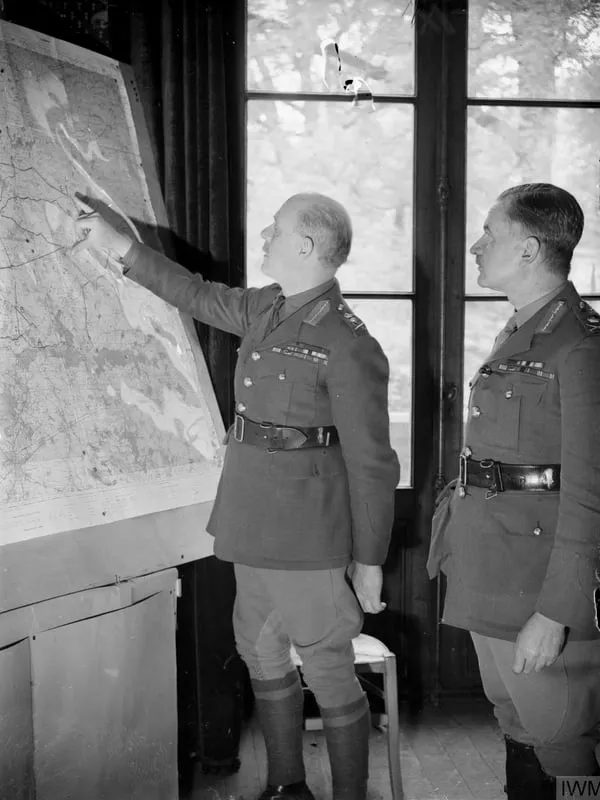
- Born:
- 10 July 1886, London
- Died:
- 31 March 1946, London
- Author:
- Łukasz
- Photo:
- War Office official photographer, Keating G (Lt), domena publiczna, Wikimedia Commons

John Standish Surtees Prendergast Vereker, 6th Viscount Gort, known simply as Lord Gort, was one of the most decorated British soldiers of the First World War and commander of the British army in France in the first year of the Second. In 1939, as Chief of the Imperial General Staff, he took part in the preparations for war with Germany; on 3 September he took command of the British Expeditionary Force, and in May 1940 he made the decision that saved most of his men: instead of continuing to fight southwards, he fell back towards the sea, to Dunkirk. Later he led the defence of besieged Malta. He still divides historians: to some he is the saviour of the BEF, to others a brave regimental officer who found himself in posts beyond his abilities.
Aristocrat and guardsman
He was born in London on 10 July 1886 into an old Anglo-Irish aristocratic family. His mother was the daughter of the novelist Robert Smith Surtees. He spent his childhood in County Durham and on the Isle of Wight, was educated at Harrow School, and in 1902, aged sixteen, inherited from his father the Irish title of Viscount Gort. In 1904 he entered the Royal Military College, Sandhurst, and in August 1905 he was commissioned as a second lieutenant in the Grenadier Guards. In May 1910 he commanded the party of guardsmen who bore the coffin of King Edward VII. Two years earlier, while hunting in Canada, he had accidentally shot a guide, who died of his wounds. The accident long cast a shadow over his reputation.
In 1911 he married his cousin Corinna Vereker. They had two sons and a daughter, but the marriage broke down and ended in divorce in 1925. The younger son died in early childhood, and the elder took his own life in 1941.
Hero of the Western Front
In August 1914 Gort went to France with the original British Expeditionary Force and took part in the retreat from Mons. For the first years of the war he was a staff officer; during the Battle of the Somme he served at British general headquarters, and in 1917 he took command of a Guards battalion, which he led at the Battle of Passchendaele. He showed exceptional courage. He was awarded the Military Cross and the Distinguished Service Order three times, was wounded several times and was mentioned in despatches nine times.
On 27 September 1918, at the Battle of the Canal du Nord, he led the 1st Battalion, Grenadier Guards, into the attack under heavy fire. Though wounded, he went in person to fetch a tank and directed it against the German positions; then, badly wounded again, he got up from his stretcher and carried on commanding until the battalion had reached its objective. More than two hundred prisoners and two batteries of guns were taken. For this action he was awarded the Victoria Cross, Britain’s highest award for gallantry. From then on he was known as “Tiger” Gort.
Between the wars
After the war he completed the Staff College at Camberley and later taught there. In 1927 he went to Shanghai, where British reinforcements had been sent to protect the International Settlement during the Kuomintang’s Northern Expedition, and reported on it to the King and the Prince of Wales. Around the turn of the 1920s and 1930s he commanded the Grenadier Guards, and then directed military training in India. He was a keen sailor and an amateur pilot. In 1935 he was promoted to major general, and in 1936 he became Commandant of the Staff College.
The real breakthrough came in 1937. The new Secretary of State for War, Leslie Hore-Belisha, considered the army’s high command ossified. In September he made Gort his Military Secretary, and on 6 December, as part of a purge of senior generals, he promoted him to full general and appointed him Chief of the Imperial General Staff, the professional head of the British Army. Gort was promoted over many more senior officers, among them John Dill, Archibald Wavell and Alan Brooke, while Edmund Ironside, passed over for the post, considered him unfit for the role.
As CIGS, Gort argued to Neville Chamberlain’s government that Britain could not avoid a commitment on the Continent. In a report of 2 December 1938, after the Munich Agreement, he stated that Germany, following the dismemberment of Czechoslovakia, was stronger than a year earlier, while the British Army lacked the forces needed to defend France. He called for full equipment for four regular infantry divisions and two armoured divisions. In the spring of 1939 the government decided to double the Territorial Army and introduce conscription, and the French were promised two corps within a month of mobilisation. His relationship with Hore-Belisha, however, grew steadily worse. The minister, advised by Basil Liddell Hart, thought Gort slow-witted, while Gort could not bear the minister’s style.
Commander of the BEF
On 3 September 1939, the day war was declared, the War Cabinet gave Gort command of the British Expeditionary Force, and Ironside took his place in London. The appointment surprised many, including Ironside himself, who had hoped for a field command. For Hore-Belisha it was a way of getting Gort out of the War Office. Gort was 53 and, as the British official history notes, had no experience of commanding large formations. Under his instructions from the government he was subordinate to the French commander of the North-Eastern Front, General Alphonse Georges, but he could appeal to London against any order he considered a danger to his army.
He arrived in France in mid-September. At the beginning of October his four divisions took over a sector of the Belgian frontier east of Lille. During the Phoney War the BEF fortified its positions, later known as the Gort Line, and grew to ten divisions. Gort, valued by his soldiers for his courage and his attention to detail, often busied himself with trivia, and at the same time he was both commander-in-chief and commander of a field army – something that would take its toll when the test came. In the winter of 1939 Hore-Belisha criticised the slow construction of fortifications in the British sector. The generals took this as an attack on their competence, and the so-called pillbox affair contributed to the minister’s dismissal in January 1940. Gort also accepted the French Dyle Plan – an advance deep into Belgium in the event of a German attack – without serious reservations, although Brooke warned that it might expose the Allied armies to envelopment.
Dunkirk
On 10 May 1940 the BEF advanced to the River Dyle according to plan. The main German blow, however, came through the Ardennes, and after breaking through the front at Sedan the German panzer divisions reached the English Channel and cut off the Allied forces in Belgium from the rest of France. On 21 May the British counter-attacked at Arras, but the French attack from the south that was meant to cut the German wedge never came. On 25 May, as the Belgian army began to collapse in the north, Gort on his own responsibility withdrew his divisions from the planned attack southwards and sent them to close the gap in the north, and then to retreat towards the coast. The decision ran counter to the wishes of the French high command and, at first, to London’s expectations as well, but it made it possible to hold the corridor to Dunkirk. By 4 June more than 330,000 British and French soldiers had been evacuated in Operation Dynamo. On 31 May, on orders from London, Gort handed over command of the rearguard to General Harold Alexander and returned home.
The judgement on this decision remains disputed to this day. Some historians believe that Gort saved the British Army, without which Britain could not have carried on the war. Others accuse him of resigning himself to retreat too quickly and of failing his allies. For Winston Churchill, Prime Minister since 10 May, the chaotic course of the campaign nevertheless settled that Gort would never again be given a command in the field.
Gibraltar, Malta, Palestine
In the summer of 1940 Gort was Inspector of Training and the Home Guard. At the end of June he flew with Duff Cooper to Rabat to encourage French ministers in North Africa to continue the fight, but the French authorities prevented any meetings. In 1941 he became Governor of Gibraltar, and in May 1942 Governor of Malta, then enduring the hardest phase of the siege. He introduced strict rationing of food and fuel, shared the hardships of the siege with the islanders and toured the island by bicycle. After the blockade was broken in the autumn of 1942, Malta became a base for the invasion of Sicily. The Maltese government presented him with a Sword of Honour. On 1 January 1943 he was promoted to field marshal, and on 20 June 1943 King George VI presented him with his baton on Malta. On 29 September 1943 Gort was present in Valletta harbour when Marshal Pietro Badoglio signed the so-called long terms of Italy’s surrender.
At the end of 1944 he became High Commissioner for Palestine and Transjordan. It was a time of growing resistance by the Jewish underground to the British authorities. Gort tried to maintain good relations with both Jews and Arabs and enjoyed the respect of both communities, but he could not stem the tension. Gravely ill, he resigned in November 1945 and returned to England. An operation at Guy’s Hospital in London revealed incurable cancer of the liver. In February 1946 he was created a viscount in the peerage of the United Kingdom. He died on 31 March 1946 at the age of 59. He was laid to rest in the Sidney family vault at Penshurst in Kent.
Significance
Gort was the kind of officer the First World War produced: a fearless battalion commander for whom the front line was his natural place. As CIGS he understood well that Britain would have to defend France on land, but he could not make up for twenty years of neglect in a year and a half. As commander of the BEF he was subordinate to a French high command that failed in 1940, and his army was too small to change the course of the campaign. His most important decision was the retreat to Dunkirk. Thanks to it, Britain preserved the cadres of an army that produced the commanders and soldiers of the later victories in Africa, Italy and Normandy.
Sources
Commanded in battles
(04)Mentioned in battles
(02)Often appears with
People who appear in the same events.
On the timeline
(26)1939
1940
January
May
- 28
- Belgium capitulatesAt 4 a.m. on 28 May 1940 the Belgian Army laid down its arms. Leopold III, defying his government, stayed as a prisoner; his ministers fought on from France.
- The War Cabinet crisisOn 25–28 May 1940 Halifax wanted to sound out peace terms via Mussolini. Churchill, backed by Chamberlain and Labour, won the government over to fighting on.