United Kingdom
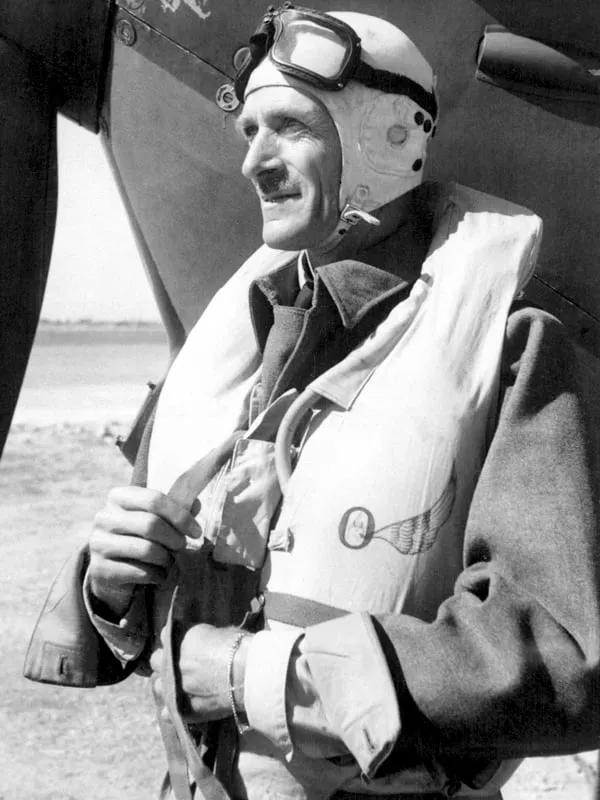
Keith Park
Commander of No. 11 Group RAF (1940), air commander on Malta (1942–1943), commander of Allied air forces in South East Asia (1945–1946)
- Born:
- 15 June 1892, Thames (New Zealand)
- Died:
- 6 February 1975, Auckland (New Zealand)
- Author:
- Natalia
- Photo:
- Royal Air Force official photographer, domena publiczna, Wikimedia Commons

Keith Park, a New Zealander serving in the British air force, was the commander who directed the fighting in the Battle of Britain most directly. His No. 11 Group defended London and south-east England, the area that bore the brunt of the German attacks. Throughout the summer and autumn of 1940 Park decided from his operations room at Uxbridge which squadrons to scramble, when and against whom, and in between he flew his own Hurricane round the airfields to see how his men were coping. After the victory, like his superior Hugh Dowding, he was removed from his command, but two years later, in a similar role, he saved Malta.
Seaman and gunner
Keith Rodney Park was born on 15 June 1892 in Thames on New Zealand’s North Island, the ninth child of James Park, a Scottish geologist and director of the local school of mines, and Frances Rogers, a New Zealander. His parents separated when he was a boy, and the children were brought up by their father, who moved to Dunedin as a university lecturer. Keith loved boats from childhood. After school he went to work in coastal shipping as a purser on passenger steamers and colliers sailing along the coasts of New Zealand, to Australia and to the Pacific islands. His family called him “Skipper”. At the same time he served in the territorial artillery.
In December 1914 he enlisted in the New Zealand Expeditionary Force and sailed for the Middle East as an artillery corporal. On 25 April 1915 he landed with a howitzer battery at Anzac Cove on the Gallipoli peninsula. For distinguishing himself in the trench fighting he was commissioned as a second lieutenant in July. He then made an unusual decision: he transferred from the New Zealand forces to the British Army and, as an artillery officer in the British 29th Division, fought until the end of the Gallipoli campaign, from which he was evacuated in January 1916.
In the spring of 1916 his division was sent to the Somme. On 21 October, during the Battle of the Somme, a German shell blew him off his horse. Wounded, he was declared unfit for service in the field, which meant that he could not ride a horse – but nothing prevented him from flying. In December 1916 he transferred to the Royal Flying Corps.
Fighter ace
After training and a few months as an instructor, in July 1917 Park joined No. 48 Squadron in Flanders, which flew Bristol F.2 Fighter two-seaters. He quickly became its most successful pilot. In August, for a fight in which he and his gunner destroyed one German aircraft and sent three others down out of control, he was awarded the Military Cross, and soon afterwards a bar to it. On 5 September 1917 over Ostend he shot down the pilot Franz Pernet, stepson of General Erich Ludendorff. He also received the French Croix de Guerre. In the spring of 1918, during the great German offensive, he took command of No. 48 Squadron as a major; by then he was the only pilot left from the previous year. The number of his victories varies from source to source: the squadron’s records credited him with twenty, the Air Ministry with fourteen, while his biographer Vincent Orange considered eleven certain. After the war he was awarded the Distinguished Flying Cross. On 25 November 1918 he married Dorothy Parish, a nurse, in London; they had two sons.
Between the wars
In 1919 Park received a permanent commission in the Royal Air Force. For twenty years he moved through a succession of command and staff posts: he commanded a technical school, attended the first course at the RAF Staff College at Andover (together with Sholto Douglas and Charles Portal, both later Chiefs of the Air Staff), served in Egypt and on the staff of the Air Defence of Great Britain, and commanded No. 111 Fighter Squadron and the airfield at Northolt. In 1929 he worked on Dowding’s staff during the first trials of controlling fighters from the ground. From 1934 he was air attaché for South America, based in Buenos Aires, where he promoted British aircraft. After his return he attended the Imperial Defence College and commanded the fighter station at Tangmere.
In 1938 Park became Senior Air Staff Officer at Fighter Command, in effect Dowding’s deputy at Bentley Priory. The two worked together exceptionally well. Park improved the fighter control system by persuading Dowding that the operations tables should receive only verified and collated reports rather than every sighting at once. He also wrote a manual of fighter tactics. He argued in vain for replacing the machine guns of the Hurricanes and Spitfires with heavier armament and for abandoning the rigid three-aircraft formations.
Dunkirk and the Battle of Britain
On 20 April 1940 Park took command of No. 11 Group, responsible for the defence of London and south-east England. The appointment rankled with the commander of the neighbouring No. 12 Group, Trafford Leigh-Mallory, with whom Park was already on bad terms. A month later Park directed the fighter cover for the evacuation from Dunkirk. His squadrons fought dozens of kilometres from their own bases, without radar support and with only a few tens of minutes over the beaches. Park himself flew his Hurricane over Dunkirk to assess the situation, and persuaded his superiors that instead of providing continuous cover with weak forces they should send stronger patrols of two to four squadrons.
In the Battle of Britain, which the British date from 10 July 1940, No. 11 Group, which had some twenty squadrons that summer, faced the bulk of the Luftwaffe. Within minutes Park had to judge which of the formations approaching from France were bombers and which were merely decoys made up entirely of fighters, and to scramble his squadrons in time for them to gain height before the enemy reached the target. He usually sent them up singly or in pairs, against the bombers rather than the escorting fighters, and made sure that they were never all on the ground refuelling at the same time. In July, during the fighting over the convoys in the English Channel, he sent small formations over the ships, saving his strength for the main battle.
In August and early September, when the Germans were bombing No. 11 Group’s sector airfields, Park went through his hardest times. His airmen were exhausted and airfields such as Biggin Hill were wrecked. Park toured them by car and by air in his distinctive white overalls, talking to pilots and ground crews. The switch of the German attacks to London on 7 September gave him a respite; he later said that the Germans lost the Battle of Britain when they stopped bombing his airfields and started bombing the capital. On 15 September, the day of the largest daylight raid on London, Winston Churchill was in his operations room at Uxbridge. When the prime minister asked about reserves, Park replied that there were none: every squadron was in the air. The attacks were beaten off, and 15 September became Battle of Britain Day in Britain.
Throughout the battle Park was locked in a dispute with Leigh-Mallory. No. 12 Group was supposed to protect No. 11 Group’s airfields while its squadrons were fighting over Kent, but Leigh-Mallory preferred to assemble several squadrons into a single “Big Wing”, which took so long that Park’s airfields had already been bombed. On 17 October, at a meeting at the Air Ministry, Leigh-Mallory’s views won support and Park had to defend his tactics.
Removal and Malta
In November Dowding was dismissed, and in December 1940 Park handed No. 11 Group over to Leigh-Mallory. Officially he needed a rest; he himself was convinced that he had fallen victim to intrigue. The future Chief of the Air Staff, Arthur Tedder, later said that if any one man won the Battle of Britain, it was Park. For a year Park commanded No. 23 Group, a training formation, and at the beginning of 1942 he became air commander in Egypt, responsible for the defence of the Nile Delta.
On 14 July 1942 he took command of the air forces on Malta, at that time one of the most heavily bombed places in the world. He arrived by flying boat during an air raid. Instead of fighting over the island, he introduced a forward interception plan: the Spitfires were to break up the formations of German and Italian bombers over the sea before they reached their target. Within a few weeks the daylight raids had practically ceased. Park then switched Malta’s air forces to the offensive: his bombers and torpedo aircraft attacked the convoys to North Africa, and in 1943 he directed from the island the air forces supporting the landings in Sicily. He was knighted.
In January 1944 he became Air Officer Commanding-in-Chief of the RAF in the Middle East, and in February 1945 commander of the Allied air forces in South East Asia Command. His aircraft supplied from the air General William Slim’s Fourteenth Army on its march through Burma to Rangoon. On 12 September 1945 he was present in Singapore at the signing of the surrender of the Japanese forces in the region. In 1946 he served for a few weeks as acting Supreme Allied Commander in South East Asia.
Final years
On 20 December 1946 Park retired as an air chief marshal. He returned to New Zealand, where he represented the aircraft company Hawker Siddeley in the Pacific region and campaigned for the construction of an international airport at Auckland. For three terms, from 1962, he sat on Auckland City Council. In 1951 his younger son, a policeman in Malaya, was killed on duty. In 1969 Park saw the film Battle of Britain, in which he was played by Trevor Howard; he found the scene of his quarrel with Leigh-Mallory less dramatic than the real thing. He died on 6 February 1975 in Auckland. His ashes were scattered from an aircraft over the Waitematā Harbour.
Significance
Park was both the executor and a co-creator of the defence system devised by Dowding. It was he who in practice conducted the Battle of Britain day by day, and it was his decisions in the most difficult weeks of August and September that ensured Fighter Command was not destroyed and the Luftwaffe did not win the air superiority without which Hitler could not risk an invasion. His tactics, criticised by the advocates of the “Big Wing”, proved right in the conditions of south-east England, where about twenty minutes passed between the detection of the enemy and his arrival. On Malta he showed that he could not only defend but also go over to the attack. For many years his achievements remained in the shadows. Only in 2009 did a statue of him stand temporarily on the Fourth Plinth in Trafalgar Square, and in 2010, on the 70th anniversary of the battle, a permanent bronze statue was unveiled in Waterloo Place in London.
Sources
Commanded in battles
(02)Mentioned in battles
(01)Often appears with
People who appear in the same events.