- Category:
- Military operations
- Front:
- Mediterranean
- Date:
- 18 November 1941
- Author:
- Natalia
- Battle:
- Operation Crusader
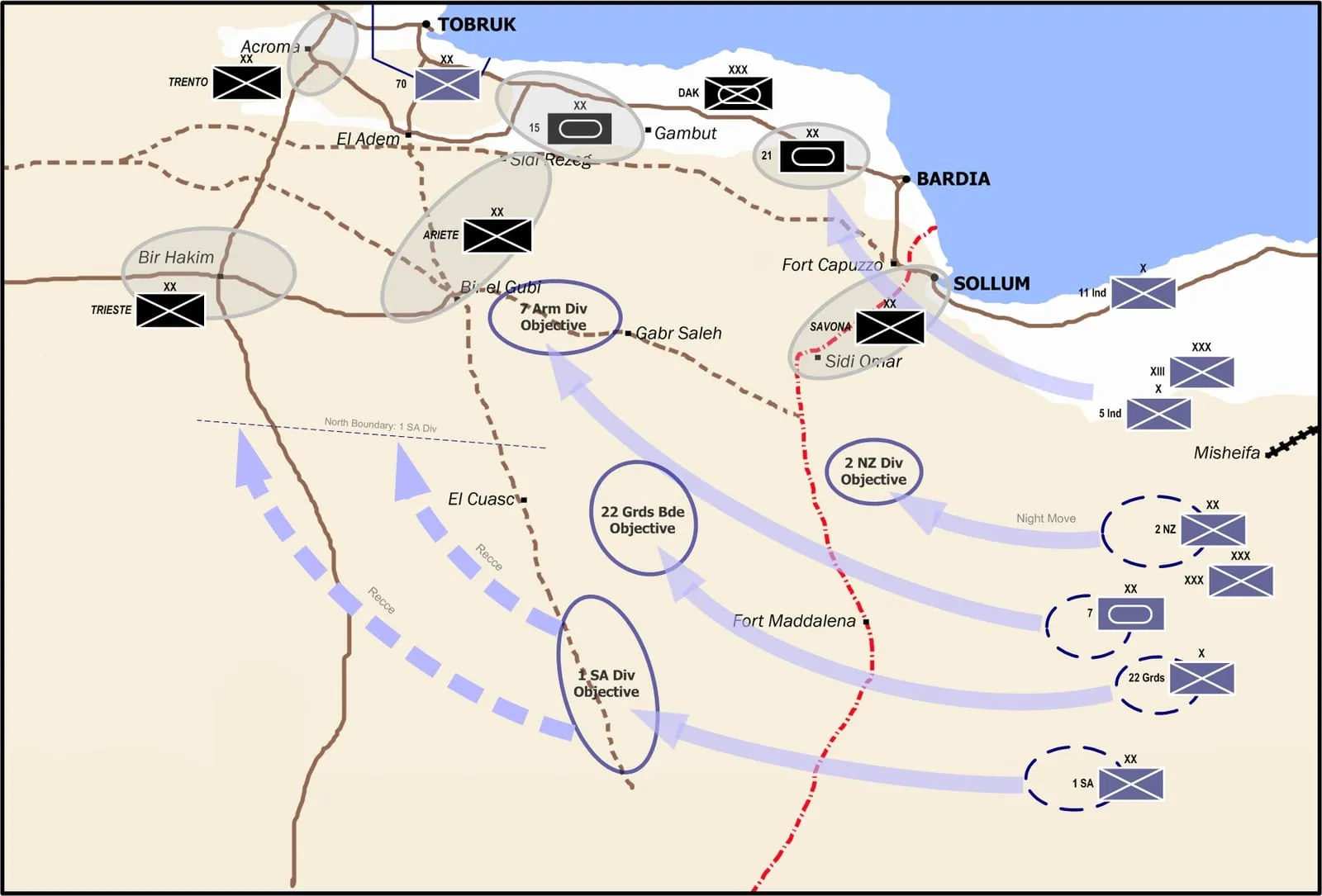
Before dawn on 18 November 1941 the British Eighth Army under Lieutenant General Alan Cunningham moved out of the desert of western Egypt and crossed the Libyan frontier. So began Operation Crusader, the first great offensive by the forces of the British Empire against the German and Italian armies in North Africa since Erwin Rommel had taken Cyrenaica from the British in the spring. Its aims were to destroy the German armoured divisions, to break the siege of Tobruk, which had lasted since April, and to recover the whole of eastern Libya. On the night before the attack a violent storm with torrential rain swept over the desert, turning the Axis airfields to mud and grounding the reconnaissance aircraft. Tens of thousands of soldiers and hundreds of tanks entered Libya unseen, and the first day of the offensive passed almost without fighting.
What actually happened
War chronologies often record under 18 November that Commonwealth forces and their allies entered Libya and, “at least temporarily”, broke the siege of Tobruk. The first part of this is accurate; the second compresses several weeks of fighting into one. Nobody reached Tobruk on 18 November: by the evening the leading elements of the Eighth Army had halted several dozen kilometres from the fortress. Contact with the garrison was made only on the night of 26–27 November, when the New Zealanders met troops breaking out of Tobruk on the Ed Duda ridge. The corridor was narrow, and on 1 December the Germans cut it again. The ring around the fortress finally fell apart only when Rommel withdrew his forces from Tobruk at the beginning of December; in Poland the end of the siege is usually dated to 10 December, when soldiers of the Carpathian Brigade took the hill of Ras el Medauar. The 18th of November itself brought the crossing of the frontier, and the offensive was preceded by night-time commando operations.
Cunningham’s plan
The offensive had been in preparation since the summer. After the failure of Operation Battleaxe, General Claude Auchinleck became Commander-in-Chief Middle East and, despite pressure from Winston Churchill, postponed the attack until he had assembled enough tanks, men and supplies. In the autumn the Eighth Army was formed in western Egypt from British, New Zealand, South African and Indian troops. According to British figures it numbered some 118,000 men and about 770 tanks, including those in Tobruk. Many of them were new: the British Crusader cruiser tanks, which gave the operation its name; the American light Stuarts, going into action for the first time; and the Valentine infantry tanks, also making their combat debut. The air forces in the Western Desert and on Malta, commanded in the field by Air Vice-Marshal Arthur Coningham, had, according to the British official history, up to about 720 front-line aircraft.
The army had two corps. XXX Corps under Lieutenant General Willoughby Norrie was its armoured fist: Major General William Gott’s 7th Armoured Division with the 7th and 22nd Armoured Brigades, the independent 4th Armoured Brigade with more than 160 Stuarts, and two brigades of the 1st South African Division. XIII Corps under Lieutenant General Reade Godwin-Austen comprised the infantry: Major General Bernard Freyberg’s 2nd New Zealand Division, Major General Frank Messervy’s 4th Indian Division, and the 1st Army Tank Brigade with its infantry tanks.
The plan was for XXX Corps to cross the frontier far to the south, bypass the Axis fortifications that ran from the coast at Sollum and the Halfaya Pass through Fort Capuzzo to Sidi Omar, and wheel north-west towards Tobruk. Cunningham expected that Rommel, threatened in the rear, would throw his two armoured divisions against him, and that the British, with their numerical superiority, would destroy them in a single great battle in the open desert. The chosen site for this clash was the area of Gabr Saleh, an insignificant rise beside the desert track known as the Trigh el Abd, roughly halfway between the frontier and Tobruk. Only once the German tanks had been destroyed was XXX Corps to advance on Tobruk and join hands with the garrison, which would strike out to meet it. Meanwhile XIII Corps was to outflank and cut off the frontier positions and then push west through Bardia.
The plan had a weakness that historians still point to: Gabr Saleh meant nothing to the enemy. There was no base or road there that the Germans would have to defend, so the whole concept depended on whether Rommel chose to come to the designated battlefield. In addition, the 4th Armoured Brigade was at the same time to cover the left flank of XIII Corps’ infantry, which tied it to the eastern part of the battlefield and split the British armour before anyone had met the enemy.
The preparations were accompanied by a carefully devised deception plan. The Germans and Italians were to believe that the British would not be ready before December and that the main blow would fall far to the south, from the oasis of Jarabub on the edge of the Great Sand Sea. This impression was reinforced by a detachment called Oasis Force – the 29th Indian Brigade and South African armoured cars – which was to pose as the vanguard of a great outflanking movement across the desert towards the oasis of Jalo. Troop movements near the frontier took place at night, and vehicles and supply dumps were camouflaged against air observation.
On the other side of the front
The Axis forces in Libya were formally subordinate to the Italian commander-in-chief, General Ettore Bastico. Rommel, a General der Panzertruppe since the summer, commanded Panzer Group Africa, which comprised General Ludwig Crüwell’s Afrika Korps with the 15th and 21st Panzer Divisions, the German Afrika Division for special purposes, and the Italian XXI Corps with four infantry divisions. South of Tobruk, at Bir el Gubi, stood the Italian XX Motorised Corps with the Ariete armoured division and the Trieste motorised division, subordinate not yet to Rommel but to Bastico. The frontier fortifications were held by the Italian Savona Division together with German units. According to the British official history the Afrika Korps had some 250–260 tanks, including several dozen light ones, and the Ariete 146 Italian M13/40 medium tanks. In the air the British had the advantage: in mid-November the German air commander in Africa had about 140 aircraft, of which roughly 76 were serviceable, while the Italian 5th Air Fleet had some 440 machines in Libya, about 300 of them serviceable.
Rommel was not thinking of defence at the time. For months he had been preparing a general assault on Tobruk, which denied him a port he needed for supply and threatened the rear of any operation he might undertake towards Egypt. His two armoured divisions stood between Tobruk and Bardia, ready either to assault the fortress or to beat off a relief attempt, while the Italian divisions outside the fortress stockpiled ammunition. The date of the attack was postponed several times because of supply problems: on the night of 8–9 November Force K from Malta destroyed the entire Duisburg convoy, and British ships and aircraft were sinking an ever larger share of the vessels bound for Libya. In mid-November the assault was set for the last ten days of the month; the sources give dates between 21 and 24 November.
At the beginning of November Rommel flew to Rome to obtain the Italian high command’s consent to the assault and to press for better supplies. He also spent his fiftieth birthday there with his wife, on 15 November. The Italians warned that the British might strike first, but Rommel considered these fears exaggerated. He returned to Africa via Athens and, according to most accounts, reached his headquarters only on 18 November, the day the British offensive began. British intelligence knew from decrypted signals that the general was not in Africa, but this information did not reach in time the men who were just about to go looking for him.
The raid on “Rommel’s headquarters”
The offensive was preceded by two daring and at the same time unsuccessful special operations. On the night of 16–17 November a small new parachute unit under Lieutenant David Stirling, L Detachment of the Special Air Service Brigade, was to drop near the airfields at Gazala and Tmimi and destroy the aircraft there. The parachutists jumped in a gale, were scattered, lost most of their equipment and attacked no target at all. Of the several dozen men, about twenty, according to various sources, reached the rendezvous, where they were picked up by men of the Long Range Desert Group. This disaster marked the beginning of one of the most famous special forces in the world: from then on the SAS travelled to its targets in LRDG vehicles.
Far better known was the second raid, Operation Flipper. Two submarines, Torbay and Talisman, carried some sixty commandos from Alexandria, mostly from the former No. 11 (Scottish) Commando, under Lieutenant Colonel Robert Laycock. On the night of 14–15 November, in heavy seas, they landed on the coast of Cyrenaica, several hundred kilometres behind the front line. Only some of the men got ashore, so of the four planned attacks – on Rommel’s supposed headquarters, on a radio station at Apollonia, on an Italian communications centre near Cyrene and on the headquarters of an Italian division – three remained. The most difficult was taken on by the 24-year-old Lieutenant Colonel Geoffrey Keyes, son of Admiral Roger Keyes, who had already won the Military Cross for the fighting on the Litani in Syria. For two nights his party marched through pouring rain across the Jebel Akhdar mountains towards a building in Beda Littoria (today Beida) where, according to reconnaissance, Rommel was living.
Just before midnight on 17–18 November Keyes and two companions forced their way into the building. The sentry who opened the door was shot, a gunfight broke out in the corridor and Keyes fell mortally wounded. The attack had been pointless from the start: the house had long served as the quartermaster’s headquarters of the Panzer Group, and Rommel, who had moved his headquarters closer to Tobruk, was that night far from Libya. According to German records four Germans were killed. Almost all the commandos were captured; only Laycock and Sergeant Jack Terry, who reached their own lines after 37 days, and one of the men guarding the beach made their way across the desert to the British lines. On Rommel’s orders Keyes was buried with military honours in the local cemetery, beside the German dead.
Keyes was awarded a posthumous Victoria Cross. The citation, however, was written by Laycock, who had not witnessed the fighting in the building, and historians who have studied the raid, among them Michael Asher and James Owen, point out that many of its statements do not match the accounts of participants or the German records. According to their findings Keyes may have been killed by a bullet from one of his own men. British propaganda presented the raid as a heroic attempt on Rommel’s life. In reality it was the first of many demonstrations of how hard it was to strike at a commander who was rarely at his headquarters and spent most of his time driving among his troops in the front line.
18 November
The main forces set off before dawn. The columns of XXX Corps passed through the old Italian frontier wire in the area of Fort Maddalena, some 80 kilometres south of Sidi Omar, and wheeled north-west. On the left flank went the 22nd Armoured Brigade, in the centre the 7th Armoured Brigade with the 7th Armoured Division’s Support Group, on the right the 4th Armoured Brigade, and behind them the South Africans. XIII Corps took up positions facing the frontier fortifications: the 7th Indian Brigade stood before Sidi Omar, while the New Zealand Division crossed the frontier and prepared to outflank the Axis positions from the west. British aircraft circled over the columns, while the German and Italian machines stood on waterlogged airfields: the night’s downpour, which flooded the wadis and the coastal roads, meant that Axis air reconnaissance detected nothing all day.
There was no serious fighting. The British spearheads met only German armoured cars and reconnaissance patrols, which fell back to the north. In the evening the tanks of XXX Corps halted around and to the south of Gabr Saleh, where according to the plan they were to wait for the German counter-attack. In the units Churchill’s order of the day was read out, announcing that for the first time British and Empire troops would meet the Germans with an ample supply of modern weapons, and declaring: “The Desert Army may add a page to history which will rank with Blenheim and with Waterloo.”
The counter-attack did not come. Rommel, back at his headquarters, took the reports of movement near the frontier for a reconnaissance in force and did not want to interrupt the preparations for the assault on Tobruk. Crüwell proposed moving the 15th Panzer Division south, but Rommel held the armoured divisions where they were. Only the next day, as the picture began to clear, did he allow a battle group of the 21st Panzer Division to be sent towards Gabr Saleh. Meanwhile in Tobruk the garrison under Major General Ronald Scobie – the British 70th Division, Brigadier General Stanisław Kopański’s Polish Independent Carpathian Rifle Brigade, the Czechoslovak 11th Infantry Battalion and the tanks of the 32nd Army Tank Brigade – awaited the order for a sortie that was to go out to meet the approaching armour.
The first day was thus a complete success for the British: surprise was total and losses negligible. At the same time, on the evening of 18 November, the weakness of the plan became apparent. The enemy had not done what was expected of him, and Cunningham had to decide what to do next. Instead of waiting, the next day he sent his armoured brigades off in different directions: the 22nd Brigade against the Ariete at Bir el Gubi, the 7th Brigade towards the airfield at Sidi Rezegh, a dozen or so kilometres from the Tobruk perimeter, while the 4th Brigade remained at Gabr Saleh. When the German armoured divisions finally moved, they met the British brigades one at a time.
Place in the war
Operation Crusader lasted until the end of December 1941 and was one of the most chaotic battles of the war in Africa. Over the following days Rommel destroyed one British armoured brigade after another at Sidi Rezegh, wiped out the 5th South African Brigade on 23 November and the next day set off with his tanks towards the Egyptian frontier, spreading panic in the rear of the Eighth Army. Auchinleck refused to break off the offensive and on 26 November replaced Cunningham with General Neil Ritchie. Freyberg’s New Zealanders broke through to Tobruk, and Rommel, short of fuel and ammunition, withdrew in December to Gazala and then all the way to El Agheila on the border between Cyrenaica and Tripolitania. The encircled Axis frontier garrisons surrendered in January 1942: Bardia on 2 January and the positions at the Halfaya Pass on 17 January. According to the most frequently cited figures, the Eighth Army lost some 17,700 killed, wounded and missing in the operation, and the Axis forces about 38,000, a large proportion of them prisoners.
The operation is regarded as the first great British land victory over German forces in this war and Rommel’s first defeat. It relieved Tobruk and removed the threat to Egypt and the Suez Canal, and the crisis in Libya prompted Hitler to transfer more U-boats to the Mediterranean and, in December, an entire air corps from the Eastern Front. The victory, however, proved short-lived: the British command had not yet learned to co-ordinate tanks, infantry and artillery, and on 21 January 1942 Rommel, reinforced by convoys, went over to the counter-offensive and drove the Eighth Army back to Gazala. The Polish Carpathian Brigade, which had left the fortress once the siege was over, fought on in December in the pursuit of Rommel at Gazala.
Sources
Meanwhile
(04)Elsewhere, within a week.
- 15 November 1941 · Eastern FrontThe November offensive on MoscowOn 15 November 1941, with the ground frozen, Army Group Centre resumed its advance on Moscow. Panzer groups were to bypass the capital to north and south.
- 21 November 1941 · Eastern FrontThe Germans take RostovOn 21 November 1941 Kleist’s 1st Panzer Army took Rostov-on-Don, the gateway to the Caucasus. But the Soviet 37th Army was already striking from the north.
- 22 November 1941 · DiplomacyThe British ultimatum to FinlandOn 22 November 1941 Stalin received Churchill’s pledge of war on Finland if it did not stop fighting. On 28 November London sent Helsinki an ultimatum.
- 23 November 1941 · DiplomacyThe Americans in SurinameIn November 1941 the USA and the Dutch government-in-exile agreed to send American troops to Suriname to protect its bauxite mines.
Related events
(04)The same battle, people or subject.
- 24 November 1941 · MediterraneanRommel’s dash to the wireOn 24 November 1941 Rommel drove his tanks to the Egyptian frontier, spreading panic behind the Eighth Army. Meanwhile the New Zealanders reached Tobruk.
- 22 November 1941 · MediterraneanThe Battle of Sidi RezeghOn 22 and 23 November 1941 the Afrika Korps retook Sidi Rezegh airfield, shattered British armoured brigades and destroyed the 5th South African Brigade.
- 21 October 1941 · MediterraneanBefore Operation CrusaderIn autumn 1941 the British readied the Eighth Army in Egypt to relieve Tobruk. New Zealanders trained in the desert; Fort Capuzzo was still held by the Axis.
- 16 December 1941 · MediterraneanRommel withdraws from GazalaOn 16 December 1941 Rommel, facing encirclement at Gazala, began retreating across Cyrenaica against Italian wishes. On 24 December the British took Benghazi.