1940–1943: The North African campaign
Operation Crusader
- Dates:
- 18 November – 30 December 1941
- Front:
- Mediterranean
- Location:
- Eastern Cyrenaica and Marmarica (Libya): the Libyan–Egyptian frontier from Sollum, the Halfaya Pass and Fort Capuzzo to Sidi Omar; the plateau south-east of Tobruk with Sidi Rezegh airfield, the Belhamed and Ed Duda ridges and Bir el Gubi; then the Gazala line and the Jebel Akhdar as far as Agedabia on the Gulf of SirteOn the battle map →
- Sides:
- United Kingdom, New Zealand, South Africa, British India, Australia, Poland and CzechoslovakiaClaude Auchinleck, Alan Cunningham, Neil RitchieNazi GermanyErwin RommelItalyEttore Bastico
- Result:
- Allied victory. After heavy and chaotic armoured battles at Sidi Rezegh the Eighth Army withstood Rommel's counter-strokes, linked up with the Tobruk garrison on 27 November and in December forced the German and Italian forces to retreat through Gazala to Agedabia and El Agheila. The siege of Tobruk was over and Cyrenaica was once again in British hands. The victory was incomplete, however: the British lost more tanks than the enemy, failed to destroy the Afrika Korps, and in January 1942 Rommel counter-attacked and regained western Cyrenaica.
- Author:
- Natalia
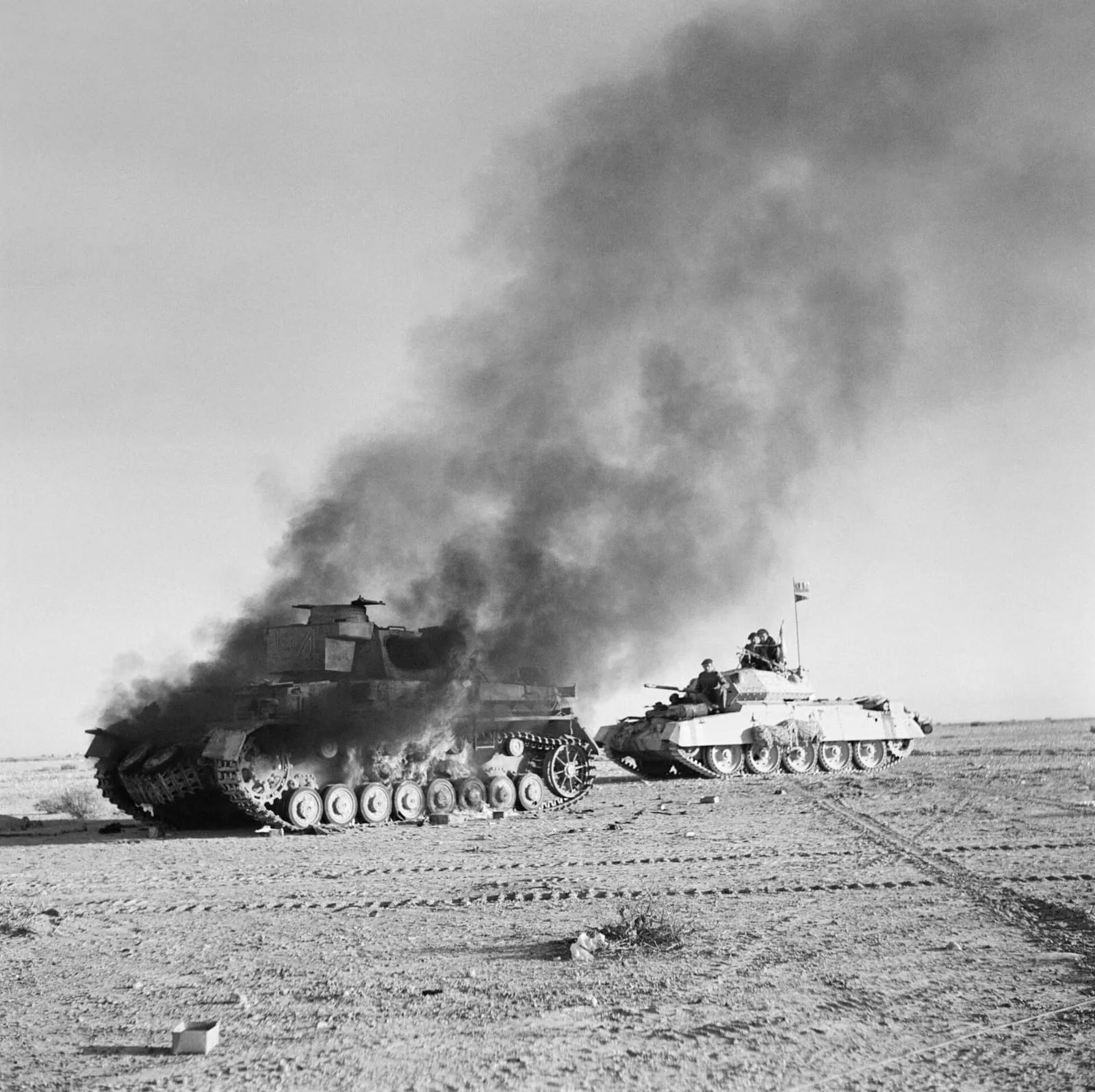
Operation Crusader was the British Army’s first victory over German land forces in the war and the largest armoured battle yet fought in the desert. On 18 November 1941 Lieutenant General Alan Cunningham’s newly formed Eighth Army – British, New Zealanders, South Africans and Indians, and in besieged Tobruk also Poles, Czechoslovaks and the last Australians – crossed the Libyan frontier. Its task was to destroy the German panzer divisions, break the siege of Tobruk and retake Cyrenaica, lost in the spring in Rommel’s first offensive. Facing it stood Panzer Group Africa under General der Panzertruppe Erwin Rommel – the German Afrika Korps and several Italian divisions – together with an Italian motorised corps subordinated to the Italian Commander-in-Chief in Libya, General Ettore Bastico.
The battle went quite differently from the British plan. In the first week the dispersed British armoured brigades were defeated one after another in the fighting for Sidi Rezegh airfield, and on 23 November, the German Sunday of the Dead, the Afrika Korps destroyed the 5th South African Brigade. Cunningham wanted to break off the offensive, but the Commander-in-Chief Middle East, General Claude Auchinleck, ordered the fighting to continue and on 26 November handed the Eighth Army to General Neil Ritchie. Rommel’s dash to the Egyptian frontier caused panic in the British rear but decided nothing, and meanwhile General Bernard Freyberg’s New Zealand Division fought its way through to Tobruk. After another ten days of bitter fighting, an exhausted Rommel, starved of supplies, abandoned the siege of the fortress and withdrew across the whole of Cyrenaica.
Name and dates
“Crusader” was the code name of the offensive plan that Auchinleck had been preparing since the summer of 1941. The same name was borne by the new British cruiser tank, the Mk VI Crusader, which received its baptism of fire in this very battle with the 22nd Armoured Brigade. In German and Italian literature the fighting of November and December 1941 often appears as the winter battle in Marmarica or the Battle of Tobruk, and its hardest phase as the Battle of Sidi Rezegh.
The start is taken to be 18 November 1941, when before dawn XXX and XIII Corps crossed the Libyan–Egyptian frontier; the sources agree on this date. The end is a matter of convention. Most English-language studies take 30 December 1941 as the end of the operation, when the armoured fighting at El Haseia near Agedabia, the last clash of the pursuit across Cyrenaica, came to an end. Some authors end the battle as early as 7 December, with Rommel’s withdrawal from Tobruk; others around 6 January 1942, when the Axis forces took up positions at El Agheila, or on 17 January, when the last Axis garrison on the Egyptian frontier, at the Halfaya Pass, surrendered. The siege of Tobruk, which was the objective of the whole operation, ended in the course of it: on 27 November the fortress garrison linked up with the New Zealanders at Ed Duda, and the ring finally broke up on 7–10 December.
Background
After the failure of Operation Battleaxe in June 1941, Prime Minister Winston Churchill replaced General Archibald Wavell with Auchinleck and expected a swift offensive in the desert from him. Auchinleck refused to act before the autumn. He considered that he first had to secure Syria, Iraq and Persia, and that to retake Cyrenaica he needed a substantial superiority in tanks, including a reserve to cover losses and breakdowns, as well as an army trained for desert warfare. Throughout the summer and autumn convoys sailed round Africa to Egypt with tanks, lorries, guns and new divisions. In September the Eighth Army headquarters was created, under Cunningham, the victor of the East African campaign, who had no experience of commanding armoured forces.
On the other side Rommel, commander of Panzer Group Africa since August, was thinking above all of taking Tobruk. The fortress in his rear tied down several divisions and denied him a port through which he could have supplied his troops on the Egyptian frontier. All his supplies had to travel hundreds of kilometres by lorry from Benghazi and Tripoli, while shipments from Italy were being sunk by ships and aircraft from Malta. According to tallies based on Italian data, in the autumn of 1941 roughly a quarter of the ships bound for Libya went to the bottom, and on the night of 8/9 November the British Force K from Malta destroyed the entire Duisburg convoy. Even so, Rommel was amassing artillery and stocks for a general assault on Tobruk, which was postponed several times and was finally planned for some day between 21 and 24 November. He did not believe the British would strike first. In the first half of November he was in Italy, where he was seeking approval for the assault and where on 15 November he celebrated his fiftieth birthday; he returned to Africa by way of Athens only on 18 November, the day the British offensive began.
The British knew of the planned assault from German and Italian signals encrypted with Enigma that they had broken, and the command prepared a deception plan intended to convince the enemy that the offensive would not be ready before December and would come far to the south, through the oasis of Jarabub. Rommel, however, also had a good source of information: throughout the autumn the German 621st Radio Intercept Company was reading poorly secured British field communications. The deception plan succeeded – the offensive took the Axis command completely by surprise.
Forces and plans
According to British tallies the Eighth Army numbered some 118,000 men. It had two corps. Lieutenant General Willoughby Norrie’s XXX Corps was the armoured fist: Major General William Gott’s 7th Armoured Division with the 7th and 22nd Armoured Brigades and Brigadier Jock Campbell’s Support Group, the independent 4th Armoured Brigade with American Stuart light tanks, and the 1st South African Division, newly arrived from East Africa. Lieutenant General Alfred Reade Godwin-Austen’s XIII Corps grouped the infantry: Freyberg’s 2nd New Zealand Division, Major General Frank Messervy’s 4th Indian Division and the 1st Army Tank Brigade with Matilda and Valentine infantry tanks. The 2nd South African Division stood in reserve, and far to the south, at the oasis of Jarabub, a small group called Oasis Force was to draw the enemy’s attention.
In Tobruk the garrison of Major General Ronald Scobie was waiting: the British 70th Infantry Division, the 32nd Army Tank Brigade, Brigadier General Stanisław Kopański’s Polish Independent Carpathian Rifle Brigade, Lieutenant Colonel Karel Klapálek’s Czechoslovak 11th Infantry Battalion, placed under the Polish brigade since October, and the Australian 2/13th Battalion, which had not managed to leave the fortress in time. Including Tobruk, the Eighth Army had some 770 tanks, with many more in reserve and in the workshops. Air Marshal Arthur Tedder’s air forces in the Western Desert and on Malta numbered up to about 700 front-line aircraft.
In General Ludwig Crüwell’s Afrika Korps Rommel had two panzer divisions – General Walter Neumann-Silkow’s 15th and General Johann von Ravenstein’s 21st – with some 250–260 tanks, including several dozen light ones, as well as the Afrika Division, assembled from various units and renamed the 90th Light Division during the battle. Outside Tobruk stood the Italian XXI Corps with the Bologna, Brescia, Pavia and Trento infantry divisions, while the Egyptian frontier, from Bardia through Sollum and the Halfaya Pass to Sidi Omar, was held by the strongpoints of the Savona Division and German units. South of the fortress, at Bir el Gubi, stood General Gastone Gambara’s Italian motorised corps with the Ariete armoured division (146 M13/40 medium tanks) and the Trieste motorised division; until 23 November it was subordinate not to Rommel but to Bastico. In the air, according to the British official history, the Axis forces in Libya had some 76 serviceable German aircraft and about 300 Italian ones – clearly fewer than the British.
Cunningham’s plan rested on the assumption that Rommel, threatened at Tobruk and on the frontier, would throw his tanks into a counter-attack, and that the British armour would destroy them in one great battle in the open desert. XXX Corps was to outflank the frontier defences from the south, take up position in the Gabr Saleh area and await the German attack there, and after its victory advance on Tobruk, whose garrison was to strike out to meet it. XIII Corps meanwhile was to cut off and capture the Axis frontier positions. The plan had weak points: XXX Corps had little infantry, the armoured brigades had differing equipment and differing experience, and the 4th Armoured Brigade also had to cover the left flank of XIII Corps.
A few days before the offensive the British sent two special operations behind the front line. On the night of 16/17 November parachutists of Captain David Stirling’s newly formed SAS were to destroy aircraft on the airfields at Gazala and Tmimi, but a storm scattered them across the desert, and of some 55 men fewer than half returned. On the night of 17/18 November commandos under Lieutenant Colonel Geoffrey Keyes, in Operation Flipper, raided a house at Beda Littoria believed to be Rommel’s headquarters. Rommel was not there, and Keyes was killed; he was posthumously awarded the Victoria Cross. Of several dozen commandos, two made it back to British lines, among them the commander of the whole operation, Lieutenant Colonel Robert Laycock.
Course of the battle
The advance and the first clashes (18–20 November)
On the night of 17/18 November a violent storm with a downpour swept over the desert, waterlogging the airfields and grounding the aircraft of both sides. Before dawn XXX Corps crossed the frontier wire near the old Italian fort of Maddalena, a few dozen kilometres south of Sidi Omar, and set off north-westwards, while XIII Corps worked round the frontier positions from the south. The advance took the enemy by surprise: Rommel, convinced that he was dealing with a reconnaissance in force, did not allow Crüwell to throw his tanks into a counter-attack on the first day, and was himself still thinking of the assault on Tobruk. The British tanks halted at Gabr Saleh and waited for an enemy who did not come.
So on 19 November Norrie divided his forces. The 22nd Armoured Brigade, which had only just arrived from Britain with its new Crusaders, attacked the Italian Ariete Division at Bir el Gubi. The Italians, dug in with their anti-tank guns, repulsed the attack; according to British tallies the brigade lost some 25 tanks destroyed and many damaged, and the Italians about 34. Meanwhile the 7th Armoured Brigade and the Support Group reached Sidi Rezegh airfield, a dozen or so kilometres south-east of the Tobruk perimeter, without a fight and captured a dozen or so aircraft on the ground. In the east part of the 21st Panzer Division clashed at Gabr Saleh with the 4th Armoured Brigade, which on 19 and 20 November, fighting both German panzer divisions, lost several dozen Stuarts. The three British armoured brigades were thus fighting separately, dozens of kilometres apart – exactly what the plan had been meant to avoid. On the evening of 20 November Rommel realised that this was a major offensive aimed at Tobruk, and sent the full strength of the Afrika Korps towards Sidi Rezegh.
Sidi Rezegh and the sortie from Tobruk (21–22 November)
At dawn on 21 November the Tobruk garrison struck south-eastwards out of the fortress towards the Ed Duda ridge to join hands with the units at Sidi Rezegh. During the night sappers had cleared gaps through their own minefields and bridged the anti-tank ditch, and before the attack about a hundred guns fired thousands of rounds at the positions of the Italian divisions. The Poles and Czechoslovaks made feint attacks in the western sector, below the hill of Ras el Medauar. The 70th Division, with the tanks of the 32nd Brigade, took several Italian and German strongpoints, and the Scottish Black Watch battalion lost some two hundred men and its commanding officer in its charge on the “Tiger” position. The breach was driven a few kilometres deep, but the attack stalled when it became clear that the tanks from Sidi Rezegh would not arrive.
At Sidi Rezegh the 7th Armoured Brigade and the Support Group, instead of moving on Tobruk, had to turn back to face both German panzer divisions approaching from the south-east. In a chaotic fight in which the tanks, guns and infantry of both sides became intermingled in clouds of dust, the 7th Hussars were almost wiped out. The commander of the Support Group, Brigadier Jock Campbell, personally led individual tanks and batteries in counter-attacks, driving about in an open car amid the shellfire, for which he was awarded the Victoria Cross. On the afternoon of 22 November the 21st Panzer Division retook the airfield. The Germans, though they had fewer tanks, fought in well-drilled groups of tanks, infantry and anti-tank guns, against which the British brigades attacked separately, often charging like cavalry. The 7th Armoured Brigade withdrew with a handful of serviceable tanks out of the roughly 150 with which it had begun the battle, and the 22nd Brigade lost several dozen more. According to the British official history, by 22 November the Eighth Army had lost some 530 tanks from all causes, breakdowns included, and the Axis forces about a hundred.
On the frontier the British fared better. On 22 November the 5th New Zealand Brigade took Fort Capuzzo, and the 7th Indian Brigade, with Matildas, captured Sidi Omar and most of the defences around it, losing several dozen tanks to mines and anti-tank guns. Cunningham ordered the rest of the New Zealand Division to advance westwards along the Trigh Capuzzo track to help the troops at Sidi Rezegh and to push on towards Tobruk.
Totensonntag (23 November)
23 November was the last Sunday of the church year, observed in Germany as the Sunday of the Dead (Totensonntag), and it is under that name that the day passed into the German history of the battle. In the morning the 6th New Zealand Brigade, advancing westwards along the Trigh Capuzzo, stumbled upon the Afrika Korps headquarters and captured most of its officers and its radio station; Crüwell himself happened to be away. Instead of striking straight at the British units at Sidi Rezegh, as Rommel had ordered, Crüwell led the 15th Panzer Division in a wide arc to the south to join the Ariete and attack the enemy from the rear. In the afternoon the German tanks, followed by lorried infantry, made a frontal attack on the 5th South African Brigade, dug in south of the airfield. The South Africans, fighting the Germans for the first time, defended themselves fiercely, and their guns knocked out tank after tank, but towards evening the brigade was overrun. Most of its men were killed, wounded or taken prisoner.
It was a tactical victory for the Afrika Korps, but it was bought with losses that could not be made good. According to the British official history, the Germans lost that day some 70 of the 160 tanks with which they had gone into the attack, as well as many officers and NCOs. On the same day the Italian Supreme Command agreed to place Gambara’s motorised corps under Rommel.
For Cunningham it was a day of crisis. XXX Corps reported that it had some 44 serviceable tanks against more than a hundred German ones, and the Eighth Army commander began to consider breaking off the offensive and withdrawing to Egypt to defend the frontier. He summoned Auchinleck to his headquarters; Auchinleck flew in on the evening of 23 November, heard the reports and decided that the fight must go on. On 25 November he left Cunningham a written directive to attack the enemy “relentlessly using all your resources even to the last tank”, the ultimate objective remaining the capture of Cyrenaica and an advance on Tripoli.
The dash to the wire (24–27 November)
Rommel concluded that the British armour had been destroyed and decided to seize the initiative with a single bold stroke. Late on the morning of 24 November he personally led both panzer divisions and the Ariete eastwards towards the Egyptian frontier, to cut the Eighth Army off from its bases, relieve his own frontier positions and force the British to retreat. The German columns drove through the British rear, scattering headquarters, supply columns and workshops. Panic broke out among the rear units, and lorries fled eastwards towards Egypt. Rommel himself, with Crüwell and a handful of officers, spent the night near the frontier wire, unable to find a gap and out of contact with his own troops.
The dash, however, struck mostly at empty desert. The Germans passed within a few kilometres of the two great forward supply bases of XIII and XXX Corps without knowing that they existed, and the remnants of the British armoured brigades had time to withdraw, rest and receive new tanks. On 25 November at Sidi Omar the 7th Indian Brigade twice repulsed Panzer Regiment 5, with the 1st Field Regiment firing at the tanks over open sights, so that the German regiment was left with only a few serviceable vehicles. The German columns were attacked from the air, and their fuel was running out. On 26 November the 15th Panzer Division reached Bardia to replenish fuel and ammunition, and on 27 November at Sidi Azeiz it overran the headquarters of the 5th New Zealand Brigade, taking some 700 prisoners, among them the brigade commander, Brigadier James Hargest.
On 26 November Auchinleck, back in Cairo after talks with Tedder and the Minister of State in the Middle East, relieved Cunningham. Officially the Eighth Army commander had gone into hospital suffering from overwork. His successor was Major General Neil Ritchie, Auchinleck’s Deputy Chief of Staff, promoted to acting lieutenant general, who was to conduct the battle according to the Commander-in-Chief’s guidance. Rommel, learning that the New Zealanders were threatening his troops outside Tobruk, turned his divisions back westwards during the night of 26/27 November.
The corridor to Tobruk (25 November – 1 December)
In the absence of the German tanks the New Zealanders pressed westwards. The 4th Brigade retook the Belhamed hill, and the 6th Brigade, in bloody fighting against German and Italian infantry, captured the ridge above Sidi Rezegh airfield with the white tomb of a local holy man, which the British called the Prophet’s Tomb. From the other side the 70th Division resumed its attack out of Tobruk, taking further strongpoints. On 26 November Scobie ordered Ed Duda to be taken, and during the night of 26/27 November troops from the fortress, together with tanks, seized the ridge and met the vanguard of the New Zealand 19th Battalion. The corridor to Tobruk was open, and Freyberg could report that the New Zealanders had joined hands with the garrison. On 28 November the Australian 2/13th Battalion was brought from the fortress to Ed Duda, and on the night of 29/30 November it retook lost positions with the bayonet.
The link, however, was tenuous. The narrow corridor ran through ground still held by Italian and German units, and the Afrika Korps was returning from the frontier. On 28 November Italian Bersaglieri captured a New Zealand field hospital with about a thousand patients and several hundred doctors and orderlies, freeing the German prisoners held there. On 29 November a New Zealand patrol captured the commander of the 21st Panzer Division, General Ravenstein, and in the evening the Ariete Division drove through the positions of the 21st Battalion on Point 175, whose men mistook the Italian tanks for approaching South Africans. On 30 November the 15th Panzer Division overran two battalions of the 6th Brigade at Sidi Rezegh, and on 1 December, after a heavy bombardment, it attacked Belhamed and all but destroyed the 20th Battalion. The Trieste Division cut the corridor, and the New Zealanders, whom the British armoured brigades had failed to support in time, withdrew eastwards by night. Their remnants, some 3,500 men, returned to Egypt to rebuild. The Tobruk garrison nevertheless held Ed Duda. A Polish artillery battalion and an anti-tank battalion, sent out from the fortress on 26 and 30 November, also fought there.
According to New Zealand figures, Freyberg’s division lost 879 killed, 1,699 wounded and 2,042 taken prisoner in this battle – the hardest ordeal of the New Zealand army in the whole war.
The withdrawal from Tobruk (2–10 December)
Rommel had won another tactical success, but his divisions were melting away. On 2 December he sent out two columns to restore contact with the garrisons on the frontier; on 3 December the 5th New Zealand Brigade almost destroyed the northern one at Menastir near Bardia, and the southern one was stopped by British guns and aircraft. On 4 December a failed attack on Ed Duda ended the attempts to close the ring round Tobruk again. Meanwhile Ritchie, reinforced by the 4th Indian Division and the fresh 22nd Guards Brigade, shifted the weight of the fighting southwards towards Bir el Gubi, threatening to cut off the whole Panzer Group. There, on 4–7 December, an Italian battalion of the Giovani Fascisti youth formation defended Point 174 for several days against the 11th Indian Brigade until German tanks came to its aid. On 6 December the commander of the 15th Panzer Division, General Neumann-Silkow, was mortally wounded.
On 5 December the Italian Supreme Command informed Rommel that he could not count on any improvement in supplies before the end of the month. Rommel pulled his troops out of the eastern part of the ring around the fortress, and on 7 December, against the views of some of the Italian generals, began a retreat to a previously prepared line at Gazala, a few dozen kilometres west of Tobruk. The Italian divisions outside the fortress withdrew until 9 December. During the night of 9/10 December soldiers of the Carpathian Brigade occupied the hill of Ras el Medauar, in enemy hands since May, and the White Knoll position by the road to Derna. The siege of Tobruk was finally over.
Gazala and the pursuit across Cyrenaica (11–30 December)
On 13 December XIII Corps attacked the Gazala line. The Italians and Germans put up a stubborn defence: on 15 December the Afrika Korps and the Ariete overran a battalion of the Buffs from the 5th Indian Brigade on Point 204, and the Brescia and Pavia divisions halted the attack of the 5th New Zealand Brigade and of the Carpathian Brigade, which had come up from Tobruk. The Poles nevertheless took Point 187, and on 16 December stormed Point 183 on the Carmuset er Regem escarpment. Rommel, left with a few dozen serviceable tanks, feared encirclement by the British armoured brigades working round his line from the south, and during the night of 15/16 December, despite the vehement objections of Bastico and Crüwell, ordered a retreat. On 17 December the Polish 2nd Battalion captured a Bersaglieri battalion during the pursuit. According to Polish studies the Carpathian Brigade lost 23 killed and 94 wounded at Gazala and took almost 1,700 prisoners.
The Axis forces withdrew in good order through the Jebel Akhdar and the desert to the south of it, escaping the fate of the Italians in the winter of 1940. The British took Derna and on 24 December entered Benghazi. Rommel halted at Agedabia, where his supplies from Tripoli were close at hand and new tanks had arrived from Italy. In the last days of December his counter-attacks at El Haseia inflicted heavy losses on the British 22nd Armoured Brigade, bringing the offensive to an end. In the first days of January 1942 the Panzer Group withdrew to positions at El Agheila, where it had begun its advance in March 1941.
In the Eighth Army’s rear the Axis garrisons on the Egyptian frontier were cut off. Bardia surrendered on 2 January 1942 to the 2nd South African Division, supported among others by a Polish artillery regiment; Sollum followed on 12 January and the Halfaya Pass on 17 January. Altogether some 13,800 Germans and Italians went into captivity.
Losses
The loss figures are rounded and cover different periods. According to Playfair’s British official history, between 18 November and mid-January the Eighth Army lost some 17,700 men: about 2,900 killed, 7,300 wounded and 7,500 missing and captured. The same history puts Axis losses at some 38,000 men, including about 14,600 Germans and 23,700 Italians; the great majority were missing and prisoners, among them the garrisons of Bardia and Halfaya. Some 800 British tanks were destroyed or damaged in the fighting, but many were repaired, and permanent losses are estimated at about 280–320 vehicles; the Germans and Italians lost some 340 tanks, almost all they had at the start of the battle. The British lost about 300 aircraft, the Axis about 330 shot down and destroyed, plus more than two hundred abandoned on airfields during the retreat.
Significance
Crusader was the first British victory over Rommel and the German armoured forces. Tobruk was relieved after eight months, Cyrenaica returned to British hands, and the threat to Egypt and the Suez Canal was averted for several months. The British owed their victory not to better tactics but to material superiority, air power, Auchinleck’s obstinacy and the fact that ships and aircraft from Malta were cutting Rommel off from his supplies. At the same time the battle laid bare the weakness of the British armoured arm: the brigades fought dispersed and without infantry and artillery support, and their commanders did not know how to counter the German combination of tanks and anti-tank guns.
The success proved short-lived. After the Japanese attack on Pearl Harbor and Malaya in December 1941, some of the troops and aircraft intended for the Middle East were diverted to the Far East, and Field Marshal Albert Kesselring’s German air forces arrived in Sicily, neutralising Malta and allowing convoys to reach Libya again. On 21 January 1942 Rommel counter-attacked, retook Benghazi and pushed the Eighth Army back to Gazala, where in May 1942 the Battle of Gazala began. For the Poles of the Carpathian Brigade, Tobruk and Gazala were their first great battles since the fall of France, and for the New Zealanders the bloodiest battle of the whole war.