United Kingdom
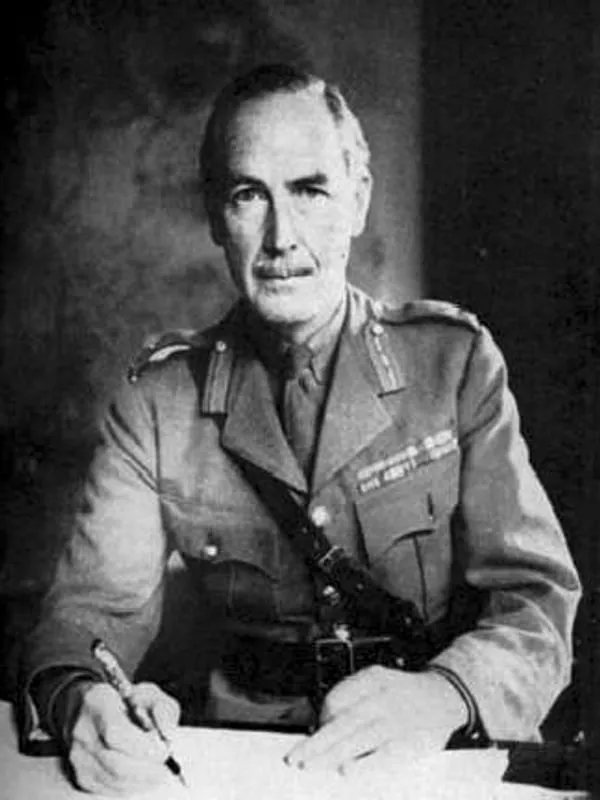
Alan Cunningham
Commander of forces in Kenya (1940–1941), commander of the Eighth Army (1941), High Commissioner for Palestine (1945–1948), general
- Born:
- 1 May 1887, Rathmines, near Dublin (Ireland)
- Died:
- 30 January 1983, Royal Tunbridge Wells (England)
- Author:
- Natalia
- Photo:
- autor nieznany, domena publiczna, Wikimedia Commons

Alan Cunningham was a British general whose Second World War career went from one of the swiftest victories of the war to one of its most talked-about dismissals. In the spring of 1941 his troops set out from Kenya, took Italian Somaliland, crossed the Ogaden and in less than two months reached Addis Ababa, contributing to the collapse of Italian East Africa. A few months later, as commander of the newly formed Eighth Army, he led Operation Crusader in Libya against Erwin Rommel’s forces and was removed from command at its most difficult moment. After the war, as the last British High Commissioner for Palestine, he governed the Mandate during the years of fighting against the Jewish underground and sailed from Haifa on the day the establishment of Israel was proclaimed. He was the younger brother of Admiral Andrew Cunningham, commander of the Mediterranean Fleet.
Early life and the First World War
He was born on 1 May 1887 at Rathmines on the outskirts of Dublin, into the Scottish family of Daniel John Cunningham, professor of anatomy at Trinity College, and Elizabeth, née Browne. He was educated at Cheltenham College and then at the Royal Military Academy, Woolwich, the school for artillery and engineer officers. In 1906 he was commissioned into the Royal Artillery. His father’s death in 1909 deprived him of family support, and as an officer’s life in England was expensive, for a time he sought service in the Indian Army.
During the First World War he fought in France as an artillery officer, first in the horse artillery and then in command of a howitzer battery. In 1915 he was awarded the Military Cross and in 1918 the Distinguished Service Order, and he was mentioned in dispatches three times. In 1917 he was brigade major, Royal Artillery, of the 20th (Light) Division.
Between the wars
After the war he spent two years on the staff in the Straits Settlements on the Malay Peninsula, and then served with various artillery regiments, among other places in Egypt. He completed a course at the Royal Naval College, Greenwich – a rarity for an army officer – was chief instructor in anti-aircraft defence at the Small Arms School at Netheravon, and in 1935 took command of the 1st Medium Brigade, Royal Artillery, at Portsmouth. In 1937 he passed through the Imperial Defence College, the highest military college of the Empire. He was to have become commander of the artillery of the 1st Infantry Division, but in 1938, promoted to major general, he was given the task of forming the 5th Anti-Aircraft Division. Its headquarters were at Reading, and the division defended the skies over Bristol, Portsmouth and Southampton.
Kenya and Italian Somaliland
After the evacuation from Dunkirk Cunningham briefly formed and trained the 66th Infantry Division in Manchester, and then in Scotland the 9th (Highland) Division, which was renamed the 51st (Highland) Division after most of the original 51st Division had been captured in France in June 1940. In the autumn, with only three days’ notice, he learnt that he was to take over the forces in Kenya. At the end of October he attended a conference in Khartoum at which Anthony Eden, Jan Smuts, Archibald Wavell and Emperor Haile Selassie I agreed a plan for an offensive against Italian East Africa, and in November, as an acting lieutenant general, he took over command in Nairobi.
His army consisted of General George Brink’s 1st South African Infantry Division and the 11th and 12th African Divisions of Generals Harry Wetherall and Reade Godwin-Austen, with brigades from Kenya, Uganda, Nigeria and the Gold Coast. Wavell instructed him to recover British Somaliland and liberate Addis Ababa, while William Platt’s forces attacked Eritrea from the Sudan. Cunningham at first believed that before the rainy season he could at most clear the border area. In mid-January 1941 the South Africans drove the Italians out of El Yibo in northern Kenya, and on 31 January they entered southern Ethiopia, as part of the offensive launched in January around the whole perimeter of the Italian empire.
Cunningham decided to launch the main thrust, into Italian Somaliland, on 11 February 1941. The objective was to be only the port of Kismayo and a bridgehead over the River Juba. Before the attack he issued a famous order of the day: “Hit them, hit them hard and hit them again.” On 14 February he took Kismayo, on 22 February he broke through the Juba defences at Jelib, and when he realised that the Italians had no line of defence in depth, he threw forward a motorised Nigerian brigade, which covered nearly four hundred kilometres in three days and on 25 February entered Mogadishu without a fight. According to an anecdote, when Wavell asked him when he could take the capital of Italian Somaliland, Cunningham answered briefly: “I have it.”
The pursuit pressed on northwards, through the Ogaden to Jijiga, and from there through the Marda Pass onto the Ethiopian highlands. On 26 March the British took Harar, and on 6 April 1941 South African and African troops entered Addis Ababa. According to British figures, in about eight weeks Cunningham’s forces advanced some 2,700 kilometres and took about fifty thousand prisoners, while losing about five hundred men themselves. On 5 May Haile Selassie returned to his capital. Cunningham’s South African brigade then joined up with Platt’s forces at Amba Alagi, where the Duke of Aosta capitulated on 19 May, while his other units cleared the Italians out of the province of Galla-Sidamo. For the campaign Cunningham was made a Knight Commander of the Order of the Bath.
The Eighth Army and Operation Crusader
His success in East Africa led Wavell’s successor, General Claude Auchinleck, to entrust Cunningham in the summer of 1941 with forming and training the new Eighth Army in the Western Desert. It consisted of two corps: Godwin-Austen’s infantry XIII Corps and the armoured XXX Corps, whose commander, the armour specialist Vyvyan Pope, was killed in an air crash in October. He was replaced by the less experienced General Willoughby Norrie. Cunningham, a gunner with no experience of handling large armoured formations, had a few weeks to prepare the army for an offensive that, under pressure from Winston Churchill, could not be postponed.
Operation Crusader began on 18 November 1941 and took the enemy completely by surprise. The plan envisaged one great armoured battle, but the brigades of XXX Corps went into action separately, around Sidi Rezegh, and Erwin Rommel destroyed them one after another. Within a few days the British had lost most of their tanks. Cunningham considered breaking off the attack to rebuild his strength and turned to Auchinleck, who on 23 November flew to his headquarters and ordered him to continue the offensive. The next day Rommel set off with his panzer divisions towards the Egyptian frontier, into the rear of the Eighth Army, but his raid brought no decision. On 26 November Auchinleck dismissed Cunningham and gave command to his own deputy chief of staff, General Neil Ritchie. At Auchinleck’s request Cunningham reported to hospital, so that his departure would look like the result of illness. The doctor who examined him on 29 November found exhaustion after a week with almost no sleep, but no nervous breakdown. Even so, the story of a breakdown spread through the army and clung to his name for a long time. The offensive, continued according to his plan, led to the relief of Tobruk and Rommel’s retreat to El Agheila.
The last years of the war
At first Churchill did not want to give him any post. Only the intercession of the Chief of the Imperial General Staff, Alan Brooke, and of Smuts helped. In 1942 Cunningham, once again a major general, became Commandant of the Staff College at Camberley. In 1943 he took command of the forces in Northern Ireland, where he prepared the American troops stationed there for the invasion of France, for which he received the American Legion of Merit. In 1944 he took over Eastern Command in England. During these years he gave lectures on military leadership which, years later, won recognition from military historians.
High Commissioner for Palestine
On 30 October 1945 Cunningham was promoted to full general, and on 21 November he took office as High Commissioner for Palestine and Commander-in-Chief of the British forces in the Mandate. He arrived just as the Jewish armed organisations – the Haganah, the Irgun and Lehi – began a joint struggle against British rule, in opposition to the restrictions on the immigration of Jewish Holocaust survivors. On 29 June 1946 the Mandate authorities carried out Operation Agatha, mass arrests of the leaders of the Jewish Agency and members of the Haganah. On 22 July the Irgun blew up a wing of the King David Hotel in Jerusalem, which housed the offices of the Mandate administration and the military command; 91 people were killed. Cunningham, who favoured a limited use of force and seeking agreement with moderate Jewish leaders, often clashed with the military, who demanded harsher repression. In October 1946 he retired from the army and from then on was solely a civilian High Commissioner.
In February 1947 the British government announced that it would refer the Palestine question to the United Nations, which it formally did in April. After the adoption on 29 November 1947 of Resolution 181 on the partition of the country, a civil war broke out between Jews and Arabs, and Cunningham directed the winding-up of the Mandate administration and the evacuation of the troops. On 14 May 1948 he left Jerusalem and sailed from Haifa. On the same day David Ben-Gurion proclaimed the establishment of the State of Israel. For his service in Palestine Cunningham received the Grand Cross of the Order of St Michael and St George.
Last years
On his return to England he turned down the post of Gentleman Usher of the Black Rod in the House of Lords and withdrew from public life. Until 1954 he was Colonel Commandant of the Royal Artillery, and from 1951 to 1963 he chaired the council of Cheltenham College. In 1951, at the age of sixty-four, he married Margery Snagge. In 1954 he helped to organise Emperor Haile Selassie’s visit to Britain, on which occasion the Emperor decorated him with the Order of Menelik II. He died on 30 January 1983 at Royal Tunbridge Wells at the age of ninety-five. He was buried in Edinburgh, beside his parents.
Significance
Cunningham went down in history as the commander of two very different campaigns. In the East African campaign he showed boldness in seizing an opportunity: an operation that was meant to end at Kismayo he turned into a pursuit across the whole Horn of Africa, which hastened the fall of the Italian empire and Haile Selassie’s return to the throne. In the Libyan desert he faced a far more dangerous opponent and became the first of several British commanders of the Eighth Army whose careers foundered in their encounter with Rommel. Some historians now consider his dismissal unjust, and believe that the story of a nervous breakdown served to conceal the disagreements between him and Auchinleck. As the last High Commissioner for Palestine he witnessed the end of the British Mandate and the birth of Israel, and with them the beginning of a conflict that continues to this day.
Sources
Commanded in battles
(02)Mentioned in battles
(01)Often appears with
People who appear in the same events.